数字媒体

Search documents
数字媒体板块1月6日涨1.67%,掌阅科技领涨,主力资金净流出3.76亿元
Zheng Xing Xing Ye Ri Bao· 2026-01-06 09:03
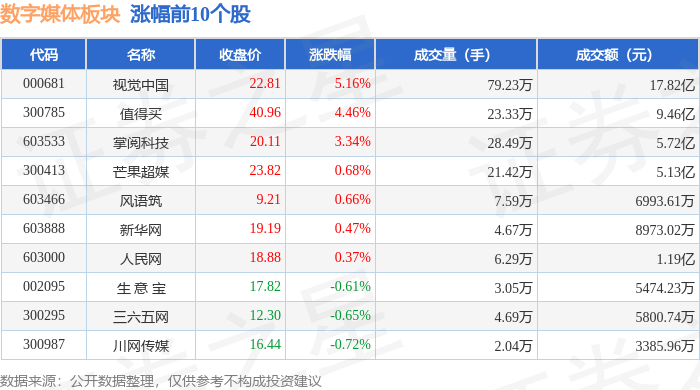
Market Performance - The digital media sector increased by 1.67% on January 6, with Zhangyue Technology leading the gains [1] - The Shanghai Composite Index closed at 4083.67, up by 1.5%, while the Shenzhen Component Index closed at 14022.55, up by 1.4% [1] Individual Stock Performance - Zhangyue Technology (603533) closed at 23.71, up by 4.54%, with a trading volume of 543,700 shares and a transaction value of 1.253 billion [1] - Xinhua Net (603888) closed at 20.64, up by 2.64%, with a trading volume of 288,900 shares and a transaction value of 596 million [1] - Mango Super Media (300413) closed at 25.37, up by 2.51%, with a trading volume of 354,400 shares and a transaction value of 888 million [1] - Guomai Culture (600640) closed at 13.06, up by 2.27%, with a trading volume of 99,700 shares and a transaction value of 129 million [1] - Fengyuzhu (603466) closed at 10.24, up by 2.09%, with a trading volume of 487,200 shares and a transaction value of 498 million [1] Capital Flow Analysis - The digital media sector experienced a net outflow of 376 million from institutional investors, while retail investors saw a net inflow of 430 million [2] - The main stocks with significant capital flow include Mango Super Media, which had a net inflow of 65.36 million from institutional investors [3] - Zhangyue Technology experienced a net outflow of 19.23 million from institutional investors, but a net inflow of 28.96 million from retail investors [3]


人民网涨2.05%,成交额2.05亿元,主力资金净流入1069.10万元
Xin Lang Zheng Quan· 2026-01-05 05:41
Core Viewpoint - As of January 5, 2025, People's Daily (人民网) shares increased by 2.05%, with a trading volume of 2.05 billion yuan and a market capitalization of 21.495 billion yuan. The company has seen fluctuations in its stock price over various time frames, indicating mixed performance in the market [1]. Financial Performance - For the period from January to September 2025, People's Daily reported a revenue of 1.138 billion yuan, reflecting a year-on-year decrease of 3.29%. The net profit attributable to shareholders was 33.6422 million yuan, down 40.10% compared to the previous year [2]. - Cumulatively, since its A-share listing, People's Daily has distributed a total of 1.668 billion yuan in dividends, with 513 million yuan distributed over the last three years [3]. Shareholder Information - As of September 30, 2025, the number of shareholders for People's Daily was 114,200, a decrease of 8.95% from the previous period. The average number of circulating shares per shareholder increased by 9.83% to 9,682 shares [2]. - Among the top ten circulating shareholders, Hong Kong Central Clearing Limited ranked as the fifth largest, holding 12.3238 million shares, an increase of 919,200 shares from the previous period. Conversely, the Southern CSI 500 ETF held 8.0197 million shares, a decrease of 163,200 shares [3]. Business Overview - People's Daily, established on February 6, 2005, and listed on April 27, 2012, operates primarily in internet advertising, information services, mobile value-added services, and other technical services. The revenue breakdown includes advertising and promotional services (51.03%), content technology services (26.98%), data and information services (16.49%), and network technology services (5.50%) [1]. - The company is classified under the media industry, specifically in the digital media and portal website sector, and is associated with concepts such as AI corpus, intellectual property, Kimi concept, state-owned cloud, and short videos [1].
值得买涨2.01%,成交额8.90亿元,主力资金净流出2608.55万元
Xin Lang Zheng Quan· 2026-01-05 05:14
Core Viewpoint - The company "值得买" has shown a positive stock performance with a 2.01% increase on January 5, 2025, and a total market capitalization of 8.89 billion yuan, despite some net outflow of funds [1] Group 1: Financial Performance - For the period from January to September 2025, the company achieved operating revenue of 806 million yuan, a year-on-year decrease of 20.37%, while the net profit attributable to shareholders increased by 253.49% to 13.45 million yuan [2] - Cumulative cash distribution since the company's A-share listing amounts to 216 million yuan, with 84.18 million yuan distributed over the last three years [3] Group 2: Shareholder and Market Activity - As of December 19, 2025, the number of shareholders decreased by 3.04% to 41,000, while the average circulating shares per person increased by 3.14% to 2,984 shares [2] - The top ten circulating shareholders include Hong Kong Central Clearing Limited, which increased its holdings by 6.25 million shares to 7.96 million shares, and new entrants such as 诺安积极回报混合A and 汇添富科技创新混合A [3] Group 3: Business Overview - The company operates a content-driven e-commerce platform, "什么值得买" (www.smzdm.com), providing promotional services for e-commerce and brand companies, with revenue sources including information promotion (41.83%), internet marketing platform services (28.38%), operational service fees (27.62%), brand marketing (2.00%), and product sales (0.17%) [1] - The company is classified under the media-digital media-portal website sector and is associated with concepts such as Kimi, 小红书, AI language database, and network marketing [2]

数字媒体板块12月31日涨2.82%,掌阅科技领涨,主力资金净流入4.96亿元
Zheng Xing Xing Ye Ri Bao· 2025-12-31 09:07
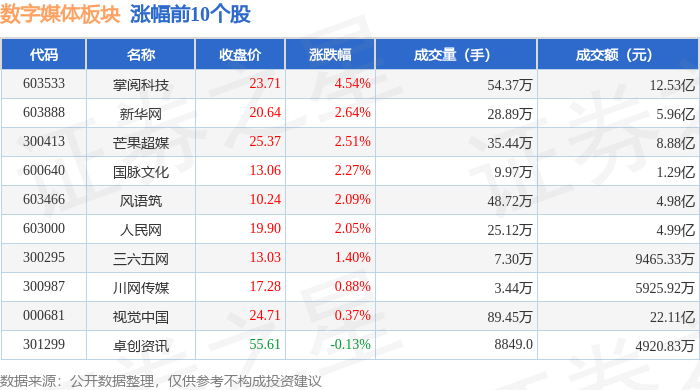
Group 1 - The digital media sector increased by 2.82% on December 31, with Zhangyue Technology leading the gains [1] - The Shanghai Composite Index closed at 3968.84, up 0.09%, while the Shenzhen Component Index closed at 13525.02, down 0.58% [1] - Key stocks in the digital media sector showed significant price movements, with Zhangyue Technology rising by 10.00% to a closing price of 22.12 [1] Group 2 - The digital media sector experienced a net inflow of 496 million yuan from institutional investors, while retail investors saw a net outflow of 317 million yuan [2] - Major stocks like Zhangyue Technology had a net inflow of 2.60 billion yuan from institutional investors, representing 22.56% of its trading volume [3] - Visual China and other companies faced net outflows from retail investors, indicating a mixed sentiment among different investor types [3]

卓创资讯涨2.08%,成交额2015.66万元,主力资金净流入19.34万元
Xin Lang Cai Jing· 2025-12-31 03:35
Group 1 - The core viewpoint of the news is that Zhaochuang Information has shown fluctuations in stock performance, with a recent increase in share price and notable trading activity, despite a year-to-date decline [1][2] - As of December 31, Zhaochuang Information's stock price rose by 2.08% to 54.52 yuan per share, with a market capitalization of 3.292 billion yuan [1] - The company has experienced a year-to-date stock price decline of 4.05%, but has seen a 3.04% increase over the last five trading days [1] Group 2 - Zhaochuang Information's main business segments include information services (57.19%), smart services (20.98%), exhibition services (12.08%), and consulting services (9.74%) [1] - For the period from January to September 2025, Zhaochuang Information reported revenue of 263 million yuan, a year-on-year increase of 19.91%, while net profit attributable to shareholders decreased by 5.93% to 49.52 million yuan [2] - The company has distributed a total of 325 million yuan in dividends since its A-share listing [3]

传媒ETF(159805)涨超2.2%,教育部计划出台AI赋能教育相关政策
Xin Lang Cai Jing· 2025-12-31 02:43
Group 1 - The core viewpoint of the news is the strong performance of the media sector, particularly driven by the announcement from the Ministry of Education regarding the introduction of AI in education policies, which is expected to boost the commercial potential of AI in education [1][2] - The China Securities Media Index (399971) rose by 2.07%, with notable increases in constituent stocks such as BlueFocus (300058) up 15.73%, Liou Co. (002131) up 9.94%, and Yidian Tianxia (301171) up 7.51% [1] - The Media ETF (159805) also saw an increase of 2.20%, with the latest price reported at 1.39 yuan [1] Group 2 - The China Securities Media Index comprises 50 large-cap listed companies from sectors such as marketing and advertising, cultural entertainment, and digital media, reflecting the overall performance of representative companies in the media field [2] - As of November 28, 2025, the top ten weighted stocks in the China Securities Media Index include companies like Focus Media (002027) and Giant Network (002558), which together account for 50.98% of the index [2] - The report highlights the strong user willingness to pay for AI+ education solutions, with a projected global market size exceeding $30 billion by 2025 and a compound annual growth rate of over 40% [1]


今年十大最惨板块,跌麻了
3 6 Ke· 2025-12-30 12:11
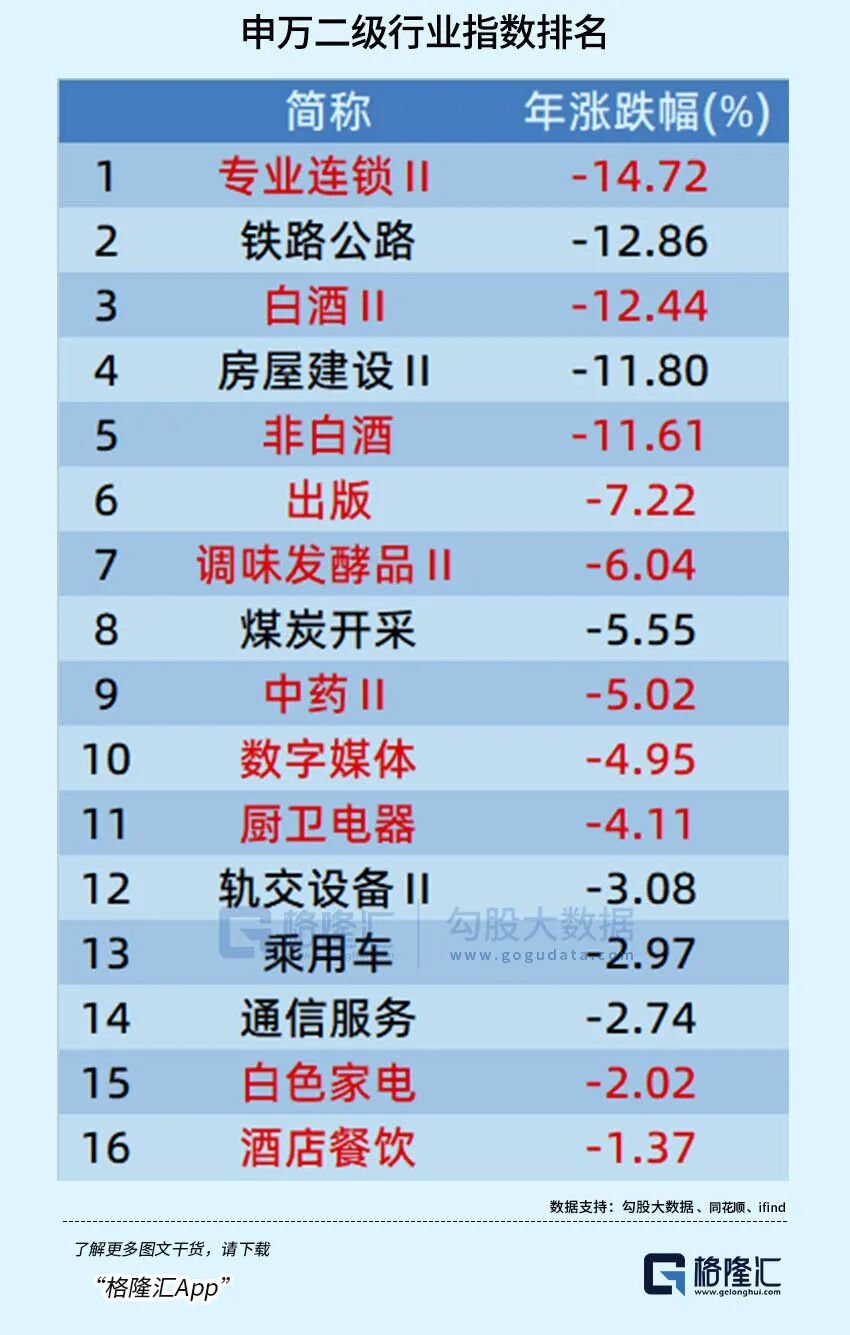
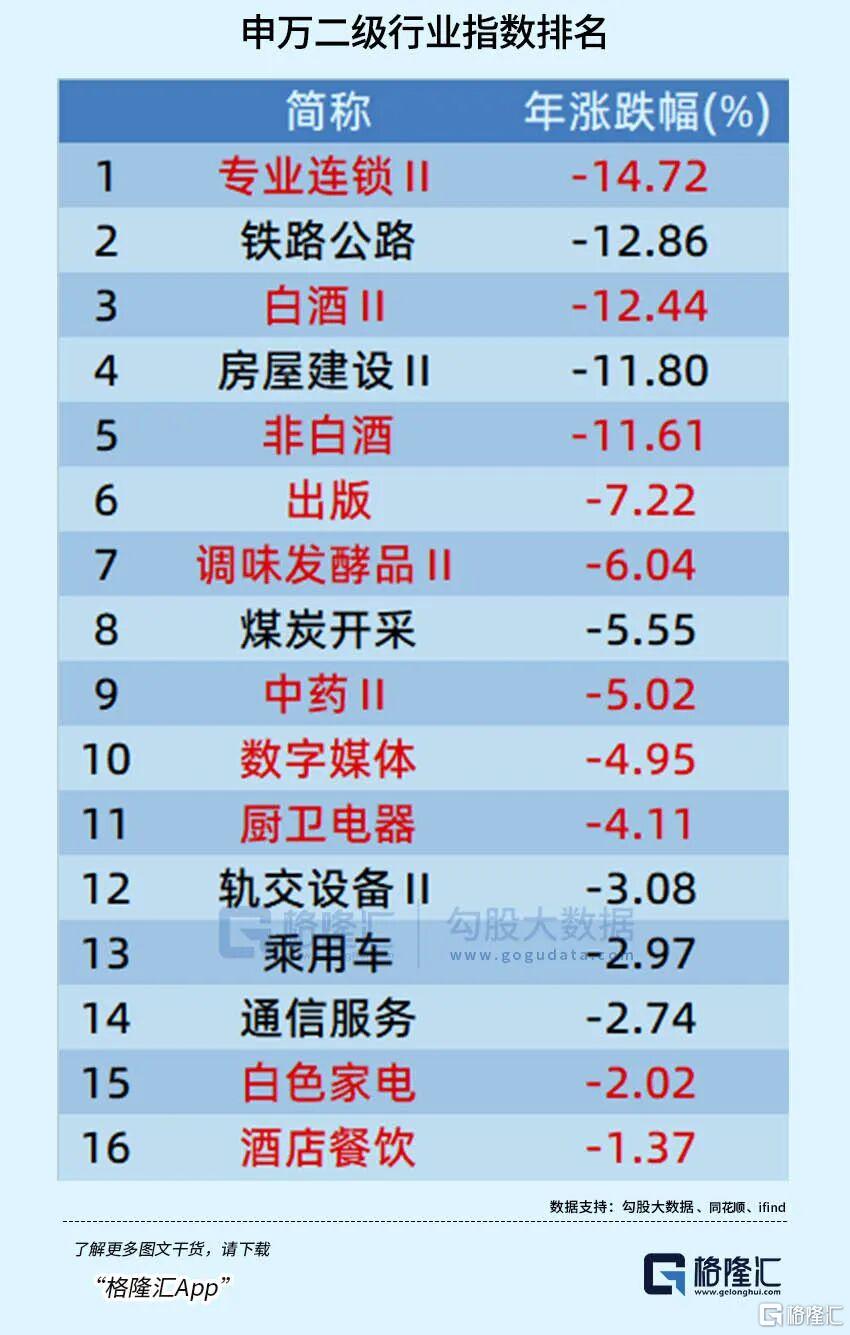
Core Viewpoint - The consumer sector has faced significant challenges in the past year, with many industries within this sector experiencing declines despite overall market growth. The focus on domestic demand and consumption has not translated into positive performance for many consumer-related industries [1]. Group 1: Consumer Sector Performance - In the first half of the year, 10 out of 16 industries that saw declines were from the consumer sector, indicating a troubling trend for consumer-related stocks [1]. - The white liquor sector, a key component of the consumer market, has seen a year-to-date decline of 12.44%, with major brands like Wuliangye experiencing significant drops in revenue and profit [5][8]. - The professional chain sector has been particularly hard hit, with a year-to-date decline of 14.72%, as traditional retail models struggle to adapt to changing consumer behaviors [13][14]. Group 2: White Liquor Industry - The white liquor industry is facing its eighth consecutive year of production decline, with both volume and price dropping, leading to increased inventory pressure and cash flow issues for many companies [9]. - Wuliangye reported a 10.26% decline in revenue and a 13.72% drop in net profit for the first three quarters, marking its first negative growth in nearly a decade [8]. - The changing consumer landscape, with a shift towards lower-alcohol and healthier options, is forcing white liquor companies to adapt or risk further declines [12]. Group 3: Professional Chain Sector - The professional chain sector is experiencing a crisis, with many traditional stores closing and business models failing to adapt to the digital age [14][19]. - The decline of major players like Renrenle, which has seen its market value plummet and faced continuous losses, exemplifies the struggles within this sector [18]. - The shift towards online shopping and personalized consumer experiences is reshaping the retail landscape, leaving traditional large-format stores at a disadvantage [20]. Group 4: Non-White Liquor Sector - The non-white liquor sector, including beer and wine, has also faced challenges, with a year-to-date decline of 11.61% [22]. - Budweiser APAC reported an 8.2% drop in domestic sales and a 24.4% decline in net profit, reflecting broader issues within the beer industry [25]. - The rise of cross-industry competition, with liquor companies diversifying into other beverage categories, indicates a shift in market dynamics [27]. Group 5: Publishing Industry - The publishing industry has seen a decline in the overall market, with a 10.4% drop in the domestic paper book market, yet some companies have managed to increase profits through cost control [35][38]. - Chinese Media, a leading player in the sector, has faced significant revenue and profit declines, highlighting the challenges of adapting to changing educational policies [36][38]. Group 6: Seasoning Industry - The seasoning industry has experienced a 6.04% decline, with companies like Qianhe Flavor struggling due to a drop in sales across key product lines [43][47]. - The industry is facing increased competition and changing consumer preferences, necessitating a shift in strategy for many companies [52]. Group 7: Traditional Chinese Medicine - The traditional Chinese medicine sector has seen a 5.02% decline, with companies like Pian Zai Huang facing significant revenue and profit drops due to rising costs and regulatory pressures [53][56]. - The industry is undergoing a transformation as companies seek to innovate and diversify their product offerings in response to market challenges [62]. Group 8: Digital Media - The digital media sector has faced a 4.95% decline, with traditional advertising models struggling to keep pace with new digital trends [67]. - Companies like Mango TV have reported significant revenue declines, indicating the need for adaptation in a rapidly changing media landscape [66]. Group 9: Kitchen and Bathroom Appliances - The kitchen and bathroom appliance sector has seen a 4.11% decline, largely due to a slowdown in new housing demand and increased competition [69][70]. - Companies like Boss Appliances are experiencing revenue declines for the first time in years, reflecting broader industry challenges [69]. Group 10: White Goods - The white goods sector has faced a 2.02% decline, with major players like Gree Electric experiencing significant revenue and profit drops due to increased competition and market saturation [76][80]. - The industry is shifting towards a focus on product quality and operational efficiency as traditional growth drivers diminish [80]. Group 11: Hotel and Catering - The hotel and catering sector has seen a 1.37% decline, with many businesses struggling to convert increased travel demand into profits due to high commission fees from online platforms [84][85]. - The industry is witnessing a shift towards more refined operational models as companies seek to adapt to changing consumer behaviors and market conditions [86].
2025年A股十大最惨板块,跌麻了
Ge Long Hui· 2025-12-30 11:30
Core Viewpoint - The consumer sector has faced significant challenges in the past year, with many sub-sectors experiencing declines despite overall market growth. The focus on domestic demand and consumption has not translated into positive performance for many consumer-related industries [1][5]. Consumer Sector Performance - In the first half of the year, 10 out of 16 declining industries were from the consumer sector, indicating a broader trend of underperformance [1]. - The white liquor sector, a key component of the consumer market, has seen a year-to-date decline of 12.44%, with major brands like Wuliangye experiencing significant drops in revenue and profit [6][9]. - The professional chain sector has been particularly hard-hit, with a year-to-date decline of 14.72%, exemplified by the struggles of companies like Renrenle [16][20]. White Liquor Sector - The white liquor industry is facing its eighth consecutive year of production decline, with both volume and price dropping simultaneously [10]. - Wuliangye reported a 10.26% decline in revenue and a 13.72% drop in net profit for the first three quarters, marking its first negative growth in a decade [9]. - The industry is shifting from a growth-driven model to one focused on consumer choice, with a need for companies to adapt to changing consumer preferences [15]. Professional Chain Sector - The professional chain sector is experiencing a crisis, with many physical stores closing and traditional business models failing [16][20]. - Renrenle, once a leading private supermarket, has seen its market value plummet and is now facing delisting due to ongoing financial struggles [21][24]. - The shift towards online shopping and personalized consumer demands has further exacerbated the challenges faced by traditional retail chains [24][25]. Non-White Liquor Sector - The non-white liquor sector, including beer and wine, has also faced declines, with the beer segment seeing a notable drop in sales and profits [27][32]. - Budweiser APAC reported an 8.2% decline in domestic sales and a 24.4% drop in net profit, reflecting broader industry challenges [32][33]. - The market is witnessing a trend of cross-industry competition, with liquor companies diversifying into new beverage categories [34]. Publishing Sector - The publishing industry has shown resilience despite a 10.4% decline in the overall market for printed books, with listed companies managing to increase net profits by 14.65% [43][44]. - However, leading companies like Zhongwen Media are struggling, with significant revenue and profit declines due to changes in educational material procurement policies [45][48]. Seasoning Sector - The seasoning industry has faced a 6.04% decline, with companies like Qianhe Flavor struggling due to falling revenues and a loss of consumer trust [51][55]. - The industry is experiencing a shift in consumer preferences and increased competition, necessitating a reevaluation of business strategies [60]. Traditional Chinese Medicine Sector - The traditional Chinese medicine sector is facing challenges, with companies like Pian Zai Huang reporting significant declines in revenue and profit due to rising costs and regulatory pressures [61][66]. - The industry is undergoing a transformation as companies seek to innovate and diversify their product offerings [70]. Digital Media Sector - The digital media industry has seen a 4.95% decline, with companies like Mango TV reporting significant drops in revenue and profit due to changing consumer behaviors and market dynamics [71][74]. - The sector is grappling with the need to adapt to new content consumption trends while facing pressure from traditional advertising models [75]. Kitchen and Bathroom Appliances Sector - The kitchen and bathroom appliance sector has experienced a 4.11% decline, largely due to reduced demand from the real estate market [78][79]. - Companies like Boss Electric are facing revenue declines for the first time in years, highlighting the challenges of adapting to a changing market landscape [79][80]. White Goods Sector - The white goods sector has seen a 2.02% decline, with major players like Gree Electric facing significant revenue and profit pressures due to increased competition and market saturation [83][84]. - The industry is shifting towards a focus on product quality and brand strength as external stimuli diminish [88]. Hotel and Restaurant Sector - The hotel and restaurant sector has faced a 1.37% decline, with revenue pressures stemming from changing consumer spending habits and increased competition from online platforms [89][92]. - Companies are beginning to adopt more refined operational strategies to navigate the challenging market environment [96].




今年十大最惨板块,跌麻了
格隆汇APP· 2025-12-30 11:04
Core Viewpoint - The article discusses the significant downturn in various consumer sectors, particularly the liquor and retail industries, highlighting the challenges and potential opportunities for recovery amidst changing consumer behaviors and market dynamics [2][4][43]. Group 1: Liquor Industry - The liquor sector, especially the white liquor segment, has faced substantial declines, with the overall white liquor market down by 12.44% this year [9][15]. - Major brands like Wuliangye have reported significant drops in revenue and profit, with a 10.26% decline in revenue and a 13.72% drop in net profit for the first three quarters [17]. - The white liquor industry is experiencing a shift from a growth-driven model to one focused on consumer preferences, with a need for companies to adapt to changing consumption patterns [26][27]. Group 2: Retail Industry - The professional chain sector has seen a dramatic decline of 14.72%, with many traditional retail models struggling to survive [28][30]. - Companies like Renrenle have faced severe financial difficulties, leading to a significant reduction in store numbers and ultimately triggering delisting procedures [34][35]. - The shift towards online shopping and changing consumer preferences have forced traditional retailers to innovate or face extinction [36][39]. Group 3: Non-White Liquor Sector - The non-white liquor sector, including beer and wine, has also suffered, with a reported decline of 11.61% this year [40]. - Major players like Budweiser APAC have experienced significant sales drops, with a 9.5% revenue decrease and a 24.4% decline in net profit [46]. - The industry is witnessing a trend of cross-industry competition, with liquor companies diversifying into other beverage categories to adapt to market changes [51][56]. Group 4: Publishing Industry - The publishing sector has faced a 7.22% decline, with the overall market for printed books down by 10.40% [60]. - Despite the downturn, some publishing companies have managed to increase profits through cost control and operational efficiency, with a 14.65% rise in net profit for listed companies [61][62]. - The industry is undergoing significant transformation, moving from traditional sales models to more dynamic content management and IP development strategies [70][71]. Group 5: Seasoning Industry - The seasoning sector has seen a 6.04% decline, with companies like Qianhe Flavor struggling due to a drop in revenue and profit [74]. - The industry is facing challenges from both market saturation and changing consumer preferences, necessitating a shift in strategy for many companies [81]. Group 6: Traditional Chinese Medicine - The traditional Chinese medicine sector has experienced a 5.02% decline, with companies like Pian Zai Huang facing significant revenue and profit drops [86]. - The industry is under pressure from regulatory changes and increased competition, pushing companies to innovate and diversify their product offerings [91][92]. Group 7: Digital Media - The digital media sector has reported a 4.95% decline, with traditional advertising models struggling to adapt to new market realities [97][100]. - Companies like Mango TV have seen significant revenue drops, highlighting the challenges of maintaining profitability in a rapidly changing landscape [101][104]. Group 8: Kitchen and Bathroom Appliances - The kitchen and bathroom appliance sector has faced a 4.11% decline, with major players like Boss Electric experiencing revenue drops for the first time in years [112]. - The industry is grappling with reduced demand due to a slowdown in the real estate market, necessitating a shift towards innovation and international expansion [117][118]. Group 9: White Goods - The white goods sector has seen a 2.02% decline, with companies like Gree Electric facing significant challenges due to market saturation and increased competition [126][129]. - The industry is shifting towards a more rational consumer base that prioritizes product quality and brand reputation over traditional growth drivers [133]. Group 10: Hotel and Restaurant Industry - The hotel and restaurant sector has experienced a 1.37% decline, with many businesses struggling to convert increased tourism into profits [140][141]. - The industry is witnessing a shift towards more refined operational models, with companies focusing on member engagement and digital transformation to enhance profitability [142][143].





数字媒体板块12月30日涨1.14%,视觉中国领涨,主力资金净流入4.27亿元
Zheng Xing Xing Ye Ri Bao· 2025-12-30 09:08
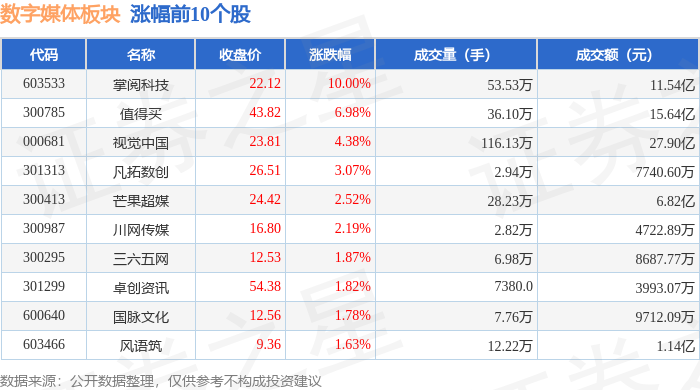
| 代码 | 名称 | 收盘价 | 涨跌幅 | 成交量(手) | | 成交额(元) | | | --- | --- | --- | --- | --- | --- | --- | --- | | 000681 | 视觉中国 | 22.81 | 5.16% | | 79.23万 | | 17.82亿 | | 300785 | 值得买 | 40.96 | 4.46% | | 23.33万 | | 9.46 Z | | 603533 | 掌阅科技 | 20.11 | 3.34% | | 28.49万 | | 5.72亿 | | 300413 | 芒果超媒 | 23.82 | 0.68% | | 21.42万 | | 5.13亿 | | 603466 | 风语筑 | 9.21 | 0.66% | | 7.59万 | | 6993.61万 | | 603888 | 新华网 | 19.19 | 0.47% | | 4.67万 | | 8973.02万 | | 603000 | 人民网 | 18.88 | 0.37% | | 6.29万 | | 1.19亿 | | 002095 | 生意宝 | 17.82 | -0.61% ...