
基金

Search documents
公募改革措施逐步落地:机构纷纷免收直销费用,密集调整风险等级
Shang Hai Zheng Quan Bao· 2026-02-25 17:31
Core Viewpoint - The new regulations in the public fund industry are being implemented, leading to significant changes such as the elimination of subscription fees for direct sales channels by various fund companies [1][2][3]. Group 1: Fee Waivers - From February 24, 2025, investors can subscribe to public fund products through the direct sales channels of Caizheng Asset Management without incurring subscription fees [2] - Xingsheng Global Fund announced a similar initiative starting January 26, 2025, waiving front-end subscription fees for its public fund products [2] - The new regulations from the China Securities Regulatory Commission (CSRC) prohibit fund managers from charging subscription fees and sales service fees, effective from January 1, 2026 [3] Group 2: Risk Level Adjustments - Multiple fund companies are adjusting the risk levels of their funds, with Noan Fund changing the risk level of its Noan Selected Return Mixed Fund from R3 to R4 effective March 5, 2025 [4] - Zhonghai Fund also announced a similar adjustment for its Zhonghai CSI A500 Index Enhanced Fund, moving from R3 to R4 [4] - The China Securities Investment Fund Industry Association is working on guidelines to establish a comprehensive risk level classification system for funds [4] Group 3: Enhanced Risk Disclosure - Fund companies are improving risk disclosures, as seen with Pengyang Fund's announcement regarding the cash portion of its Pengyang 30-Year Treasury ETF, highlighting discrepancies between estimated and actual cash amounts [5] - Pengyang Fund issued multiple risk alerts related to its 30-Year Treasury ETF around the Spring Festival, indicating a proactive approach to investor communication [5]
机器人主题基金总规模突破700亿元 节后两个交易日净流入超6.3亿元
Zheng Quan Ri Bao· 2026-02-25 16:22
Group 1 - The core viewpoint is that the robot-themed funds are experiencing significant inflows, indicating growing investor interest and confidence in the sector [1][2] - From February 24 to 25, 13 robot-themed funds saw a net inflow of over 630 million yuan, with the top two funds, Huaxia CSI Robot ETF and Tianhong CSI Robot ETF, attracting 303 million yuan and 181 million yuan respectively [1] - As of February 25, the total scale of these 13 funds has surpassed 70 billion yuan, with three funds exceeding 10 billion yuan in size [1] Group 2 - The growth trend of robot-themed funds reflects an increasing focus from investors, with continuous capital inflow [2] - The manager of the Galaxy CSI Robot Index Fund highlighted that the 2026 Spring Festival Gala will showcase domestic humanoid robot companies, marking a leap from "preset actions" to "autonomous intelligence" [2] - The capital logic in the industry has shifted from a broad investment approach to concentrating on leading companies with clear application scenarios and mass production capabilities [2][3] Group 3 - The robot performances during the Spring Festival highlighted the technological advancements and practical capabilities of domestic robot companies, boosting market expectations for the industry [3] - The robot industry is entering a phase of industrialization, supported by a combination of policy, technology, and commercialization [3] - The composition of the CSI Robot Index includes companies concentrated in industrial and information technology sectors, reflecting the development trends across the robot industry's supply chain [3]

机器人主题基金总规模突破700亿元
Zheng Quan Ri Bao· 2026-02-25 16:16
Group 1 - The core viewpoint is that the robot-themed funds are experiencing significant inflows, indicating growing investor interest and confidence in the robotics sector [1][2] - From February 24 to 25, 13 robot-themed funds saw a net inflow of over 630 million yuan, with notable contributions from 华夏中证机器人ETF and 天弘中证机器人ETF, which received net inflows of 303 million yuan and 181 million yuan respectively [1] - As of February 25, the total scale of these 13 robot-themed funds has surpassed 70 billion yuan, with three funds exceeding 10 billion yuan in scale [1] Group 2 - The growth trend of robot-themed funds reflects an increasing focus from investors, with a shift in capital logic towards head enterprises with clear application scenarios and production capabilities [2] - The demand for robotic products is expected to rise due to their applications in industrial, household, and medical settings, supported by a decrease in the cost of core robotic components [2] - The recent robot performances during the Spring Festival highlighted the technological advancements and commercialization of domestic robotics, indicating a significant shift towards industrialization in the sector [3]
2/25财经夜宵:得知基金净值排名及选基策略,赶紧告知大家
Sou Hu Cai Jing· 2026-02-25 16:00
Core Insights - The article provides an overview of the performance of various mutual funds, highlighting the top and bottom performers based on net asset value changes [1]. Group 1: Top Performing Funds - The top 10 mutual funds with the highest net value growth include: Qianhai Kaiyuan Hong Kong-Shenzhen Core Resource Mixed A (5.8790, +6.20%), Qianhai Kaiyuan Hong Kong-Shenzhen Core Resource Mixed C (5.8180, +6.19%), and Dongfang Artificial Intelligence Theme Mixed A (2.0655, +5.79%) [2]. - Other notable funds in the top 10 are: Dongfang Artificial Intelligence Theme Mixed C, Jiashi Zhongzheng Rare Earth Industry ETF Link C, and Jiashi Zhongzheng Rare Earth Industry ETF Link A, among others [2]. Group 2: Bottom Performing Funds - The bottom 10 mutual funds with the lowest net value growth include: Changcheng Jiuxiang Mixed C (1.7937, -2.97%), Changcheng Jiuxiang Mixed A (1.8273, -2.97%), and Dongfang Innovation Growth Mixed A (1.2713, -2.78%) [3]. - Other funds in this category are: Dongfang Innovation Growth Mixed C, Yifangda Zhongzheng Overseas Internet 50 ETF Link (USD) C, and Jinxin Core Competitiveness Mixed A, among others [3]. Group 3: Market Overview - The Shanghai Composite Index opened high and closed with a small gain, while the ChiNext Index also experienced a similar trend, with a total trading volume of 2.48 trillion [5]. - Leading sectors included steel, mineral products, and non-ferrous metals, with gains exceeding 3%, while the advertising packaging sector lagged behind [5]. Group 4: Fund Strategy Analysis - The Qianhai Kaiyuan Hong Kong-Shenzhen Core Resource Mixed A fund has a significant focus on resource industries, with a top holding concentration of 62.30% [6]. - The top holdings include Zijin Mining, Xiamen Tungsten, and Northern Rare Earth, with notable price increases observed in these stocks [6]. - The fund's performance is characterized as outperforming the market, particularly in the rare resources sector [6]. Group 5: Fund Style and Changes - The fund's style has shifted from a focus on artificial intelligence to a more resource-oriented approach, as indicated by the recent changes in holdings [7]. - The current fund size is reported at 0.49 billion, reflecting a potential change in investment strategy [7].

油气类QDII基金溢价走高 机构接连提示风险
Zheng Quan Ri Bao· 2026-02-25 15:42
Core Viewpoint - Multiple public fund institutions, including E Fund, Huaxia Fund, and Southern Fund, have issued warnings about the premium risk of their QDII funds, particularly in the oil and gas sector, indicating a significant premium in secondary market trading prices [1][2] Group 1: Premium Risk in QDII Funds - QDII funds have been frequently warning about premium risks since the market reopened after the Spring Festival, with various funds showing secondary market prices significantly above their net asset values [2] - For instance, on February 25, the closing price of the Fuguo S&P Oil & Gas Exploration and Production Select Industry ETF (QDII) was 1.141 yuan, representing a premium of 5.71% over its reference net value of 1.0794 yuan [2] Group 2: Factors Contributing to High Premiums - The high premiums in oil and gas QDII funds are attributed to a combination of rigid supply, increased demand, and timing mechanisms, leading to a supply-demand imbalance that drives up trading prices [3] - The scarcity of QDII investment quotas has limited the ability to arbitrage, causing concentrated demand in the secondary market, which further exacerbates price increases [3] - The design of the mechanism and the nature of the underlying assets amplify price deviations, as the trading hours of overseas markets and A-shares do not align, leading to premature price adjustments [3] Group 3: Growth of QDII Fund Scale - The total scale of QDII funds has surpassed 1 trillion yuan, reaching 1,008.73 billion yuan as of February 25, up over 65% from 609.65 billion yuan at the beginning of 2025 [4] - The increase in QDII fund scale is driven by heightened investor interest in overseas high-growth sectors and a growing demand for global asset allocation [4] Group 4: Recommendations for Investors - Investors are advised to be cautious of the real risks associated with oil and gas QDII funds, including severe premium contraction risks and the inability to arbitrage due to fund purchase limits [4] - It is suggested that investors monitor futures market trends, geopolitical developments, and the dynamics of oil supply and demand to mitigate risks [5] Group 5: Institutional Responses to Premium Risks - Public fund institutions are encouraged to take proactive measures to address high premium risks, such as applying for temporary trading suspensions and adjusting subscription limits to alleviate supply constraints [6] - Exploring flexible tools and hedging arrangements, such as introducing market makers or creating new linked products, is recommended to address supply-demand conflicts [6]
直销渠道“零费率”落地 公募行业服务比拼开赛
Zheng Quan Ri Bao· 2026-02-25 15:41
Core Viewpoint - The announcement by Caitong Asset Management to waive subscription fees for all public funds in direct sales channels marks a significant shift in the public fund industry towards a service-oriented competition model, as the industry prepares for the implementation of new regulations in 2026 [1][2]. Group 1: Regulatory Changes - The China Securities Regulatory Commission (CSRC) has issued new regulations that prohibit fund managers from charging subscription fees and sales service fees starting January 1, 2026, with a 12-month transition period [1]. - The actions of Caitong Asset Management and Xingzheng Global Fund are seen as a proactive response to these upcoming regulations, indicating a move away from price competition [1]. Group 2: Industry Impact - The implementation of the new regulations is expected to standardize and democratize the public fund sales fee structure, significantly reducing investor costs and reshaping the competitive landscape [2]. - The shift towards a "zero-fee" era in direct sales is viewed as a direct benefit for investors, leading to lower investment costs and compelling institutions to enhance their professional services and long-term value creation capabilities [2]. Group 3: Strategic Focus - Fund companies are increasingly focusing on upgrading their services rather than competing solely on price, with an emphasis on research capabilities, asset allocation, and digital services [2]. - Xingzheng Global Fund plans to enhance its direct sales platform through technological improvements, optimizing transaction processes, and providing tangible fee reductions to investors, thereby promoting a focus on long-term asset management [2].

2025年基金市场回顾及2026年展望:革故鼎新,质启未来
CMS· 2026-02-25 15:38
Report Summary 1. Investment Rating The document does not mention the investment rating of the industry. 2. Core Views The report reviews the fund market in 2025, including the overall situation of the public - offering fund industry, the development of various sub - categories of public - offering funds, and the situation of private - offering securities investment funds. It also provides a market outlook for 2026 and selects several types of funds for attention. In 2025, the public - offering fund market achieved significant positive returns, and the private - offering securities investment fund market expanded in scale. In 2026, with the resonance of China's and the US policies, the A - share market is expected to shift from liquidity - driven to profit - driven, and attention should be paid to specific investment directions and the rhythm of the fixed - income market [2][9]. 3. Summary by Directory 3.1 Public Fund Overall Overview - **Asset Management Market Overview**: By the end of Q3 2025, the total scale of China's asset management business reached 80.03 trillion yuan. Public - offering funds and private - offering funds drove the growth of the asset management scale, with public - offering funds contributing 3.92 trillion yuan to the scale growth. The public - offering fund market maintained strong vitality, with a total scale of 36.67 trillion yuan and a total share of 31.30 trillion shares by the end of 2025, showing year - on - year growth [16][20]. - **Public Fund New - issuance Market**: In 2025, stock - type and bond - type funds were the main new - issuance products. The new - issuance volume of stock - type funds was large, and the new - issuance scale was comparable to that of bond - type funds, mainly relying on passive products [40]. - **Non - monetary Head Managers of Public Funds**: Since 2021, the top - three managers in terms of non - monetary fund scale have been relatively stable. In 2025, E Fund, China Asset Management, and GF Fund had different product line focuses in terms of stock and incremental scale. Huatai - Peregrine Fund and Invesco Great Wall Fund showed good performance [47][48]. - **Performance of Public Fund Products**: In 2025, the public - offering fund market achieved significant positive returns. Commodity - type funds represented by gold performed excellently, and stock - type funds also received good returns with reduced volatility and drawdown [3][56]. 3.2 Hot Topics in the Fund Industry - **Reform of Public - offering Fund Policies**: In 2025, a series of reform measures were introduced to promote the transformation of the public - offering fund industry from "scale - oriented" to "return - oriented" [59]. - **New - style Floating - rate Funds**: In 2025, new - style floating - rate funds were successively launched, which had important impacts on the public - offering fund market, such as guiding long - term holding and strengthening the binding mechanism between fund companies and investors [67][69]. - **Commercial Real Estate REITs**: In 2025, the pilot of commercial real estate REITs was officially launched, and 12 products had been officially declared by February 13, 2026 [73][75]. - **Development of the Fund Investment Advisory Industry**: Policy support, product expansion, and institutional empowerment promoted the development of the fund investment advisory industry. The investment scope of fund investment advisors was gradually broadened, and leading public - offering funds entered the market [77][79]. 3.3 Overview of Sub - categories of Public Funds - **Active Equity Funds**: In 2025, the scale of active equity funds rebounded, with an average return of 33.29%. Funds focusing on the AI industry chain led the gains [101]. - **Industry Theme Funds**: By the end of 2025, there were 2,009 industry theme funds, with a significant increase in scale. Funds in technology communication, large - scale technology, and large - scale manufacturing sectors led the gains [4][150]. - **Active Fixed - income Funds**: In the low - interest - rate environment and the rising equity market in 2025, the management pressure of pure - bond portfolios increased, while the scale of bond - containing funds increased significantly [170][174]. - **Passive Funds**: By the end of 2025, the total scale of passive funds exceeded 7.5 trillion yuan. ETFs continued to expand, and industry themes and bonds frequently created hot topics [205]. - **FOF Funds**: By the end of 2025, the total scale of FOF funds increased significantly, with performance showing significant differentiation. The new - issuance market recovered [296][309]. - **Quantitative Funds**: The scale of quantitative funds expanded rapidly, with index - enhanced funds dominating the scale. The new - issuance market of A500 and ChiNext/Science and Technology Innovation Board index - enhanced funds was hot, and small - cap products had outstanding returns [334][346]. 3.4 Overall Situation of Private - offering Securities Investment Funds - **Existing Situation**: By the end of December 2025, the existing scale of private - offering securities investment funds reached a record high of 7.08 trillion yuan, a year - on - year increase of 35.82%. The number of funds decreased, and fund managers continued to be cleared out [377]. - **New - issuance Market**: In 2025, the number and scale of newly - registered private - offering securities investment funds both increased. The access for new fund managers remained strict [382]. - **Industry Pattern**: The number of private - offering funds with a scale of over 10 billion yuan increased, while the number of those with a scale of less than 500 million yuan decreased significantly [391]. - **Market Trends**: In 2025, the scale of quantitative private - offering funds expanded again, and 14 new quantitative private - offering funds exceeded 10 billion yuan in scale. The regulatory rules for program trading were implemented [394][399]. - **Market Trends**: The number of insurance - funded private - offering securities investment funds increased to 7, and insurance funds increased their layout in the equity market through private - offering funds [400]. 3.5 Market Outlook in 2026 - **Macroeconomic Outlook**: In 2026, China's fiscal policy aims to balance "stable growth" and "structural transformation." If the fiscal space is fully released, a series of positive macroeconomic changes are expected. The total demand growth rate is expected to return to expansion [402][404]. - **Investment Direction**: In the equity market, attention should be paid to computing power, AI applications, AI power, cutting - edge technologies proposed in the 14th Five - Year Plan, pro - cyclical sectors, and domestic demand expansion and consumption recovery. In the fixed - income market, the interest rate center may rise, and the trading rhythm should be grasped [9]. - **Fund Selection**: The report selects several types of funds, including all - market investment equity funds, equity funds under different investment themes, fixed - income funds, and index - enhanced funds [10][11][12].
汇添富基金张晖的一封信
Xin Lang Cai Jing· 2026-02-25 14:52
Core Insights - The letter from Zhang Hui, General Manager of Huatai Fund, emphasizes the importance of understanding industry rules and adhering to long-termism, which can serve as a guide for smaller fund companies [1][9][10] Group 1: Industry Challenges and Opportunities - Zhang Hui addresses the industry's prevailing restlessness, highlighting short-term investor behavior and extreme investment strategies by fund managers, which can lead to a focus on short-term performance [2][11] - He warns that smaller fund companies may be tempted to chase trends due to survival pressures, but stresses the importance of maintaining the right investment direction [2][11] Group 2: Rule-Based Investment - A core concept emphasized by Zhang Hui is "rule-based investment," which advocates for a consistent investment philosophy and strict benchmarks for fund products [3][12] - He argues that rule-based investment aims to expand human rationality through scientific methods, allowing investment capabilities to evolve within a traceable framework [3][12] Group 3: Active Thinking in a Passive Investment Environment - Zhang Hui introduces the concept of "structural inelasticity" in markets, noting that the rise of passive investments, particularly industry-themed ETFs, has altered market pricing logic [4][13] - He suggests that instead of competing directly with large firms, smaller fund companies should focus on niche areas and leverage their research capabilities to enhance passive products [4][13] Group 4: Talent and Team Dynamics - Zhang Hui emphasizes a "people-centric multi-strategy system," recognizing that the greatest asset in asset management lies in the people, both clients and employees [5][14] - He advocates for building highly collaborative, flat teams to maximize organizational efficiency, especially for smaller firms [5][14] Group 5: Embracing AI - Zhang Hui asserts that the real challenge in the industry is not AI replacing fund managers, but rather fund managers who do not utilize AI effectively [7][15] - He highlights Huatai Fund's successful integration of AI across various investment processes, which has contributed to significant asset management growth and performance [7][15] Group 6: Core Values and Long-Term Vision - The letter concludes with a focus on core values, advocating for integrity, professionalism, passion, and balance as essential components for team cohesion in smaller firms [6][14] - Zhang Hui encourages companies to find and steadfastly pursue what is worth maintaining in a rapidly changing world, emphasizing the importance of professional commitment and scientific pursuit [8][16][17]
千亿资金 流入
Shang Hai Zheng Quan Bao· 2026-02-25 14:48
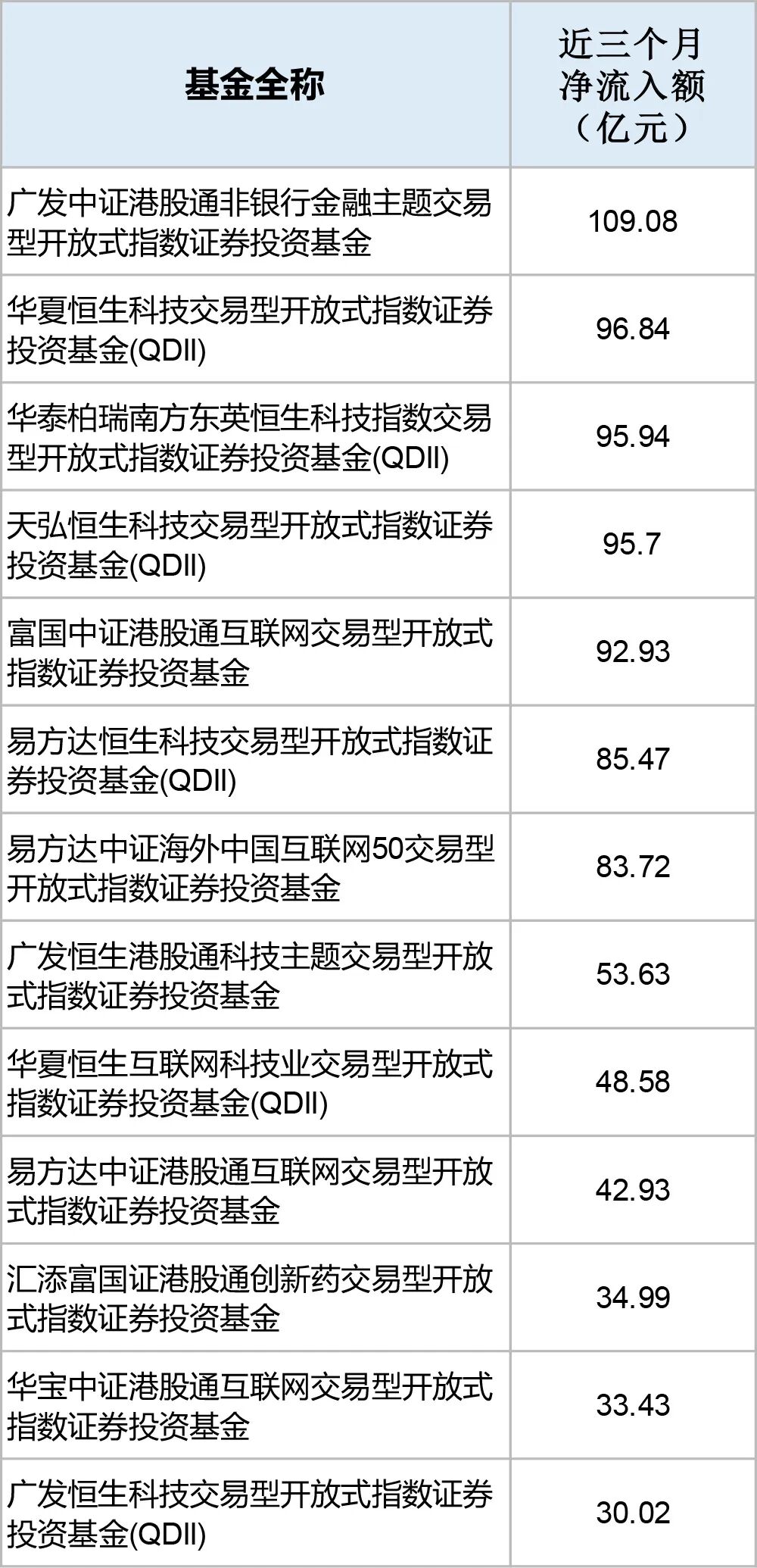
Group 1 - Significant capital inflow into Hong Kong thematic ETFs, with nearly 10 billion yuan net inflow on February 24, focusing on technology ETFs [1][2] - Over the past three months, net inflow into Hong Kong thematic ETFs exceeded 100 billion yuan [1] - Multiple Hong Kong technology thematic ETFs reached historical highs in terms of shares, with notable inflows into various funds [2] Group 2 - Specific funds with substantial net inflows over the past three months include: - GF CSI Hong Kong Stock Connect Non-Bank Financial Theme ETF: 10.91 billion yuan - Huaxia Hang Seng Technology ETF: 9.68 billion yuan - Haitong Southbound Hang Seng Technology ETF: 9.59 billion yuan - Tianhong Hang Seng Technology ETF: 9.57 billion yuan - Fortune CSI Hong Kong Stock Connect Internet ETF: 9.29 billion yuan [3][4] - New products focused on Hong Kong thematic ETFs are being launched, primarily targeting the technology sector [5] - Analysts suggest that the current valuation of the Hang Seng Technology Index is at a historically low level, indicating potential for recovery [5][6]
资金逆势涌入!恒生科技ETF半年吸金超千亿
2 1 Shi Ji Jing Ji Bao Dao· 2026-02-25 13:05
Group 1 - The core viewpoint of the article highlights a significant influx of funds into Hong Kong stock-themed ETFs, particularly the Hang Seng Technology ETF, indicating a new trend in asset allocation for 2026 [1][2][3] - As of February 24, 2023, the Hang Seng Technology ETF saw a net inflow of 342.50 billion yuan year-to-date, while the overall market for broad-based ETFs experienced net redemptions exceeding 1000 billion yuan [2][3] - The Hang Seng Technology Index has dropped over 21% since its peak in October 2022, yet this decline has not deterred investors, who are adopting a "buy the dip" strategy [2][3] Group 2 - The article notes that the Hang Seng Technology ETF has accumulated a total net subscription of 1047.30 billion yuan over the past six months, indicating strong investor interest despite market volatility [1][3] - Analysts suggest that the current low valuation of Hong Kong stocks, combined with a shift in global monetary policy, has made these ETFs an attractive option for investors seeking to capitalize on potential rebounds [2][4] - The Hang Seng Technology Index's current price-to-earnings ratio is approximately 22 times, which is considered low compared to historical averages, suggesting a favorable valuation compared to global tech indices [5][6] Group 3 - Investment strategies are being discussed, with recommendations for a balanced approach to ETF investments, including both A-shares and Hong Kong stocks, as well as sector-specific ETFs [6] - The potential for growth in the Hong Kong technology sector is linked to advancements in AI, although there are concerns about the sustainability of valuations in the face of changing market conditions [4][6] - Investors are advised to consider dollar-cost averaging as a strategy, while closely monitoring the Federal Reserve's monetary policy, which could impact the valuation recovery of Hong Kong stocks [6]