
新能源

Search documents
国内商品期市收盘涨跌参半,新能源材料多数上涨
Zhong Xin Qi Huo· 2026-02-13 01:02
1. Report Industry Investment Rating - No information provided in the given content 2. Core Viewpoints of the Report - Domestic commodity futures market closed with mixed results, with most new energy materials rising. Shipping futures led the gains, while chemical products led the losses [1]. - The US economy shows a weak - stable total and a differentiated structure. The manufacturing PMI in January was favorable, but the non - manufacturing sector weakened, and employment data was below expectations [1]. - In China, the boost from the incremental policies in Q4 2025 to the fundamentals has not been significant, but policy expectations are gradually increasing. The manufacturing PMI in January declined, but the expectation of policy support in Q1 is strengthening [1]. - Domestic equity markets are supported by policy expectations and additional liquidity. Treasury bonds are neutral, with better short - term opportunities. Gold in precious metals maintains a long - position standard, while silver is on hold. Non - ferrous metals are still promising, and short - term dips can be used for bottom - fishing. Black commodities are volatile, and crude oil may rise but with high uncertainty [1]. 3. Summary by Relevant Catalogs 3.1 Market Performance - **Domestic Commodity Futures**: Shipping futures led the gains, with the container shipping index (European line) up 6.40%. New energy materials mostly rose, with lithium carbonate up 3.66%. Basic metals mostly rose, with Shanghai nickel up 1.79%. Agricultural and sideline products all rose, with apples up 1.73%. Energy products all rose, with fuel oil up 1.09%. Chemical products led the losses, with butadiene rubber down 1.93%. Oils and fats mostly fell, with palm oil down 1.50%. Precious metals were mixed, with palladium down 1.48%. Black series all fell, with ferrosilicon down 1.47%. Non - metallic building materials all fell, with PVC down 0.78% [1]. - **Financial Market**: On February 12, 2026, among stock index futures, CSI 500 futures rose 1.31%, and CSI 1000 futures rose 1.09%. Among Treasury bond futures, 30 - year Treasury bond futures rose 0.06%. The US dollar index rose 0.06%, and the US dollar intermediate price decreased by 108 pips [9]. - **Industry Index**: On February 12, 2026, among the中信 industry indices, non - ferrous metals rose 0.98%, and machinery rose 1.29%, while agriculture, forestry, animal husbandry and fishery fell 1.48%, and consumer services fell 1.75% [10][11]. - **Overseas Commodities**: On February 11, 2026, NYMEX WTI crude oil rose 1.45%, ICE Brent oil rose 1.21%, COMEX gold rose 1.53%, and LME nickel rose 3.29% [12][13]. - **Domestic Main Commodities**: On February 12, 2026, the container shipping European line rose 5.27%, lithium carbonate rose 12.33% weekly, and iron ore fell 0.11% daily [14][15][16]. 3.2 Sector Analysis - **Finance**: Before the holiday, it may be volatile. Stock index futures may be volatile and slightly stronger, stock index options should continue to hold call options for defense, Treasury bond futures are supported by monetary easing expectations, and gold and silver are in a stage of adjustment with reduced capital enthusiasm [5]. - **Shipping**: The OOCL's March online price is $3130/FEU, and the market is in a state of shrinking trading volume and consolidation before the holiday [5]. - **Black Building Materials**: In the off - season, contradictions are accumulating, and the market is under pressure. Steel, iron ore, coke, coking coal, etc. are all in a volatile state [5]. - **Non - ferrous and New Materials**: The expected trading of "Woshi Eagle" is weakening, and basic metals stop falling and are volatile. Nickel, stainless steel, and tin are expected to be volatile and slightly stronger [5]. - **Energy and Chemicals**: Concerns about the Middle East situation continue to disrupt oil prices, and the chemical industry continues to be in a state of volatile consolidation [6]. - **Agriculture**: Optimistic sentiment supports US soybeans, and domestic double - meal is mainly volatile. Most agricultural products are in a volatile state, and the pig price is running at a low level [6].
法国率先出手,27国拟对华加征30%关税,美财长用三字概括中美关系
Sou Hu Cai Jing· 2026-02-12 23:46
Core Viewpoint - A report drafted by a French government think tank suggests imposing a 30% tariff on all goods exported from China to the EU or collectively pressuring for a 20% to 30% appreciation of the yuan against the euro, highlighting a significant trade deficit of €304.5 billion with China in 2024 [2][3][21]. Group 1: Economic Pressure Tactics - The proposed 30% tariff aims to eliminate China's manufacturing cost advantage, thereby reducing Chinese exports to Europe and creating market space for local companies [2][3]. - The report draws parallels to the 1985 Plaza Accord, suggesting a collective effort to force a significant appreciation of the yuan, which could undermine China's export competitiveness [2][3][21]. Group 2: Internal EU Dynamics - Not all EU members oppose the proposal; some see it as a way to reduce dependency on China, but the EU's official stance remains ambiguous [5][6]. - Germany, with its deep economic ties to China, poses a significant obstacle to the implementation of such tariffs, as it has recently signed substantial contracts worth over €100 billion [7][8][9]. Group 3: Potential Consequences - A 30% tariff would likely lead to a trade war, with severe repercussions for the EU economy, including increased prices for consumers and potential losses for European businesses [9][12][35]. - The report indicates that the real victims of such economic measures would be European consumers and industries, not China [14][35]. Group 4: Broader Context - The report reflects a growing anxiety in Europe regarding China's advancements in sectors like renewable energy and high-end manufacturing [29][30]. - The U.S. Treasury Secretary's comments about a "comfortable zone" in U.S.-China relations suggest a similar strategy of economic pressure, aiming for concessions from China while maintaining a competitive stance [16][18][20]. Group 5: Market Realities - The dynamics of global trade are shaped by market laws and comparative advantages, which cannot be easily altered through administrative measures or financial coercion [21][36]. - China's robust industrial system, large domestic market, and independent monetary policy provide it with significant resilience against external pressures [15][26][28].


海尔深耕六大产业生态 努力创造更美好的生活
Ren Min Ri Bao· 2026-02-12 22:24
Group 1 - The company focuses on six major industrial ecosystems: smart home, health care, digital economy, robotics, new energy, and automotive, while actively developing artificial intelligence technology to enhance the "user-centered" philosophy [1][2] - The key to smart homes is making artificial intelligence more intuitive to daily life, exemplified by the three-tub washing machine, which has sold over 400,000 units online, showcasing user participation in product co-creation [1] - The number of smart terminals linked to the platform has exceeded 100 million, providing users with more convenient smart home services [1] Group 2 - The company leverages the Kaos industrial internet platform to deepen its engagement in the digital economy, having developed the Tianzhi industrial model, which integrates over 4,700 mechanism models and 200 expert algorithms to assist enterprises in digital transformation [2] - The transition from a home appliance company to an ecosystem enterprise is underway, with ongoing expansion into new industries such as robotics, new energy, and automotive [2] - The competition in the future is expected to shift from individual companies to dialogues between ecosystems, as stated by the company's chairman and CEO [2]

中国GDP20强省份大洗牌:江苏逼近广东,福建第8,辽宁17
Sou Hu Cai Jing· 2026-02-12 21:41
Core Insights - The latest GDP rankings among Chinese provinces resemble an economic competition, highlighting both successes and challenges faced by different regions [1] Group 1: Economic Performance - Guangdong maintains its top position with a GDP of 145,846.76 billion, while Jiangsu follows closely with 142,351.5 billion, narrowing the gap to less than 350 billion [3][10] - Fujian has risen to 8th place with a GDP of 60,199.45 billion, achieving a growth rate of 4.74%, surpassing Shanghai, which is in 9th place with 56,708.71 billion [3][10] - Zhejiang shows the fastest growth rate among the top four provinces at 5.04%, indicating strong economic momentum [3][10] Group 2: Regional Highlights - Sichuan (67,665.34 billion, 5th) and Henan (66,632.79 billion, 6th) are notable inland provinces contributing to the economic landscape [3][10] - Hunan (55,308.65 billion, 10th) and Anhui (52,989 billion, 11th) form a solid backbone in the Chinese economic map [4][10] Group 3: Challenges and Transformations - Liaoning, once a prominent industrial base, ranks 17th with a GDP of 33,182.9 billion and a minimal growth of 1.97%, reflecting difficulties in transitioning from traditional industries [6][11] - The province is experiencing a structural adjustment, with emerging industries like robotics and high-end manufacturing beginning to take root [8][11] - Despite its current challenges, there is optimism for a turnaround in Liaoning, as new growth opportunities are being cultivated [8][11]

佛山佛塑科技集团股份有限公司第十一届董事会第三十六次会议决议公告
Shang Hai Zheng Quan Bao· 2026-02-12 19:20
Core Viewpoint - The company, Foshan Fosptech Group Co., Ltd., held its 36th meeting of the 11th Board of Directors on February 12, 2026, where it approved several proposals related to expected daily related transactions, property leasing, and accounting estimate changes for the year 2026. Group 1: Expected Daily Related Transactions - The company expects to engage in daily related transactions totaling 139.4 million yuan in 2026 with various related parties, including Guangdong Guangxin Holdings Group Co., Ltd. and its subsidiaries, as well as Foshan Maila Hongji Film Co., Ltd. and Ningbo Maila Hongji Film Co., Ltd. [12] - Specific transactions include purchasing products and services from Guangxin Group subsidiaries for up to 35.15 million yuan, purchasing from Maila Hongji for up to 3 million yuan, and from Ningbo Maila Hongji for up to 1 million yuan [2][3]. - The company also plans to sell products and services to Guangxin Group subsidiaries for up to 30.83 million yuan and to Maila Hongji for up to 42.22 million yuan [2][3]. Group 2: Property Leasing - The company intends to publicly lease its properties located in Foshan City, with a total area of 8,182.1 square meters, at a rental price of 23.50 yuan per square meter per month for a period of 10 years, with a 6-month rent-free period [22][27]. - The leasing decision was made to improve asset utilization efficiency and does not constitute a related transaction or a significant asset restructuring [24][29]. Group 3: Accounting Estimate Changes - The company approved changes to its accounting estimates to better reflect its financial status and operational results following the acquisition of 100% equity in Hebei Jinli New Energy Technology Co., Ltd. [32][33]. - The changes include adjustments to accounts receivable credit impairment, fixed asset depreciation, and intangible asset amortization methods, effective from February 6, 2026 [32][36]. - The board confirmed that these changes would not impact previously disclosed financial reports and would not harm the interests of the company or its shareholders [37][38].

新华全媒头条|之江奔涌向“新”行——浙江以自主创新驱动高质量发展
Xin Hua She· 2026-02-12 15:53
Core Insights - Zhejiang is focusing on self-driven innovation to achieve high-quality development, aiming to transform from a manufacturing province to an innovation-driven province and eventually a technology powerhouse [1][4]. Group 1: Innovation Capacity and Goals - Zhejiang ranks fourth nationally in regional innovation capacity, with expected R&D investment intensity reaching 3.3% and high-tech industry value-added accounting for 70% by 2025 [1][3]. - The province aims to establish a high-level innovative province by 2025 and a technology powerhouse by 2035, building on its previous success in becoming an innovative province by 2020 [4]. Group 2: Innovation Ecosystem - The province is implementing a dual-driven model of technological and institutional innovation, fostering an ecosystem that supports innovation through effective market mechanisms and proactive government involvement [2][5]. - Companies in Zhejiang are responsible for 80% to 90% of the province's R&D investment, personnel, institutions, projects, and patents, highlighting the critical role of enterprises in driving innovation [5][6]. Group 3: Key Projects and Achievements - Significant projects include the establishment of national laboratories and major scientific facilities, with notable achievements in AI, biomedicine, and new energy technologies [3][8]. - The province has seen the emergence of groundbreaking technologies, such as AI models and targeted cancer drugs, showcasing its capability in high-tech innovation [6][8]. Group 4: Future Prospects and Community Impact - Zhejiang is investing over 290 billion yuan in R&D in 2024, with innovations like four-legged robots and advanced water treatment technologies making significant impacts [8][9]. - The province's innovation efforts are also aimed at enhancing community welfare, with technologies like smart prosthetics and AI glasses improving the lives of disabled individuals [8][9].
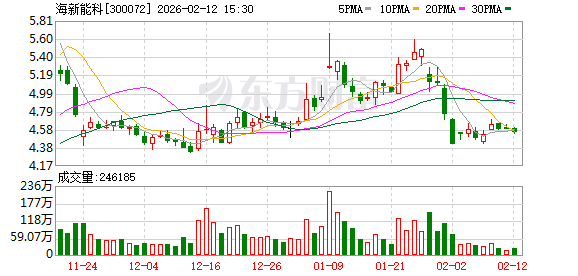
海新能科:截至2026年1月30日公司股东人数为55947户
Zheng Quan Ri Bao· 2026-02-12 13:41
Core Viewpoint - The company emphasizes that its market value is influenced by multiple complex factors, including macroeconomic conditions, capital market liquidity, and industry cycle fluctuations [2] Group 1: Company Strategy - The company prioritizes value creation as the core of its market value management efforts [2] - It is committed to continuously enhancing its intrinsic value and market performance [2] - The company plans to improve its governance mechanisms and increase the quality of information disclosure [2] Group 2: Investor Relations - The company actively engages in investor communication to convey its value and development prospects to the capital market [2] - As of January 30, 2026, the number of shareholders in the company is 55,947 [2]

特锐德(300001.SZ):预中标1.37亿元新能源项目
Ge Long Hui A P P· 2026-02-12 13:29
格隆汇2月12日丨特锐德(300001.SZ)公布,近日,华润守正采购交易平台发布了《华润新能源吐鲁番托 克逊100万千瓦风电项目-220kV升压汇集站EPC总承包工程中标候选人公示》,公司为项目第一中标候 选人,预计中标金额约1.37亿元。 ...

特锐德:预中标1.37亿元新能源项目
Ge Long Hui· 2026-02-12 13:29
(原标题:特锐德(300001.SZ):预中标1.37亿元新能源项目) 格隆汇2月12日丨特锐德(300001.SZ)公布,近日,华润守正采购交易平台发布了《华润新能源吐鲁番托 克逊100万千瓦风电项目-220kV升压汇集站EPC总承包工程中标候选人公示》,公司为项目第一中标候 选人,预计中标金额约1.37亿元。 ...
云南省能源集团揭牌 绿色能源大省再落关键子
Xin Lang Cai Jing· 2026-02-12 13:25
Core Viewpoint - The establishment of Yunnan Energy Group marks the integration of two major state-owned energy enterprises in Yunnan, aiming to enhance energy security and promote the development of a green energy province [1] Group 1: Company Formation and Objectives - Yunnan Energy Group is formed by the integration of Yunnan Energy Investment Group Co., Ltd. and Yunnan Coal Industry Group Co., Ltd. [1] - The group aims to optimize the layout of state-owned capital and is a key step in ensuring energy security in Yunnan [1] - The mission is to create a first-class national green energy enterprise and a billion-level energy backbone enterprise in Yunnan [1] Group 2: Resource and Industry Focus - Yunnan is recognized as a major green energy province with strong complementary resources in hydropower, wind, and solar energy, capable of developing over 200 million kilowatts of clean energy resources [1] - The main business areas of Yunnan Energy Group include energy, modern logistics, and new materials for green energy [1] - The company will focus on energy investment and management, environmental protection, new energy industries, oil and gas resources, and related technical services [1]