软件

Search documents
智通港股解盘 | AI负面冲击持续显现比特币又爆仓 底部汽车股被资金挖掘
Zhi Tong Cai Jing· 2026-02-06 13:02
Market Overview - US stock indices fell across the board, with December JOLTS job openings hitting a five-year low, significantly below expectations [1] - Challenger companies announced 108,000 layoffs in January, the highest for the same period since 2009, with a month-on-month increase of 205% [1] - Initial jobless claims rose to 231,000, an increase of 22,000 from the previous week, exceeding expectations, indicating a deteriorating economic situation [1] - Hong Kong stocks were also affected, closing down 1.21% [1] Technology Impact - The decline in job openings is partly attributed to advancements in artificial intelligence, such as Anthropic's Claude Opus 4.6, which outperforms GPT-5.2 in various fields [1] - Financial data service providers like FactSet experienced a significant drop of 10% in stock price, with S&P Global, Moody's, and Nasdaq also declining [1] Automotive Sector - NIO (09866) forecasted adjusted operating profit for Q4 2025 between RMB 700 million (approximately $100 million) and RMB 1.2 billion (approximately $172 million), driven by sales growth and improved product mix [3] - Li Auto (02015) is preparing to launch the new Li L9, featuring advanced technology and a price of RMB 559,800, with a market focus on high-end segments [3] - Both NIO and Li Auto showed positive stock performance, with NIO rising nearly 7% and Li Auto increasing by nearly 4% [3] Consumer Goods - The upcoming Spring Festival is boosting sales in the snack sector, with major companies ramping up production to meet demand [4] - Zhongtong Express (02057) projected total revenue for 2025 between RMB 48.5 billion and RMB 50 billion, a growth of approximately 9.5% to 12.9% from 2024 [4] - SF Express (09699) expects a profit of no less than RMB 238 million for 2025, with a year-on-year increase of over 80% [4] Dairy Industry - Dairy prices are at a low point, with a reduction in dairy cow inventory and losses in farms leading to the exit of inefficient production capacity [5] - The price of milk is expected to stabilize and rise by 2026, benefiting upstream farms and downstream dairy companies [5] - Yurun Dairy (09858) and Mengniu Dairy (02319) saw stock increases of over 4% and 3%, respectively [5] Pharmaceutical Sector - Innovent Biologics (09969) announced a positive earnings forecast, expecting revenue of RMB 2.37 billion for 2025, a year-on-year increase of approximately 134% [6] - The company anticipates its first profitable year with a net profit of around RMB 630 million [6] - Federal Pharmaceutical (03933) received approval for a new drug, enhancing its position in the market [6] Oil Market - Reports indicate that Russia has increased discounts on oil exports to China, aiming to attract demand amid declining purchases from India [7] - If India reduces its imports, China may become the primary buyer of discounted Russian oil, benefiting oil refining companies [7] - Major companies in the Hong Kong market include Sinopec (00386) and Shanghai Petrochemical (00338) [7] Duty-Free Market - China Duty Free Group (01880) reported a nearly 20% year-on-year increase in shopping totals at duty-free stores in Hainan since the new policy implementation [8] - The company holds a significant market share in Hainan's duty-free sector, with a strong supply chain and partnerships with over 1,000 luxury brands [9] - The expansion of duty-free shopping in Hainan is expected to enhance the company's growth prospects [9]


Anthropic步步紧逼OpenAI,大型SaaS却先崩盘
第一财经· 2026-02-06 12:59
Core Viewpoint - The competition between major AI model companies, particularly OpenAI and Anthropic, is intensifying as both firms release updates to their foundational models, focusing on enhancing task execution capabilities and AI agent functionalities, which has led to a sell-off in the software sector [2][5]. Group 1: Model Updates and Competition - OpenAI and Anthropic launched updates to their models, GPT-5.3-Codex and Claude Opus 4.6, respectively, with a focus on AI agents and engineering capabilities [2][5]. - GPT-5.3-Codex is touted as having the "best programming performance," with a significant reduction in token consumption during task execution compared to its predecessor [5]. - Claude Opus 4.6 has improved programming skills and excels in financial analysis and document creation, showcasing a shift towards broader task capabilities [5]. Group 2: Market Reactions and Stock Performance - Following the announcements, the U.S. stock market experienced a downturn, with major tech stocks like Microsoft, Amazon, and Nvidia seeing declines of 4.95%, 4.42%, and 1.33% respectively [2]. - The S&P North American Technology Software Index (IGV) dropped approximately 25.8% since January, reflecting growing concerns about the software sector's valuation amidst AI advancements [7]. Group 3: Industry Perspectives and Future Outlook - Industry leaders express differing views on the impact of AI on existing software tools, with some suggesting a new workflow driven by AI, while others believe AI will enhance rather than replace current systems [8]. - Major tech companies are significantly increasing their capital expenditures, with Amazon planning $200 billion and Alphabet $185 billion for 2026, indicating a strong commitment to AI despite market volatility [9]. - The ongoing competition highlights the need for software companies to demonstrate stable net retention rates and pricing power in the face of AI disruptions [9].


美股前瞻 | 三大股指期货齐涨,软件股反弹
智通财经网· 2026-02-06 12:54
Market Overview - US stock index futures turned positive before the market opened on February 6, with Nasdaq futures up 0.51%, S&P 500 futures up 0.52%, and Dow futures up 0.60% after previously dropping over 1.6% [1] - European indices also showed gains, with Germany's DAX up 0.33%, UK's FTSE 100 up 0.54%, France's CAC40 up 0.23%, and the Euro Stoxx 50 up 0.34% [2][3] Oil Prices - WTI crude oil rose by 1.39% to $71.99 per barrel, while Brent crude oil increased by 1.34% to $75.66 per barrel [3] Employment and Economic Data - The US non-farm payroll report for January has been delayed to February 11, and the CPI report has been postponed to February 13, which may lead to market volatility [4] Stock Market Trends - Momentum trading strategies have faced significant setbacks, with a notable sell-off in the software sector, which has seen declines exceeding 20% due to concerns over AI applications potentially displacing certain companies [5] - Despite the sell-off, sectors such as apparel retail, travel, and home goods manufacturing have seen stock price increases, indicating a shift towards value stocks [5] Cryptocurrency Market - Bitcoin experienced a sharp decline, dropping 12% to around $63,000 before rebounding above $66,000. The drop was attributed to position liquidations rather than fundamental issues [6] AI and Software Sector - The narrative of a "software stock apocalypse" has led to widespread sell-offs in the SaaS and broader software sectors, although some institutional investors are beginning to buy the dip, believing that the market has overreacted [7] - Wistron, a supplier for Nvidia, stated that AI is not a bubble but the beginning of a new era, with orders expected to grow significantly [8] Automotive Industry - Toyota raised its full-year profit guidance, expecting net profit to reach 3.57 trillion yen, up from a previous estimate of 2.93 trillion yen, aided by a weak yen and cost-cutting measures [13] - Stellantis announced a €22 billion write-down due to high costs and weak electric vehicle sales, indicating a significant restructuring of its business [14] Semiconductor Supply Issues - Intel and AMD have notified Chinese customers of a CPU supply shortage, with delivery times extending up to six months, leading to price increases of over 10% for Intel's server products in the Chinese market [15]



三年牛市逻辑逆转!科技股成弃子,AI无法替代的实体崛起
Jin Shi Shu Ju· 2026-02-06 12:31
Group 1 - The core viewpoint of the articles highlights a shift in investor sentiment towards sectors that are less likely to be disrupted by AI technology, such as construction, transportation, and heavy machinery, while technology stocks are experiencing declines due to concerns over AI's impact on their business models [1][2][3] - The S&P 500 index has seen a decline, primarily driven by software stocks, while essential consumer goods stocks have risen by 4.7%, potentially marking their best weekly performance since 2022 [1] - JonesTrading's chief market strategist, Michael O'Rourke, notes that investors are gravitating towards sectors with "anti-AI attributes," which are seen as safer investments in the current market environment [1] Group 2 - Analysts from Citizens and Baird indicate that the construction sector is benefiting from the spring home-buying season, with potential for further price increases if funds rotate from tech stocks into construction stocks [2] - The machinery manufacturing and transportation sectors are also expected to achieve their best weekly performance since May of the previous year, supported by declining interest rates and stronger-than-expected economic resilience [2] - Essential consumer goods and chemical companies are categorized as anti-AI sectors, with companies like Dollar General and Dow Chemical seeing positive market performance due to anticipated improvements in demand and industry conditions [3] Group 3 - The chemical sector is expected to rebound as market conditions improve, with analysts predicting a recovery in earnings for commodity chemical companies amid a rotation of funds away from high-growth tech sectors [3] - The market has shown a divergence, with truck transportation, machinery manufacturing, and essential consumer goods reaching historical highs, while the tech-heavy Nasdaq 100 index has declined by 6% since its peak in October [3]
Anthropic步步紧逼OpenAI,大型SaaS却先崩盘
Di Yi Cai Jing· 2026-02-06 12:18
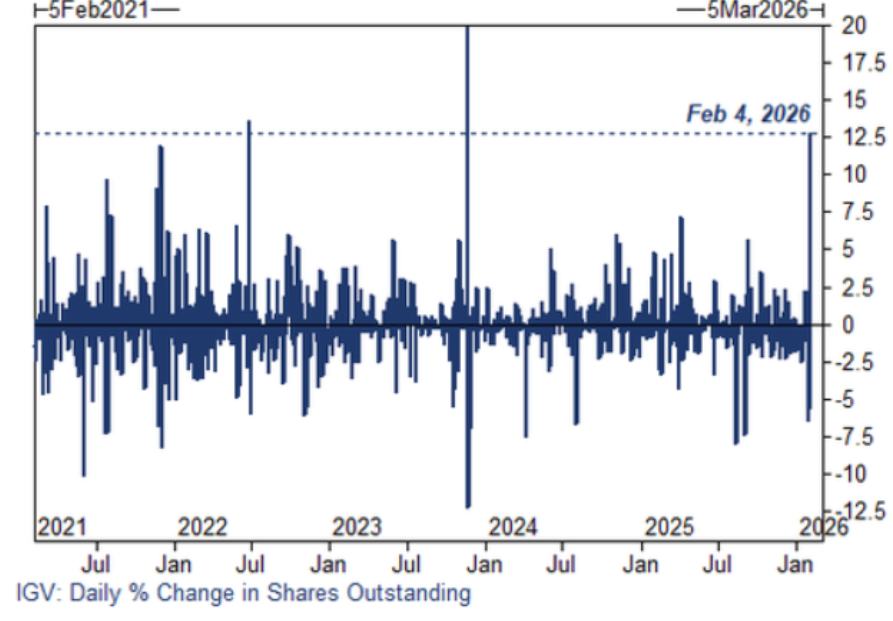
Core Insights - The competition between major AI model companies, particularly OpenAI and Anthropic, is intensifying as both firms release updates to their models aimed at enhancing task execution capabilities [1][4] - The market is experiencing a sell-off in the software sector due to fears that advancements in AI models could disrupt existing software companies, leading to a decline in stock prices for major tech firms [1][6] Group 1: Model Updates and Features - OpenAI's GPT-5.3-Codex and Anthropic's Claude Opus 4.6 have been launched with a focus on AI agents and engineering capabilities, marking a significant evolution in the AI model landscape [1][4] - GPT-5.3-Codex is touted as having the "best programming performance," with a task execution efficiency that consumes less than half the tokens compared to its predecessor [4] - Claude Opus 4.6 has improved programming skills and excels in financial analysis, document creation, and multi-tasking capabilities [4] Group 2: Market Reactions and Stock Performance - Following the announcements of new models, the U.S. stock market saw a decline, with major tech stocks like Microsoft, Amazon, and Nvidia experiencing significant drops [1][6] - The North American technology software index (IGV) has fallen approximately 25.8% since January, reflecting growing concerns about the impact of AI on software valuations [6] Group 3: Industry Perspectives and Future Outlook - Industry leaders express differing views on the impact of AI; Nvidia's CEO believes AI will enhance existing software rather than replace it, while others warn of potential profit margin pressures on software companies [7][8] - Major tech firms are significantly increasing their capital expenditure forecasts for 2026, with Amazon and Alphabet planning to invest $200 billion and $185 billion respectively, indicating a strong commitment to AI development [7]

美股常胜策略突然失效!动量交易遭遇历史性回撤:资金从科技撤离,价值股成新宠
Zhi Tong Cai Jing· 2026-02-06 12:08
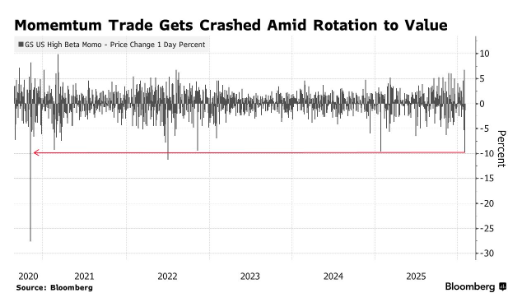
Group 1 - The momentum trading strategy, which has been a consistent approach in the stock market, suddenly failed in the past week, experiencing its second-largest single-day drop since the pandemic in 2020, surpassing declines from previous market sell-offs [1] - The decline in momentum stocks erased all gains for sectors such as storage chips, metals, rare earth mining, and technology application development for the year [1] - The sell-off was part of a broader downturn in the U.S. stock market, primarily triggered by volatility in the software sector, with concerns that AI applications could replace certain companies, leading to a drop of over 20% in that sector [1] Group 2 - Investors noted a significant rise in stock prices for clothing retail, travel companies, and home goods manufacturers, indicating a broad style shift in the market as funds moved from technology stocks to sectors more closely linked to economic recovery [3] - The UBS value stock long-short strategy basket has increased by 20% since last week, while Barclays' value stock relative to growth stock factor index recorded one of its largest excess returns in history on Thursday [3] - Despite the style shift, the significant drop in the technology sector and its high weight in the index has not been offset by the gains from the style switch, with the S&P 500 index down 1.2% on Thursday and a cumulative decline of 0.7% since 2026 [3] Group 3 - Technology stocks have become synonymous with momentum trading, particularly with software companies experiencing significant declines in the recent downturn [4] - Recent earnings reports from major tech companies have heightened market caution, with Google showing steady revenue growth but projecting capital expenditures for 2026 to exceed market expectations, while Qualcomm's revenue outlook appeared weak [4] - The current market exposure to momentum stocks is at the 99th percentile over the past year and has reached the 100th percentile over the past five years, indicating extreme volatility in momentum factors compared to historical levels [4] Group 4 - Goldman Sachs' trading team indicated that for investors considering positioning during the pullback, historical experience suggests that corrections in momentum stocks can present good buying opportunities in the medium term [5] - The team also advised that given the significant prior increase in momentum stocks and the current high levels of holdings, short-term hedging remains a reasonable choice [5]
科技股本周集体重挫的四大原因
Xin Lang Cai Jing· 2026-02-06 11:54
作者:约翰・托菲吉 智能应用程序图标与其他人工智能聊天机器人应用程序一同亮相。 本周,投资者纷纷抛售曾经炙手可热的科技股,拖累华尔街整体走弱。 据费瑟斯通数据显示,科技股占比极高的纳斯达克综合指数迎来 4 月以来最惨烈的三日连跌,本周市值 累计蒸发超 1.5 万亿美元。 对华尔街、科技巨头及整个软件行业而言,过去几日市场剧烈震荡,背后原因主要有四: 比特币等风险资产遭遇抛售(比特币价格近日跌至 2024 年 10 月以来新低),也可能推动投资者转向更 安全的资产。 德意志银行全球宏观研究主管吉姆・里德在周四的研报中表示:"近几个月,市场心态已从'所有科技股 都是赢家'转变为残酷的'优胜劣汰'格局。" 人工智能引发的担忧致软件股持续下挫 人工智能初创公司安索普里克于上周五推出多款新工具,称其能为法律行业完成更多工作。这让华尔街 忧心忡忡,担心企业很快会放弃现有的专业数据分析和研究软件订阅服务,直接冲击软件企业的利润。 这一担忧是否会成为现实尚无定论,但投资者已陷入恐慌,纷纷抛售法律和金融软件及服务类企业的股 票。 跟踪软件行业的某交易所交易基金已连续八日下跌,而市场对人工智能蚕食软件行业市场份额的担忧早 已存在 ...

科技股回调 “抗AI”板块成为新赢家
Xin Lang Cai Jing· 2026-02-06 11:53
Group 1 - The core viewpoint of the article highlights that companies in sectors less susceptible to artificial intelligence are emerging as winners amid a decline in technology stocks [1] - The S&P 500 index fell by 2%, primarily driven down by software companies, while sectors such as homebuilders, transportation companies, and heavy machinery manufacturers experienced strong gains [1] - Essential consumer goods companies, viewed as safe havens during economic downturns, rose by 4.7%, potentially marking their best weekly performance since 2022 [1] Group 2 - Michael O'Rourke, Chief Market Strategist at JonesTrading, notes that investors are rotating into "anti-AI" sectors, which include industries with tangible, real-world elements [1] - Analysts from Citigroup and Citizens emphasize that the core activities of these companies, such as manufacturing, distribution, and assembly, are not areas where artificial intelligence can easily replace human involvement [1] - Jay McCanless from Citizens states that human presence is still essential for tasks like building homes, reinforcing the idea that certain industries will remain resilient against AI advancements [1]
软件股末日论”点燃大变革! 恐慌抛售之后,市场将捧起AI时代的“软件基石
Zhi Tong Cai Jing· 2026-02-06 11:49
Core Viewpoint - The recent narrative of "Software-mageddon" has led to a significant sell-off in the software sector, particularly affecting SaaS stocks, following the launch of new AI tools by Anthropic, which are perceived as threats to traditional software business models [1][4][5]. Group 1: Market Reaction - The S&P 500 Software & Services Index has experienced a decline of approximately 30% since its recent peak at the end of October, marking the most severe sell-off since 2022 [1][6]. - Major software companies, including Thomson Reuters and Salesforce, have seen their stock prices drop significantly, with some experiencing declines of up to 10% in a single day [5][6]. - The sell-off has been exacerbated by disappointing earnings guidance from major companies, including Microsoft, and heightened expectations for AI infrastructure spending [5][6]. Group 2: Institutional Response - Some institutional investors are beginning to enter the market to buy undervalued software stocks, believing that the market has overreacted to the AI threat [2][12]. - Analysts express a divided view on the long-term impact of AI on software companies, with some believing that AI will reshape profit trajectories rather than eliminate the need for existing software [9][14]. Group 3: Expert Opinions - Rick Sherlund, a prominent analyst, argues that the software industry undergoes significant transformations every 10 to 15 years, and companies with strong fundamentals, like SAP, will likely benefit from AI rather than be threatened by it [3][16]. - Nvidia's CEO Jensen Huang emphasizes that the notion of AI completely replacing software is illogical, suggesting that AI will enhance existing software rather than replace it [7][8]. - The current market panic is described as "micro-hysteria," with experts suggesting that the fears surrounding AI's impact on software are exaggerated [8][12]. Group 4: Future Outlook - The software sector is expected to experience a technical rebound as investors reassess the long-term value of companies that integrate AI into their operations [2][11]. - High-quality software companies that embrace AI are likely to emerge stronger from the current turmoil, as the market begins to differentiate between those with robust business models and those that are more vulnerable [11][15].

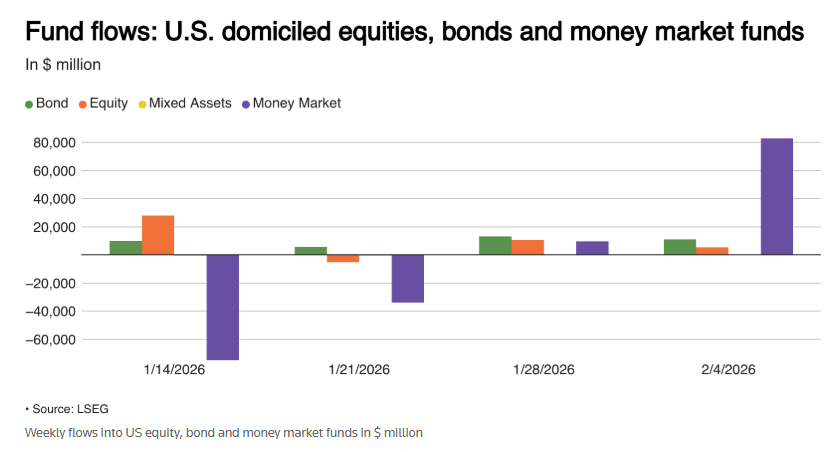
全球资金流向生变!“Anthropic风暴”重创科技 价值股与债基成“新避风港”
智通财经网· 2026-02-06 11:40
Core Viewpoint - The recent statistics indicate a significant decline in investment demand for U.S. equity funds, attributed to fears surrounding AI's potential to disrupt the software industry, despite strong earnings reports from major companies like Eli Lilly and Super Micro Computer [1] Group 1: Market Trends - U.S. equity funds saw a net inflow of approximately $55.8 billion for the week ending February 4, a sharp decrease of about 48% from the previous week's inflow of $108.2 billion [1] - The introduction of new AI tools by Anthropic has intensified market fears regarding the disruption of the SaaS software industry, leading to a collective crash in software stocks [4] - Major U.S. indices experienced a significant drop following the announcement of advanced AI capabilities that threaten traditional software services [4] Group 2: Fund Flows - Large-cap equity funds recorded a surprising net inflow of about $11 billion, indicating ongoing bullish sentiment towards major tech companies like Google, Nvidia, and Apple [5] - Mid-cap and small-cap equity funds experienced outflows of approximately $15.9 billion and $16.7 billion, respectively, reflecting a shift in investor sentiment [5] - Investors directed $21.1 billion into undervalued industrial sectors and approximately $14.4 billion into metals and mining, while withdrawing about $23.4 billion from the tech sector [5] Group 3: Bond and Cash Market Activity - U.S. bond funds achieved a net inflow of $111.1 billion over the latest week, marking the fifth consecutive week of significant inflows [8] - Short- to medium-term investment-grade bond funds received net investments of about $63.4 billion, the largest weekly inflow since at least 2022 [8] - Money market funds recorded a net inflow of $830.9 billion, the highest since early December, indicating a shift towards cash and bonds amid declining risk appetite [11]