
Securities

Search documents
India fast-tracks key reforms to shield itself from US tariffs
The Economic Times· 2025-12-20 03:09
Economic Reforms - The Indian Parliament approved significant bills to open the nuclear industry to private firms and allow full foreign ownership of insurance companies, aiming to modernize the financial framework and encourage market participation [1][2] - The finance minister proposed unifying India's securities market laws under a single code, which is expected to attract more investments [1][2] Investment Potential - These reforms could unlock hundreds of billions of dollars in investments, supporting Prime Minister Modi's goal of transforming India into a developed nation within the next two decades [2] - The Adani Group is already planning to capitalize on these changes by developing a commercial nuclear energy project in northern India [2] Economic Growth Projections - Economists predict a growth rate of 6.9% for 2026, with a steady pace of 6.5% expected for the fiscal year through March, although this is below the 8% growth needed for India to achieve developed-nation status by 2047 [6][7] - The recent policy actions are seen as a shift towards diversification and structural reforms, aimed at attracting long-term capital [6] Trade Relations - India's exports to the US have weakened due to higher tariffs imposed by the Trump administration, with ongoing negotiations for a trade deal lacking clarity [8] - Tamil Nadu, a key export-reliant state, has reported significant losses due to high tariffs, highlighting the impact on local businesses [10] Legislative Activity - December's parliamentary session was the most productive in five years, with 61.7 hours spent on legislation and eight bills passed, indicating a proactive legislative environment [11][14] - The burst of policy action is expected to energize Modi's Bharatiya Janata Party ahead of upcoming state elections [12][14]



云南省金融事业迈出新步伐 机构体系不断健全 供给能力持续提升
Xin Lang Cai Jing· 2025-12-19 20:27
Core Viewpoint - Yunnan Province has made significant progress in financial development during the "14th Five-Year Plan" period, focusing on high-quality growth and risk management, which has provided strong support for the province's economic and social development [1] Financial Strength and Growth - The financial system in Yunnan has seen a substantial increase in its comprehensive strength, with 223 banking institutions and total assets of 6.38 trillion yuan as of November [2] - The social financing increment reached 2.47 trillion yuan since the beginning of the "14th Five-Year Plan" [2] - The balance of deposits increased from 3.57 trillion yuan in early 2021 to 4.71 trillion yuan, a cumulative growth of 32%, while the balance of loans rose from 3.51 trillion yuan to 5.03 trillion yuan, a cumulative growth of 44% [2] - The average interest rate for newly issued loans was 3.52%, down 1.46 percentage points from 2020 [2] Capital Market Development - Yunnan has accelerated the construction of a multi-level capital market system, with the establishment of the Yunnan Equity Exchange Center and the successful launch of new companies [3] - As of November, there are 39 domestic listed companies and 5 listed in Hong Kong, with a total of 172.69 billion yuan raised through stock and bond financing [3] Risk Management and Regulatory Compliance - The province has maintained a stable financial environment, with improvements in key regulatory indicators such as capital adequacy ratios and non-performing loan ratios [3] - A two-year crackdown on illegal fundraising has led to a significant decrease in related criminal cases and amounts involved [3] Financial Services and Policy Implementation - The financial system is actively supporting the central government's policies to stabilize expectations and boost confidence, particularly in rural revitalization and green finance [4] - Financial support for key sectors such as agriculture, tourism, and small enterprises has been enhanced, with a loan balance of 1.76 trillion yuan for targeted financial initiatives, reflecting a year-on-year growth of 12.46% [4] Future Financial Development - Yunnan plans to strategically plan for financial development in the "15th Five-Year Plan" to contribute more significantly to the modernization process in China [5]
证监会网信办联合出手
21世纪经济报道· 2025-12-19 14:56
Core Viewpoint - The article emphasizes the importance of accurate and truthful information in the capital market, highlighting recent regulatory actions against false information and malicious activities that disrupt market stability and investor confidence [1][2]. Group 1: Regulatory Actions - The National Internet Information Office and the China Securities Regulatory Commission have initiated a campaign to address false information related to the capital market, targeting accounts that spread rumors and illegal stock recommendations [1][2]. - This campaign focuses on five major issues, including the dissemination of regulatory policy rumors, defamation of financial institutions and listed companies, and the use of AI to fabricate false information [1][2][4]. Group 2: Impact of False Information - Certain self-media accounts have been found to fabricate false IPO policies and misrepresent market information, which can mislead public perception and investor decisions [3][4]. - The spread of false regulatory information can lead to significant market volatility, affecting the normal trading order and undermining the implementation of policies [4][6]. Group 3: Protection of Corporate Reputation - Malicious aggregation of negative information about companies and financial institutions by self-media accounts has been identified as a serious issue, damaging corporate reputations and market confidence [6][8]. - The recent "Clean and Optimize the Business Network Environment" campaign aims to address these harmful behaviors and protect corporate rights [6][8]. Group 4: AI and Misinformation - The rapid development of AI technology has led to its misuse by some self-media accounts to generate false information, complicating the regulatory landscape [10][11]. - AI-generated content can appear more realistic and is often difficult for ordinary investors to distinguish from genuine information, increasing the challenge for regulators [11].

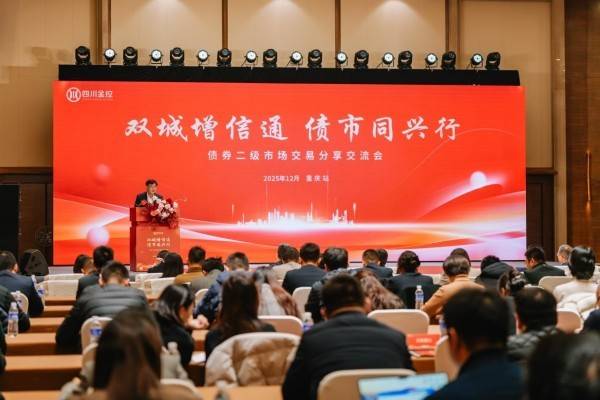
“双城增信通 债市同兴行”交易分享交流会举行
Sou Hu Cai Jing· 2025-12-19 13:35
Core Viewpoint - The event "Shuangcheng Credit Enhancement Bond Market Exchange" aims to promote the development of the bond market in the Chengdu-Chongqing economic circle by gathering professionals from various financial sectors to discuss trends and innovative service models [1][3]. Group 1: Event Overview - The event was hosted by Sichuan Financial Holding Group and organized by Shuangcheng Credit Enhancement Company, attracting over a hundred professionals from credit enhancement institutions, banks, securities, and funds [1]. - The gathering focused on the development trends of the bond market and aimed to foster collaboration within the industry to enhance the bond market's growth in the region [1][3]. Group 2: Key Presentations - Zhou Xingyun, Chairman of Sichuan Financial Holding Group, emphasized the group's long-standing commitment to the bond market and the importance of the exchange platform for discussing macroeconomic conditions and investment strategies [3]. - Lang Wei, Chief Credit Enhancement Officer of Zhongzheng Credit Enhancement, shared insights on the company's development history and business layout, advocating for deeper collaboration within the industry [5]. - Dai Xuemei, Chairman of Shuangcheng Credit Enhancement Company, outlined the company's two-year development and future plans, focusing on a dual-driven financial service system combining credit enhancement and investment [7]. Group 3: Expert Contributions - Experts from Southern Fund, Shenwan Hongyuan Securities, Huatai Securities, and Songgang Capital Group discussed macroeconomic trends for 2026, optimization of bond investment strategies, and the establishment of quantitative systems for bond investment [9]. - The event utilized diverse formats such as keynote speeches and case studies to analyze core issues in bond market development, injecting new momentum into the industry's high-quality growth [9].
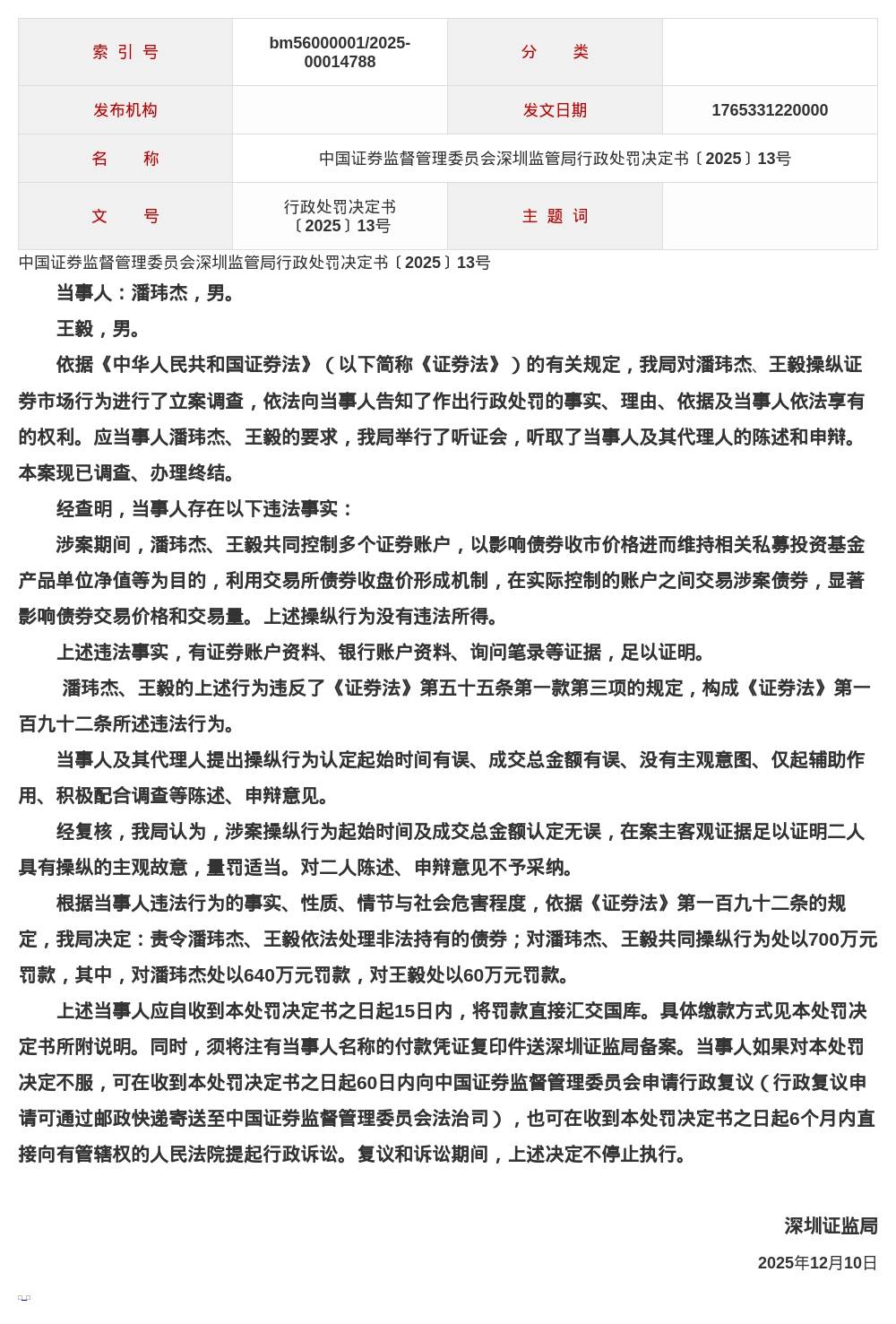
潘玮杰、王毅共被罚700万,涉操纵证券市场
Sou Hu Cai Jing· 2025-12-19 11:44
Group 1 - The Shenzhen Securities Regulatory Bureau issued an administrative penalty decision against Pan Weijie and Wang Yi for manipulating the securities market [1] - Pan Weijie and Wang Yi controlled multiple securities accounts to influence bond closing prices, aiming to maintain the net asset value of related private equity fund products [1] - Their actions involved trading bonds between accounts they controlled, significantly affecting bond trading prices and volumes, but did not result in illegal gains [1] Group 2 - The manipulation behavior violated relevant provisions of the Securities Law [1] - The Shenzhen Securities Regulatory Bureau ordered Pan Weijie and Wang Yi to legally handle the illegally held bonds [1] - A total fine of 7 million yuan was imposed for their joint manipulation, with Pan Weijie fined 6.4 million yuan and Wang Yi fined 600,000 yuan [1]
2025年21世纪高质量发展研究(资本市场)优秀案例发布
2 1 Shi Ji Jing Ji Bao Dao· 2025-12-19 09:54
Core Insights - The Southern Finance Forum 2025, themed "The Power of Consensus," focuses on "Innovation Surge and China's Asset Revaluation," attracting over 300 financial experts in Guangzhou [1] Group 1: Event Overview - The forum is organized by Southern Finance Media Group and hosted by 21st Century Digital Media [1] - The event includes the "21st Century Excellence Board Annual Meeting," where 65 exemplary cases in high-quality development are announced [1] Group 2: Awarded Cases - The awarded entities include 46 companies, 8 banks and branches, 7 securities firms, and 4 other financial institutions [1] - Categories for the awards encompass 19 projects, including Annual Excellence Board, Annual Excellence ESG Practicing Listed Companies, Annual Technology Value Listed Companies, and more [1][2] Group 3: Purpose of Awards - The purpose of the 21st Century High-Quality Development Research Excellent Cases is to recognize companies that lead industry thinking, innovation, and future trends [2] - The focus is on benchmark enterprises in corporate governance, information disclosure, ESG practices, and investor relations management, particularly in the context of capital market reforms [2]
四大维度提质增效 续写津沽大地资本新篇章|决胜“十四五” 擘画“十五五”·地方资本市场高质量发展之天津篇
证券时报· 2025-12-19 09:09
Core Viewpoint - The article discusses the development and transformation of Tianjin's capital market during the "14th Five-Year Plan" period, emphasizing the integration of capital market reforms with economic needs and technological innovation. Group 1: Market Growth and Structure - During the "14th Five-Year Plan," Tianjin's capital market has seen a steady expansion, with the number of listed companies increasing to 71, an 18% growth compared to the end of the "13th Five-Year Plan" [7] - By the end of November 2025, the total market capitalization of listed companies in Tianjin is projected to reach approximately 1.66 trillion yuan, an 80% increase [7] - The bond financing channel has become prominent, with 109 bond issuers and a total bond scale of 1.28 trillion yuan, ranking among the top in the country [7] Group 2: Technological Innovation and R&D - The capital market in Tianjin has deeply integrated with technological innovation, with 14 new companies listed on the A-share market in the past five years, nearly 80% of which are technology-oriented [11] - Cumulatively, listed companies in Tianjin have invested over 100 billion yuan in R&D, an increase of nearly 80% compared to the "13th Five-Year Plan" [11] - The overall R&D intensity of key industry chain listed companies reached 7.64%, while companies on the "Two Innovation Boards" and the Sci-Tech Innovation Board had R&D intensities of 13.53% and 28.16%, respectively [11] Group 3: Mergers, Acquisitions, and Risk Management - Tianjin's capital market has introduced policies to support listed companies in accelerating technological upgrades and extending industrial chains through mergers and acquisitions [12] - In 2024, the "Six Merger Guidelines" were released, leading to over 26 billion yuan in merger and acquisition activities among listed companies [12] - Nearly 4,800 industrial enterprises have actively utilized the futures market for risk management, with participation increasing 2.3 times compared to the "13th Five-Year Plan" [12] Group 4: Financing and Investment - Over the past five years, enterprises in Tianjin have utilized multi-level capital markets for direct financing totaling 1.6 trillion yuan, 1.6 times the total financing amount during the "13th Five-Year Plan" [14] - The public fund fee reform has been fully implemented in Tianjin, with significant growth in the scale of equity funds managed by Tianhong Fund, reaching 213.4 billion yuan, a 173% increase [14] - Listed companies in Tianjin have implemented cash dividends exceeding 170 billion yuan, 7.5 times that of the "13th Five-Year Plan," with an average annual dividend yield of 3.08% [15] Group 5: Regulatory and Ecological Improvements - The regulatory framework for Tianjin's capital market has been established, with a "1+N" policy system guiding further reforms [17] - The Tianjin Securities Regulatory Bureau has strengthened collaboration with various departments to enhance enforcement and regulatory measures, resulting in significant penalties for financial misconduct [18] - The market has seen a reduction in key risks, with effective measures taken to address issues in the private equity sector and the exit of underperforming companies [18]

机构:银价长期中枢抬升 工业属性放大弹性
Zheng Quan Shi Bao Wang· 2025-12-19 00:46
Group 1 - The core viewpoint is that the silver market is experiencing a dual drive from its financial attributes and a surge in industrial demand, leading to a bullish trend in silver prices [1] - Silver prices have shown a significant increase, with the main futures contract rising by 3.44% and reaching a historical high during trading [1] - The macroeconomic environment is favorable, with an expanding supply-demand gap and a rapid correction in the gold-silver ratio contributing to the medium to long-term upward momentum in silver prices [1] Group 2 - The financial attributes of silver are becoming more pronounced, serving as both a currency and an investment asset, which makes it more sensitive to macroeconomic conditions and market sentiment compared to gold [1] - Industrial demand for silver is projected to account for 59% of global consumption in 2024, with photovoltaic demand representing approximately 17% of total demand [1] - The long-term trend indicates an upward shift in the price center for silver, driven by the economic cycle and the elasticity of its industrial properties [2]
华泰证券:公募绩效考核优化 关注优质金融
Zheng Quan Shi Bao Wang· 2025-12-18 23:53
人民财讯12月19日电,华泰证券研报称,12月《基金管理公司绩效考核管理指引(征求意见稿)》下 发,强化长期业绩导向、提高强制跟投比例,并明确量化降薪问责机制等,将基金公司及其核心投研人 员的利益与投资者的长期利益深度绑定。资本市场中长期稳步向上趋势不改,奠定资管产品发展基础。 建议把握优质个股,银行推荐零售及财富管理标杆,财富管理战略地位提升的公司;券商推荐大财富管 理产业链具备较强优势的公司。 ...

X @Bloomberg
Bloomberg· 2025-12-18 22:07
Macquarie's Australian securities business admitted to misleading conduct in misreporting millions of short sales over several years and agreed to pay a $23 million fine https://t.co/fCgIPvuC1b ...