云计算

Search documents
Clawdbot爆火,阿里云、腾讯云支持部署!云计算ETF汇添富(159273)连续4日吸金!机构:算力产业链通胀有望延续,驱动利润改善!
Sou Hu Cai Jing· 2026-01-29 07:35
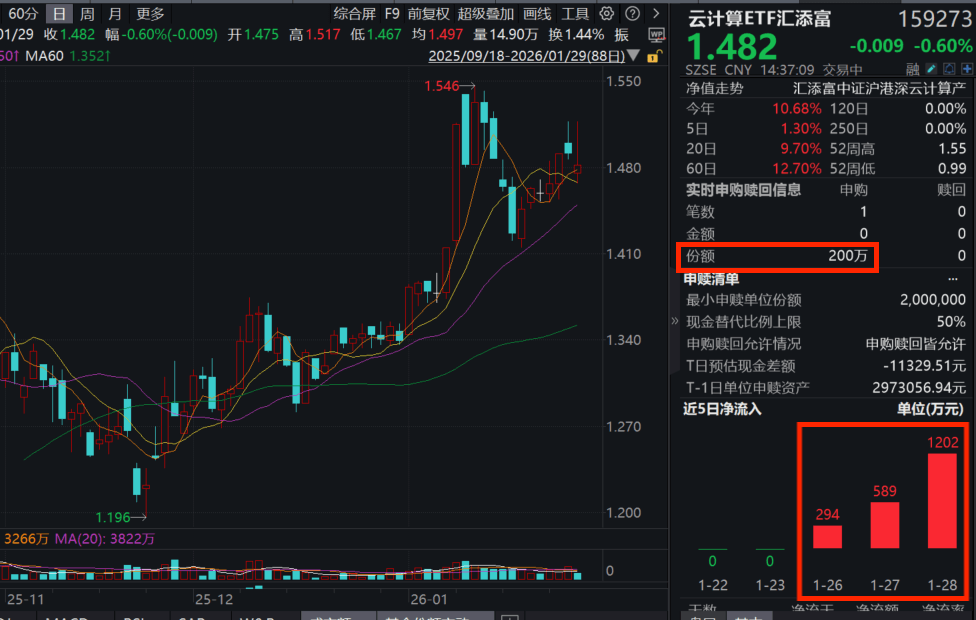
Group 1 - The core viewpoint of the articles highlights the increasing demand for AI-driven cloud computing services, leading to a tightening supply-demand dynamic in the computing power sector, which is reflected in rising prices from major cloud providers [8][11]. - The "算力ETF" (Computing Power ETF) has seen significant inflows, with over 1.4 billion yuan accumulated in the last ten days, indicating strong investor interest in the sector [1]. - Major tech companies like Microsoft, Meta, and others have reported impressive cloud revenue, with Microsoft achieving $50 billion in cloud revenue for the second fiscal quarter, surpassing analyst expectations [4]. Group 2 - Clawdbot, an open-source AI assistant, has gained significant attention, with deployment support from Tencent Cloud and Alibaba Cloud, indicating a shift towards more personalized AI applications [3][6]. - The pricing strategies of leading cloud providers, such as Google and AWS, have been adjusted upwards, reflecting the increased costs associated with AI training and inference demands [8][9]. - The computing power supply chain is experiencing inflation, with projections indicating significant price increases for DRAM and NAND storage, as well as CPU products, driven by AI demand [9][10]. Group 3 - The rapid growth in token usage for AI models, particularly from OpenAI and Google, suggests a burgeoning market for AI applications across various sectors, with daily token calls reaching unprecedented levels [10]. - The anticipated rise in AI model applications is expected to further drive demand for computing resources, benefiting companies involved in hardware, cloud services, and AI development [11]. - The computing power ETF, 汇添富 (159273), is positioned to capture the growth opportunities in the AI-driven cloud computing market, covering a wide range of sectors including hardware, IT services, and data center operations [12].


国海证券:头部云厂商接连涨价 算力产业链通胀有望延续
智通财经网· 2026-01-29 07:10
Core Insights - Major cloud providers like Google and AWS are increasing their data transmission service prices due to a surge in AI training demand, leading to a tightening supply-demand dynamic in computing power [1][3] - The global cloud computing market is expected to undergo a pricing restructuring as leading firms like Microsoft Azure and Alibaba Cloud evaluate their pricing strategies in response to these changes [1][3] Pricing Adjustments - Google announced a price increase for its data transmission services effective May 1, 2026, with North America rising from $0.04/GB to $0.08/GB, Europe from $0.05/GB to $0.08/GB, and Asia from $0.06/GB to $0.085/GB [2][3] - AWS has also raised prices for its EC2 machine learning capacity instances, with a notable increase of approximately 15% in most regions, bringing the price to around $39.80/hour, and nearly $50/hour in high-demand areas [3] Supply Chain Inflation - The computing power supply chain is experiencing inflation, affecting storage, CPUs, and other semiconductor chips, with expected price increases of 55%-60% for DRAM and 33%-38% for NAND in Q1 2026 [4] - Major chip manufacturers are planning to raise server CPU prices by 10%-15% due to AI demand and capacity constraints, with significant pre-sales already reported [4] AI Model Developments - The release of new AI models by leading companies in 2025 is expected to unlock various application demands, significantly increasing the daily token usage in enterprise-level services [5] - OpenAI and Google are leading in token usage, with daily calls reaching approximately 70 trillion and 43 trillion tokens, respectively, by October 2025 [5] Focus on Key Stocks - Key stocks in the cloud computing sector include companies like Chuangxin Data, Hongjing Technology, and Kingsoft Cloud, among others [6][7] - CDN/MSP and edge computing sectors also have notable companies such as Wangsu Technology and Zhongke Chuangda listed for potential investment [6][7]

“真武”亮相,“通云哥”出道,阿里打出AI“同花顺”
Shang Hai Zheng Quan Bao· 2026-01-29 06:45
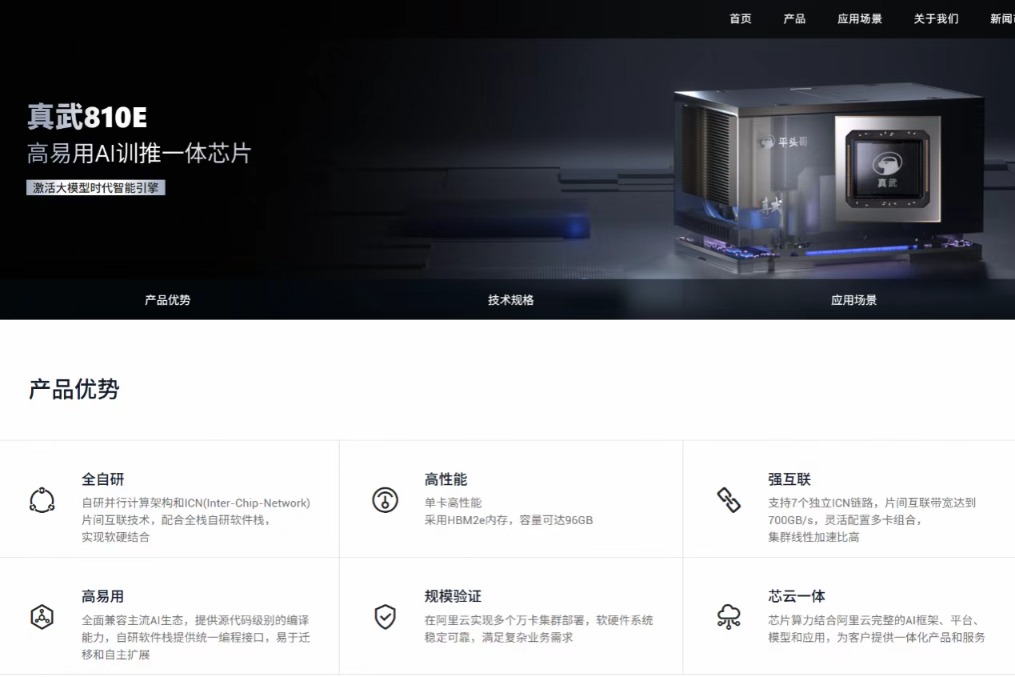
Core Viewpoint - Alibaba has officially launched its high-end AI chip "Zhenwu 810E," marking a significant milestone in its transformation from an e-commerce company to a high-tech enterprise driven by both e-commerce and AI [1][16]. Group 1: Product Launch and Technology - The "Zhenwu" PPU chip features a self-developed parallel computing architecture and inter-chip interconnection technology, with a memory of 96G HBM2e and an interconnection bandwidth of 700GB/s, suitable for AI training, inference, and autonomous driving [5]. - The performance of the "Zhenwu" PPU surpasses mainstream domestic GPUs and is comparable to NVIDIA's H20, receiving positive feedback from industry professionals [5][7]. - The chip has been deployed in multiple clusters on Alibaba Cloud, serving over 400 clients, including major organizations like the State Grid and Xpeng Motors [5][7]. Group 2: Strategic Development - Alibaba has established a comprehensive AI ecosystem, referred to as "Tongyun Ge," which integrates self-developed chips, leading cloud services, and top-tier open-source models [6][9]. - The company has been investing in AI since 2009, with Alibaba Cloud becoming a leading player in the Asia-Pacific region, serving over 5 million customers [7][11]. - The "Tongyun Ge" strategy represents a culmination of 17 years of strategic investment and vertical integration, positioning Alibaba as a key competitor in the global AI landscape [7][16]. Group 3: Market Position and Future Outlook - Alibaba is one of only two companies globally that possess top-tier capabilities in large models, cloud computing, and AI chips, alongside Google [1][13]. - The company is focusing on becoming a leading full-stack AI service provider, with plans for significant investments in AI infrastructure, amounting to 380 billion yuan over three years [15][17]. - The AI-related products of Alibaba Cloud have shown consistent triple-digit growth for nine consecutive quarters, indicating strong market demand and potential for revenue acceleration [15][17].


阿里证实自研AI芯片PPU,“通云哥”阵型浮出水面
Mei Ri Jing Ji Xin Wen· 2026-01-29 06:29
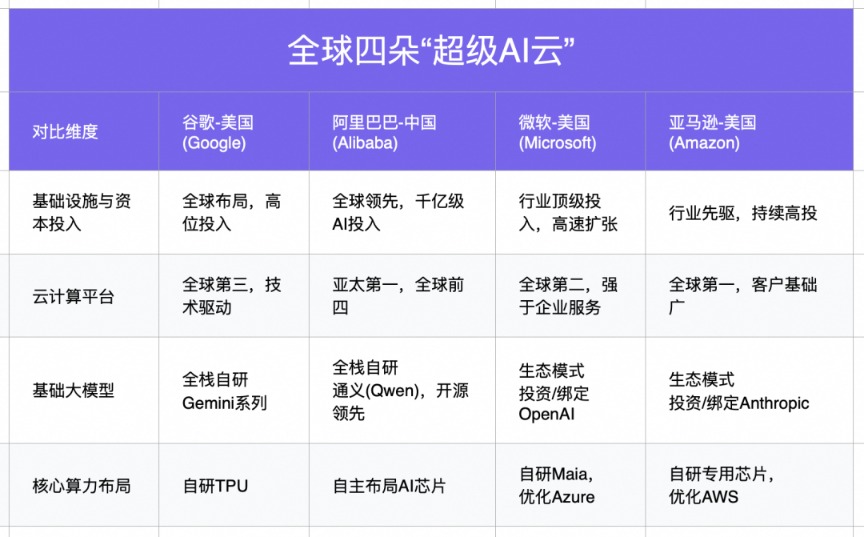
Core Insights - Alibaba's self-developed AI chip "Zhenwu 810E" has officially launched, marking a significant milestone in its 17-year strategic journey in AI and cloud computing [2][4][6] - The "Zhenwu" PPU chip features a 96GB HBM2e memory and a 700 GB/s interconnect bandwidth, positioning it as a competitive alternative to mainstream domestic GPUs and comparable to NVIDIA's H20 [4][5] - The launch of the "Zhenwu" PPU completes Alibaba's strategic framework of "large models + cloud + chips," establishing it as a leading player in the AI industry [4][7] Product and Technology - The "Zhenwu" PPU utilizes a self-developed parallel computing architecture and inter-chip interconnect technology, along with a fully self-developed software stack [4] - The chip has been in high demand, with multiple deployments in Alibaba Cloud serving over 400 clients, including major organizations like the State Grid and Xpeng Motors [4][7] - The chip's performance has been validated through extensive internal testing, demonstrating its stability and cost-effectiveness [6] Market Position and Strategy - Alibaba Cloud has achieved a 34% revenue growth, with AI-related product revenues increasing for nine consecutive quarters, indicating strong market demand for AI computing resources [7] - The company is prioritizing investments in AI infrastructure to meet the growing demand, with plans to potentially increase capital expenditures [7] - Alibaba's strategy contrasts with competitors like Amazon and Microsoft, focusing on a "full-stack self-research" approach rather than relying on external partnerships [8][9] Competitive Landscape - The global cloud market is dominated by four major players: Amazon, Microsoft, Google, and Alibaba, with Alibaba and Google pursuing a self-research strategy that may offer long-term value [8] - Self-developed chips are seen as a critical factor in reducing total cost of ownership (TCO) for AI computing, with examples like Google's TPU demonstrating significant cost advantages [9] - Alibaba's "Tongyun Ge" framework positions it favorably in the AI competition, enhancing its capabilities across cloud infrastructure, AI models, and chip technology [11]
阿里集结AI铁三角“通云哥”,发布自研AI芯片“真武”对标英伟达H20
Di Yi Cai Jing Zi Xun· 2026-01-29 05:51
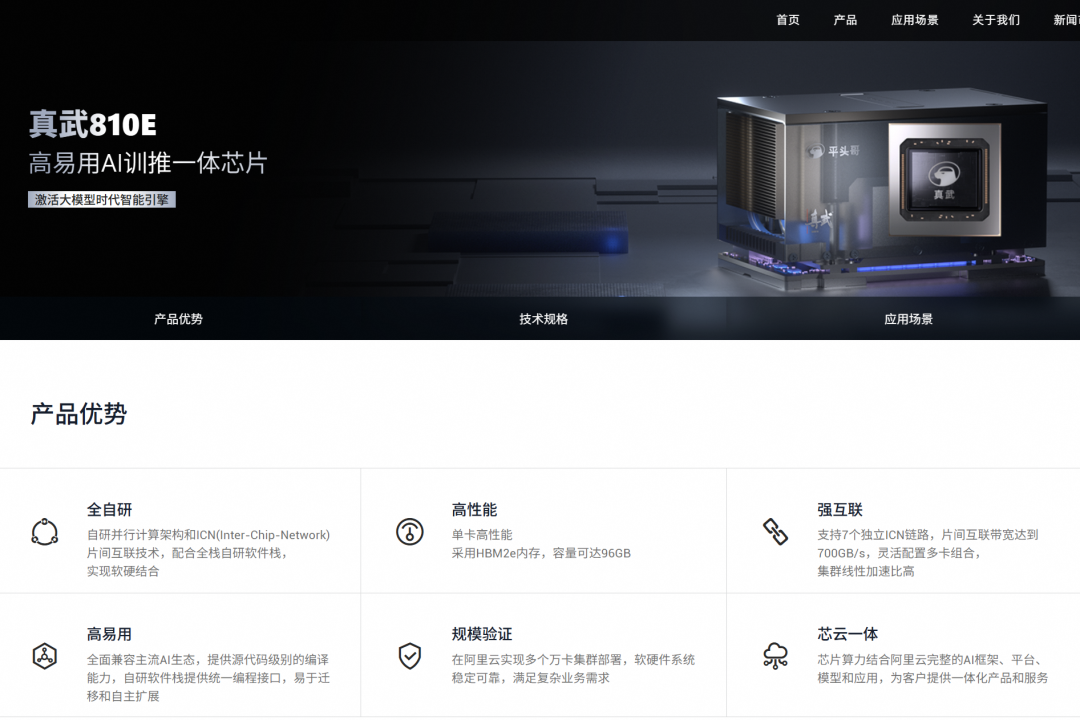
Core Insights - Alibaba has launched the "Zhenwu 810E" high-end AI chip, known as "Zhenwu" PPU, which was previously highlighted by CCTV [1][3] - The "Zhenwu" PPU features a self-developed parallel computing architecture and inter-chip interconnection technology, with a memory of 96G HBM2e and an interconnection bandwidth of 700 GB/s, suitable for AI training, inference, and autonomous driving [3] - The performance of "Zhenwu" PPU surpasses Nvidia's A800 and mainstream domestic GPUs, comparable to Nvidia's H20, and the upgraded version outperforms Nvidia's A100 [3] - The chip has been validated in external markets, receiving positive feedback for its stability and cost-effectiveness, with over 400 clients including State Grid, Chinese Academy of Sciences, and Xpeng Motors [3] Group 1 - The formation of the "Tongyun Ge" AI triangle, consisting of Tongyi Lab, Alibaba Cloud, and Pingtouge, marks a significant strategic move for Alibaba in the AI sector [4] - Alibaba has invested 17 years in strategic development, establishing a full-stack deployment of self-developed AI chips, a world-class cloud platform, and a leading large model [4] - The "Tongyun Ge" aims to create an AI supercomputer, leveraging self-developed chips, a leading cloud platform, and the world's strongest open-source model "Qianwen" for maximum efficiency [4] Group 2 - The recent release of the Qwen3-Max-Thinking model by Tongyi Lab has set multiple global records, rivaling GPT-5.2 and Gemini 3 Pro [5] - Alibaba Cloud's revenue growth has reached new highs, with AI-related product revenue achieving triple-digit year-on-year growth for nine consecutive quarters [5] - CEO Wu Yongming indicated a strong demand for AI, predicting a supply chain expansion cycle due to shortages in storage, CPU, and AI servers starting in the second half of 2025 [6] - Alibaba is accelerating its infrastructure investment, with a potential increase in the planned 380 billion yuan investment over three years, reflecting the growing AI demand [6]
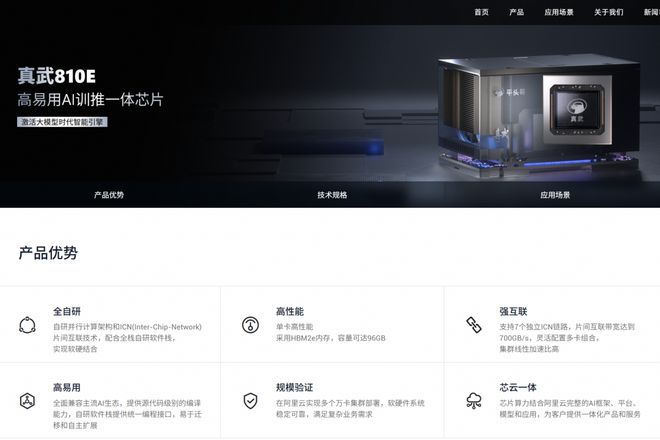
阿里集结AI铁三角“通云哥”,发布自研AI芯片“真武”对标英伟达H20
第一财经· 2026-01-29 05:41
Core Viewpoint - Alibaba has officially launched its self-developed high-end AI chip "Zhenwu 810E," showcasing its commitment to AI technology and innovation [1][4]. Group 1: Product Features and Performance - The "Zhenwu" PPU utilizes a self-developed parallel computing architecture and inter-chip interconnection technology, featuring 96G HBM2e memory and a bandwidth of 700 GB/s, suitable for AI training, inference, and autonomous driving [4]. - The performance of "Zhenwu" PPU surpasses Nvidia's A800 and mainstream domestic GPUs, comparable to Nvidia's H20, with an upgraded version outperforming Nvidia's A100 [4]. - The chip has been validated in external markets, receiving positive feedback for its excellent performance, stability, and cost-effectiveness, with demand exceeding supply [4]. Group 2: Strategic Development and Integration - The formation of the "Tongyun Ge" AI triangle, consisting of Tongyi Lab, Alibaba Cloud, and Pingtouge, represents Alibaba's strategic investment in AI over the past 17 years, integrating self-developed AI chips, a world-class cloud platform, and advanced large models [5]. - Alibaba aims to build "Tongyun Ge" into an AI supercomputer, leveraging its self-developed chips, leading cloud services, and top-tier open-source models to achieve maximum efficiency in training and deploying large models [5]. Group 3: Market Trends and Future Outlook - The launch of "Tongyun Ge" enhances Alibaba's competitive edge in the AI era, with the flagship inference model Qwen3-Max-Thinking setting new global records and the number of derivative models exceeding 200,000 [6]. - Alibaba Cloud's revenue growth has reached new highs, with AI-related product revenues showing triple-digit year-on-year growth for nine consecutive quarters [6]. - CEO Wu Yongming indicated strong demand for AI solutions, predicting a supply chain expansion cycle due to shortages in global storage, CPU, and AI servers starting in the second half of 2025, leading to potential increases in Alibaba's infrastructure investment plan [6].
Meta狂飙,微软暴跌!三大科技巨头最新财报揭晓,AI成股价分水岭?
证券时报· 2026-01-29 04:39
Core Insights - The latest earnings reports from Microsoft, Meta, and Tesla highlight a deepening "AI arms race" and accelerating business structure differentiation within the tech industry, with Meta's stock rising nearly 11%, Tesla's up over 4%, and Microsoft's down over 7% post-earnings [1] Group 1: Earnings Performance - Meta reported Q4 revenue of $59.893 billion, a 24% year-over-year increase, exceeding analyst expectations of $58.42 billion, with 97% of revenue coming from its core advertising business [3] - Microsoft achieved Q2 FY2026 revenue of $81.27 billion, a 17% year-over-year increase, surpassing expectations, but its cloud business growth showed signs of fatigue with Azure growth slowing to 38% [4] - Tesla's total revenue for 2025 was $94.8 billion, a 3% year-over-year decline, with its core automotive business revenue down 10% [5] Group 2: Strategic Focus on AI - Meta is heavily investing in AI, with a focus on "super intelligence," planning capital expenditures of $72.22 billion in 2025, which is expected to increase by 1.6 to 1.9 times in 2026 [7] - Microsoft continues to deepen its partnership with OpenAI, with a $250 billion cloud services agreement, but faces concerns over the independence of its core cloud business due to reliance on OpenAI [8] - Tesla is transitioning from a traditional automotive company to an AI-focused entity, with significant investments in AI and energy, including a $2 billion investment in xAI to enhance its AI capabilities [8] Group 3: Market Reactions and Future Outlook - Post-earnings, Meta's stock surged, while Microsoft's fell, indicating a shift in investor sentiment towards companies that can demonstrate effective AI integration with core business operations [9] - The tech industry is expected to undergo a restructuring and valuation reassessment as more companies, including Amazon and Google, release their earnings, further clarifying the trends in AI investment and business model transformation [12]




阿里,重磅!自研AI芯片亮相
证券时报· 2026-01-29 04:39
Core Viewpoint - Alibaba has officially launched its self-developed AI chip "Zhenwu 810E," marking the debut of the AI computing triangle formed by Tongyi Lab, Alibaba Cloud, and Pingtouge, aimed at creating a super AI computing platform [1][4]. Group 1: Chip Development - The "Zhenwu" PPU utilizes a self-developed parallel computing architecture and inter-chip communication technology, achieving full-stack self-research in both hardware and software [3]. - The memory of the "Zhenwu" PPU is 96G HBM2e, with an inter-chip communication bandwidth of 700 GB/s, suitable for AI training, inference, and autonomous driving applications [3]. Group 2: Performance Comparison - The overall performance of the "Zhenwu" PPU surpasses that of Nvidia's A800 and mainstream domestic GPUs, comparable to Nvidia's H200, and the upgraded version outperforms Nvidia's A100 [4]. - Industry insiders have noted that the "Zhenwu" PPU is well-regarded for its excellent stability and cost-effectiveness, with demand exceeding supply in the market [4]. Group 3: Strategic Development - Alibaba has invested 17 years in strategic development and vertical integration, culminating in the complete layout of the "Tongyun Ge" full-stack AI [4]. - The launch of the "Zhenwu" PPU reflects Pingtouge's accumulated strength in the chip sector, with Alibaba Cloud established in 2009 and Pingtouge founded in 2018 [4]. Group 4: AI Model Achievements - On January 26, Tongyi Lab released the flagship inference model Qwen3-Max-Thinking, setting multiple global records and performing comparably to GPT-5.2 and Gemini 3 Pro [4]. - The number of derivative models from the Qianwen open-source model has exceeded 200,000, with download counts surpassing 1 billion, maintaining its position as the largest AI open-source community globally [4].

综述|美科技巨头业绩喜忧参半
Xin Hua She· 2026-01-29 04:33
Group 1: Tesla - Tesla reported a total revenue of $94.83 billion for the previous year, a decrease of 3% compared to the previous year, with a net profit of $3.79 billion, down 46% [1] - In 2025, Tesla's global vehicle deliveries are expected to be approximately 1.636 million, marking a second consecutive year of decline, down 8.6% from 2024 [1] - Tesla's electric vehicle sales were surpassed by Chinese manufacturer BYD for the first time, with Q4 2025 production at approximately 434,000 vehicles and deliveries at about 418,000, a year-on-year decline of about 16% [1] Group 2: Microsoft - Microsoft reported a revenue of $81.3 billion for Q2 of fiscal year 2026, a year-on-year increase of 17%, with a net profit of approximately $38.5 billion, up 60% [2] - The cloud computing segment drove significant growth, with cloud revenue reaching $51.5 billion, a 26% increase year-on-year, and intelligent cloud revenue at $32.9 billion, up 29% [2] - Microsoft's CEO Satya Nadella noted that while AI adoption is still in its early stages, the scale of Microsoft's AI business has already surpassed its core traditional operations [2] Group 3: Meta (formerly Facebook) - Meta reported Q4 revenue of approximately $59.9 billion, a 24% year-on-year increase, with a net profit of about $22.8 billion, up 9% [2] - For 2025, Meta anticipates revenue of approximately $201 billion, a 22% increase year-on-year, while net profit is expected to be around $60.5 billion, down 3% [2] - CEO Mark Zuckerberg expressed optimism about strong business performance in 2025 and plans to advance "personal superintelligence" in 2026 [3] Group 4: Amazon - Amazon announced a new round of organizational restructuring, affecting approximately 16,000 positions, following a previous layoff of about 14,000 employees in October of the previous year [3] - The restructuring is part of Amazon's ongoing efforts to optimize its organizational structure and improve efficiency, focusing on reducing management layers [3]
阿里自研高端AI芯片曝光 黄金三角“通云哥”浮出水面
Zhong Guo Jing Ying Bao· 2026-01-29 03:47
Core Insights - Alibaba's chip company, PingTouGe, has launched a high-end AI chip named "Zhenwu 810E," marking a significant step in its AI strategy and the formation of the "Tongyun Ge" AI supercomputer with Alibaba Cloud and Tongyi Lab [1][2] - The "Zhenwu" PPU has been deployed in multiple clusters on Alibaba Cloud, serving over 400 clients, showcasing PingTouGe's capabilities in the chip sector [2] - Alibaba and Google are currently the only two companies globally with top-tier capabilities across large models, cloud, and chip technologies [3] Group 1 - The "Zhenwu" PPU features a self-developed parallel computing architecture and inter-chip communication technology, with 96G HBM2e memory and a bandwidth of 700 GB/s, suitable for AI training, inference, and autonomous driving [7] - The performance of the "Zhenwu" PPU surpasses Nvidia's A800 and mainstream domestic GPUs, comparable to Nvidia's H20, and the upgraded version outperforms Nvidia's A100 [7] - The launch of the "Zhenwu" PPU is part of Alibaba's 17-year strategic investment and vertical integration in AI, which includes Alibaba Cloud, PingTouGe, and the Qianwen model [2][7] Group 2 - The chip concept is closely tied to Alibaba's market valuation, with recent news of PingTouGe's potential independent listing leading to a market capitalization increase of approximately HKD 100 billion in two days [8] - The Qianwen flagship reasoning model, Qwen3-Max-Thinking, has set multiple global records, demonstrating performance comparable to GPT-5.2 and Gemini 3 Pro [7] - The Qianwen open-source model has seen over 200,000 derivative models and more than 1 billion downloads, maintaining its position as the largest in the world [7]