小金属

Search documents
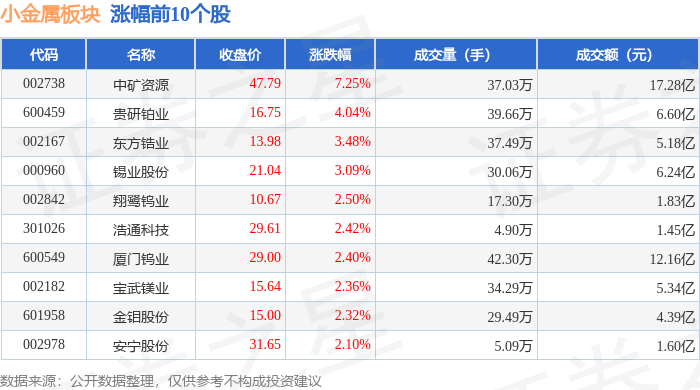
小金属板块9月29日涨1.41%,中矿资源领涨,主力资金净流出8961.59万元
Zheng Xing Xing Ye Ri Bao· 2025-09-29 08:39
Market Overview - The small metals sector increased by 1.41% on September 29, with Zhongkuang Resources leading the gains [1] - The Shanghai Composite Index closed at 3862.53, up 0.9%, while the Shenzhen Component Index closed at 13479.43, up 2.05% [1] Key Stocks Performance - Zhongkuang Resources (002738) closed at 47.79, up 7.25% with a trading volume of 370,300 shares and a transaction value of 1.728 billion [1] - Guiyan Platinum (600459) closed at 16.75, up 4.04% with a trading volume of 396,600 shares and a transaction value of 660 million [1] - Dongfang Cuoye (002167) closed at 13.98, up 3.48% with a trading volume of 374,900 shares and a transaction value of 518 million [1] - Xiyegong (000960) closed at 21.04, up 3.09% with a trading volume of 300,600 shares and a transaction value of 624 million [1] - Other notable performers include Xianglu Tungsten (002842), Haotong Technology (301026), and Xiamen Tungsten (600549) with respective increases of 2.50%, 2.42%, and 2.40% [1] Fund Flow Analysis - The small metals sector experienced a net outflow of 89.6159 million from main funds, while retail investors saw a net inflow of 238 million [2] - Major stocks like Zhongkuang Resources and Jin Aluminum (601958) had significant net inflows from main funds, while others like Xiamen Tungsten and Guiyan Platinum experienced net outflows from retail investors [3]


财经态度丨两融业务火热,投资者需警惕哪些风险?专家提醒
Yang Guang Wang· 2025-09-29 08:13
Core Insights - The recent surge in the A-share margin trading balance has reached approximately 2.44 trillion yuan as of September 25, marking a historical high [1] - Several brokerage firms have announced increases in margin trading limits, indicating a robust market environment [1] Market Performance - The A-share market has shown strong performance this year, with active themes and improved trading sentiment among market participants [1] - There is a notable enhancement in the overall profitability of the stock market, reflecting investors' optimistic outlook and increased risk appetite [1] Leverage and Investment Structure - The current use of leveraged funds is more rational compared to the past, with a higher proportion of institutional investors involved, who typically possess stronger research and investment capabilities [1] - The primary flow of funds is directed towards high-growth sectors such as telecommunications, AI computing applications, battery technology in electrical equipment, robotics, automation equipment, engineering machinery, electronic components, consumer electronics, and precious metals in the non-ferrous metals sector [1]
铜,Grasberg影响定量,强化矿紧逻辑 | 投研报告
Zhong Guo Neng Yuan Wang· 2025-09-29 08:01
Group 1: Copper Market - Copper prices have shown an upward trend, with domestic copper closing at 81,890 CNY/ton, and the main contract price reaching 82,980 CNY/ton, marking an increase of over 3% [1][2] - The significant price surge on September 24 was triggered by Freeport's update on Grasberg, leading to a broad increase in LME metal futures [1][2] - Despite the bullish market sentiment, the actual demand remains sluggish, with downstream enterprises adopting a wait-and-see approach after the price spike [2] Group 2: Aluminum Market - Aluminum prices have experienced a decline, with domestic aluminum closing at 20,660 CNY/ton [2] - The theoretical operating capacity of the electrolytic aluminum industry has increased due to capacity transfers and resumed operations in various regions [2] - The average price of domestic alumina has decreased to 3,014.75 CNY/ton, down 40.02 CNY/ton from the previous week, indicating a 1.31% drop [2] Group 3: Precious Metals - Gold and silver prices have risen, with domestic gold averaging 837.58 CNY/gram, up 1.00% from the previous week, and silver averaging 10,173 CNY/kg, up 2.09% [3] - The market anticipates a potential interest rate cut by the Federal Reserve in October, contributing to the rise in precious metal prices [3] - COMEX silver inventory has increased by 0.35% to 52,715.51 million ounces, while Shanghai Futures Exchange silver delivery inventory has decreased by 4.88% [3] Group 4: Minor Metals - The antimony market continues to show weakness, with prices for various grades of antimony ingots decreasing by 0.3 CNY/ton compared to the previous week [4] - Demand remains lackluster, with downstream inquiries reported as generally weak, and suppliers maintaining cautious pricing strategies [4] - The overall sentiment in the market is subdued, with limited purchasing activity observed ahead of the National Day holiday [4] Group 5: Rare Earths - Prices for rare earths have shown fluctuations, with light rare earth oxide prices decreasing by 1.5% to 562,500 CNY/ton [5] - The integration of separation plants is ongoing, and processing fees have risen above 20,000 CNY, indicating a potential long-term opportunity in the sector [5] - Companies in the magnetic materials sector, such as Ningbo Yunsheng and Zhenghai Magnetic Materials, are recommended for attention due to their strong fundamentals [5]
金钼股份涨2.11%,成交额2.59亿元,主力资金净流入1821.60万元
Xin Lang Zheng Quan· 2025-09-29 05:27
Core Viewpoint - Jinmoly Co., Ltd. has shown a significant stock price increase of 54.97% year-to-date, with a recent market capitalization of 48.302 billion yuan, indicating strong investor interest and market performance [1][2]. Financial Performance - For the first half of 2025, Jinmoly reported operating revenue of 6.959 billion yuan, reflecting a year-on-year growth of 5.55%, while net profit attributable to shareholders decreased by 8.27% to 1.382 billion yuan [2]. - Cumulatively, since its A-share listing, Jinmoly has distributed a total of 10.336 billion yuan in dividends, with 3.549 billion yuan distributed over the past three years [3]. Shareholder Structure - As of June 30, 2025, the number of shareholders for Jinmoly decreased by 2.94% to 74,500, while the average number of circulating shares per person increased by 3.03% to 43,303 shares [2]. - The top ten circulating shareholders include Hong Kong Central Clearing Limited as the second-largest shareholder with 88.957 million shares, an increase of 8.2662 million shares from the previous period [3].

全球铜矿供应趋紧!有色龙头ETF(159876)拉升1.5%!...
Xin Lang Cai Jing· 2025-09-29 02:12
Core Insights - The article highlights the strong performance of the non-ferrous metal sector, particularly the increase in the price of copper and aluminum, driven by supply disruptions and demand recovery [1][2] Group 1: Market Performance - The non-ferrous metal ETF showed a stable performance with a 1.5% increase in price and a transaction volume of 1.4755 million yuan, bringing the fund's total size to 303 million yuan [1] - Key stocks such as Baiyin Nonferrous, Guiyan Platinum, and Xingye Silver Tin saw significant gains of 3.6%, 3.23%, and 2.92% respectively, while Shenghe Resources experienced a decline of 1.41% [1] Group 2: Supply and Demand Dynamics - The Grasberg copper mine, the second largest globally, has halted production due to an accident, leading Freeport to project a significant decrease in copper sales by Q4 2025 and a potential 35% drop in production in 2026, exacerbating supply tightness [1] - The aluminum sector is witnessing a positive trend with successful technological advancements in aluminum alloy materials for automotive applications, recognized by high-end clients like BMW and Mercedes, which is expected to drive industry transformation [1] Group 3: Price Outlook - Tianfeng Securities indicates a bullish sentiment in the copper market, with prices expected to continue rising due to supply-demand dynamics and a favorable outlook for aluminum prices supported by inventory reductions and seasonal demand [1][2] - The cobalt sector is facing increased prices due to export bans and quota policies from the Democratic Republic of Congo, leading to a tightening of raw material supply [2]



中金:共识景气赛道之外 A股行业配置还有哪些线索?
智通财经网· 2025-09-29 00:05
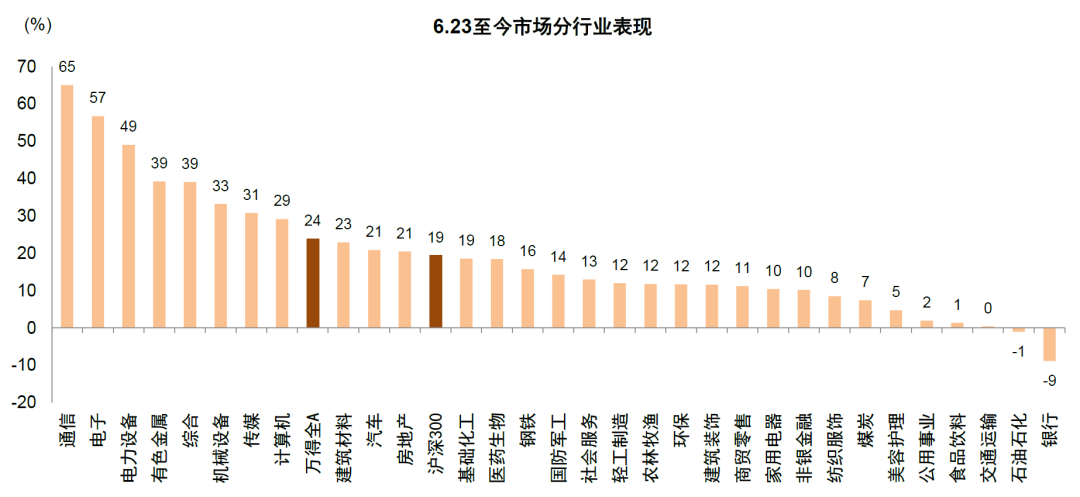
Core Viewpoint - The market is currently in a consolidation phase since late August, with upward movement constrained by profit-taking after rapid gains, indicating a need for new catalysts for future performance [1] - The global monetary order is undergoing rapid restructuring, leading to a decline in the safety of dollar assets and a revaluation of RMB assets, suggesting that the foundation for market growth remains intact [1] Industry Recommendations - High consensus industries such as AI computing power and robotics are still worth focusing on in the medium term, as long as there is no significant downturn in industry prosperity [1] - Sectors like innovative pharmaceuticals, consumer electronics, batteries, and non-ferrous metals have already seen substantial gains, but they still hold good allocation value due to supply clearing and demand improvement [1] - Sub-industries within non-ferrous metals are expected to benefit directly from macro changes due to the global monetary order restructuring [1] - Industries like engineering machinery, power grid equipment, and aquaculture have not experienced significant gains but offer good cost-performance ratios when considering capacity cycle positions and overseas expansion prospects [1] Capacity Cycle Perspective - Identifying turning point industries and elastic sectors from a capacity cycle perspective remains meaningful, with a focus on sectors that can achieve capacity clearing and demand improvement [4] - The current market shows that most industries are in the deepening phase of capacity reduction, with a notable increase in industries entering the clearing phase [5] - The report highlights key industries for 2024, including communication equipment, commercial vehicles, and lithium batteries, identified through capacity cycle analysis [4][5] High-End Manufacturing - High-end manufacturing has shown significant improvement in capacity cycle positions, with key sectors like automotive parts, communication equipment, consumer electronics, components, batteries, and medical services recommended for allocation [8][9] - The battery sector is expected to lead in capacity clearing and expansion due to high demand growth and significant reductions in capital expenditure across the industry [8] Traditional Manufacturing & Non-Manufacturing - Traditional manufacturing and non-manufacturing sectors have seen prolonged periods of reduced capital expenditure, with higher standards for recognizing capacity clearing due to weaker demand [10] - Notable sectors for potential investment include engineering machinery, aquaculture, and feed, which have undergone significant capital expenditure reductions and are showing signs of demand stabilization [10]
小金属板块9月26日跌0.78%,云南锗业领跌,主力资金净流出4.2亿元
Zheng Xing Xing Ye Ri Bao· 2025-09-26 08:41
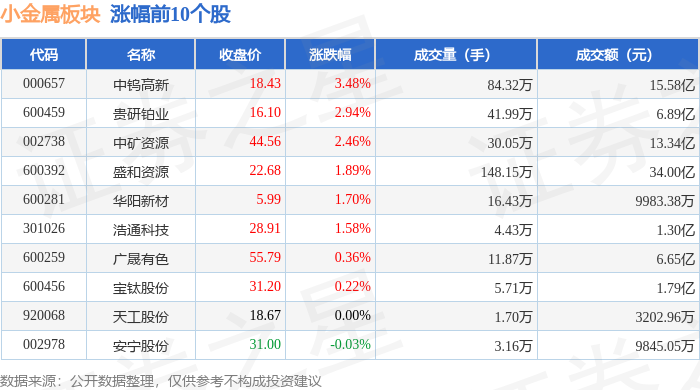
Market Overview - The small metal sector experienced a decline of 0.78% on September 26, with Yunnan Zhenye leading the drop [1] - The Shanghai Composite Index closed at 3828.11, down 0.65%, while the Shenzhen Component Index closed at 13209.0, down 1.76% [1] Stock Performance - Notable gainers in the small metal sector included: - Zhongtung High-tech (000657) with a closing price of 18.43, up 3.48% and a trading volume of 843,200 shares, totaling 1.558 billion yuan [1] - Guiyan Platinum (600459) closed at 16.10, up 2.94% with a trading volume of 419,900 shares, totaling 689 million yuan [1] - Zhongkuang Resources (002738) closed at 44.56, up 2.46% with a trading volume of 300,500 shares, totaling 1.334 billion yuan [1] - Major decliners included: - Yunnan Cuo Industry (002428) closed at 27.52, down 3.47% with a trading volume of 336,900 shares, totaling 946 million yuan [2] - Dongfang Cuo Industry (002167) closed at 13.51, down 2.95% with a trading volume of 316,600 shares, totaling 436 million yuan [2] - Northern Rare Earth (600111) closed at 46.39, down 1.88% with a trading volume of 1,315,600 shares, totaling 6.223 billion yuan [2] Capital Flow - The small metal sector saw a net outflow of 420 million yuan from main funds, while retail investors contributed a net inflow of 327 million yuan [2][3] - Notable capital flows included: - Zhongtung High-tech (000657) had a main fund net inflow of 254 million yuan, but a retail net outflow of 238 million yuan [3] - Shenghe Resources (600392) experienced a main fund net inflow of 152 million yuan, with significant retail outflows [3] - Guosheng Nonferrous (600259) had a main fund net inflow of 71.7 million yuan, but retail outflows of 45.7 million yuan [3]

章源钨业涨2.14%,成交额4.19亿元,主力资金净流入1538.72万元
Xin Lang Zheng Quan· 2025-09-26 03:06
Company Overview - Changyuan Tungsten Industry Co., Ltd. is located in Chongyi County, Ganzhou City, Jiangxi Province, established on February 28, 2000, and listed on March 31, 2010 [2] - The company specializes in the tungsten industry chain, including products such as APT, tungsten oxide, tungsten powder, tungsten carbide powder, tungsten materials, and hard alloys [2] - The revenue composition includes tungsten carbide powder (34.10%), tungsten powder (31.47%), hard alloys (21.28%), and other products [2] Financial Performance - For the first half of 2025, the company achieved operating revenue of 2.399 billion yuan, a year-on-year increase of 32.27%, and a net profit attributable to shareholders of 115 million yuan, up 2.54% year-on-year [2] - Since its A-share listing, the company has distributed a total of 862 million yuan in dividends, with 269 million yuan distributed in the last three years [3] Stock Market Activity - On September 26, the stock price increased by 2.14%, reaching 12.41 yuan per share, with a trading volume of 419 million yuan and a turnover rate of 2.85%, resulting in a total market capitalization of 14.91 billion yuan [1] - Year-to-date, the stock price has risen by 93.97%, with a slight decline of 0.24% over the last five trading days and a 16.43% drop over the last 20 days [1] - The company has appeared on the "Dragon and Tiger List" twice this year, with the most recent appearance on August 26, where it recorded a net buy of -121 million yuan [1] Shareholder Information - As of June 30, 2025, the number of shareholders was 54,300, a decrease of 3.46% from the previous period, with an average of 22,019 circulating shares per shareholder, an increase of 3.58% [2] - Major shareholders include Hong Kong Central Clearing Limited, which holds 8.7857 million shares, and other significant shareholders such as Yinhua XinJia Two-Year Holding Period Mixed Fund and Southern CSI 1000 ETF [3]

谨慎看涨?
第一财经· 2025-09-25 11:06
Core Viewpoint - The article highlights the strong performance of the Shenzhen Composite Index, driven by the robust growth of technology stocks, particularly in the AI sector and other emerging industries [4]. Market Performance - The Shenzhen Composite Index reached a new high, outperforming the Shanghai market, with the ChiNext Index leading the three major indices due to strong performance in technology growth stocks [4]. - The market saw a total trading volume of 2.3 trillion yuan, reflecting a 1.9% increase, indicating high overall market activity and participation enthusiasm [7]. Sector Analysis - Key sectors showing strength include CPO (light modules), liquid-cooled servers, AI applications, gaming and media, certain renewable energy stocks, and non-ferrous metals [5]. - Conversely, sectors such as precious metals, port shipping, oil and gas extraction, textiles, agriculture, home appliances, banking, liquor (baijiu), and real estate exhibited weak performance [5]. Capital Flow - There was a net outflow of funds from major players, while retail investors showed a net inflow, indicating a shift in investment strategies [8]. - Institutional investors are favoring technology and high-end manufacturing sectors driven by policy support and high economic activity, with significant capital flowing into power equipment, computer devices, and digital economy sectors [8]. Investor Sentiment - Retail investor sentiment is at 75.85%, with a notable portion of investors increasing their positions (30.74%) while others are reducing their holdings (21.34%) [9][12]. - The overall sentiment reflects a cautious optimism among retail investors, with many actively participating in the market despite the mixed performance of various sectors [9].

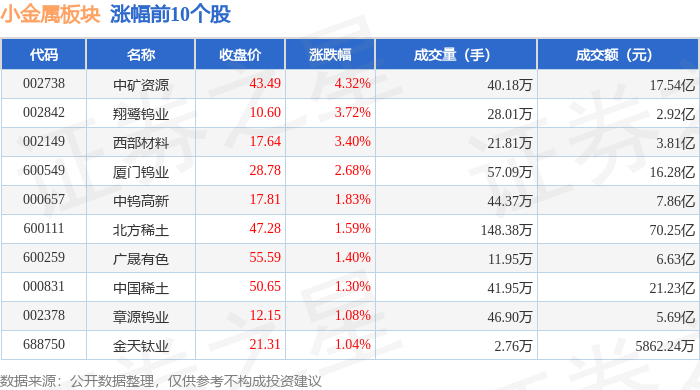
小金属板块9月25日涨1.03%,中矿资源领涨,主力资金净流入4.79亿元
Zheng Xing Xing Ye Ri Bao· 2025-09-25 08:38
Core Insights - The small metals sector experienced a rise of 1.03% on September 25, with Zhongkuang Resources leading the gains [1] - The Shanghai Composite Index closed at 3853.3, down 0.01%, while the Shenzhen Component Index closed at 13445.9, up 0.67% [1] Small Metals Sector Performance - Zhongkuang Resources (002738) closed at 43.49, up 4.32%, with a trading volume of 401,800 shares and a transaction value of 1.754 billion [1] - Xianglu Tungsten Industry (002842) closed at 10.60, up 3.72%, with a trading volume of 280,100 shares [1] - Western Materials (002149) closed at 17.64, up 3.40%, with a trading volume of 218,100 shares and a transaction value of 381 million [1] - Xiamen Tungsten Industry (600549) closed at 28.78, up 2.68%, with a trading volume of 1,570,900 shares and a transaction value of 1.628 billion [1] - Northern Rare Earth (600111) closed at 47.28, up 1.59%, with a trading volume of 1,483,800 shares and a transaction value of 7.025 billion [1] Capital Flow Analysis - The small metals sector saw a net inflow of 478 million from institutional investors, while retail investors experienced a net outflow of 823 million [2][3] - Northern Rare Earth (600111) had a net inflow of 27.7 million from institutional investors, but a net outflow of 360 million from retail investors [3] - Xiamen Tungsten Industry (600549) recorded a net inflow of 126 million from institutional investors, with a significant net outflow of 198 million from retail investors [3]