软件

Search documents
恐慌蔓延,卖盘正引发更多卖盘
Hua Er Jie Jian Wen· 2026-02-05 13:26
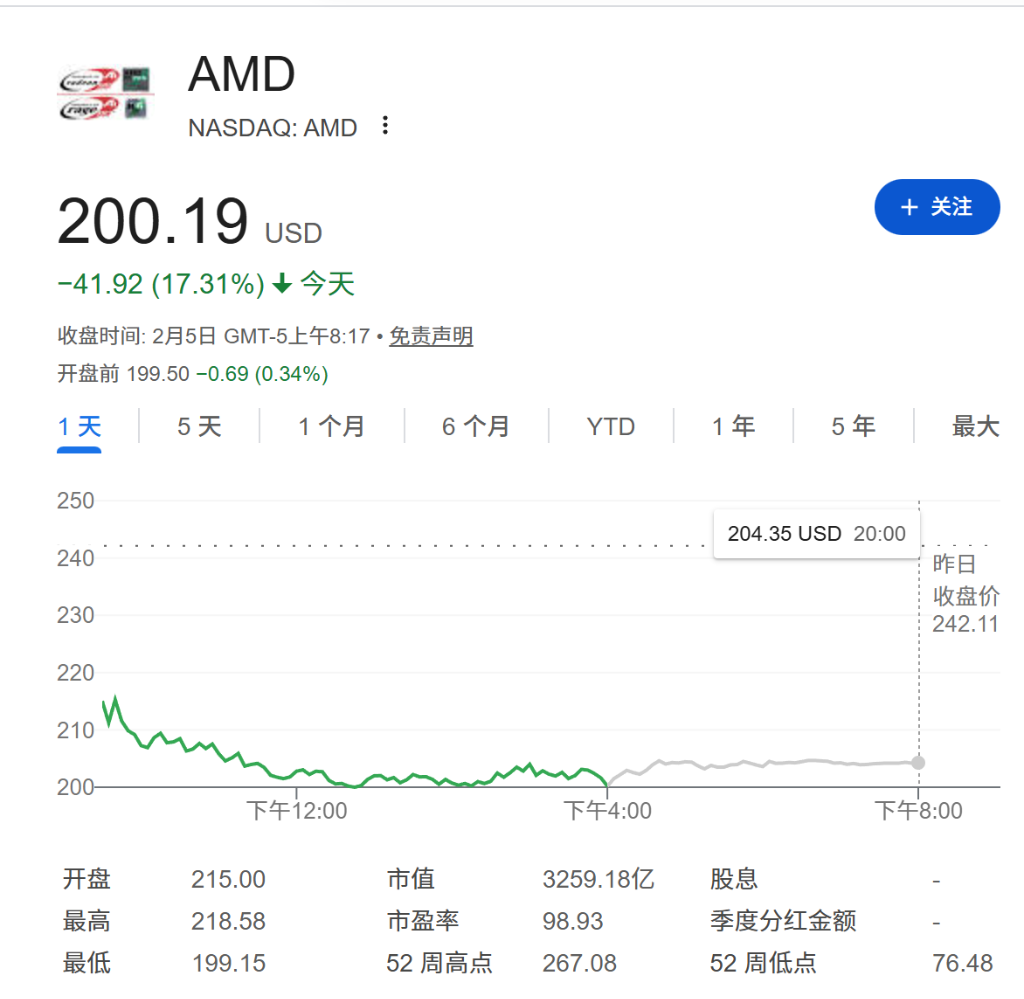
Core Viewpoint - The technology sector is experiencing heightened anxiety, leading to a reversal in investor sentiment regarding artificial intelligence (AI) and its disruptive impacts, resulting in increased market volatility [1] Group 1: Market Reactions - A significant sell-off in the software industry has rapidly spread to chip manufacturers and large tech stocks, creating a self-reinforcing selling pressure that has affected global stock markets, cryptocurrencies, and commodity markets [1] - The chip industry has been particularly hard hit, with AMD's stock plummeting by 17% and Palantir's shares dropping by 12% [1] - The Korean Kospi index fell nearly 4% due to the impact of Wall Street's chip stock declines, indicating a rapid spread of the sell-off to Asian markets [7] Group 2: AI Sentiment Shift - Investor sentiment towards AI has shifted from unconditional optimism to caution, as concerns grow over the potential threats AI poses to existing business models [8] - The software sector has seen a market capitalization loss of nearly $1 trillion within a week due to this anxiety, indicating a significant market reaction [7] Group 3: Capital Expenditure Concerns - Alphabet announced a capital expenditure plan that could reach between $175 billion and $185 billion this year, doubling previous estimates, which has raised concerns about the potential returns on such aggressive investments [9] - Despite the intention to alleviate computing bottlenecks and maintain a competitive edge in AI, the market reacted negatively, with Alphabet's stock declining by 2% in after-hours trading [9] Group 4: Economic Signals and Policy Focus - Mixed macroeconomic signals are emerging, with positive ISM data contrasted by lower-than-expected growth in ADP private sector employment, indicating ongoing recruitment challenges [12] - Investors are closely monitoring upcoming data releases, including job vacancy statistics and initial unemployment claims, as well as Amazon's earnings report, which will serve as a critical test for the performance of tech giants [12]




万亿美元科技股“大屠杀”:AI冲击波席卷所及,无股幸免
Xin Lang Cai Jing· 2026-02-05 13:17
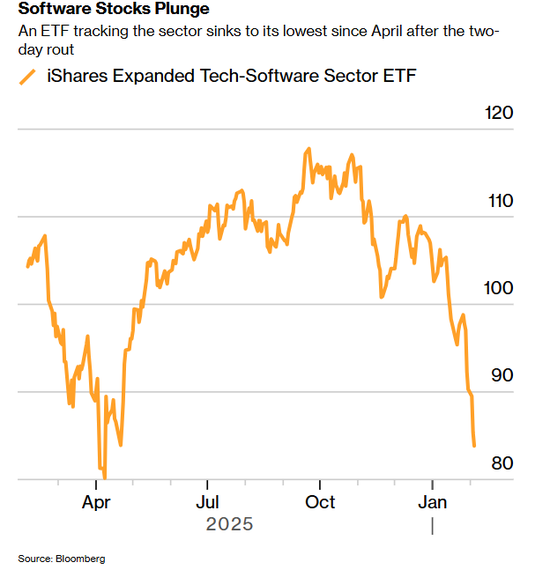
炒股就看金麒麟分析师研报,权威,专业,及时,全面,助您挖掘潜力主题机会! 来源:金十数据 自ChatGPT闯入主流视野三年以来,AI驱动的抛售潮已屡见不鲜。然而,本周在股票和信贷市场蔓延的 这场崩盘,其剧烈程度无出其右。 一方面,是其惊人的速度和广度。在短短两天内,硅谷大大小小公司的股票、债券和贷款市值蒸发了数 千亿美元。软件股处于震中,暴跌幅度如此之大,以至于一只iShares交易所交易基金(ETF)所追踪的 软件股总市值在过去七天内下跌了近1万亿美元。 另一方面,与以往的许多次暴跌不同,此次重挫并非由对泡沫的恐惧引发,而是源于一种担忧:AI正 濒临取代一大批公司的商业模式——这些公司早已被末日预言者警告处于风险之中。 "我不认为这是过度反应,"Jonestrading的首席市场策略师迈克尔·奥罗克(Michael O'Rourke)表 示。"两年来,我们一直在谈论AI将如何改变世界,以及它是一项跨代际的技术。过去几周,我们已经 看到了它在实践中展现的迹象。" 表面上看,导火索平淡无奇:AI初创公司Anthropic PBC发布了一款用于法律工作的新工具,例如审阅 合同。该产品本身目前尚未被视为颠覆性产品。 ...
美股前瞻 | 三大股指期货齐跌,“软件股末日”论甚嚣尘上,亚马逊(AMZN.US)盘后公布财报
Zhi Tong Cai Jing· 2026-02-05 13:15
Market Overview - US stock index futures are all down, with Dow futures down 0.30%, S&P 500 futures down 0.52%, and Nasdaq futures down 0.68% [1] - European indices also show declines, with Germany's DAX down 0.63%, UK's FTSE 100 down 0.40%, France's CAC40 down 0.06%, and the Euro Stoxx 50 down 0.41% [2][3] - WTI crude oil prices fell by 2.15% to $63.74 per barrel, while Brent crude oil dropped by 2.06% to $68.03 per barrel [3][4] Software Sector - The software sector is experiencing a significant downturn, with Goldman Sachs' software index declining for the seventh consecutive day, down 19% year-to-date, impacting the Nasdaq 100 index which is down 1.4% [5] - Major software companies like Microsoft, Oracle, Salesforce, and Palantir have seen declines exceeding 10%, with Adobe's stock plummeting by 20% [5] - The software sector has lost $2 trillion in market value since last year's peak, with hedge fund net positions dropping to a historical low of 4.2% [5] Trade and Geopolitical Developments - The US is planning to establish a protected trade zone for rare earths, using tariffs to set price floors, as announced by Vice President Vance [6] - A recent survey indicates that most investors believe stock returns will outperform bonds due to international policy dynamics, with a majority expecting an increase in 10-year US Treasury yields [6] Company-Specific News - Amazon faces scrutiny from German antitrust authorities, resulting in a seizure of $70 million in earnings due to price control practices [8] - Barrick Gold reported a 64% increase in Q4 revenue and a 140% increase in dividends, announcing plans for an IPO to spin off its North American gold assets [9] - SiTime's Q4 revenue reached $113.3 million, a 66% year-over-year increase, with a strong performance in its communication and data center business [10] - Alphabet (Google) reported Q4 revenue growth of 18% to $113.8 billion, driven by its services and cloud business, although it faces concerns over high capital expenditures [11] - Qualcomm's weak Q2 guidance led to a pre-market drop of over 12%, raising concerns about the smartphone market's stability [12] - Arm Holdings' revenue forecast fell short of expectations, leading to a pre-market decline of over 7% [13] - BBVA's profits were impacted by increased provisions in emerging markets, despite a 4.1% increase in net profit [14] - Shell's Q4 adjusted profit fell to $3.26 billion, below market expectations, amid declining oil prices and weak chemical performance [15] - Vodafone's stock saw a significant drop despite revenue growth, due to underperformance in the German market [16] - NIO forecasts adjusted operating profit of RMB 700 million to 1.2 billion for Q4 2025, marking its first anticipated quarterly profit [17]

股价大涨超10%,蔚来发布盈利预告;阿里巴巴涨2.7%,百度涨4.6%;软件行业市值今年已蒸发1万亿美元,对冲基金已赚240亿美元【美股盘前】
Mei Ri Jing Ji Xin Wen· 2026-02-05 12:51
Market Overview - Major U.S. stock index futures are down, with Dow futures falling by 0.27%, S&P 500 futures down by 0.10%, and Nasdaq futures decreasing by 0.05% [1] Storage Sector - The storage sector is rebounding in pre-market trading, with Micron Technology up over 2% after a previous drop of over 9%, SanDisk rising nearly 3% after a nearly 16% decline, and Seagate Technology increasing by 1% following a nearly 6% drop [1] Semiconductor and Chip Equipment Stocks - Semiconductor and chip equipment stocks are experiencing gains in pre-market trading, with Broadcom rising nearly 6%, and AMD and NVIDIA both increasing by over 2%. Alphabet, Google's parent company, indicated that its capital expenditures could double by 2026 [1] AI Application Software Stocks - AI application software stocks are collectively rebounding in pre-market trading, with Applovin up over 3%, Unity rising nearly 1%, Roblox increasing by over 1%, and SAP SE gaining nearly 2% [1] Chinese Concept Stocks - Chinese concept stocks are generally rising in pre-market trading, with Baidu up 4.6%, Alibaba increasing by 2.7%, Pinduoduo rising by 0.7%, and NetEase up by 0.9%. NIO's pre-market gains have expanded to 10%, with expectations of adjusted operating profit between 700 million to 1.2 billion yuan for Q4 2025, marking the company's first quarter of adjusted operating profit [1] Software Industry - The U.S. software industry has seen a market value decline of $1 trillion since 2026, with hedge funds profiting $24 billion from short-selling activities [2] Qualcomm Performance - Qualcomm's stock has dropped over 11% following its earnings report, which, despite exceeding expectations for Q1 2026, indicated a revenue forecast for Q2 between $10.2 billion and $11 billion, and adjusted EPS between $2.45 and $2.65, which fell short of expectations [2] AMD Guidance - Citigroup reported that AMD's Q1 guidance exceeded market expectations but did not meet buyer expectations, leading to a "neutral" rating [2] Alphabet and Apple Collaboration - Alphabet's CEO Sundar Pichai announced plans to collaborate with Apple to develop the next generation of Apple's foundational models based on Gemini technology, positioning Alphabet as Apple's preferred cloud service provider [3]


如果AI击溃了软件,“AI龙头”英伟达为何被软件股“拉下水”?
硬AI· 2026-02-05 12:32
Core Viewpoint - The article discusses the contradictory market narratives surrounding AI and software, particularly how the decline in AI chip stocks, represented by companies like Nvidia, is driven by fears of diminishing returns on AI investments while simultaneously suggesting that AI adoption will significantly increase productivity, which is logically inconsistent [3][7]. Group 1: AI and Software Market Dynamics - The narrative that "AI will defeat software" has led to a broad sell-off in the software sector, which has negatively impacted AI chip stocks as well [4][6]. - Nvidia's stock fell by 3.41%, Broadcom by 3.83%, Micron by 10%, and SanDisk by over 15%, indicating a significant market reaction [4]. - Bank of America analyst Vivek Arya argues that the simultaneous decline in chip and software stocks reflects an overreaction from the market, as the two outcomes cannot coexist [7][11]. Group 2: AI Investment Trends - Arya notes that despite the current market fears, AI spending is expected to increase, with cloud capital expenditures projected to grow by 69% year-over-year by 2025, significantly higher than the initial 20% to 30% growth expectations [9]. - The article emphasizes that even if AI models show impressive performance, it may take years to prove their value in terms of productivity, suggesting that AI investment is unlikely to slow down in the short term [9]. - The chip sector is expected to continue benefiting from the AI investment cycle, as enterprise-level AI adoption is still in its early stages, with more sovereign nations increasing their AI investments [9][10]. Group 3: Implications for Investors - The current market downturn appears to be driven by narrative-based correlations, where the simultaneous sell-off of software and AI chips reflects a risk-off sentiment rather than fundamental changes in AI capital spending and demand [11]. - Investors in Nvidia and similar companies need to discern whether price fluctuations are due to actual changes in AI capital expenditures or merely a reaction to the prevailing narrative of AI's impact on software [11].


Claude一个插件吓哭华尔街,软件公司集体暴跌,2万亿元一日蒸发
3 6 Ke· 2026-02-05 12:01
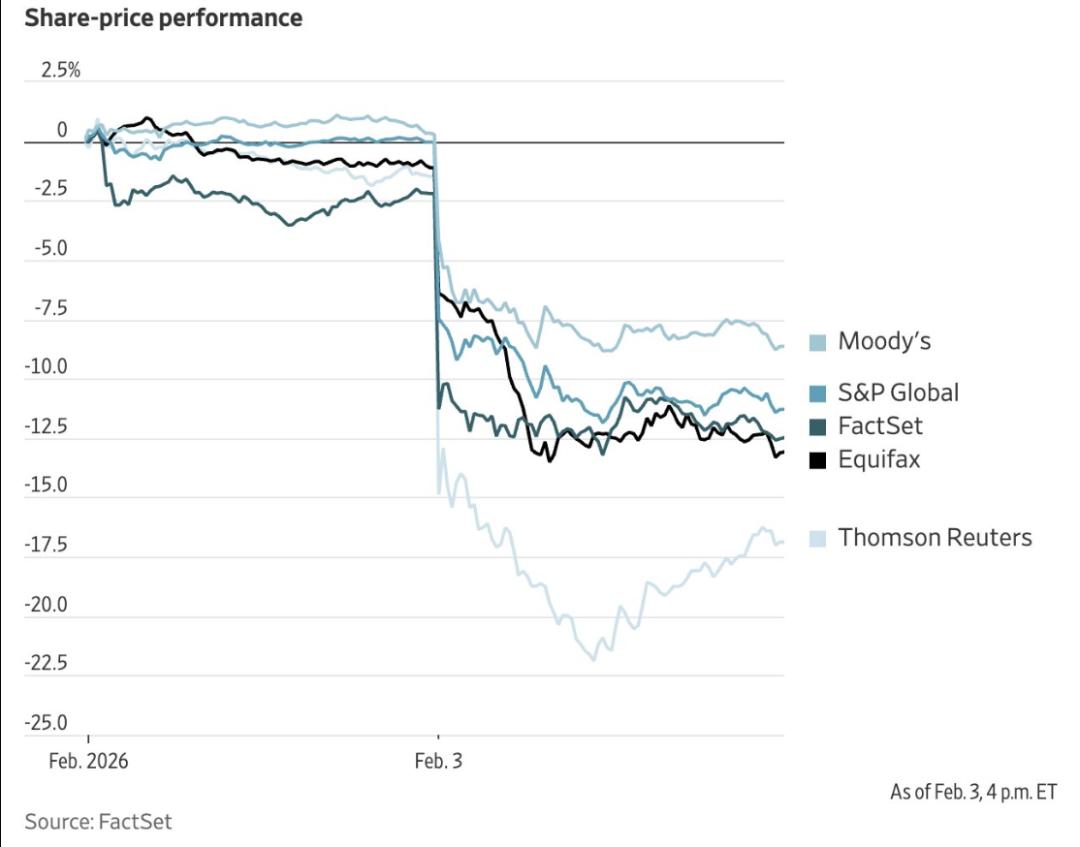
Core Viewpoint - The launch of Anthropic's "plugins" feature, which introduced 11 "silicon employees," has triggered a significant sell-off in the software sector, leading to a loss of approximately $285 billion in market value for Nasdaq stocks, with a notable 6% drop in Goldman Sachs' U.S. software stock portfolio, marking the largest single-day decline since April of the previous year [1][3][4]. Group 1: Market Reaction - The pessimistic sentiment on Wall Street has escalated into a doomsday narrative regarding SaaS companies, with traders expressing a desire to exit their positions regardless of current prices [3][4]. - Following the introduction of Anthropic's legal plugin, which automates tasks traditionally performed by legal software, the legal software sector experienced a sharp decline, with companies like Thomson Reuters and LegalZoom seeing drops of 16% and 20% respectively [5][6]. - The broader software sector faced a sell-off, with the Nasdaq 100 index dropping 1.6% and the iShares expanded technology software ETF declining nearly 20% over the past year, indicating a bear market [8][11]. Group 2: Anthropic's Impact - Anthropic's Claude Cowork, designed for non-technical users, can perform complex tasks such as document drafting and legal compliance checks, which were previously reliant on traditional software [4][5]. - The introduction of the legal plugin has raised concerns about increased competition in the legal software market, with analysts predicting significant disruptions to existing players [5][6]. - The perception that AI could replace software has led to a reevaluation of the SaaS business model, as AI becomes a more accessible infrastructure for users [11][21]. Group 3: Industry Dynamics - Historically, software companies viewed AI as a complementary tool, but Anthropic's direct approach to application development has challenged this notion, positioning AI as a competitor to traditional software [7][8]. - The software industry is facing a potential transformation, where the value of SaaS as an intermediary is being questioned, as users may prefer direct interaction with AI models [11][12]. - Despite the current turmoil, established software companies may still hold advantages due to proprietary data and robust engineering capabilities, suggesting that the transition may not be as straightforward as anticipated [13][14][21].
Claude一个插件吓哭华尔街,软件公司集体暴跌,2万亿元一日蒸发
量子位· 2026-02-05 11:20
Core Viewpoint - The emergence of AI tools, particularly Anthropic's "Claude Cowork," is perceived as a significant threat to the Software as a Service (SaaS) industry, leading to a dramatic sell-off in software stocks and a widespread belief that "SaaS is dead" [1][2][8]. Group 1: Market Reaction - The launch of Anthropic's "plugins" resulted in a loss of approximately $285 billion in market value for Nasdaq, with software stocks experiencing a 6% drop, the largest single-day decline since April of the previous year [3][4]. - Following the initial drop, the iShares expanded technology software ETF fell an additional 2%, indicating ongoing market distress [6]. - The overall sentiment on Wall Street has shifted to a pessimistic outlook, with many investors eager to exit software stocks regardless of current prices [8][28]. Group 2: AI's Impact on SaaS - Anthropic's "Claude Cowork" can automate tasks traditionally handled by various software, such as legal document review, significantly reducing costs for businesses from $50,000 annually to potentially just over $100 monthly [14][20]. - The introduction of AI capabilities is expected to disrupt numerous vertical industries, including finance, sales, and marketing, as more plugins are developed [23][30]. - The perception that AI will replace software has led to a reevaluation of the SaaS model, which was previously seen as a complementary relationship [25][38]. Group 3: Competitive Landscape - Anthropic's self-developed underlying model positions it as a formidable competitor, potentially undermining traditional legal services and existing startups in the legal automation space [17][20]. - Other companies, such as Harvey AI and Legora, are also active in the legal automation sector, but Anthropic's capabilities may give it a competitive edge [15][17]. - The market is witnessing a broader trend where AI is seen as a direct competitor to SaaS companies, challenging their traditional business models [27][39]. Group 4: Long-term Outlook - Despite the current turmoil, some industry leaders, like Jensen Huang, argue that software will remain essential as a tool for AI, suggesting that the notion of SaaS being "dead" is misguided [9][47]. - The future may see a transformation in the SaaS business model, where SaaS becomes a more foundational infrastructure rather than a direct user interface [48][49]. - The long-term viability of SaaS companies may depend on their ability to adapt and leverage proprietary data and robust systems to maintain their competitive advantage [42][44].

美股软件股,六日市值蒸发近万亿美元
Di Yi Cai Jing Zi Xun· 2026-02-05 10:56
Core Viewpoint - The recent market sell-off, particularly in the software and AI sectors, has been unprecedented in speed and breadth, driven by concerns over AI's potential to disrupt existing business models rather than fears of an AI bubble [2][3]. Group 1: Market Reaction - The sell-off has primarily affected Software as a Service (SaaS) stocks, with the S&P 500 Software and Services Index losing approximately $830 billion in market value since January 28 [2]. - Major companies like Alphabet and Arm Holdings reported disappointing earnings forecasts, contributing to declines in their stock prices during after-hours trading [2]. - The sell-off has spread from software stocks to semiconductor and other AI infrastructure companies, with AMD experiencing a 17% drop, marking its largest single-day decline since 2017 [3]. Group 2: Credit Market Impact - The average price of loans for software companies has decreased from 94.71 cents to 91.27 cents since the end of last year, indicating a significant decline in credit market confidence [5]. - The spread between software loans and short-term U.S. Treasury yields has widened, reflecting increased risk perception among investors [5]. - Approximately $25 billion in software company loans are now classified as non-performing, representing nearly one-third of all bad loans [5]. Group 3: Investment Strategy Shift - Investment strategies are shifting from "AI enablers," which build the infrastructure for AI, to "AI beneficiaries," which leverage AI to enhance productivity and efficiency [3][6]. - There is a consensus among market analysts that while AI investments still hold value, investors need to be more discerning in identifying potential winners and losers within the sector [6][8]. - Specific sectors such as healthcare, industrials, and financials are expected to benefit significantly from AI applications, with healthcare being highlighted for its data-intensive nature and potential for improved diagnostics [8]. Group 4: Broader Market Trends - Despite the sell-off in tech stocks, traditional sectors like energy, materials, and consumer staples have seen gains, with each sector rising at least 12% this year [9]. - Companies in non-AI sectors are also benefiting from AI advancements, with some reporting significant reductions in technology update timelines due to AI investments [9]. - The overall sentiment remains cautiously optimistic regarding AI's long-term impact on productivity and profitability across various industries, although challenges remain for traditional business models [9].

【美股盘前】软件行业市值今年已蒸发1万亿美元,对冲基金年内赚240亿美元;中概股普涨,百度涨4.6%;美股存储板块反弹,闪迪涨近3%;博通涨近6%;业绩...
Mei Ri Jing Ji Xin Wen· 2026-02-05 10:29
Market Overview - Major U.S. stock index futures are down, with Dow futures falling by 0.27%, S&P 500 futures down by 0.10%, and Nasdaq futures decreasing by 0.05% [1] Storage Sector - The storage sector saw a pre-market rebound, with Micron Technology rising over 2% after a previous drop of over 9%, SanDisk increasing nearly 3% following a nearly 16% decline, and Seagate Technology up by 1% after a nearly 6% drop [1] Semiconductor and Chip Equipment Stocks - Semiconductor and chip equipment stocks experienced a pre-market increase, with Broadcom rising nearly 6%, and both AMD and NVIDIA increasing by over 2%. Alphabet, Google's parent company, indicated that its capital expenditures could double by 2026 [1] AI Application Software Stocks - AI application software stocks collectively rebounded in pre-market trading, with Applovin rising over 3%, Unity increasing nearly 1%, Roblox up by over 1%, and SAP SE rising nearly 2% [1] Chinese Concept Stocks - Chinese concept stocks saw a general increase in pre-market trading, with Baidu rising by 4.6%, Alibaba up by 2.7%, Pinduoduo increasing by 0.7%, and NetEase rising by 0.9% [1] Software Industry Performance - The U.S. software industry has seen a market capitalization decline of $1 trillion since 2026, with hedge funds profiting $24 billion from short-selling activities [2] Qualcomm's Earnings Guidance - Qualcomm's stock fell over 11% after reporting better-than-expected earnings for Q1 of fiscal year 2026, but provided a revenue forecast for Q2 between $10.2 billion and $11 billion, which was below expectations [2] AMD's Market Guidance - Citigroup reported that AMD's Q1 guidance exceeded market expectations but did not meet buyer expectations, maintaining a "neutral" rating on the stock [2] Alphabet's Collaboration with Apple - Alphabet's CEO Sundar Pichai announced a collaboration with Apple to develop the next generation of Apple's foundational model based on Gemini technology, positioning Alphabet as Apple's preferred cloud service provider [3]

如果AI击溃了软件,“AI龙头”英伟达为何被软件股“拉下水”?
华尔街见闻· 2026-02-05 09:56
周二,Anthropic为其Claude Cowork推出近十项工具,将AI应用推进到销售、数据分析等更多场景,市场随即把"AI将击败软件"的叙事进一步内化为估值下 调。但软件股的下跌引发了包括AI板块在内的,更大范围的抛售。 Bank of America分析师Vivek Arya认为,芯片股跟随下挫说不通。他指出,芯片下跌暗示AI投资回报正在恶化,而软件下跌又暗示AI采用将极度普及,两种结 论难以同时成立,当前市场反应过度。 AI对软件行业的冲击叙事正引发一轮"无差别"抛售,并把以英伟达为代表的AI芯片股一起卷入下跌,但卖出的逻辑本身存在内在矛盾。 周三英伟达股价下跌3.41%,博通下跌3.83%,美光下跌10%,闪迪跌超15%。与此同时,软件板块抛压仍在延续,iShares Expanded Tech-Software Sector ETF,IGV周三再跌1.8%。 "这两种结果不可能同时发生。" Arya写道,这种交易结构与今年1月"DeepSeek冲击"期间的恐慌相似,最终被证明缺乏事实支撑。当时市场担忧DeepSeek以 更低成本做出有竞争力的模型,会降低对昂贵高性能芯片的需求。 AI投入未见降温 ...