造船

Search documents
黄奇帆最新讲话!信息量大
21世纪经济报道· 2025-07-12 13:14
Core Viewpoint - The production service industry has five strategic functions that are crucial for economic development and should be given high importance [1][4]. Group 1: Strategic Functions of Production Service Industry - The production service industry is a growth driver for GDP and often becomes the largest sector in developed economies [1]. - It serves as the driving force for high-quality development in manufacturing, being the largest sector for unicorn companies globally [1]. - The production service industry is a growth engine for service trade, with insufficient development in China leading to a reliance on imported production services [1]. - It forms the basis for high added value in products, as seen in the example of a smartphone where a significant portion of the price is derived from production services [2]. - The production service industry is essential for the development of total factor productivity, requiring knowledge and talent-intensive inputs [2]. Group 2: Current Status and Challenges - Despite significant achievements in manufacturing, China lags in the production service industry, reflected in five key indicators: low GDP share, low service trade proportion, low manufacturing profit margins, low unicorn representation, and low total factor productivity [4]. - The goal for the period from 2021 to 2040 is to address these shortcomings by focusing on the development of the production service industry to promote high-quality manufacturing and the healthy development of new productivity [4].


黄奇帆:生产性服务业有五大战略性功能,应该高度重视
2 1 Shi Ji Jing Ji Bao Dao· 2025-07-12 11:04
Core Viewpoint - The production service industry has five strategic functions that are crucial for economic development and should be given high importance [1][3]. Group 1: Strategic Functions of Production Service Industry - The production service industry is a growth driver for GDP and often becomes the largest sector in developed economies [1]. - It serves as the driving force for high-quality development in manufacturing and is the largest sector for unicorn companies globally [1]. - The production service industry is a growth engine for service trade, with insufficient development in China leading to a reliance on imported production services [1]. - It forms the basis for high added value in products, as seen in the example of a smartphone where a significant portion of the price is derived from production services [2]. - The production service industry is essential for the development of total factor productivity, requiring knowledge and talent-intensive inputs [2]. Group 2: Current Status and Future Goals - Despite significant achievements in manufacturing, China lags in the production service industry, reflected in five weak indicators: low GDP share, low service trade share, low manufacturing profit margins, low proportion of unicorns, and low total factor productivity [3]. - The goal for the period from 2021 to 2040 is to address these weaknesses by focusing on the development of the production service industry to promote high-quality manufacturing and the healthy development of new productivity [3].
中国重工(601989):业绩预增超预期,船价已现企稳迹象,重组事项提上日程
Shenwan Hongyuan Securities· 2025-07-11 10:11
Investment Rating - The report maintains a "Buy" rating for China Shipbuilding Industry Company Limited (601989) [6] Core Views - The company is expected to see a significant increase in net profit for H1 2025, with estimates ranging from 1.5 billion to 1.8 billion yuan, representing a year-on-year increase of 182% to 238% [6] - High-priced orders are being delivered, leading to improvements in both revenue and cost [6] - The impact of the U.S. 301 tariffs on shipyards has significantly weakened, alleviating negative sentiment in the market [6] - Ship prices have shown signs of stabilization as of June, with new ship orders increasing month-on-month [6] - The merger with China State Shipbuilding Corporation will result in a combined capacity that accounts for 33% of global capacity in DWT terms and 18% in CGT terms [6] - The report maintains profit forecasts for 2025E-2027E, with expected net profits of 3.7 billion, 7.2 billion, and 11 billion yuan respectively [6] Financial Summary - Total revenue is projected to grow from 55,436 million yuan in 2024 to 93,996 million yuan in 2027, with a compound annual growth rate (CAGR) of approximately 20.8% [2][8] - The net profit attributable to shareholders is expected to increase from 1,311 million yuan in 2024 to 10,992 million yuan in 2027, reflecting a significant growth trajectory [2][8] - The gross profit margin is anticipated to rise from 10.8% in 2024 to 19.7% in 2027, indicating improved profitability [2][8] - The price-to-earnings (PE) ratio is projected to decrease from 29 in 2025 to 10 in 2027, suggesting that the stock may be undervalued [2][8]

韩国外交部:美国国务卿鲁比奥与韩国、日本外交官一致同意加强在能源、造船、供应链安全(包括关键矿产和人工智能)等领域的合作。
news flash· 2025-07-11 08:05
Group 1 - The core viewpoint of the article highlights the agreement between U.S. Secretary of State Rubio and diplomats from South Korea and Japan to enhance cooperation in various sectors, including energy, shipbuilding, and supply chain security [1] Group 2 - The collaboration will focus on critical minerals and artificial intelligence, indicating a strategic alignment among the three nations in addressing emerging technological and resource challenges [1]
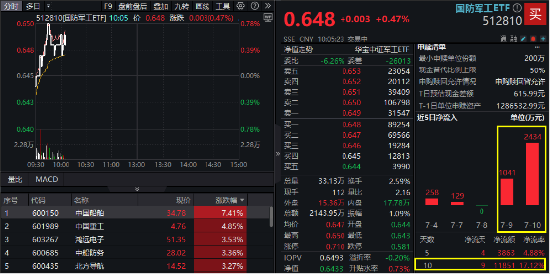
业绩翻倍暴增,中国船舶劲涨逾7%!国防军工ETF(512810)配置价值凸显,资金连续进场!
Xin Lang Ji Jin· 2025-07-11 02:12
Group 1 - The core viewpoint of the news highlights the significant profit growth forecasts for major Chinese shipbuilding companies, China Shipbuilding and China Shipbuilding Industry Corporation, with expected net profit increases of 98%-119% and 182%-238% respectively for the first half of the year [1] - The Shanghai Stock Exchange has approved the share swap merger plan between China Shipbuilding and China Shipbuilding Industry Corporation, which is expected to create the largest and most comprehensive listed shipbuilding giant globally, positioning it as a key player in China's entry into the high-end equipment market [1] - The defense and military industry sector is showing positive performance, with the Defense and Military ETF (512810) experiencing significant capital inflows, having attracted over 100 million yuan in the last 10 trading days [3] Group 2 - Analysts from Guolian Minsheng Securities believe that the defense and military sector will remain a favorable investment option amid the current trend of global multipolarity, with the industry poised to experience three pivotal turning points: the "14th Five-Year Plan," "domestic demand acceleration," and "foreign trade orders from 0 to 1" [3] - The Defense and Military ETF (512810) has undergone a share split to lower the trading threshold, reducing the price from approximately 120 yuan to around 60 yuan, making it more accessible for investors [3] - The ETF covers a wide range of themes, including traditional military forces and emerging sectors such as commercial aerospace, deep-sea technology, military AI, low-altitude economy, and large aircraft [3]

申万宏源证券晨会报告-20250711
Shenwan Hongyuan Securities· 2025-07-11 00:43
Group 1: Stablecoin Compliance and Payment Infrastructure - The development of compliant stablecoins in Hong Kong is strategically significant, with a focus on monitoring license applications and issuance progress [2][11] - Key beneficiaries of this trend include securities IT service providers, licensed stablecoin institutions, cross-border payment companies, and Web3.0 technology service providers [2][11] - The stablecoin market is expected to grow rapidly, potentially reaching a size of $2-3.7 trillion within 3-5 years [11] Group 2: HaiXing Electric (603556) Overview - HaiXing Electric has a strong international presence, with a complete industrial chain and sales channels established overseas, contributing to its revenue growth [2][10] - The company’s smart electric products and systems accounted for 76.07% of its revenue, with a total revenue of 4.717 billion yuan and a net profit of 1.002 billion yuan, reflecting year-on-year growth of 12.30% and 2.00% respectively [10][12] - The global smart meter market is projected to grow from 162 million units in 2024 to 236 million units by 2029, with a compound annual growth rate of 7.81% [12][13] Group 3: Alibaba (BABA) FY1Q26 Forecast - Alibaba is expected to generate revenue of 249.2 billion yuan in FY1Q26, representing a year-on-year growth of 2.4%, while the Non-GAAP net profit is projected to decline by 11% to 36 billion yuan [3][12] - The company is focusing on enhancing its instant retail capabilities and leveraging AI to drive cloud intelligence [3][12] - The overall valuation target for Alibaba is set at $138 per share, indicating a potential upside of 33% [3][12] Group 4: Shipping Industry Insights - China Shipbuilding (600150) anticipates a significant increase in net profit for H1 2025, estimated between 2.8 billion to 3.1 billion yuan, reflecting a year-on-year increase of 98%-119% [19] - The company is benefiting from high-value orders and a stable ship price environment, with a projected increase in new ship orders [19] - The merger with China State Shipbuilding Corporation is expected to enhance production capacity significantly, potentially reaching 33% of global capacity [19] Group 5: Photovoltaic Industry Analysis - The price of polysilicon has surged, with N-type dense material quoted at 44,500 yuan per ton, reflecting a 0.55% increase [22] - The photovoltaic industry is expected to benefit from rising prices, particularly in the export market, which may offset domestic demand declines [22] - Investment recommendations include companies involved in polysilicon production and those with independent alpha opportunities in the photovoltaic sector [22]
大陆斩断8家涉“独”台军工链,台舆论:打在“七寸”上
Zhong Guo Xin Wen Wang· 2025-07-11 00:00
Group 1 - The Chinese government has placed eight Taiwanese entities on an export control list due to their alleged cooperation with "Taiwan independence" forces, prohibiting the export of dual-use items to these companies [1][2] - The listed companies include major players in Taiwan's defense technology, aerospace, drone production, shipbuilding, and ballistic protection equipment sectors, indicating a significant impact on these industries [2] - Taiwan imports approximately NT$600 billion (around US$20 billion) worth of rare earth materials annually, some of which come from mainland China and may be used for military purposes, highlighting the strategic importance of these materials in the current geopolitical context [2] Group 2 - The Chinese government views this export control as a necessary measure to safeguard national sovereignty and territorial integrity, as well as a warning against provocations from "Taiwan independence" forces [3] - The action is seen as a response to Taiwan's previous technology restrictions on mainland China, particularly in areas like semiconductor design and AI software, indicating a tit-for-tat dynamic in cross-strait relations [2]
双双预计净利润翻倍!中国船舶、中国重工上半年业绩为“南北船”合并添彩头
Mei Ri Jing Ji Xin Wen· 2025-07-10 14:58
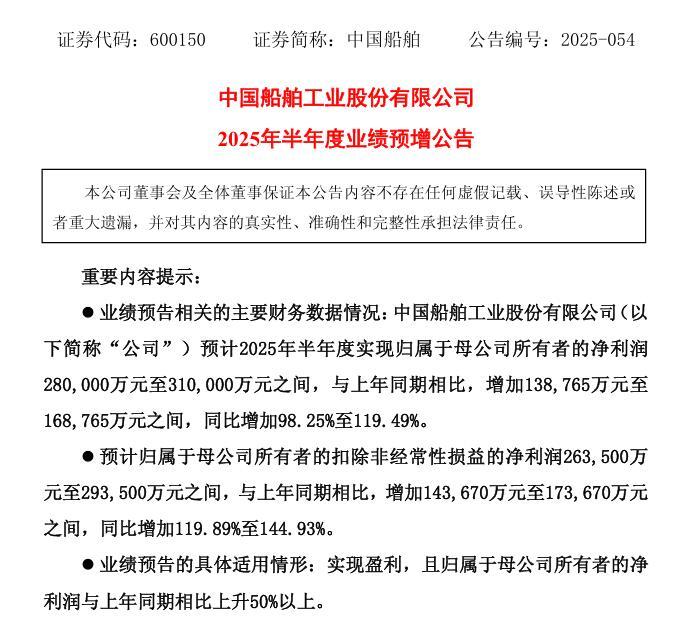
Core Viewpoint - Both China Shipbuilding (SH600150) and China State Shipbuilding Corporation (SH601989) are expected to report significant year-on-year growth in net profit for the first half of 2025, with China Shipbuilding's profit scale projected to be higher than that of China State Shipbuilding, while the latter's growth rate is anticipated to be faster [1][8]. Group 1: Profit Forecasts - China Shipbuilding anticipates a net profit of between 2.8 billion to 3.1 billion yuan, representing a year-on-year increase of 98.25% to 119.49% [8]. - China State Shipbuilding expects a net profit of between 1.5 billion to 1.8 billion yuan, with a year-on-year growth of 181.73% to 238.08% [8]. Group 2: Reasons for Profit Growth - The profit growth for China Shipbuilding is attributed to increased prices and quantities of delivered civil ships, along with effective cost control [8]. - China State Shipbuilding's profit increase is due to its ability to leverage the shipbuilding industry's development trends, enhance efficiency, and significantly increase the number of civil ship deliveries [9]. Group 3: Industry Trends and Strategic Moves - The shipbuilding industry is experiencing a positive development trend, with both companies optimizing their order structures and improving operational performance [9]. - China Shipbuilding is set to absorb high-quality assets from China State Shipbuilding, aiming to become the largest and most technologically advanced shipbuilding company in China [10]. - The company plans to enhance its deep-sea technology capabilities, which are expected to create new demands in exploration, communication, equipment, materials, and services [11]. Group 4: Future Goals - China Shipbuilding aims to achieve an operating revenue of 80.5 billion yuan in 2025, with specific targets including the completion of 89 civil ships and 270 repair ships [11]. - The company is focusing on high-demand ship types such as large LNG carriers and VLCCs, while also enhancing its capabilities in deep-sea equipment development [11].
美国忌惮俄罗斯,日本关税战强势反击,七艘准航母显露真实目的
Sou Hu Cai Jing· 2025-07-10 05:00
Group 1 - Japan has unexpectedly taken a strong stance against the U.S. during the trade war, indicating a shift from being a passive player to an active strategist [1][6][28] - The U.S. has historically focused on Russia as a primary strategic concern, but Japan's military developments have gone unnoticed [3][6][28] - Japan's maritime capabilities have rapidly increased, particularly through the construction of seven quasi-aircraft carriers, which are significantly more capable than traditional destroyers [8][10][30] Group 2 - Japan's "Maritime Self-Defense Force Reconstruction Plan" aims to enhance naval power in East Asia, with a focus on building advanced naval vessels [8][10] - The construction of these quasi-aircraft carriers has been remarkably efficient, with Japan producing them at a rate of one every four months, forming three complete carrier battle groups [10][13] - Japan's stealth destroyers have also advanced, with 11 vessels launched in four years, showcasing cutting-edge technology and compatibility with U.S. military systems [11][15][13] Group 3 - Japan employs a clever disguise strategy in its military expansion, labeling its quasi-aircraft carriers as "helicopter destroyers" to mask their true capabilities [17][19] - The gradual enhancement of these vessels allows Japan to increase its military capabilities without drawing significant attention [19][24] - Japan's military ambitions have evolved from a defensive posture to a more offensive capability, facilitated by U.S. support and a shift in strategic focus [24][28] Group 4 - The U.S. initially supported Japan's military developments, viewing them as a means to bolster its own strategic interests in the Asia-Pacific region [26][28] - However, Japan's growing military independence and capabilities have raised concerns for the U.S., which now recognizes Japan as a significant military power rather than just an ally [28][30] - The recent acknowledgment of Japan's quasi-aircraft carrier strike groups by U.S. observers marks a significant shift in perception regarding Japan's military strength [30]