能源

Search documents
小鱼易连以“会议智能体”引领能源行业视讯智能化跃迁
Zhong Guo Neng Yuan Wang· 2025-12-24 03:12
Core Viewpoint - The 15th Energy Enterprise Informationization Conference highlighted the importance of digital transformation in the energy sector, emphasizing the need for efficient, secure, and intelligent communication systems to support collaboration and decision-making in energy enterprises [1] Group 1: Digital Transformation in Energy Sector - The energy industry is undergoing a digital transformation, requiring high levels of security, stability, and integration in communication and collaboration [3] - The conference gathered representatives from national energy authorities, research institutions, and leading energy companies to discuss digital development paths and technological innovations [1] Group 2: Company Solutions and Innovations - Xiaoyu Yilian has developed a "high security, super-converged, fully connected" video conferencing solution that has been implemented in major energy companies such as Sinopec, CNOOC, and the Three Gorges Group [3] - The company’s new generation video solution includes a "super-converged video platform, multi-modal terminals, AI meeting intelligence, and audio-video capability base," aimed at enhancing operational efficiency and intelligent decision-making in the energy sector [1][3] Group 3: AI Integration in Video Conferencing - The transition from "tool-based" to "intelligent" video conferencing is driven by advancements in AI and domestic model development, marking a significant change in collaboration methods and decision-making efficiency [4] - Xiaoyu Yilian's intelligent meeting agent supports the entire meeting process, from pre-meeting preparations to post-meeting documentation, enhancing the overall collaboration experience for energy enterprises [4][7] Group 4: Practical Applications and Recognition - Xiaoyu Yilian has been recognized for its contributions to remote collaboration, cross-national management, and emergency command in the energy sector [8] - The company has successfully implemented unified video capability platforms for companies like Sinopec, enhancing efficient collaboration and resource optimization [9] - Collaborations with CNOOC and the Three Gorges Group have led to innovative applications in emergency command and global communication, supporting high-quality management and business expansion [10][11]


富格林:鉴识欺诈依托措施保障出金
Sou Hu Cai Jing· 2025-12-24 02:41
Group 1 - Gold prices continue to rise, reaching a record high above $4,490 per ounce, closing at $4,484.87, with a gain of 0.93% [1] - Silver prices have surpassed the key psychological level of $70, closing at $71.45, with an increase of 3.54% [1] - WTI crude oil prices rose by 0.84% to $58.37 per barrel, while Brent crude oil increased by 0.66% to $62.44 per barrel, amid concerns over supply disruptions due to geopolitical tensions [1] Group 2 - The U.S. economy expanded at a rate of 4.3% in the third quarter, marking the fastest growth in two years, despite a decline in consumer confidence for five consecutive months [1] - The ADP weekly employment report indicates that private sector employers added an average of 11,500 jobs per week over the four weeks ending December 6, 2025 [1] - Discussions are suggested regarding adjusting the Federal Reserve's inflation target to a range of 1.5%-2.5% or 1%-3% [1]
英伟达涨超 3% 市值增超 9400 亿元 美股科技股与大宗商品齐掀涨势
Sou Hu Cai Jing· 2025-12-24 02:41
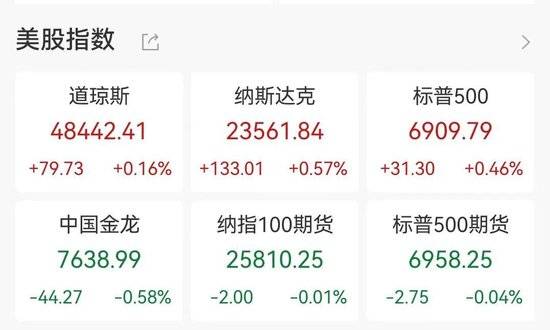
Market Performance - The US stock market showed a broad increase, with all three major indices rising for four consecutive days, and the S&P 500 index reaching a new closing high [1] - The Dow Jones Industrial Average rose by 0.16% to 48,442.41 points, the Nasdaq Composite increased by 0.57% to 23,561.84 points, and the S&P 500 gained 0.46% to 6,909.79 points [2] - Major technology stocks performed well, with Nvidia's stock price surging over 3%, adding approximately $134.1 billion (about 94.25 billion RMB) to its market capitalization [1][2] Commodity Market - The commodity market also experienced strong performance, with LME copper futures prices surpassing $12,000 per ton for the first time in history, leading to gains in copper-related stocks [3] - Precious metals saw significant increases, with spot gold prices rising by 1.02% to $4,489.18 per ounce, nearing the $4,500 mark, while COMEX gold and silver futures rose by 1.02% and 4.44%, respectively [3] - In the energy sector, WTI crude oil futures settled at $58.38 per barrel, up 0.64%, and Brent crude oil futures increased by 0.50% to $62.38 per barrel [3] Individual Stocks - Novo Nordisk's stock surged over 7% following FDA approval of its first oral GLP-1 weight loss drug, expected to launch in early 2026 at a starting cash price of $149 per month [4] - Chinese concept stocks mostly declined, with the Nasdaq China Golden Dragon Index falling by 0.58%, while some stocks like BrainCo and Suzhou Dazhong Bio performed well, with gains exceeding 14% and 12%, respectively [4] - The cryptocurrency market faced a sharp decline, with Bitcoin dropping below $87,000, leading to significant liquidations across various cryptocurrencies [4] Economic Indicators - The US Department of Commerce reported a preliminary estimate showing a 4.3% annualized growth in GDP for Q3, up from 3.8% in Q2 [5] - Market attention is focused on the Federal Reserve, with President Trump expressing a desire for the new Fed chair to lower interest rates when the market performs well, and indicating potential candidates for the position [5] - According to CME FedWatch, there is an 86.7% probability that the Fed will maintain interest rates in January, with a 40.7% chance of a 25 basis point cut by March [5]

全球大宗商品定价影响力形成机理及启示
Qi Huo Ri Bao· 2025-12-24 02:18
Core Viewpoint - The article discusses the influence of structural power on commodity pricing, emphasizing that this influence is formed through the combined effects of production, trade, finance, and information dimensions. It highlights the evolution of the global cotton pricing center and outlines both the favorable conditions and constraints faced by China in enhancing its commodity pricing influence [1][2]. Group 1: Structural Power in Commodity Pricing - Structural power, as defined by Susan Strange, refers to the ability of certain countries or organizations to shape and influence the behavior of others through the establishment of rules and standards in the international political economy [3]. - In the global commodity market, structural power can be obtained through various channels, including production, trade, finance, and information [3]. Group 2: Production Structural Power - Possessing resource endowments is fundamental for gaining pricing influence, as seen with the U.S. being a leading exporter of corn, sorghum, and soybeans, significantly impacting global food prices [4]. - Cross-border capital control over production resources allows entities to influence commodity production decisions, as demonstrated by large mining groups and multinational financial capital [4]. - Technological advancements have led to increased production efficiency, exemplified by the U.S. shale gas production rising from 11 billion cubic meters in 2000 to 840 billion cubic meters in 2024, making the U.S. the largest natural gas producer and exporter [4]. Group 3: Trade Structural Power - Developed countries influence global commodity trade through the establishment of trade rules and policies, affecting pricing and market conditions [5]. - Major grain traders dominate approximately 70% of international grain and oilseed trade, significantly impacting agricultural prices [5]. - Control over shipping logistics is crucial, as over 80% of international trade is conducted via maritime transport, with shipping costs affecting commodity prices [5]. Group 4: Financial Structural Power - The dominance of the U.S. dollar as the primary currency for commodity pricing and settlement significantly influences global commodity prices, with the Federal Reserve's interest rate hikes impacting demand [6]. - The U.S. and other developed nations lead the international financial system, affecting commodity trade through cross-border payment systems [6]. - Established futures exchanges in the U.S. and Europe serve as pricing centers for energy, metals, and agricultural products, with regulatory frameworks influencing market operations [6]. Group 5: Information Structural Power - The release of price information and data by developed countries serves as authoritative references for global commodity markets, impacting price trends [7]. - Price benchmarks established by reporting agencies play a critical role in setting market prices for non-standardized commodities [7]. - Market forecasts from international financial institutions can directly influence market expectations and pricing [7]. Group 6: Evolution of Commodity Pricing Influence - The historical evolution of the global cotton pricing center illustrates the shifting role of structural power across different periods and countries [8]. - From the 16th to 18th centuries, colonial economies dominated cotton trade, with Western European countries exerting significant influence over pricing through direct control [9]. - The 19th century marked the emergence of structural power in cotton pricing, with the U.K. becoming the global center due to industrial advancements and trade networks [11]. - Post-19th century, the U.S. emerged as a leading cotton producer and established futures trading, solidifying its position as the global pricing center [12]. Group 7: Conditions and Constraints for China - Favorable conditions for China include its large market size, diversified international trade, ongoing internationalization of the RMB, and rapid development of its futures market [13][14]. - Constraints include reliance on imported raw materials, the dichotomy between domestic and international markets, insufficient internationalization of the futures market, and weak information influence [15][16]. Group 8: Recommendations for Enhancing Pricing Influence - China should integrate the enhancement of commodity pricing influence into its strategic framework, supporting enterprises in global mergers and investments [17]. - Tailored policies should be implemented to enhance futures pricing influence based on specific commodities, particularly in regions like the Belt and Road Initiative [17]. - Building a world-class futures market and fostering commodity service providers and information institutions are essential for strengthening pricing influence [18].

对话联合国副秘书长:基础设施、技术治理与全球合作如何重塑可持续发展
Xin Lang Cai Jing· 2025-12-24 02:00
Core Insights - The article emphasizes the urgent need for systemic transformation to drive the global transition towards a green, resilient, and inclusive future, particularly in the context of climate change and sustainable development challenges [1][2]. Group 1: Infrastructure and Climate Goals - Infrastructure is responsible for approximately 79% of greenhouse gas emissions and consumes 88% of climate adaptation funds, while influencing up to 92% of the Sustainable Development Goals (SDGs) [5][11]. - Immediate and radical changes in the planning, delivery, and management of infrastructure are necessary to meet the Paris Agreement and SDGs [5][11]. - There is a unique opportunity to align infrastructure decisions with global and national climate goals, integrating inclusive and rights-based climate action [12][32]. Group 2: Clean Energy Transition - Infrastructure is key to the clean energy transition, necessitating a significant reduction in its carbon footprint and support for decarbonization in sectors like energy, transport, and buildings [6][34]. - UNOPS is committed to ensuring access to affordable sustainable energy and supporting a just transition away from fossil fuels [6][34]. Group 3: AI and Governance - The rise of AI is closely linked to the clean energy transition, with significant increases in energy demand from global data centers [7][36]. - AI presents opportunities to reduce costs and emissions, but countries are starting from unequal positions in managing its benefits and risks [7][36]. - Ethical and inclusive governance is essential to prevent AI from exacerbating global inequalities [7][36]. Group 4: Global Governance and Implementation Gaps - There are significant gaps in policy, financing, and implementation that hinder progress towards the SDGs, with a widening divide between ambitions and the capacity to deliver results [8][38]. - Many developing countries are facing a debt-driven development crisis, making it crucial to reform global financial structures to achieve climate and development goals [8][39]. - Investment in systems that enable sustainable planning, financing, and implementation is necessary to build long-term resilience [8][39]. Group 5: UNOPS Commitment and Future Outlook - UNOPS focuses on practical implementation support to create resilient, sustainable, and inclusive infrastructure [9][40]. - The organization aims to strengthen transparency, accountability, and efficiency in public investment and service delivery [9][41]. - Greater global solidarity is essential for developing countries to have the necessary tools and resources for sustainable futures [9][41]. Group 6: China's Role in Climate Action - China's role is pivotal in accelerating progress towards the SDGs, with UNOPS committed to supporting inclusive development and climate resilience [10][42]. - The partnership between UNOPS and China aims to advance green, inclusive, and resilient development through collaborative efforts [10][42].

能源化工期权:能源化工期权策略早报-20251224
Wu Kuang Qi Huo· 2025-12-24 01:10
1. Report Industry Investment Rating - No relevant information provided 2. Core Viewpoints of the Report - The energy - chemical sector is divided into energy, alcohols, polyolefins, rubber, polyesters, alkalis, and others. Strategies mainly involve constructing option portfolios with sellers as the main component, along with spot hedging or covered call strategies to enhance returns [3][9] 3. Summary by Related Catalogs 3.1 Futures Market Overview - Various energy - chemical option underlying futures have different price, trading volume, and open interest changes. For example, the latest price of crude oil (SC2602) is 442, up 1 with a 0.14% increase, trading volume of 7.98 million lots (down 0.21 million lots), and open interest of 3.69 million lots (down 0.29 million lots) [4] 3.2 Option Factors - Volume and Open Interest PCR - Different option varieties have different volume and open interest PCR values and their changes. For instance, the volume PCR of crude oil options is 0.63 (down 0.00), and the open interest PCR is 0.77 (up 0.03) [5] 3.3 Option Factors - Pressure and Support Levels - Each option variety has corresponding pressure and support levels. For example, the pressure level of crude oil is 540, and the support level is 400 [6] 3.4 Option Factors - Implied Volatility - Implied volatility of different option varieties varies. For example, the at - the - money implied volatility of crude oil is 25.14%, and the weighted implied volatility is 27.56% (up 0.24%) [7] 3.5 Option Strategies and Recommendations 3.5.1 Energy - related Options (Crude Oil) - Fundamental analysis: US crude oil inventories have different changes. The overall performance of crude oil is a weak market trend. - Option factor research: Implied volatility is below the average, open interest PCR is below 0.70, pressure level is 540, and support level is 430. - Option strategies: Construct bearish option bear - spread strategy, short - biased call + put option combination strategy, and long collar strategy for spot hedging [8] 3.5.2 Liquefied Petroleum Gas (LPG) - Fundamental analysis: Supply decreased, and demand increased. The market is a bearish oscillating market. - Option factor research: Implied volatility is around the average, open interest PCR is below 0.80, pressure level is 4300, and support level is 4000. - Option strategies: Construct bearish option bear - spread strategy, short - biased call + put option combination strategy, and long collar strategy for spot hedging [10] 3.5.3 Alcohols (Methanol) - Fundamental analysis: Demand changes may be limited in the short term. The market is a rebound - then - decline market. - Option factor research: Implied volatility is around the historical average, open interest PCR is below 0.60, pressure level is 2300, and support level is 2000. - Option strategies: Construct short - biased call + put option combination strategy and long collar strategy for spot hedging [10] 3.5.4 Alcohols (Ethylene Glycol) - Fundamental analysis: Inventory pressure increases, indicating a supply - surplus situation. The market is a weak bearish market. - Option factor research: Implied volatility is above the average and rising, open interest PCR is below 0.60, pressure level is 3800, and support level is 3600. - Option strategies: Construct bearish option bear - spread strategy, short volatility strategy, and long collar strategy for spot hedging [11] 3.5.5 Polyolefins (PVC) - Fundamental analysis: Inventory and production rates have changed. The market is a weak bearish market. - Option factor research: Implied volatility has decreased to below the average, open interest PCR is below 0.60, pressure level is 5000, and support level is 4300. - Option strategies: Construct long collar strategy for spot hedging [11] 3.5.6 Rubber - Fundamental analysis: Inventory has increased. The market is a weak oscillating market. - Option factor research: Implied volatility is approaching the average, open interest PCR is below 0.60, pressure level is 16000, and support level is 15000. - Option strategies: Construct short - neutral call + put option combination strategy [12] 3.5.7 Polyesters (PTA) - Fundamental analysis: Supply is becoming more abundant, and inventory is high. The market is a short - term strong rebound market. - Option factor research: Implied volatility is at a low - average level, open interest PCR is around 0.80, pressure level is 4750, and support level is 4400. - Option strategies: Construct bullish option bull - spread strategy, short - bullish call + put option combination strategy [12] 3.5.8 Alkaline Chemicals (Caustic Soda) - Fundamental analysis: Capacity utilization has decreased. The market is a weak bearish market. - Option factor research: Implied volatility is at a high level, open interest PCR is below 0.60, pressure level is 2320, and support level is 2000. - Option strategies: Construct bear - spread strategy and long collar strategy for spot hedging [13] 3.5.9 Alkaline Chemicals (Soda Ash) - Fundamental analysis: Production costs and profits have changed. The market is a low - level weak oscillating market. - Option factor research: Implied volatility is at a relatively high historical level, open interest PCR is below 0.50, pressure level is 1300, and support level is 1100. - Option strategies: Construct bear - spread strategy, short volatility combination strategy, and long collar strategy for spot hedging [13] 3.5.10 Urea - Fundamental analysis: Supply - demand difference has increased, and inventory has decreased. The market is a short - term weak market. - Option factor research: Implied volatility is at a low - historical average level, open interest PCR is below 0.60, pressure level is 1700, and support level is 1640. - Option strategies: Construct short - neutral call + put option combination strategy and long collar strategy for spot hedging [14]
广汇能源股份有限公司关于2025年11月担保实施进展的公告
Shang Hai Zheng Quan Bao· 2025-12-23 18:46
Core Viewpoint - Guanghui Energy Co., Ltd. has announced the progress of its guarantee implementation for November 2025, detailing the changes in guarantee amounts and the status of its subsidiaries [1][2]. Group 1: Guarantee Amounts and Balances - The company increased the guarantee amount by 683.25 million yuan and decreased it by 921.65 million yuan (including exchange rate fluctuations) in November 2025 [2][5]. - As of November 30, 2025, the total guarantee balance is 1,290.54 million yuan, which is 47.81% of the company's latest audited equity attributable to shareholders [8]. Group 2: Guarantee Structure and Conditions - The guarantees involve six companies that are either controlled or associated with Guanghui Energy [2]. - There are both counter-guarantees and related guarantees in place, with no overdue guarantees reported [3][6]. Group 3: Future Guarantee Projections - For 2025, the company plans to provide a total guarantee amount not exceeding 20 billion yuan, with a net increase of up to 6 billion yuan [4]. - The projected net increase in guarantees includes 5.71 billion yuan for controlled subsidiaries and 290 million yuan for associated companies [4]. Group 4: Necessity and Reasonableness of Guarantees - The guarantees are deemed necessary and reasonable to ensure the stable operation of controlled and associated companies, which are reported to have stable operations and good credit status [7].

长江能科:公司拟聘任中汇会计师事务所(特殊普通合伙)为2026年年度的审计机构
Zheng Quan Ri Bao Wang· 2025-12-23 14:15
证券日报网讯12月23日,长江能科发布公告称,公司拟聘任中汇会计师事务所(特殊普通合伙)为2026年 年度的审计机构。 ...
商品量化CTA周度跟踪:有色截面动量分化-20251223
Guo Tou Qi Huo· 2025-12-23 12:34
Report Overview - Report Title: Commodity Quantitative CTA Weekly Tracking [1] - Report Date: December 23, 2025 [2] - Research Team: Guotou Futures Research Institute, Financial Engineering Group [2] Industry Investment Rating - No industry investment rating information is provided in the report. Core Viewpoints - The proportion of long positions in commodities increased slightly this week. The factor strength of precious metals remained high, while that of the agricultural products sector decreased slightly. The precious metals and non - ferrous sectors were relatively strong in cross - section, the black and energy sectors were above the neutral range, and the agricultural products sector was relatively weak [3]. - In the methanol strategy, the inventory factor weakened by 0.02% last week, the synthetic factor declined by 0.02%, and the comprehensive signal this week is long. In the float glass strategy, the synthetic factor increased by 1.38% last week, and the comprehensive signal this week is short. In the iron ore strategy, the comprehensive factor weakened by 0.19% last week, and the comprehensive signal this week remains neutral. In the lead strategy, the synthetic factor strengthened by 0.42% last week, and the comprehensive signal this week changed from short to long [5][8][10] Section Summaries Commodity Market Overview - The proportion of long positions in commodities increased slightly this week. Precious metals and non - ferrous sectors were strong in cross - section, agricultural products were weak. Gold's time - series momentum rose slightly, silver's position increased more marginally. In the non - ferrous sector, short - cycle momentum recovered, and the term structure differentiation narrowed. In the black sector, time - series momentum showed a marginal decline. In the energy and chemical sector, short - cycle momentum factors recovered. In the agricultural products sector, the cross - section differentiation of oilseeds and meals narrowed [3] Performance of Different Factors - **Methanol**: Last week, the inventory factor weakened by 0.02%, the synthetic factor declined by 0.02%. The import methanol arrival volume and domestic road transport prices sent long signals on the supply side; the raw material procurement volume of domestic methanol - to - olefins enterprises decreased on the demand side; the methanol port continued to destock on the inventory side; the domestic methanol spot price fell while the port price was strong on the spread side [5] - **Float Glass**: Last week, the supply factor increased by 1.51%, the demand factor strengthened by 1.62%, the inventory factor weakened by 0.13%, the spread factor increased by 0.29%, the profit factor strengthened by 0.21%, and the synthetic factor increased by 1.38%. The supply side is neutral, the demand side is slightly long, the inventory side turns neutral, and the profit side remains short [8] - **Iron Ore**: Last week, the inventory factor declined by 0.59%, and the comprehensive factor weakened by 0.19%. The supply side turns to short feedback but the signal remains neutral, the demand side's long feedback weakens and turns to neutral, the inventory side's signal turns from short to neutral, and the spread side's short feedback weakens slightly and the signal remains neutral [10] - **Lead**: Last week, the supply factor increased by 0.6%, the demand factor strengthened by 0.56%, the spread factor increased by 0.51%, and the synthetic factor strengthened by 0.42%. The supply side signal turns from short to neutral, the inventory side signal turns from neutral to long, and the spread side signal turns from short to long [10] Data Tables - **Commodity Factors Performance Table**: It shows the last week's and current month's returns of supply, demand, inventory, spread, and the cumulative returns of major categories [4] - **Factor Index Table for Different Sectors**: It presents the time - series momentum, cross - section momentum, term structure, and position volume of black, non - ferrous, energy and chemical, agricultural products, stock index, and precious metals sectors [6]
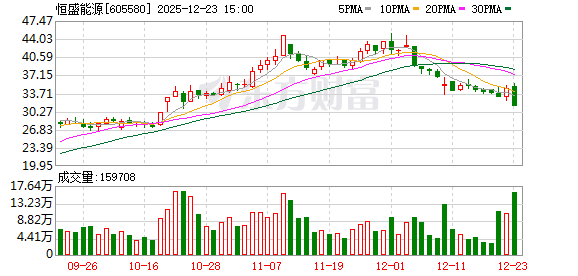
恒盛能源跌停,沪股通龙虎榜上净卖出2866.43万元
Zheng Quan Shi Bao Wang· 2025-12-23 11:57
恒盛能源(605580)今日跌停,全天换手率5.70%,成交额5.16亿元,振幅14.03%。龙虎榜数据显示,沪 股通净卖出2866.43万元,营业部席位合计净卖出2595.87万元。 10月30日公司发布的三季报数据显示,前三季度公司共实现营业收入6.88亿元,同比增长16.32%,实现 净利润9571.63万元,同比下降13.51%。(数据宝) 恒盛能源12月23日交易公开信息 | 买/ | 会员营业部名称 | 买入金额(万 | 卖出金额(万 | | --- | --- | --- | --- | | 卖 | | 元) | 元) | | 买一 | 中信建投证券股份有限公司上海浦东南路证券营业部 | 1377.95 | | | 买二 | 国泰海通证券股份有限公司总部 | 1251.08 | | | 买三 | 中泰证券股份有限公司长沙五一大道证券营业部 | 1182.80 | | | 买四 | 高盛(中国)证券有限责任公司上海浦东新区世纪大道证券 营业部 | 1148.99 | | | 买五 | 中航证券有限公司南昌赣江北大道证券营业部 | 1030.80 | | | 卖一 | 国泰海通证券股份有限公司总部 ...