
非银金融

Search documents
12月5日深港通金融R(483025)指数涨1.16%,成份股瑞达期货(002961)领涨
Sou Hu Cai Jing· 2025-12-05 11:01
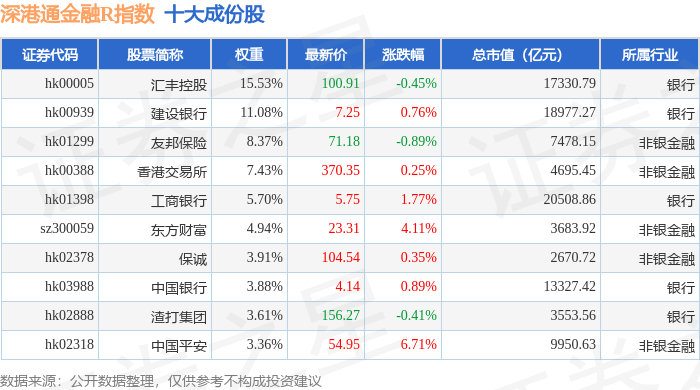
Core Insights - The Shenzhen-Hong Kong Stock Connect Financial R Index (483025) closed at 10,743.61 points, up 1.16%, with a trading volume of 47.173 billion yuan and a turnover rate of 0.43% [1] - Among the index constituents, 65 stocks rose, with Ruida Futures leading with a 10.01% increase, while 22 stocks fell, with Electric Power Investment and Financing leading with a 3.86% decline [1] Index Constituents Summary - The top ten constituents of the Shenzhen-Hong Kong Stock Connect Financial R Index include major financial institutions such as HSBC Holdings, China Construction Bank, and AIA Group, with respective weights of 15.53%, 11.08%, and 8.37% [1] - The total market capitalization of the index constituents varies significantly, with China Construction Bank at 1,897.73 billion yuan and HSBC Holdings at 1,733.08 billion yuan [1] Capital Flow Analysis - The net inflow of main funds into the index constituents totaled 1.556 billion yuan, while retail funds experienced a net outflow of 1.068 billion yuan [3] - Notable net inflows were observed in stocks like Dongfang Wealth and Guotai Junan Securities, with net inflows of 532 million yuan and 132 million yuan respectively [3]






12月5日金融指数(399240)涨2.22%,成份股瑞达期货(002961)领涨
Sou Hu Cai Jing· 2025-12-05 10:24
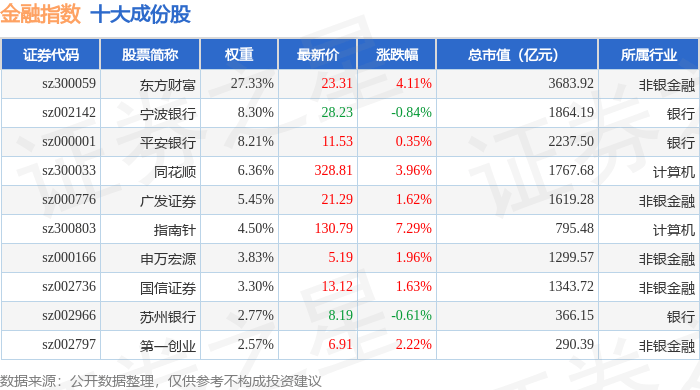
Core Insights - The financial index (399240) closed at 1590.59 points, up 2.22%, with a trading volume of 38.556 billion yuan and a turnover rate of 1.29% [1] - Among the index constituents, 27 stocks rose, led by Ruida Futures with a 10.01% increase, while 6 stocks fell, with Qingdao Bank leading the decline at 2.06% [1] Financial Index Performance - The top ten constituents of the financial index include: - Dongfang Fortune: 27.33% weight, latest price 23.31, up 4.11%, market cap 368.392 billion yuan [1] - Ningbo Bank: 8.30% weight, latest price 28.23, down 0.84%, market cap 186.419 billion yuan [1] - Ping An Bank: 8.21% weight, latest price 11.53, up 0.35%, market cap 223.750 billion yuan [1] - Tonghuashun: 6.36% weight, latest price 328.81, up 3.96%, market cap 176.768 billion yuan [1] - Guotai Junan: 5.45% weight, latest price 21.29, up 1.62%, market cap 161.928 billion yuan [1] - Zhinanzhen: 4.50% weight, latest price 130.79, up 7.29%, market cap 79.548 billion yuan [1] - Shenwan Hongyuan: 3.83% weight, latest price 5.19, up 1.96%, market cap 129.957 billion yuan [1] - Guosen Securities: 3.30% weight, latest price 13.12, up 1.63%, market cap 134.372 billion yuan [1] - Suzhou Bank: 2.77% weight, latest price 8.19, down 0.61%, market cap 36.615 billion yuan [1] - First Venture: 2.57% weight, latest price 6.91, up 2.22%, market cap 29.039 billion yuan [1] Capital Flow Analysis - The net inflow of main funds into the financial index constituents totaled 2.177 billion yuan, while retail funds saw a net outflow of 1.563 billion yuan [3] - Detailed capital flow for key stocks includes: - Dongfang Fortune: 532 million yuan net inflow from main funds, 125 million yuan net outflow from retail [3] - Zhinanzhen: 532 million yuan net inflow from main funds, 392 million yuan net outflow from retail [3] - Guotai Junan: 132 million yuan net inflow from main funds, 868.578 million yuan net outflow from retail [3] - Other notable stocks include Tonghuashun and Ruida Futures, with varying net inflows and outflows [3]





非银金融行业今日涨3.50%,主力资金净流入44.87亿元
Zheng Quan Shi Bao Wang· 2025-12-05 09:25
非银金融行业资金流向排名 | 代码 | 简称 | 今日涨跌幅(%) | 今日换手率(%) | 主力资金流量(万元) | | --- | --- | --- | --- | --- | | 601318 | 中国平安 | 5.88 | 1.29 | 96956.05 | | 300059 | 东方财富 | 4.11 | 4.10 | 51525.74 | | 601696 | 中银证券 | 10.02 | 6.12 | 44084.43 | | 600030 | 中信证券 | 2.43 | 1.35 | 37850.29 | | 601377 | 兴业证券 | 5.57 | 4.08 | 27739.93 | | 601336 | 新华保险 | 4.57 | 1.27 | 16847.70 | | 000776 | 广发证券 | 1.62 | 1.07 | 12807.29 | | 002961 | 瑞达期货 | 10.01 | 6.31 | 11823.72 | | 600095 | 湘财股份 | 4.56 | 3.12 | 11204.15 | | 000987 | 越秀资本 | 2.05 | 1.41 | ...



A股“吹哨人”突放大利好!非银金融集体狂飙,中银证券涨停
2 1 Shi Ji Jing Ji Bao Dao· 2025-12-05 09:12
Core Viewpoint - The A-share market showed signs of recovery on December 5, with the ChiNext index rising over 1% after an initial drop of more than 0.5%. The non-bank financial sector experienced significant gains, driven by positive news regarding China Ping An and regulatory adjustments in the insurance sector [2]. Group 1: Market Performance - The A-share market rebounded, with the ChiNext index increasing by over 1% after a morning decline [2]. - The non-bank financial sector saw a collective surge in the afternoon, with notable stocks like China Ping An and China Pacific Insurance rising over 5% [2]. Group 2: Company-Specific Developments - Morgan Stanley, referred to as the "whistleblower" of the A-share market, added China Ping An to its focus list and maintained it as a top pick [2]. - Morgan Stanley raised the target price for China Ping An's A-shares from 70 yuan to 85 yuan and for its H-shares from 70 HKD to 89 HKD [2]. Group 3: Regulatory Changes - The Financial Regulatory Bureau released a notice adjusting risk factors related to insurance companies' business operations, aiming to promote high-quality development while maintaining risk control [2]. - The adjustments include changes to the risk factors for insurance companies investing in stocks and for export credit insurance, encouraging greater support for foreign trade enterprises [2].

通信行业资金流入榜:实达集团、永鼎股份等净流入资金居前
Zheng Quan Shi Bao Wang· 2025-12-05 09:07
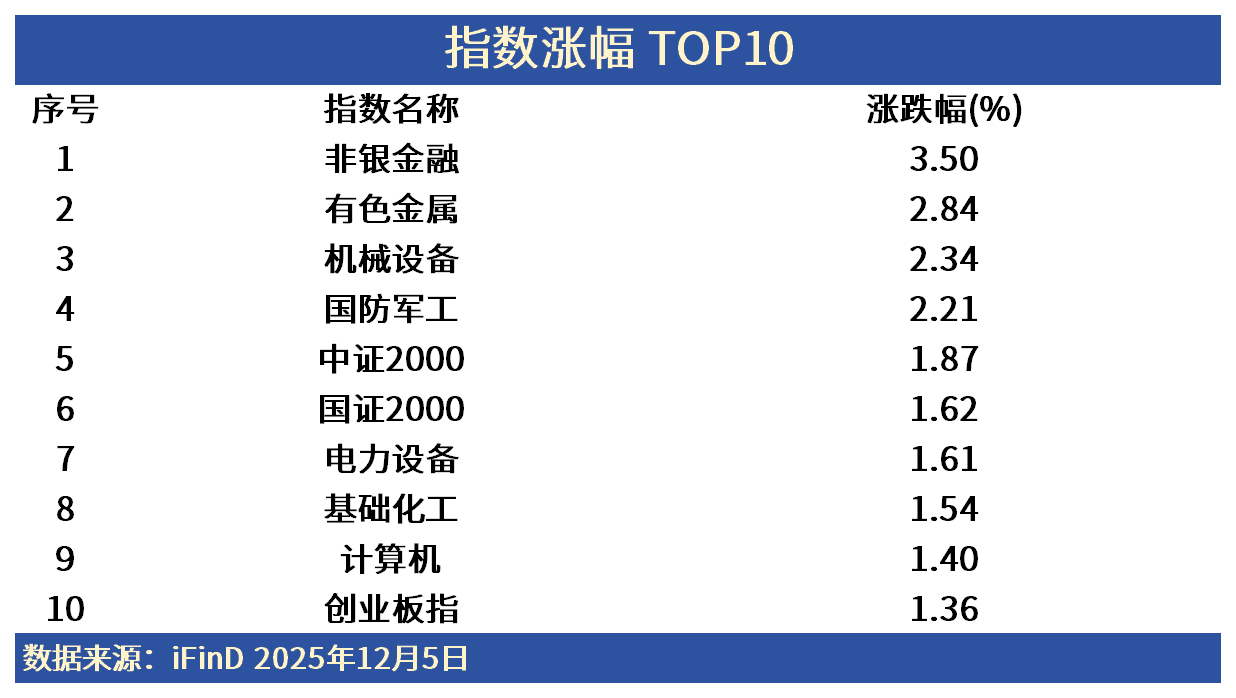
Market Overview - The Shanghai Composite Index rose by 0.70% on December 5, with 29 out of the 31 sectors in the Shenwan classification experiencing gains, led by non-bank financials and non-ferrous metals, which increased by 3.50% and 2.84% respectively [1] - The communication sector also saw an increase of 1.23% [1] - The banking sector was the only one to decline, with a drop of 0.58% [1] Capital Flow - The net inflow of capital in the two markets reached 16.316 billion yuan, with 20 sectors experiencing net inflows [1] - The non-bank financial sector had the highest net inflow of 4.487 billion yuan, followed by the non-ferrous metals sector with a net inflow of 3.781 billion yuan [1] - Conversely, 11 sectors experienced net outflows, with the household appliances sector leading with a net outflow of 1.202 billion yuan, followed by the media sector with a net outflow of 1.04 billion yuan [1] Communication Sector Performance - The communication sector had a net inflow of 2.729 billion yuan, with 106 out of 124 stocks in the sector rising, including 3 stocks hitting the daily limit [2] - The top three stocks with the highest net inflow were Shida Group (1.135 billion yuan), Yongding Co. (962 million yuan), and Taicheng Light (553 million yuan) [2] - Eight stocks in the communication sector experienced net outflows exceeding 100 million yuan, with ZTE Corporation leading at 955 million yuan [3] Communication Sector Capital Inflow - The top stocks in the communication sector by capital inflow included: - Shida Group: +9.93%, turnover rate 36.14%, inflow 1.134 billion yuan - Yongding Co.: +10.03%, turnover rate 13.55%, inflow 962 million yuan - Taicheng Light: +9.25%, turnover rate 21.27%, inflow 553 million yuan [2] Communication Sector Capital Outflow - The top stocks in the communication sector by capital outflow included: - ZTE Corporation: -2.26%, turnover rate 4.12%, outflow 954.91 million yuan - Zhongji Xuchuang: +0.29%, turnover rate 2.56%, outflow 567.94 million yuan - Xinyi Sheng: +0.87%, turnover rate 4.00%, outflow 407.15 million yuan [3]






ETF日报 | “牛市旗手”卷土重来!反弹行情中的板块轮动怎么把握?
Sou Hu Cai Jing· 2025-12-05 07:47
Non-Bank Financials - The Guangdong provincial government has issued a plan to support the integration and merger of industrial chains, allowing insurance funds to increase equity investment in M&A projects, which will enhance the role of non-bank financials as "patient capital" [2] - Morgan Stanley has included China Ping An in its focus list, expressing optimism about its long-term performance [2] - Donghai Securities is optimistic about the sector's configuration opportunities driven by year-end style switching and the "New Year Red" initiative, highlighting the importance of M&A restructuring, wealth management transformation, and ROE improvement [2] Nonferrous Metals - Three rare earth permanent magnet companies have obtained general export licenses, with the Chinese government facilitating compliant trade to maintain global supply chain stability [3] - Changjiang Futures believes that nonferrous metals like copper and aluminum will benefit from the optimization of traditional industries and the growth of emerging sectors during the 14th Five-Year Plan period [3] - The focus on rare metals such as rare earths and lithium is increasing, with the rare metal ETF (159608) gaining attention [3] Machinery Equipment - The "Machinery Industry Stable Growth Work Plan (2025-2026)" sets a revenue target of 10 trillion yuan by 2026, emphasizing innovation in key areas like industrial mother machines and smart equipment [4] - Excavator sales increased by 17% year-on-year from January to October, with engineering machinery exports reaching $48.57 billion, up 12% [4] - Bohai Securities notes a continued recovery in the engineering machinery sector, driven by domestic demand and significant infrastructure projects [4] Market Performance - As of December 5, 2025, the A-share market saw non-bank financials, nonferrous metals, and machinery equipment leading with gains of 3.50%, 2.84%, and 2.34% respectively [1][5] - The banking sector experienced a decline of 0.58%, with Chongqing Bank and Qilu Bank showing the largest drops [5][8] Pharmaceutical Sector - The upcoming release of the new basic medical insurance drug list and the first version of the commercial insurance innovative drug list is expected to create investment opportunities in related pharmaceutical companies [6] - The ongoing flu season is increasing interest in sectors such as in vitro diagnostics, vaccines, and pharmacies, presenting short-term investment opportunities [6] - The largest Hong Kong innovative drug ETF (513120) has seen continuous net inflows over the past six days, indicating strong investor interest [6]
粤开市场日报-20251205
Yuekai Securities· 2025-12-05 07:41
Market Overview - The A-share market showed a positive trend today, with the Shanghai Composite Index rising by 0.70% to close at 3902.81 points, and the Shenzhen Component Index increasing by 1.08% to 13147.68 points. The ChiNext Index remained unchanged at 1326.10 points, while the Growth Enterprise Market Index rose by 1.36% to 3109.30 points. Overall, 4384 stocks increased, 974 stocks decreased, and 93 stocks remained flat, with a total trading volume of 17258 billion yuan, an increase of 1768 billion yuan compared to the previous trading day [1][12]. Industry Performance - Among the Shenwan first-level industries, non-bank financials, non-ferrous metals, machinery and equipment, defense and military industry, and comprehensive sectors led the gains, with increases of 3.50%, 2.84%, 2.34%, 2.21%, and 1.76% respectively. The banking sector was the only one to decline, with a decrease of 0.58% [1][12]. Sector Highlights - The top-performing concept sectors today included stock trading software, selected insurance, cross-strait integration, superconductors, selected industrial metals, nuclear fusion, commercial aerospace, optical modules (CPO), optical chips, aluminum industry, copper industry, ultra-high voltage, large aircraft, financial technology, and nuclear power [2][11].
收评:深指、创指涨超1% 沪指重回3900点 非银金融集体走强
Xin Lang Cai Jing· 2025-12-05 07:02
A股三大指数今日探底回升,截至收盘,上证指数涨0.7%,深证成指涨1.08%,创业板指涨1.36%,北证 50涨1.52%。沪深京三市全天成交额17390亿元,较上日放量1773亿元。全市场超4300只个股上涨。板 块题材上,保险、互联网金融等非银金融板块午后异动拉升,有色金属、可控核聚变、福建自贸区、商 业航天板块涨幅居前;银行板块跌幅居前。盘面上,非银金融板块午后表现强势,保险方向领涨,中国 太保、中国平安涨超5%;多元金融、互联网金融冲高,赢时胜、瑞达期货盘中涨停。稀土永磁板块走 高,宁波韵升涨停。有色金属板块全天强势,精艺股份、闽发铝业涨停。可控核聚变走高,西部材料、 冰轮环境等涨停。银行板块表现稍逊,重庆银行跌超3%。 ...
12月4日区块链50(399286)指数涨0.13%,成份股东华软件(002065)领涨
Sou Hu Cai Jing· 2025-12-05 06:46
证券之星消息,12月4日,区块链50(399286)指数报收于3866.03点,涨0.13%,成交305.46亿元,换手 率1.7%。当日该指数成份股中,上涨的有19家,东华软件以5.94%的涨幅领涨,下跌的有30家,智度股 份以3.19%的跌幅领跌。 | 代码 | 名称 | 主力净流入(元) | 主力净占比 游资净流入 (元) | | 游资净占比 散户净流入 (元) | | 散户净占比 | | --- | --- | --- | --- | --- | --- | --- | --- | | 300007 | 汉威科技 | 1.48 Z | 9.69% | -371.68万 | -0.24% | -1.44 Z | -9.44% | | 002065 | 东华软件 | 9052.31万 | 4.97% | 1500.75万 | 0.82% | -1.06 Z | -5.79% | | 300059 | 东方财富 | 7689.48万 | 1.91% | -3485.67万 | -0.87% | -4203.81万 | -1.04% | | 000776 广发证券 | | 3800.40万 | 7.16% | ...

A股2026年策略展望:盈科而进
Huajin Securities· 2025-12-05 02:49
Core Views - The report suggests that 2026 may witness a structural recovery in earnings, leading to a slow bull market in A-shares, driven by technology and cyclical sectors, despite high valuations [5][17] - The main theme for 2026 is expected to be a continuation of loose liquidity and a structural recovery in earnings, with potential for strong performance in technology and cyclical industries [6][37] Macroeconomic Environment - The macroeconomic outlook for 2026 indicates that the Federal Reserve may continue to lower interest rates, maintaining a loose liquidity environment domestically [19][24] - Exports are anticipated to face high base pressure but may still show resilience, particularly in high-tech products and emerging markets [26][27] - Infrastructure investment growth is expected to stabilize and recover, supported by proactive fiscal policies and increased issuance of special bonds [28] - Real estate investment growth is likely to remain weak, although policies may ease, leading to a gradual stabilization in housing prices and sales [30] - Manufacturing investment growth is projected to stabilize and recover, driven by policies promoting new productive forces and equipment upgrades [32] Industry Allocation - The report recommends focusing on technology growth and cyclical growth as the main allocation themes for 2026, with specific attention to sectors such as TMT (Technology, Media, and Telecommunications), electric new energy, machinery, pharmaceuticals, non-ferrous metals, chemicals, military industry, and non-bank financials [7] - Large-cap and small-cap stocks are expected to perform relatively well, with a tilt towards cyclical styles [7] Earnings Recovery - Earnings in the technology and cyclical sectors are expected to continue rising, contributing positively to overall A-share performance [37][39] - The report highlights that fiscal policy support may enhance corporate earnings growth, similar to past instances of fiscal stimulus [39]