小金属

Search documents
【机构策略】预计A股市场维持震荡偏强走势
Sou Hu Cai Jing· 2025-09-17 01:13
Group 1 - The A-share market showed a rebound after a dip, with the Shanghai Composite Index and Shenzhen Component Index experiencing fluctuations, while sectors like automotive, internet services, robotics, and computer equipment performed well [1] - Global capital is flowing into the A-share market, with an acceleration of household savings moving towards capital markets, creating a continuous source of incremental funds [1] - The expectation of a dovish signal from the Federal Reserve and a weaker dollar is likely to facilitate foreign capital returning to the A-share market [1] Group 2 - The A-share market continued its volatile trend, but individual stocks were active, and trading volume slightly increased ahead of the Federal Reserve's meeting [2] - The current valuation of A-shares remains attractive in the medium to long term, with policies aimed at reducing internal competition and demand-side policies being crucial for the market's future performance [2] - The influx of household savings into the market is expected to support the strengthening of market indices, indicating that the foundation for a slow bull market still exists [2]
锑板块更新:供应面临约束,出口需求修复在即
2025-09-17 00:50
Summary of the Antimony Sector Update and Company Insights Industry Overview - The antimony export demand in China is recovering, with private enterprises accelerating export order approvals, while state-owned enterprises are lagging due to responsibility tracing systems. Overall export volume is currently below the pre-October 2024 level of approximately 3,000 tons per month, but there is considerable room for recovery [1][2] - The photovoltaic (PV) sector shows early signs of demand recovery, with daily melting volume of PV glass rebounding from a mid-2024 peak of 117,000 tons per day to nearly 90,000 tons per day, indicating positive inventory depletion and rising panel prices [1][2] Supply Dynamics - Global antimony supply is significantly contracting, with overseas production from Polar Gold expected to be zero in the first half of 2025 due to mining area transitions, affecting 10% of global supply. Domestically, China's antimony production has decreased by 20%, impacting 14% of global supply [1][4] - Overall, global antimony supply is projected to decrease by nearly 25% in 2025 due to reduced overseas mining and increased environmental inspections in China, with limited new supply expected from regions like Xinjiang, Australia, and the U.S. until around 2027 [1][4] Investment Opportunities - Recommended companies for investment include Hunan Gold, Huayu Mining, Xiyou Color, and Yuguang Gold Lead. Yuguang Gold Lead is highlighted for its low valuation and strong expected performance, with a profit structure comprising 60% precious metals, 20% minor metals, and 20% base metals [1][5][6] - Yuguang Gold Lead's business model involves sourcing lead and copper concentrates globally, producing lead ingots and cathode copper, and generating significant revenue from by-products like gold, silver, and antimony oxide [5][6] Profitability Insights - In the lead-zinc mining business, the pricing of gold and silver typically incurs a discount, allowing for a 10% margin through the purchase of lead-zinc mines containing these metals. The unit gross profit increases with rising gold and silver prices [3][7] - The minor metals recycling business benefits from low-grade raw materials, leading to revenue growth that outpaces cost increases, thus driving profit margins upward [8] Valuation and Market Position - Yuguang Gold Lead is viewed as a small metal mining company with stable smelting costs. Its profit structure spans precious, minor, and base metals, providing a comprehensive coverage of the non-ferrous industry chain. The company’s products are currently in a price-upward cycle, ensuring strong performance growth [9][10] - The company’s projected profits for the first half of 2025 are estimated at 500 million yuan, with a potential market capitalization of 18 billion yuan if a 15x valuation is applied to a full-year profit of 1.2 billion yuan [10]

看涨
第一财经· 2025-09-16 11:09
Market Overview - The market has shown a "bullish engulfing" pattern on the daily chart, recovering above the 5-day moving average, with a MACD golden cross on the 60-minute chart indicating a potential upward trend [3]. - A total of 3,627 stocks have risen, indicating a broad-based market rally [3]. Sector Performance - The stock market exhibits a dual characteristic of widespread gains among individual stocks and sector differentiation, with the internet e-commerce sector leading the gains. Other active sectors include electric machinery, humanoid robots, automotive parts, and brain-computer interface, while the aquaculture, small metals, and China shipbuilding sectors lagged [4]. Trading Volume - Today's trading volume in both markets showed a "moderate rebound," with increased market activity. The technology growth sector has become the focal point for capital, and the market is expected to maintain a consolidation phase in the short term. It is crucial to monitor whether trading volume can sustain above 2.5 trillion yuan to break through key resistance levels [5]. Capital Flow - There is a net outflow of institutional funds, while retail investors are experiencing a net inflow of funds [6]. Institutional Behavior - The balance between defensive and offensive strategies among institutions is intensifying, with cyclical sectors being heavily reduced. Conversely, technology stocks on the Sci-Tech Innovation Board are gaining traction, as some institutions begin to allocate towards defensive assets while still capitalizing on policy benefits. Retail investors are exhibiting a mixed sentiment of high volatility and cautious observation, favoring short-term gains through leverage and small-cap stocks, while also showing increased wariness towards external risks [7]. Investor Sentiment - Retail investor sentiment is characterized by a blend of aggressive trading and heightened risk awareness, particularly in small-cap stocks, as they pursue hot topics like robotics and AI computing power [7].


小金属板块9月16日跌2.56%,广晟有色领跌,主力资金净流出47.29亿元
Zheng Xing Xing Ye Ri Bao· 2025-09-16 08:46
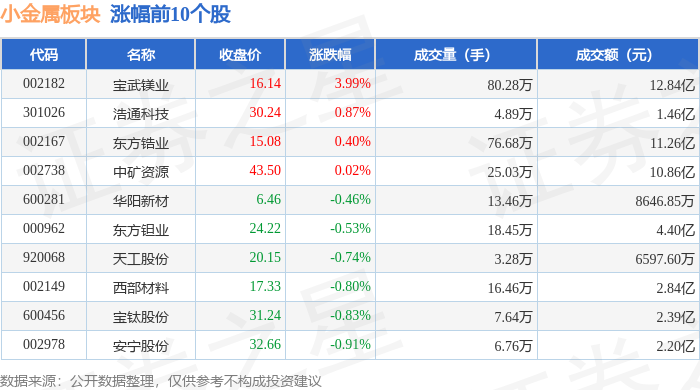
Group 1 - The small metal sector experienced a decline of 2.56% on September 16, with Guangsheng Nonferrous Metals leading the drop [1][2] - The Shanghai Composite Index closed at 3861.87, up 0.04%, while the Shenzhen Component Index closed at 13063.97, up 0.45% [1] - Major stocks in the small metal sector showed mixed performance, with Baowu Magnesium rising by 3.99% and Guangsheng Nonferrous Metals falling by 4.68% [1][2] Group 2 - The small metal sector saw a net outflow of 4.729 billion yuan from main funds, while retail investors contributed a net inflow of 3.898 billion yuan [2][3] - The trading volume and turnover for key stocks varied significantly, with Baowu Magnesium achieving a turnover of 1.284 billion yuan and Guangsheng Nonferrous Metals at 1.231 billion yuan [1][2] - The net inflow from retail investors was notable in several stocks, including Huayang New Materials, which saw a net inflow of 142.386 million yuan [3]


A股三大指数收涨,机器人概念股掀涨停潮
Sou Hu Cai Jing· 2025-09-16 08:14
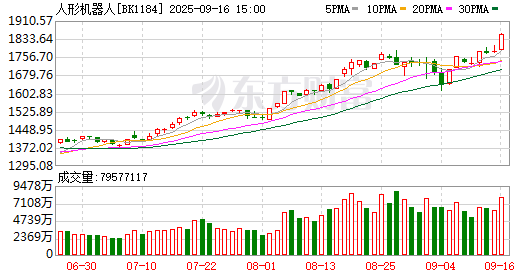
Market Overview - The A-share market experienced fluctuations but ultimately rose, with the ChiNext index initially dropping over 1% before recovering in the afternoon [1] - The total trading volume in the Shanghai and Shenzhen markets reached 2.34 trillion yuan, an increase of 64 billion yuan compared to the previous trading day [1] Index Performance - At the close, the Shanghai Composite Index rose by 0.04% to 3861.87 points, the Shenzhen Component Index increased by 0.45% to 13063.97 points, and the ChiNext Index gained 0.68% to 3087.04 points [2] Market Sentiment - Market sentiment showed a clear improvement, with more stocks rising than falling; over 3500 stocks increased in value [3] - Most industry sectors saw gains, with notable increases in the electric machinery, automotive parts, real estate services, logistics, computer equipment, diversified finance, consumer electronics, and textile and apparel sectors [3] Stock Performance - More than 3600 stocks rose, with nearly 90 stocks hitting the daily limit up [5] - The robotics sector saw significant gains, with companies like Hongchang Technology and Hanwei Technology reaching the 20% limit up, along with several others [5] Capital Flow - In terms of capital flow, sectors such as internet services, automotive parts, and general equipment saw significant net inflows, with internet services attracting a net inflow of 3.298 billion yuan [6] - Conversely, sectors like small metals, banking, and batteries experienced notable net outflows, with small metals seeing a net outflow of 5.868 billion yuan [8]


【开盘】上证指数高开0.14%,创业板指涨0.2%,贵金属、小金属板块走强
Xin Lang Cai Jing· 2025-09-16 01:46
Market Overview - On September 16, A-shares opened higher across the board, with the Shanghai Composite Index rising by 0.14% and the ChiNext Index increasing by 0.2% [1] - The precious metals and small metals sectors showed strong performance, while sectors such as rare earths, photovoltaics, and agriculture experienced declines [1] Monetary Policy - The People's Bank of China announced a 287 billion yuan reverse repurchase operation for 7 days at a fixed rate of 1.40%, with a total bid amount of 287 billion yuan and a successful bid amount of 287 billion yuan [1] - On the same day, 247 billion yuan of reverse repos matured, resulting in a net injection of 40 billion yuan [1] Margin Trading - The margin trading balance in the two markets increased by 18.43 billion yuan, totaling 2369.99 billion yuan [2]

调仓?
第一财经· 2025-09-15 12:23
Core Viewpoint - The A-share market shows a mixed performance with the Shanghai Composite Index experiencing adjustments, while the ChiNext Index reaches a new high driven by leading stocks in the battery and energy sectors [4]. Market Performance - A total of 1,913 stocks rose while 3,371 stocks fell, indicating a predominance of declines in the market [5]. - The market's profit-making effect is concentrated in sectors driven by strong policies or events, such as gaming, battery and energy, automotive industry chain, and smart driving, while sectors like communication equipment, semiconductors, and small metals are undergoing adjustments [6]. Trading Volume and Market Sentiment - The trading volume in both markets has significantly decreased, largely due to market participants adopting a wait-and-see approach ahead of key external events like the Federal Reserve's September meeting [7]. - The market exhibits characteristics of "strong in Shenzhen, weak in Shanghai" and "growth stronger than cyclical," with funds shifting from high-performing sectors to relatively lower-performing or policy-favored sectors [7]. Fund Flow Dynamics - Institutional investors are taking profits and rotating sectors, with funds flowing out of previously high-performing technology and cyclical sectors like communication equipment and semiconductors, while flowing into automotive parts, gaming, and complete vehicles [9]. - Retail investors are following hot trends and actively participating, with significant fund inflows into the automotive industry chain and gaming sectors, while some funds are supporting high-tech and cyclical sectors that have been sold off by institutional investors [9]. Investor Sentiment - As of September 15, 28.24% of investors are increasing their positions, while 19.17% are reducing their positions, with 52.59% maintaining their current positions [14]. - The sentiment indicates a cautious approach among investors, with a notable percentage (60.90%) anticipating a market decline [16].

小金属板块9月15日跌2.12%,章源钨业领跌,主力资金净流出34.46亿元
Zheng Xing Xing Ye Ri Bao· 2025-09-15 08:43
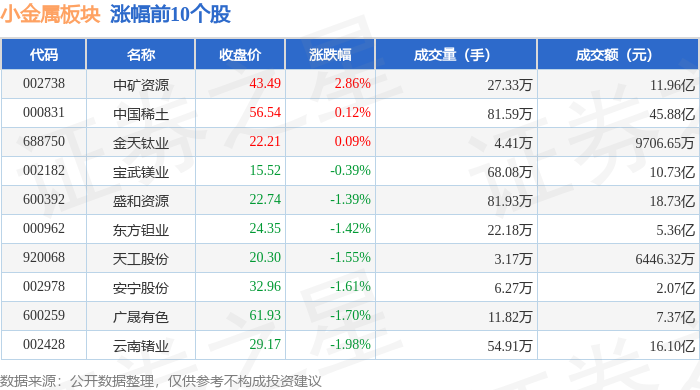
Market Overview - The small metals sector experienced a decline of 2.12% on September 15, with Zhangyuan Tungsten leading the drop [1] - The Shanghai Composite Index closed at 3860.5, down 0.26%, while the Shenzhen Component Index closed at 13005.77, up 0.63% [1] Individual Stock Performance - Zhongkuang Resources (002738) rose by 2.86% to close at 43.49, with a trading volume of 273,300 shares and a transaction value of 1.196 billion [1] - China Rare Earth (000831) saw a slight increase of 0.12%, closing at 56.54, with a trading volume of 815,900 shares [1] - Other notable declines included Caonong Tungsten (002378) down 5.89% to 13.11, and Huaxi Nonferrous (600301) down 5.32% to 32.19 [2] Capital Flow Analysis - The small metals sector experienced a net outflow of 3.446 billion in main funds, while retail investors saw a net inflow of 2.121 billion [2] - The table of capital flow indicates that major funds were predominantly exiting, while retail investors were entering the market [2][3] Detailed Stock Capital Flow - China Rare Earth (000831) had a net inflow of 36.1354 million from main funds, while retail investors contributed a net inflow of 11.0657 million [3] - Anning Shares (002978) faced a significant net outflow of 22.0635 million from main funds, despite a retail net inflow of 18.4799 million [3] - Huayang New Materials (600281) showed a stark contrast with a net outflow of 32.3273 million from main funds, while retail investors contributed a net inflow of 28.6828 million [3]


超3300只个股下跌
第一财经· 2025-09-15 07:43
Core Viewpoint - The article discusses the performance of the stock market on September 15, highlighting mixed results among major indices and sector performances, with a focus on active sectors like gaming and pork, while noting the underperformance of certain materials sectors [2][5][10]. Market Performance - The three major indices closed with mixed results: Shanghai Composite Index at 3860.5 points, down 0.26%; Shenzhen Component Index at 13005.77 points, up 0.63%; and ChiNext Index at 3066.18 points, up 1.52% [2][3]. - The total trading volume in the Shanghai and Shenzhen markets was 2.28 trillion yuan, a decrease of 245.8 billion yuan from the previous trading day, with over 3300 stocks declining and more than 1900 stocks rising [2][3]. Sector Performance - Active sectors included pork (+2.82%), gaming (+3.65%), and automotive parts, while superconductors and retail concepts showed weak performance [5][6]. - Notable stocks in the gaming sector included Xinghui Entertainment, which hit a 20% limit up, and Perfect World, which also reached the limit up, with several other gaming stocks rising over 6% [6]. - In the pork sector, stocks like Delisi and Aonong Biological reached their daily limit, while Tiankang Biological rose over 8% [7]. Capital Flow - Main capital inflows were observed in the automotive, electric equipment, and machinery sectors, while there were outflows from electronics, communications, and defense sectors [10]. - Specific stocks with significant net inflows included BYD, Top Group, and Zhongdali De, with net inflows of 840 million yuan, 716 million yuan, and 700 million yuan respectively [11]. - Conversely, stocks like Northern Rare Earth, Wolong Electric Drive, and Zhongji Xuchuang faced substantial net outflows of 2.01 billion yuan, 1.83 billion yuan, and 1.386 billion yuan respectively [12]. Institutional Views - Citic Securities noted that the market is entering a high-level consolidation phase, with macro trading becoming a significant variable affecting market direction [14]. - Huatai Securities expressed a positive mid-term outlook for the domestic fundamentals, suggesting maintaining a high position while focusing on cost-effectiveness and industry prosperity [14].






收评:指数分化创业板指涨1.51% 游戏板块走强
Zhong Guo Jing Ji Wang· 2025-09-15 07:28
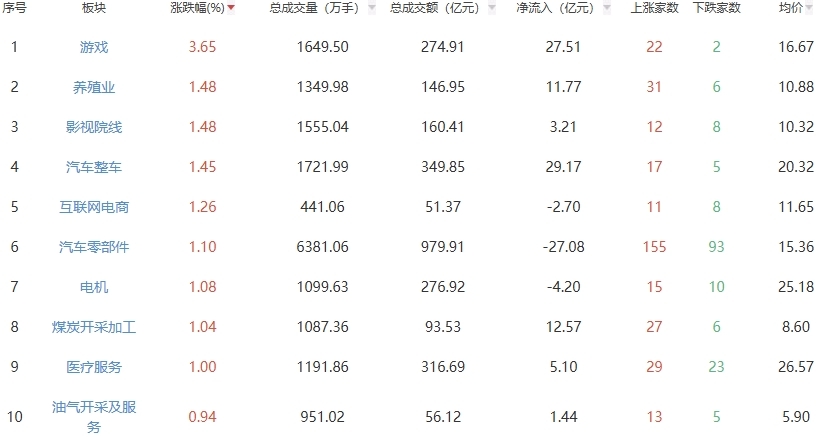
Market Overview - The three major indices in the A-share market collectively rose in early trading, with mixed performance in the afternoon session. The Shanghai Composite Index closed at 3860.50 points, down 0.26%, with a trading volume of 986.17 billion yuan. The Shenzhen Component Index closed at 13005.77 points, up 0.63%, with a trading volume of 1291.21 billion yuan. The ChiNext Index closed at 3066.18 points, up 1.51%, with a trading volume of 616.54 billion yuan [1]. Sector Performance - The gaming, aquaculture, and film and television sectors saw the highest gains, while small metals, precious metals, and cultural media sectors experienced the largest declines [2]. Sector Rankings - The gaming sector led with a gain of 3.65%, totaling a trading volume of 1649.50 million hands and a transaction value of 27.49 billion yuan, with a net inflow of 2.75 billion yuan [3]. - The aquaculture sector increased by 1.48%, with a trading volume of 1349.98 million hands and a transaction value of 1.47 billion yuan, showing a net inflow of 1.18 billion yuan [3]. - The film and television sector also rose by 1.48%, with a trading volume of 1555.04 million hands and a transaction value of 1.60 billion yuan, along with a net inflow of 0.32 billion yuan [3]. - In contrast, the small metals sector fell by 2.10%, with a trading volume of 1171.95 million hands and a transaction value of 35.17 billion yuan, experiencing a net outflow of 4.57 billion yuan [3]. - The cultural media sector declined by 1.46%, with a trading volume of 2730.78 million hands and a transaction value of 25.87 billion yuan, facing a net outflow of 2.39 billion yuan [3].