海洋经济

Search documents
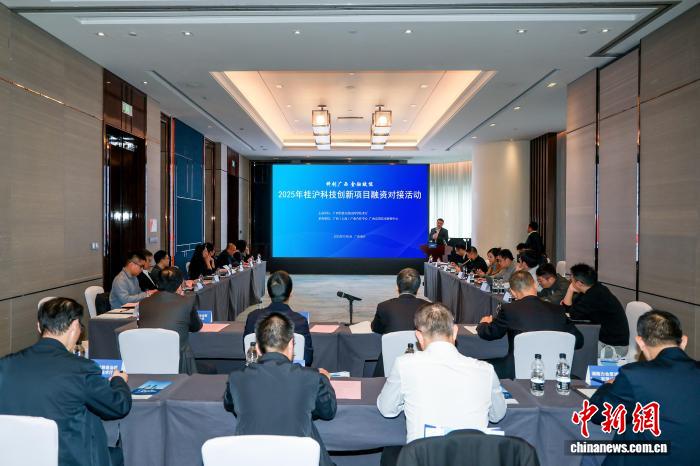
2025年桂沪科技创新项目融资对接活动在南宁举办
Zhong Guo Xin Wen Wang· 2025-11-05 09:27
Core Insights - The 2025 Guangxi-Shanghai Technology Innovation Project Financing Matchmaking Event was held in Nanning, aiming to connect high-quality technology projects with financial capital to promote the transformation of technological achievements in Guangxi [1][3] Group 1: Event Overview - The event was organized by the Guangxi Zhuang Autonomous Region Science and Technology Department, focusing on key sectors such as high-end equipment manufacturing, advanced new materials, new generation information technology, new energy and storage, biomedicine, modern characteristic agriculture, marine economy, and green low-carbon technology [3][4] - Eight technology companies from Guangxi and beyond presented their technological achievements, market prospects, and financing needs, attracting significant attention from investment institutions [3][4] Group 2: Financial Mechanisms - The Guangxi Science and Technology Department has implemented the "Guangxi Technology Achievement Transformation Fund Management Measures (Trial)" to establish a profit-sharing and risk tolerance mechanism, creating a fund operation system that includes "mother fund + sub-fund + direct investment" [3] - The focus is on supporting seed-stage and early-stage technology enterprises, with plans to continuously optimize the technology finance ecosystem and accelerate fund deployment to provide comprehensive financial support for industrial upgrades [3][4] Group 3: Investment Opportunities - Over ten investment institutions, including CITIC Jinshi Capital Management Co., Ltd. and Beijing Zhongguancun Capital Fund Management Co., Ltd., engaged in in-depth discussions with the presenting companies to explore cooperation and investment opportunities [4]

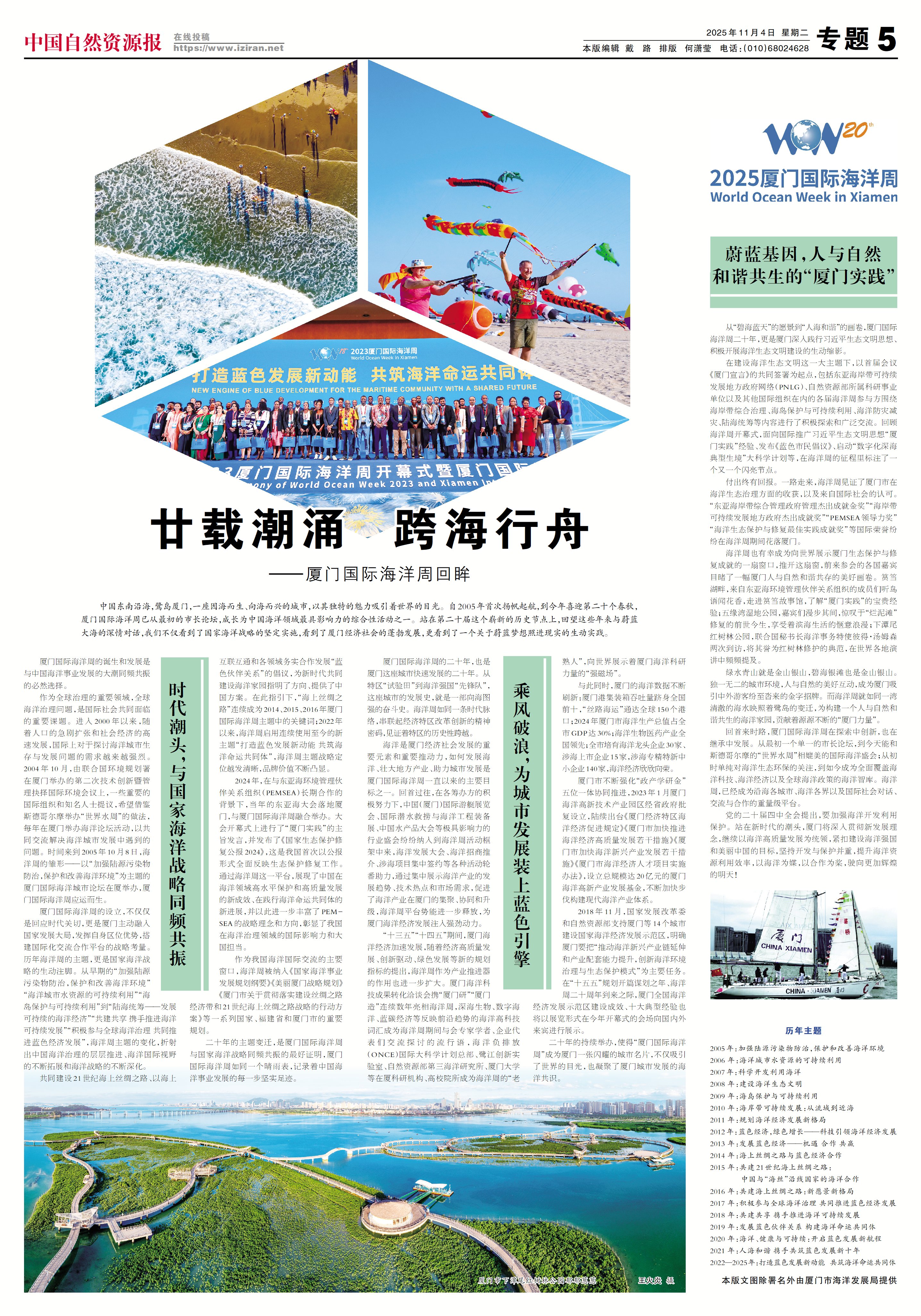
廿载潮涌 跨海行舟——厦门国际海洋周回眸
Zhong Guo Zi Ran Zi Yuan Bao· 2025-11-04 02:15
Core Viewpoint - The Xiamen International Ocean Week has evolved into a significant platform for marine governance and development in China, reflecting the country's commitment to marine strategy and sustainable development over the past two decades [4][8][11]. Group 1: Historical Development - The Xiamen International Ocean Week began in 2005 as a response to the growing need for discussions on marine urban development, inspired by international initiatives like the "World Water Week" in Stockholm [11][12]. - The event has grown from a mayoral forum to one of the most influential marine events in China, marking its 20th anniversary in 2024 [8][19]. Group 2: Strategic Importance - The establishment of the Ocean Week aligns with national development goals, leveraging Xiamen's geographical advantages to create an international cooperation platform [5][12]. - Themes of the Ocean Week have evolved to reflect national marine strategies, with recent themes focusing on sustainable marine economic development and international cooperation [12][30][31]. Group 3: Economic Impact - The Ocean Week has facilitated significant events such as the China (Xiamen) International Yacht Exhibition and various marine industry conferences, promoting the growth of the marine economy in Xiamen [16][17]. - Xiamen's marine economy has seen rapid growth, with projections indicating that marine production value will account for 30% of the city's GDP by 2024 [17]. Group 4: Environmental Initiatives - The Ocean Week serves as a platform for showcasing China's achievements in marine ecological protection and restoration, including the release of the "National Ecological Protection and Restoration Bulletin 2024" [13][25]. - The event has garnered international recognition for Xiamen's efforts in marine ecological governance, receiving various awards for excellence in coastal management and sustainable development [25][26]. Group 5: Future Directions - Moving forward, Xiamen aims to enhance its role in marine high-quality development, focusing on balancing marine resource utilization and environmental protection [27]. - The city is committed to continuing its efforts in building a modern marine industry system, supported by various government initiatives and funding [18].
四大证券报精华摘要:11月4日
Zhong Guo Jin Rong Xin Xi Wang· 2025-11-04 00:41
Group 1 - The A-share market experienced a rebound on November 3, with all three major indices rising, and over 3,500 stocks increasing in value, indicating a positive market trend [1] - The trading volume in the A-share market reached 2.13 trillion yuan, marking the sixth consecutive trading day above 2 trillion yuan, reflecting strong market activity [1] - Over 180 stocks have been included in the brokerage "golden stock" list for November, with Top Group receiving recommendations from five brokerages, highlighting its popularity among investors [1] Group 2 - The banking sector, specifically Industrial and Commercial Bank of China and China Construction Bank, announced a temporary suspension of certain gold investment services, which was later lifted, indicating a response to changes in gold tax policies and market conditions [2] - The securities industry is undergoing significant changes, with six brokerages having completed name changes this year, reflecting a strategic restructuring in response to regulatory pressures and market challenges [3] - The Hong Kong stock market has become a popular listing destination, with IPO financing reaching 216.47 billion HKD in 2023, a 203.5% increase year-on-year, indicating a robust market environment [3] Group 3 - The Ministry of Industry and Information Technology and the Ministry of Water Resources released a plan for the high-quality development of water-saving equipment, aiming to enhance the water resource utilization in response to the country's water scarcity issues [4] - The marine economy in China showed a positive trend, with a GDP of 7.9 trillion yuan in the first three quarters of the year, growing by 5.6% year-on-year, and a significant increase in approved marine project areas [5] - The energy storage sector is witnessing rapid growth, with major companies securing significant contracts, and the global lithium carbonate price has surged due to increased demand and inventory depletion [6] Group 4 - Local governments in provinces like Shanxi, Henan, and Guangdong are introducing policies to promote brain-computer interface technology, indicating a push for innovation and development in this emerging field [7] - Securities firms are increasing their margin trading limits to meet rising market demand, reflecting a bullish sentiment in the A-share market and a competitive landscape among brokerages [8] - Major projects in the Shanghai stock market are focusing on modern industrial systems, including traditional industry upgrades and investments in strategic emerging industries like semiconductors [8]
能源早新闻丨这一领域,我国迈入世界第一方阵
中国能源报· 2025-11-03 22:33
Industry Updates - The Ministry of Industry and Information Technology announced a list of 129 companies that meet the "Photovoltaic Manufacturing Industry Standard Conditions" [2] - The Ministry of Industry and the Ministry of Water Resources released a high-quality development implementation plan for water-saving equipment, aiming for breakthroughs in key areas by 2027 [2] - The marine economy showed a good performance with a marine GDP of 7.9 trillion yuan, a year-on-year increase of 5.6%, driven by growth in marine oil and gas production [3] - China's low-carbon metallurgy technology has entered the world's top tier, with significant advancements in high-end, intelligent, and green development in the steel industry [3] - Hebei's Shijiazhuang city has achieved a renewable energy installed capacity of 10.156 million kilowatts, accounting for 52% of the total installed capacity [4] - Inner Mongolia's oil and gas production increased, with crude oil production reaching 2.5 million tons, a year-on-year increase of 4.2% [6] International News - Major oil-producing countries announced a pause in production increases in early 2026, maintaining a daily increase of 137,000 barrels until then [7] - Iran plans to launch its first nuclear-powered seawater desalination plant, capable of processing 70,000 cubic meters of seawater daily [7] Corporate Developments - The North Luan Power Plant in Ningbo, Zhejiang, has been successfully commissioned, becoming the largest thermal power plant in China by installed capacity [8]
城市24小时 | 中部非省会第一城之争,洛阳“扳回一城”
Mei Ri Jing Ji Xin Wen· 2025-11-03 15:55
Economic Performance - Xiangyang's GDP for the first three quarters reached 435.546 billion yuan, with a year-on-year growth of 4.0%, which is 1.2 percentage points lower than the national average [1][2] - In comparison, Luoyang's GDP was 445.49 billion yuan, growing by 5.8%, and Yichang's GDP was 455.328 billion yuan, with a growth rate of 7.0%, both surpassing Xiangyang [1][2] Industry Structure - The industrial structure of Xiangyang is divided into three sectors: 9.2% primary, 41.4% secondary, and 49.4% tertiary [1] - Luoyang's industrial growth is driven by high-tech manufacturing, which saw an increase of 75.7%, contributing significantly to the overall industrial growth [3] Competitive Landscape - The competition for the title of "first non-provincial city" in Central China has intensified, with Yichang and Xiangyang vying for the top position after surpassing Luoyang [1] - By 2024, both Yichang and Xiangyang are projected to exceed 600 billion yuan in GDP, with Yichang expected to lead with 619.112 billion yuan [1] Industry Challenges - Xiangyang's economic growth has been hindered by its reliance on the automotive industry, which has not been able to compensate for declines in other emerging sectors [2] - Luoyang faces similar challenges, as it continues to focus on traditional industries while other cities are advancing in high-value sectors like semiconductors and new energy vehicles [2] Future Prospects - The establishment of a new battery manufacturing facility by CATL in Luoyang is expected to significantly boost the local economy, with an anticipated annual output value exceeding 200 billion yuan [5] - Both cities are under pressure to reshape their industrial structures to avoid being left behind in the ongoing industrial transformation [2]
收评:沪指涨0.55%创业板指涨0.29% 分散染料和海南板块涨幅靠前
Xin Hua Cai Jing· 2025-11-03 07:24
Market Overview - The three major stock indices in Shanghai and Shenzhen opened lower on November 3, with the Shenzhen Component Index dropping as much as 1.64% and the ChiNext Index down 2.09% at one point. However, the Shanghai Composite Index turned positive during the morning session, while both the Shenzhen Component and ChiNext indices rebounded in the afternoon [1] - By the end of the trading day, the Shanghai Composite Index closed at 3976.52 points, up 0.55%, with a trading volume of approximately 941.7 billion yuan. The Shenzhen Component Index closed at 13404.06 points, up 0.19%, with a trading volume of about 1165.4 billion yuan. The ChiNext Index ended at 3196.87 points, up 0.29%, with a trading volume of around 540.4 billion yuan [1] Sector Performance - The sectors that performed well included dispersed dyes, Hainan, internet, media and entertainment, short drama games, combustible ice, Sora concept, steel, shipbuilding, TOPCon batteries, marine economy, and nuclear power, all showing significant increases [1] - Conversely, sectors such as composite copper foil, rare earth permanent magnets, and engineering machinery experienced notable declines, although their losses narrowed in the afternoon as the indices rebounded [1] Institutional Insights - According to institutional views, the market is expected to maintain an upward trend, with a focus on high-growth sectors such as semiconductors, consumer electronics, artificial intelligence, robotics, and low-altitude economy [2] - The return of the A-share market to the 4000-point level is attributed to fundamental changes in the economy, including low risk-free interest rates and significant shifts in top-level design and planning that have altered the market ecosystem [2] Policy Developments - The People's Bank of China and the Bank of Korea have renewed a bilateral currency swap agreement with a scale of 400 billion yuan / 70 trillion won, effective for five years, which aims to deepen financial cooperation and facilitate bilateral trade [4] - The Ministry of Industry and Information Technology and the Ministry of Water Resources have issued a plan to cultivate leading enterprises in water-saving equipment and specialized "little giant" companies by 2027, focusing on breakthroughs in water supply, usage, and recycling technologies [5]

【图解】“十四五”高质量发展答卷:山水林田湖草沙一体化 自然资源实现高质量发展
Zhong Guo Jing Ji Wang· 2025-10-30 00:09
Core Insights - The "14th Five-Year Plan" has led to significant advancements in the high-quality development of natural resources in China, with a focus on sustainable management and utilization [1][2]. Group 1: Agricultural Resources - As of the end of 2024, the cultivated land area reached 1.94 billion acres, an increase of 28 million acres since 2020, firmly maintaining the protection of arable land [1]. Group 2: Mineral Resources - A comprehensive assessment of 163 types of mineral resources has been conducted, revealing the quantity, distribution, and utilization status, with 534 new large and medium-sized oil and gas fields and mineral sites discovered [2]. Group 3: Water Resources - The total water resource volume is 31.1 trillion cubic meters, including 8.679 trillion cubic meters of groundwater [3]. Group 4: Marine Economy - By 2024, the marine production value increased by 34% compared to the end of the "13th Five-Year Plan," accounting for 7.8% of the national GDP, highlighting the marine economy's role in stabilizing economic growth [4]. Group 5: Forest and Ecological Resources - Forest coverage reached 25.09%, an increase of approximately 2 percentage points since 2020, making China the fastest-growing country in terms of greening; forest stock volume reached 20.988 billion cubic meters, achieving the 2030 climate change target ahead of schedule [5].

山东省委书记林武:努力打造北方地区经济重要增长极
Bei Jing Ri Bao Ke Hu Duan· 2025-10-29 00:50
Core Points - The 20th Central Committee's Fourth Plenary Session emphasizes the importance of the "14th Five-Year Plan" and the upcoming "15th Five-Year Plan," showcasing the strategic planning and responsibility of the central leadership under Xi Jinping [1][2][3] - The session aims to unify thoughts and actions around the significant achievements during the "14th Five-Year Plan" and to outline the strategic tasks for the "15th Five-Year Plan" [2][3] Summary by Sections Economic Development - Shandong's GDP is projected to increase from 7.44 trillion yuan in 2020 to 9.86 trillion yuan by 2024, with expectations to surpass 10 trillion yuan this year [5] - The high-tech industry accounts for 55.2% of the total industrial output, with over 35,000 high-tech enterprises [5] - The province's non-fossil energy installed capacity exceeds 130 million kilowatts, representing 53.4% of the total, with a cumulative reduction of 18.5% in energy consumption per unit of GDP over four years [5] Social Development - Shandong has implemented 20 key livelihood projects, maintaining a fiscal expenditure on people's livelihoods at around 80%, with an average annual growth of 6.4% in per capita disposable income over four years [5] Strategic Planning - The "15th Five-Year Plan" focuses on high-quality development, emphasizing the need for quality, efficiency, and innovation in economic growth [7][10] - The plan aims to address existing issues such as insufficient innovation capacity and regional development imbalances [8] Regional Coordination - The strategy includes promoting regional coordination and urban-rural integration, with a focus on the Yellow River's ecological protection and the development of a modern marine economy [12] Common Prosperity - The plan emphasizes enhancing public services and social security systems to ensure equitable access to resources and opportunities for all citizens [13] Safety and Security - The strategy incorporates a comprehensive approach to maintaining economic and social stability, addressing risks in various sectors, including finance and production safety [14] Implementation and Accountability - The emphasis is on strong execution of the plans, with clear timelines and responsibilities assigned to ensure that the objectives of the "15th Five-Year Plan" are met effectively [15][16][17]
新质引领 威震海疆——山东企业一线调研·威海篇
Shang Hai Zheng Quan Bao· 2025-10-28 20:26
Core Insights - The article discusses the recent developments in the coastal region of Weihai, highlighting its economic growth and investment potential [1] Group 1: Economic Growth - Weihai's coastal area has seen a significant increase in tourism, contributing to a 15% rise in local GDP over the past year [1] - The local government has implemented policies to attract foreign investment, resulting in a 20% increase in foreign direct investment (FDI) compared to the previous year [1] Group 2: Investment Opportunities - Several infrastructure projects are underway, including a new port and transportation network, expected to enhance connectivity and boost trade [1] - The region is positioning itself as a hub for renewable energy, with plans to invest 5 billion in solar and wind energy projects over the next five years [1] Group 3: Challenges and Considerations - Despite the growth, there are concerns regarding environmental sustainability and the impact of rapid development on local ecosystems [1] - The local workforce is undergoing training programs to meet the demands of new industries, with a focus on technology and green jobs [1]
重磅!十五五规划建议发布(全文)
第一财经· 2025-10-28 08:45
Core Viewpoint - The "15th Five-Year Plan" period is crucial for achieving basic socialist modernization, building on the significant achievements of the "14th Five-Year Plan" period, and addressing complex domestic and international challenges [2][3][4] Group 1: Achievements and Challenges - The "14th Five-Year Plan" period saw major achievements in economic stability, high-quality development, technological innovation, and social governance despite facing severe challenges such as the pandemic [2] - The "15th Five-Year Plan" period will focus on consolidating advantages, overcoming bottlenecks, and enhancing weaknesses to secure strategic initiatives in international competition [3][4] Group 2: Economic and Social Development Guidelines - The guiding ideology for the "15th Five-Year Plan" emphasizes the importance of Marxism, Xi Jinping's thoughts, and the goal of building a modern socialist country [6] - Key principles include maintaining the Party's leadership, prioritizing people’s needs, promoting high-quality development, and deepening reforms [7][8] Group 3: Economic Goals - Significant progress in high-quality development is expected, with economic growth maintained within a reasonable range and improvements in productivity and consumption rates [10] - The aim is to enhance self-reliance in technology, improve the national innovation system, and achieve breakthroughs in key technologies [10] Group 4: Modern Industrial System - The focus will be on building a modern industrial system that emphasizes the real economy, with advancements in traditional industries and the cultivation of emerging industries [12][13] - The development of a robust infrastructure system is essential for supporting economic activities and enhancing resilience [14] Group 5: Technological Self-Reliance - The plan aims to strengthen original innovation and tackle key core technologies through a comprehensive approach [15][16] - Integration of technological innovation with industrial development is crucial for enhancing productivity and competitiveness [17] Group 6: Domestic Market Development - Strengthening the domestic market is a strategic priority, with initiatives to boost consumption and investment while ensuring a reliable supply chain [20][21] - Efforts will be made to eliminate barriers to market integration and enhance the efficiency of resource allocation [22] Group 7: High-Level Socialist Market Economy - The establishment of a high-level socialist market economy is vital for ensuring sustainable high-quality development [23][24] - Enhancing the vitality of various economic entities and improving the market-oriented allocation of resources are key objectives [25][26] Group 8: Open Cooperation - Expanding high-level openness and cooperation is essential for mutual benefit and shared development [27][28] - The focus will be on trade innovation, investment cooperation, and the Belt and Road Initiative to enhance global economic integration [29] Group 9: Agricultural Modernization - Agricultural modernization is a priority, with efforts to enhance production capacity and quality while promoting rural revitalization [30][31] - Policies will be implemented to improve the effectiveness of agricultural support and ensure sustainable rural development [32][33] Group 10: Regional Economic Coordination - Promoting regional economic coordination is necessary for balanced development across different areas [34][35] - The strategy includes enhancing infrastructure connectivity and fostering collaborative development among key urban clusters [36] Group 11: Cultural and Social Development - Cultural innovation and the promotion of socialist values are essential for national cohesion and identity [37][38] - Improving public services and social welfare systems is critical for enhancing the quality of life and achieving common prosperity [40][41]