网约车

Search documents
推动平台经济开拓更多新增量
2 1 Shi Ji Jing Ji Bao Dao· 2025-09-03 22:02
Group 1 - The core viewpoint of the articles highlights the impact of aggressive subsidy competition among major internet platforms on their profitability, with significant declines in net profits reported for Meituan, JD.com, and Alibaba in Q2 [1] - Meituan's net profit decreased by 89%, JD.com's net profit fell by 50.8%, and Alibaba's net profit dropped by 18%, resulting in a combined loss of over 20 billion yuan compared to the same period last year [1] - The competition in the e-commerce sector has intensified, with companies like Douyin and Kuaishou entering the market, leading to a zero-sum game where price competition diminishes long-term profitability and investment in innovation [1] Group 2 - Alibaba's Q2 financial report showed a 26% year-on-year increase in cloud business revenue, with AI-related product revenue growing for eight consecutive quarters, indicating a shift towards a technology-driven model [2] - JD.com announced a bid to acquire Ceconomy, the parent company of MediaMarkt and Saturn, marking a significant step in its global expansion strategy and enhancing its international market presence [2] - Didi's international business has expanded to 14 countries and regions, achieving a gross transaction value of 27.1 billion yuan, with a 27.7% year-on-year growth, indicating strong performance in the Latin American market [3]
网约车“一超多强”格局稳定:滴滴继续高增,曹操、如祺努力止亏
2 1 Shi Ji Jing Ji Bao Dao· 2025-09-02 12:31
Core Insights - The domestic ride-hailing industry has shown a stable performance in the first half of the year, with Didi continuing to experience double-digit growth in core transaction volume and achieving an adjusted EBITA of 4.925 billion yuan [1][3] - The industry is transitioning from rapid expansion to a more stable competitive landscape characterized by "one strong player and many strong competitors," with a focus on operational efficiency and user experience [1][2][12] Didi's Performance - Didi's core platform transaction volume (GTV) reached 109.6 billion yuan in Q2, a year-on-year increase of 15.9%, with domestic GTV at 82.5 billion yuan (up 12.2%) and international GTV at 27.1 billion yuan (up 27.7%) [3][5] - Didi's revenue for Q2 was 56.4 billion yuan, a 10.9% increase from 50.9 billion yuan in the same period last year [3] - The adjusted EBITA for Didi in Q2 was 2.5 billion yuan, with the China segment contributing 3.6 billion yuan to this figure [4] Second-Tier Players - Cao Cao Mobility reported a revenue of 9.456 billion yuan in the first half of 2025, a 53.5% increase, with an adjusted net loss of 330 million yuan, narrowing by 34% [6] - Like Didi, Cao Cao Mobility's GTV reached 10.9 billion yuan, up 53.6%, with a total order volume of 37.9 million, reflecting a 49% year-on-year growth [6] - Huqiyi's revenue for the first half of 2025 was 1.676 billion yuan, a 61.7% increase, with a net loss of 120 million yuan, down 62.3% [6] Industry Trends - The ride-hailing industry is shifting from scale-driven growth to operational and service-driven strategies, emphasizing the importance of driver rights and user experience [8][9][12] - Platforms are collectively reducing driver commission rates, with Didi lowering its maximum commission from 29% to 27% and implementing measures to ensure transparency and fairness for drivers [10] - The introduction of diversified services, such as Didi's overseas travel service and customized vehicle offerings from Cao Cao Mobility, aims to enhance user engagement and satisfaction [11] Future Outlook - The industry is entering a new phase characterized by a focus on operational efficiency, user experience, driver rights, and technological innovation, with Robotaxi emerging as a potential growth area [13][15] - Didi has made significant investments in autonomous driving technology, with plans for large-scale commercial deployment of Robotaxi by 2026 [14][15] - Despite challenges such as safety, regulatory hurdles, and user acceptance, the overall market still presents growth opportunities driven by consumer demand for mobility solutions [7][15]

交通运输部公布7月网约车数据:这些平台上榜
Sou Hu Cai Jing· 2025-09-02 10:22
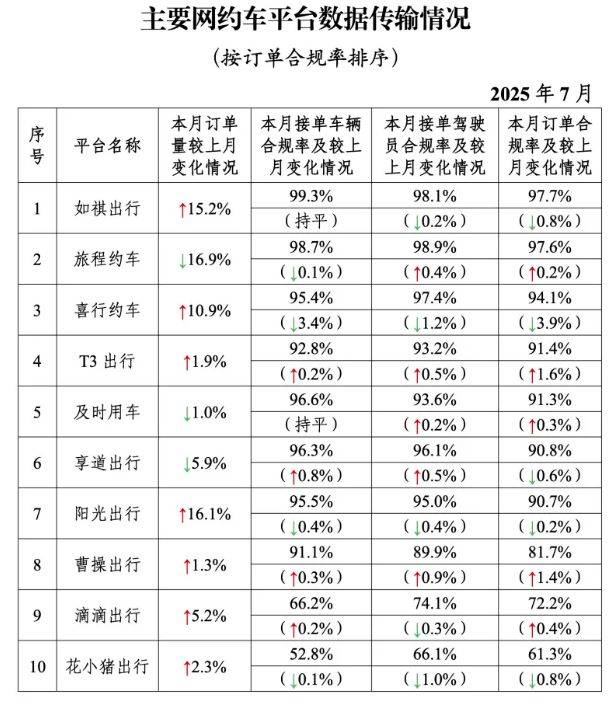
Core Insights - The core viewpoint of the article highlights the increasing importance of compliance rates as a key performance indicator for ride-hailing platforms, revealing significant disparities among leading companies and indicating a trend towards stricter regulatory oversight in the industry [10][16]. Summary by Sections Industry Overview - As of July 31, 2025, there are 392 licensed ride-hailing platforms in China, with a month-on-month increase of 3 platforms. The total number of orders processed in July reached 787 million, reflecting a 4% increase from the previous month [1]. Compliance Rates - The top 10 platforms by order volume are ranked by compliance rates, with "如祺出行" leading at 99.3%, followed by "旅程约车" at 98.7% and "喜行约车" at 95.4%. In contrast, "滴滴出行" and "花小猪出行" rank lower at 66.2% and 52.8% respectively, indicating challenges in maintaining compliance [3][10]. - Notably, "T3出行", "曹操出行", and "滴滴出行" showed the highest month-on-month growth in compliance rates, while "如祺出行", "花小猪出行", and "喜行约车" experienced declines [3][10]. Regional Compliance Variations - Major cities exhibit a "south high, north low" compliance pattern, with cities like Shenzhen, Guangzhou, and Hangzhou showing compliance rates above 80%. In contrast, northern cities such as Harbin and Urumqi struggle with lower compliance levels [6][13]. - The fastest improvements in compliance rates were observed in Urumqi, Shanghai, and Ningbo, while significant declines were noted in Kunming, Xiamen, and Lanzhou [14]. Industry Restructuring - A total of 97 ride-hailing platforms have not transmitted data for over 180 days, indicating a trend of "zombie platforms" being phased out. This reflects enhanced regulatory scrutiny and a shift towards a market dominated by capable players [15]. - The article emphasizes that compliance will become a long-term focus, impacting market access and financing capabilities for platforms with low compliance rates [16]. Future Trends and Recommendations - The article suggests that regulatory measures for aggregation platforms will likely tighten, requiring them to take on shared compliance responsibilities [17]. - It advocates for differentiated governance strategies to be implemented in northern and central-western cities, drawing from the successful experiences of southern cities [18]. - A recommendation is made to expedite the exit of non-operational platforms to free up regulatory resources and promote a healthier market environment [19].

滴滴支付7.4亿美元和解美IPO诉讼,计划赴港上市
Sou Hu Cai Jing· 2025-09-02 08:16
Core Viewpoint - Didi Global Inc. has agreed to pay $740 million to settle a shareholder class action lawsuit related to its 2021 IPO in the U.S., resulting in a significant financial loss for the company in Q2 2025 despite revenue growth [1][3][4]. Financial Performance - The settlement led to a net loss of 2.5 billion RMB (approximately $351 million) in Q2 2025, a stark decline from a profit of 854 million RMB in the same period last year [1]. - Revenue increased by 11% year-on-year, reaching 56.4 billion RMB, primarily driven by an increase in platform transaction volume [1]. Market Position and Growth - Didi achieved a record average daily transaction volume of 37.1 million in the Chinese market during Q2 2025, reflecting its continued dominance in the domestic ride-hailing market [4]. - Core platform transaction volume grew by 15%, with a 12% increase in the Chinese market and a 25% increase in overseas markets, resulting in a total gross transaction value (GTV) of 109.6 billion RMB, up 14% year-on-year [4]. Regulatory and Legal Challenges - Didi's IPO in June 2021 raised $4.4 billion at an initial price of $14 per share, but the company faced regulatory scrutiny and was fined 8 billion RMB (approximately $1.2 billion) in July 2022 for illegal data collection [3][5]. - The company has denied any wrongdoing in the shareholder lawsuit, stating that the settlement was to avoid further litigation costs and business disruptions [3]. Future Outlook - Didi plans to focus on improving service efficiency, expanding job opportunities, and enhancing driver rights protection while increasing investments in artificial intelligence and autonomous driving technology [5]. - The timeline for Didi's potential listing on the Hong Kong Stock Exchange remains uncertain, with analysts noting that stricter regulatory requirements and data compliance issues could pose challenges [5].

滴滴做会员,为什么难?
3 6 Ke· 2025-09-01 08:23
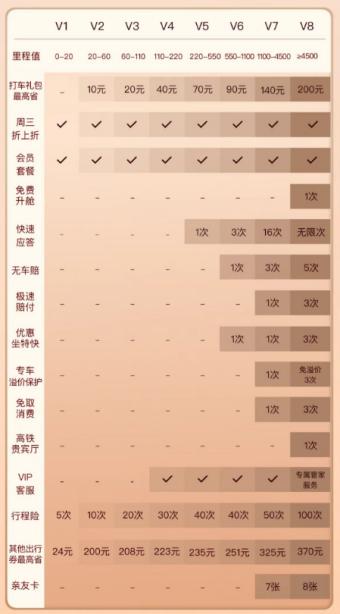
Core Viewpoint - Didi has upgraded its membership system, signaling a shift from solely ride-hailing to expanding into travel and accommodation services through partnerships with brands like Haidilao and Hilton [1][13]. Group 1: Membership System Changes - Didi's new membership system integrates with external brands and offers travel-related discounts, indicating a strategic move to broaden its service offerings beyond ride-hailing [1]. - The previous membership model was similar to Meituan's, focusing on customer operation, but the recent changes align more closely with Taobao's approach to cover a wider range of services [1][10]. - The membership system now includes eight levels, with higher tiers offering significant benefits such as hotel memberships and access to exclusive services [13][14]. Group 2: Market Position and Competition - Didi has maintained a dominant position in the ride-hailing market, achieving nearly 90% market share within four years of its establishment [2][5]. - Despite its leading position, Didi faces increasing competition from aggregators like Baidu Maps and Meituan, which have rapidly grown their order volumes [7][18]. - The second-largest player, Cao Cao, holds only about 5.4% market share, highlighting Didi's substantial lead [3][7]. Group 3: User Engagement and Challenges - Didi's membership service has struggled to significantly enhance user engagement, as users remain price-sensitive and often switch between platforms [10][14]. - The company has attempted to improve its membership offerings since 2015, but initial versions lacked substantial benefits, leading to limited user attraction [8][10]. - The challenge lies in creating a compelling value proposition that encourages users to remain loyal to Didi amidst low switching costs in the ride-hailing market [10][14]. Group 4: Strategic Expansion into Travel - Didi's CEO has long envisioned the company as a one-stop travel platform, but competitors like Ctrip and Fliggy have already captured significant market share in this area [2][18]. - The recent membership upgrades are seen as a way to leverage existing user data and enhance service offerings in the travel sector, aiming to fill market gaps [14][18]. - Didi's approach to integrating travel services is more gradual compared to its previous attempts in other sectors, focusing on leveraging existing partnerships and user resources [17][18].
滴滴Q2财报中,藏着GTV破千亿后的“加速度”与“下一站”
Xi Niu Cai Jing· 2025-09-01 04:26
Core Viewpoint - Didi's Q2 2025 performance demonstrates strong growth, with a core platform Gross Transaction Value (GTV) reaching 109.6 billion RMB, reflecting a 15.9% year-over-year increase at constant exchange rates [1][2]. Financial Highlights - In Q2 2025, Didi's total transactions increased to 4.464 billion, a 15.2% rise compared to Q2 2024 [2]. - The GTV for China Mobility was 82.5 billion RMB, up 12.2% year-over-year, while international GTV reached 27.1 billion RMB, marking an 18.6% increase [2]. - Adjusted EBITDA for Q2 2025 was 3.198 billion RMB, significantly improving from a loss of 2.482 billion RMB in Q2 2024 [2]. - The adjusted profit for the period was 3.069 billion RMB, compared to 1.475 billion RMB in Q2 2024 [2]. Operational Highlights - Didi's Q2 performance indicates a solid foundation and higher growth potential, as it continues to achieve double-digit growth in its tenth consecutive quarter [3]. - The domestic mobility market saw a GTV of 82.5 billion RMB, with a total of 44.64 billion orders, reflecting a 15.2% increase year-over-year [4]. - Didi's focus on technology-driven operational efficiency has enhanced both driver and passenger experiences, contributing to its growth [6]. International Expansion - Didi has expanded its international business to 14 countries, including regions in Latin America, Asia-Pacific, and Africa, with Q2 international GTV reaching 27.1 billion RMB, a 27.7% increase year-over-year [7][8]. - In Brazil, Didi's platform 99 has over 55 million users and has successfully launched its food delivery service, achieving significant order volumes shortly after its introduction [7]. - The company is leveraging its ride-hailing services to expand into food delivery and financial services, enhancing user engagement and market penetration [11]. Strategic Insights - Didi's Q2 GTV milestone of over 100 billion RMB signifies not just numerical growth but also reflects its strategic positioning and operational efficiency in a competitive landscape [9]. - The company is transitioning from a ride-hailing platform to a comprehensive mobility ecosystem, focusing on user needs and operational excellence to drive sustainable growth [11]. - Didi's approach emphasizes the importance of ecosystem and efficiency in future competition, moving away from reliance on subsidies for growth [9].
曹操出行(02643.HK):城市版图扩大助力份额扩张 报表端减亏初显成效
Ge Long Hui· 2025-09-01 01:54
Core Viewpoint - The company demonstrated strong revenue growth and improved cash generation capabilities in the first half of 2025, with a significant reduction in losses compared to the previous year [1][2]. Group 1: Financial Performance - The company's operating revenue reached 9.456 billion yuan, representing a 53.5% increase year-on-year [1]. - The gross profit margin improved to 8.4%, up by 1.4 percentage points [1]. - The net loss for the period was 470 million yuan, a reduction of 310 million yuan year-on-year, while the adjusted net loss was 330 million yuan, down by 170 million yuan [1]. - Cash generated from operating activities increased significantly by 164.6% to 325 million yuan, indicating enhanced self-financing capabilities [1]. Group 2: Revenue Breakdown - Revenue from mobility services was 8.6 billion yuan, up 49.8%, while vehicle sales revenue surged by 137.3% to 740 million yuan [2]. - Vehicle leasing revenue increased by 25.7% to 10 million yuan, while other business revenue fell by 62.2% due to a one-time contribution last year [2]. - The Gross Transaction Value (GTV) for mobility services reached 10.95 billion yuan, reflecting a 53.6% increase, driven by the sale of customized vehicles and expansion into 27 new cities [2]. Group 3: Operational Metrics - The platform's average daily order volume was 2.108 million, up 50.6%, with an Average Order Value (AOV) of 28.9 yuan, an increase of 3.2% [3]. - The estimated platform Take Rate was 78.5%, down by 2.0%, likely due to increased user subsidies in new cities [3]. - Driver costs and subsidies accounted for approximately 63.4%, up by 0.4 percentage points, while vehicle depreciation and maintenance costs decreased to 6.2%, down by 3.7 percentage points [3]. Group 4: Strategic Developments - The company successfully listed on the Hong Kong Stock Exchange in June 2025, raising 1.7 billion HKD to support cash flow and attract key industry investors [3]. - The launch of the autonomous driving platform in February 2025 has led to 15,000 kilometers of testing by June 2025, with plans to introduce a dedicated L4 Robotaxi model by the end of 2026 [3].
为什么女骑手越来越吃香?
吴晓波频道· 2025-09-01 00:30
Core Viewpoint - The article highlights the rapid growth of female delivery riders in China, indicating a significant shift in the labor market dynamics, particularly for middle-aged women facing economic challenges and traditional job market constraints [5][34]. Group 1: Growth of Female Riders - From 2022 to 2024, the number of female delivery riders increased from 517,000 to 701,000, representing a growth of 35.6% [8][3]. - In 2024, the number of female ride-hailing drivers is expected to exceed 1.05 million, up from 600,000 in 2023, marking a 75% year-on-year increase [9][8]. - The overall number of delivery riders on Meituan grew from 6.24 million in 2022 to 7.45 million in 2024, with female riders outpacing the overall growth rate [8][9]. Group 2: Demographics and Background of Female Riders - A significant portion of female riders are middle-aged, married, and have children, with 85% being married and 96.6% having children [14][20]. - The average age of female riders is 37, which is notably higher than their male counterparts [14]. - Many female riders have transitioned from traditional service industries, with 50.8% previously working in service sectors before entering the gig economy [22][23]. Group 3: Economic Pressures and Job Market Dynamics - Economic pressures, such as debt and job loss, have driven many women into the delivery sector, with 31.6% of riders citing unemployment as a reason for their choice [17][18]. - The article notes that over 80% of riders in one team carry debt, with many having previously faced business failures or financial struggles [18][20]. - The shrinking job market in traditional sectors like retail and hospitality has forced women into the gig economy, where they often find more flexible work options [22][23]. Group 4: Market Dynamics and Labor Quality - The influx of female riders reflects a broader market shift towards quality labor, as platforms seek to enhance service standards [26][31]. - Female riders are noted for their higher customer satisfaction ratings, indicating a potential competitive advantage in service-oriented roles [31][30]. - The article discusses the emotional labor aspect, where women’s skills in communication and empathy are increasingly valued in the gig economy [28][30]. Group 5: Conclusion and Future Implications - The rise of female riders represents a rebalancing of the labor market in the digital economy, creating new opportunities for women who have been marginalized in traditional employment [33][34]. - The article suggests that this trend may lead to a restructuring of social roles and labor dynamics, particularly for middle-aged women [33][34].

滴滴二季度国际业务日均订单增至1196万单;京东旗下跨境电商品牌Joybuy登陆法国市场|36氪出海·要闻回顾
36氪· 2025-08-31 13:49
Group 1 - Didi's Q2 orders increased by 15.2% year-on-year, with international business daily orders reaching 11.96 million [4][6] - JD's cross-border e-commerce brand Joybuy launched in France and plans to enter Germany next [4][6] - Temu topped Brazil's e-commerce traffic with 410 million visits, a 70% increase month-on-month [4][6] Group 2 - TikTok Shop upgraded logistics in Southeast Asia to offer next-day delivery services [7] - Leapmotor's European manufacturing base will be established in Zaragoza, Spain, with production expected to start in Q3 2024 [7] - BYD announced plans to build an assembly plant in Malaysia, expected to start production in 2026 [7] Group 3 - Feishu upgraded its overseas solutions and signed contracts with eight companies in South China [8] - Junsheng Electronics partnered with Alibaba Cloud for AI collaboration to develop intelligent robots [8] - DramaWave's annual revenue surpassed $240 million, positioning it as a leader in the overseas short drama market [8] Group 4 - Haicheng Energy's cumulative shipment exceeded 100 GWh, with a global service network covering over 20 countries [9] - Meikaman completed nearly 500 million yuan in financing, with overseas revenue accounting for 50% [10] - AI toy company Haivivi completed 200 million yuan in Series A financing, becoming the world's largest AI toy supplier [10] Group 5 - Hefei Tianyao completed several million yuan in A-round financing to expand overseas markets [10] - Tianxing Exploration completed angel round financing to develop satellite internet services [11] - Weijian Intelligent raised over 100 million yuan in B-round financing, with over 20% of orders coming from exports [11] Group 6 - Amazon's Prime Day will take place globally on October 7-8, covering 16 countries [12] - The Ministry of Commerce announced measures to optimize service export tax declaration processes [13] - New US tariff regulations have led 25 countries to suspend parcel shipments to the US [13]





中国公司全球化周报|滴滴二季度国际业务日均订单增至1196万单/京东旗下跨境电商品牌Joybuy登陆法国市场
3 6 Ke· 2025-08-31 04:59
Company Dynamics - Didi's Q2 orders increased by 15.2% year-on-year, with a total transaction value (GTV) of 109.6 billion yuan, reflecting a 15.9% growth at fixed exchange rates [2] - JD's cross-border e-commerce brand Joybuy officially launched in France, with plans to enter the German market soon [2] - Temu topped Brazil's e-commerce traffic with 410 million visits in July, a 70% increase month-on-month, surpassing competitors like Mercado Livre and Shopee [2] - TikTok Shop upgraded its logistics in Southeast Asia, implementing next-day delivery services across six countries, with over 170,000 merchants participating [3] - Leapmotor's European manufacturing base will be established in Zaragoza, Spain, with production expected to start in Q3 2026 [3] - BYD announced plans to build an assembly plant in Malaysia, expected to commence production in 2026 [3] Investment and Financing - Mech-Mind Robotics completed a nearly 500 million yuan financing round, with overseas business revenue accounting for 50% [6] - AI toy company Haivivi raised 200 million yuan in Series A financing, becoming the global leader in AI toy shipments [6] - Hefei Tianyao, a semiconductor materials developer, completed a multi-million yuan Series A financing to expand overseas markets [6] - Tianxing Exploration, focused on satellite internet, secured angel round financing for core technology development [6] - Weijian Intelligent, a chip packaging equipment developer, raised over 100 million yuan in Series B financing, with over 20% of orders coming from exports [6] Policy & Market - Amazon's Prime Day will globally launch on October 7-8, covering 16 countries, providing cross-border sellers with significant traffic opportunities [8] - The Ministry of Commerce announced measures to optimize the service export zero tax rate declaration process, enhancing export tax refund efficiency [8] - New US tariff regulations create uncertainty, with 25 countries suspending parcel shipments to the US due to changes in tax exemptions [8]