
煤炭开采

Search documents
滔搏(06110.HK):卓越零售能力构建竞争壁垒,高分红回馈投资者
GOLDEN SUN SECURITIES· 2025-11-21 03:27
Core Insights - The report highlights the competitive advantage of Tabo (滔搏) in the retail sector, emphasizing its strong retail capabilities and high dividend payouts to investors [4][5] - The report projects Tabo's revenue and net profit for FY2025 to FY2027, indicating a slight decline in revenue but a recovery in net profit growth by FY2027 [4][5] Company Overview - Tabo is identified as the largest sports retail and service platform in China, collaborating with major brands such as Nike and Adidas [4] - The company experienced a revenue decline of 7% in FY2025 and a projected decline of 6% in FY2026H1, with net profit dropping by 42% and 10% respectively [4][5] Financial Projections - Revenue forecasts for Tabo are set at 946 billion, 953 billion, and 1,005 billion RMB for FY2025, FY2026, and FY2027 respectively, with year-on-year growth rates of 1.2%, 0.8%, and 5.5% [4] - The net profit estimates are 37.1 billion, 52.8 billion, and 61 billion RMB for the same years, with growth rates of -8.7%, 42.4%, and 15.5% [4] Investment Recommendations - The report maintains a "buy" rating for Tabo, citing its robust dividend payout history of 107.3% since its IPO in 2019 and a current cash position of 2.54 billion RMB [5] - The expected price-to-earnings ratio for FY2026 is 14.6, with a dividend yield of 7% [5] Industry Context - The report discusses the broader retail environment, noting challenges such as fluctuating consumer demand and the need for effective e-commerce strategies [5] - It emphasizes the importance of Tabo's strong brand partnerships and retail efficiency in maintaining its competitive edge in the market [4][5]



华阳股份跌2.24%,成交额4911.17万元,主力资金净流出818.51万元
Xin Lang Cai Jing· 2025-11-21 02:00
Core Viewpoint - Huayang Co., Ltd. has experienced a decline in stock price recently, with a year-to-date increase of 15.62% but a drop of 6.33% in the last five trading days [1] Group 1: Company Overview - Huayang Co., Ltd. was established on December 30, 1999, and listed on August 21, 2003. The company is primarily engaged in coal production, processing, sales, electricity generation, and solar power generation [2] - The main revenue sources for Huayang Co., Ltd. include: raw coal (52.34%), other (13.21%), washed block coal (9.84%), purchased coal (9.50%), electricity supply (7.39%), washed raw coal (6.05%), coal slurry (1.35%), and heating (0.33%) [2] - The company belongs to the coal mining industry and is involved in sectors such as coal chemical, ultra-supercritical power generation, TOPCon batteries, and solar energy [2] Group 2: Financial Performance - For the period from January to September 2025, Huayang Co., Ltd. reported revenue of 16.956 billion yuan, a year-on-year decrease of 8.85%, and a net profit attributable to shareholders of 1.124 billion yuan, down 38.20% year-on-year [2] - The company has distributed a total of 12.930 billion yuan in dividends since its A-share listing, with 5.814 billion yuan distributed in the last three years [3] Group 3: Shareholder Information - As of September 30, 2025, Huayang Co., Ltd. had 87,000 shareholders, a decrease of 3.33% from the previous period, with an average of 41,465 circulating shares per shareholder, an increase of 3.45% [2] - Major shareholders include Guotai Junan CSI Coal ETF, which increased its holdings by 43.3179 million shares, and Hong Kong Central Clearing Limited, which increased its holdings by 14.0665 million shares [3]

大有能源涨2.05%,成交额1.03亿元,主力资金净流出252.24万元
Xin Lang Cai Jing· 2025-11-21 01:55
Core Viewpoint - Daya Energy's stock price has shown significant volatility, with a year-to-date increase of 188.44% but a recent decline of 16.37% over the past five trading days [1] Group 1: Stock Performance - As of November 21, Daya Energy's stock price was 8.48 CNY per share, with a market capitalization of 20.274 billion CNY [1] - The stock has experienced a 121.41% increase over the past 60 days, despite a 6.40% decline over the last 20 days [1] - The company has appeared on the trading leaderboard 22 times this year, with the most recent appearance on November 20, showing a net buy of -5.6633 million CNY [1] Group 2: Financial Performance - For the period from January to September 2025, Daya Energy reported operating revenue of 3.111 billion CNY, a year-on-year decrease of 19.67%, and a net profit attributable to shareholders of -1.122 billion CNY, down 42.77% year-on-year [2] - Cumulative cash dividends since the company's A-share listing amount to 3.755 billion CNY, with 1.028 billion CNY distributed in the last three years [3] Group 3: Shareholder Information - As of September 30, 2025, Daya Energy had 39,300 shareholders, an increase of 2.84% from the previous period, with an average of 60,796 circulating shares per shareholder, a decrease of 2.76% [2] - The top three circulating shareholders include Guotai Zhongxin Coal ETF, which increased its holdings by 11.6526 million shares, and other significant shareholders also adjusted their positions [3]

21股获融资净买入额超1亿元 新易盛居首
Zheng Quan Shi Bao Wang· 2025-11-21 01:25
Group 1 - On November 20, among the 31 primary industries tracked by Shenwan, 11 industries experienced net financing inflows, with the communication industry leading at a net inflow of 1.402 billion yuan [1] - Other industries with significant net financing inflows included banking, defense and military, real estate, coal, and retail [1] Group 2 - A total of 1,593 individual stocks received net financing inflows on November 20, with 111 stocks having inflows exceeding 30 million yuan [1] - Among these, 21 stocks had net inflows exceeding 100 million yuan, with Xinyi Sheng leading at 0.953 billion yuan [1] - Other notable stocks with high net financing inflows included Zhongji Xuchuang, Tianfu Communication, Ningde Times, Bank of China, Aerospace Development, Sunshine Power, Shenghong Technology, and Huatai Securities [1]

2026&2025年电煤中长协政策对比点评:向市场化方向微调
Guohai Securities· 2025-11-20 11:15
Investment Rating - The industry investment rating is "Recommended" (maintained) [1] Core Viewpoints - The report indicates a slight adjustment towards market-oriented policies in the long-term coal supply contracts for 2026 compared to 2025, with both quantity and price aspects moving closer to market mechanisms [2][7] - The signing volume for coal enterprises is set to be no less than 75% of their own resource volume, while for power generation enterprises, the minimum signing volume should be at least 80% of the demand [2] - The fulfillment rates have been relaxed slightly, with monthly fulfillment remaining at no less than 80%, quarterly fulfillment now being generally no less than 90%, and annual fulfillment also generally no less than 90% [2] - The pricing mechanism for long-term contracts may begin to reference indices, with a monthly adjustment mechanism established for the pricing of coal from production areas [3][4] - The report emphasizes that the coal mining industry continues to show a long-term upward price trend driven by factors such as rising labor costs, increased safety and environmental investments, and higher taxation by local governments [8] Summary by Sections Policy Changes - The 2026 policy document indicates that contracts for coal from production areas must align with reasonable price ranges and establish a monthly adjustment mechanism through negotiation between supply and demand enterprises [3] - The pricing for long-term contracts for coal remains unchanged, with a base price set at current levels [4] Market Performance - As of November 19, 2025, the coal mining sector has shown a performance of 2.3% over one month, 11.3% over three months, and 0.2% over twelve months, compared to the Shanghai and Shenzhen 300 index which recorded 1.6%, 8.6%, and 15.4% respectively [5] Investment Recommendations - The report suggests focusing on robust companies such as China Shenhua, Shaanxi Coal, and others, highlighting their strong cash flow and high asset quality [8] - Specific recommendations include: - Steady stocks: China Shenhua, Shaanxi Coal, and others - Stocks with greater elasticity in thermal coal: Yanzhou Coal, Jinko Energy, and others - Stocks with greater elasticity in coking coal: Huaibei Mining, Pingdingshan Coal, and others [8] Earnings Forecasts - The report provides earnings per share (EPS) and price-to-earnings (PE) ratios for key companies, indicating a positive outlook for several coal enterprises [10]



煤炭开采板块11月20日跌2.08%,大有能源领跌,主力资金净流出5.64亿元
Zheng Xing Xing Ye Ri Bao· 2025-11-20 09:16
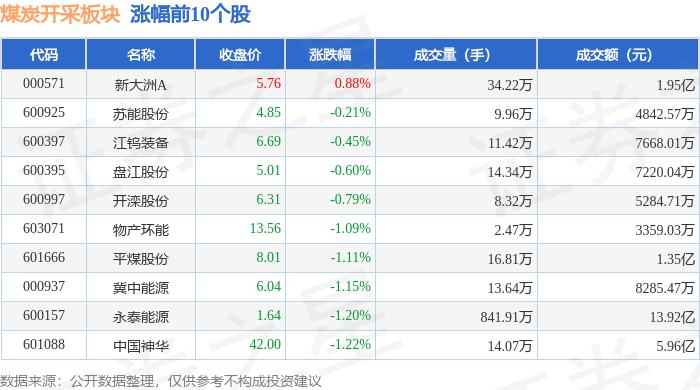
Market Overview - The coal mining sector experienced a decline of 2.08% on November 20, with Dayou Energy leading the drop [1] - The Shanghai Composite Index closed at 3931.05, down 0.4%, while the Shenzhen Component Index closed at 12980.82, down 0.76% [1] Individual Stock Performance - Notable stock performances include: - Xindazhou A (000571) increased by 0.88% to close at 5.76, with a trading volume of 342,200 shares and a turnover of 195 million yuan [1] - Dayou Energy (600403) fell by 9.97% to 8.31, with a trading volume of 1,108,400 shares and a turnover of 95.26 million yuan [2] - China Shenhua (601088) decreased by 1.22% to 42.00, with a trading volume of 140,700 shares and a turnover of 596 million yuan [1] Capital Flow Analysis - The coal mining sector saw a net outflow of 564 million yuan from major funds, while retail investors contributed a net inflow of 580 million yuan [2] - The capital flow for individual stocks indicates: - Huai Bei Mining (600985) had a net outflow of 35.39 million yuan from major funds [3] - Electric Power Investment Energy (002128) recorded a net inflow of 22.42 million yuan from major funds [3] - New Dazhou A (000571) experienced a net inflow of 18.34 million yuan from major funds [3]


港股收评:恒指尾盘回升!内房股强势,锂电池走低
Ge Long Hui· 2025-11-20 08:58
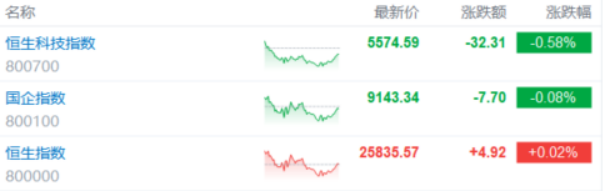
Market Overview - The Hong Kong stock market showed signs of recovery with the Hang Seng Index rising by 0.02%, while the Hang Seng China Enterprises Index fell by 0.08% and the Hang Seng Tech Index dropped by 0.58%, marking five consecutive days of decline [1] - Market sentiment remains low, but there are indications of a potential rebound [1] Sector Performance - Major technology stocks such as Baidu, Meituan, and Kuaishou saw gains, with Baidu up by 2.43% and Kuaishou up by 2.28%, while Xiaomi continued to decline, dropping nearly 3% to a new low [3][5] - Financial stocks, including banks and insurance companies, performed actively, with several Chinese brokerage stocks showing gains despite a high open and subsequent decline [3][9] - The real estate sector remained strong in the afternoon, with Sunac China and Zhongliang Holdings leading the gains [3][8] - The biopharmaceutical, home appliance, and aviation sectors also showed relative activity [3] Real Estate Market Insights - According to Centaline Property, Hong Kong's residential market recorded over 1,700 transactions in October, marking the ninth consecutive month of over 1,000 transactions, matching the longest record from March to November 2019 [7] - The month also saw at least 64 transactions exceeding HKD 50 million, totaling over HKD 6.8 billion, a new high for the year [7] - Major international banks, including Morgan Stanley and Citigroup, predict a recovery in the Hong Kong real estate market post-2025 [7] Brokerage Sector Developments - Chinese brokerage stocks saw significant increases, with Financial Street Securities rising over 4% [9][10] - The announcement of major asset restructuring plans by several brokerages is expected to enhance industry consolidation and competitiveness [9] Semiconductor Sector Activity - The semiconductor sector was active, with stocks like Contrelon rising over 8% [10][12] - Reports indicate that the U.S. may delay the imposition of long-promised semiconductor tariffs, which could impact the sector positively [11] New Energy Material Sector Decline - The new energy materials sector faced declines, with companies like China Silicon Corporation dropping over 16% [13] - The lithium battery sector also saw significant drops, with CATL falling by 5.66% [14][15] Coal Sector Insights - Coal prices have risen above RMB 830 per ton, but short-term price increases may be stabilizing [16] - The coal industry's supply-demand dynamics have fundamentally shifted since May, indicating a long-term upward trend in coal prices [16] Individual Stock Highlights - Gakos-B surged by 19.97% following the approval of its self-developed KRAS G12C inhibitor for commercialization [18] - Southbound capital saw a net inflow of HKD 15.992 billion, indicating strong investor interest [21] Future Market Outlook - CITIC Securities anticipates that the Hong Kong stock market will benefit from internal and external economic policies, predicting a second round of valuation recovery and performance resurgence by 2026 [23] - Suggested investment directions include technology sectors, healthcare, resource commodities, essential consumer goods, and sectors benefiting from RMB appreciation [23]
强调3个观点:产地扰动仍存,进口煤同环比下滑-20251120
GOLDEN SUN SECURITIES· 2025-11-20 08:33
Investment Rating - The report maintains a rating of "Buy" for the coal mining sector [5] Core Views - The report emphasizes three key viewpoints regarding the coal market dynamics and investment strategies [4][9] - It highlights that the recent price adjustments are a normal digestion of previous rapid increases, and the core logic of rising coal prices due to supply constraints remains unchanged [4] - The report anticipates that as demand (whether speculative or real) activates, coal prices will rise, with expectations for prices to peak at the end of the year, potentially exceeding market expectations [4] Summary by Sections Production - In October, the raw coal production decreased by 2.3% year-on-year, with an output of 410 million tons, maintaining the same level as September [15][8] - For the first ten months of 2025, the cumulative production reached 3.97 billion tons, reflecting a growth of 1.5% year-on-year [15] - The forecast for 2025 suggests that the total thermal coal production may reach approximately 3.88 billion tons, with a growth rate narrowing to around 1.4% [15] Imports - In October, coal imports fell by 9.75% year-on-year, totaling 41.73 million tons, which is a decrease of 4.51 million tons compared to the same month last year [21][8] - For the first ten months of 2025, total coal imports amounted to 38.76 million tons, down 11% year-on-year [21] - The report predicts that the annual thermal coal import level may decline to around 38 million tons, a decrease of 6.4% year-on-year [21] Demand - In October, the industrial power generation increased by 7.9% year-on-year, with a total of 800.2 billion kWh generated [24][8] - The industrial thermal power generation saw a year-on-year increase of 7.3%, reversing a decline of 5.4% in September [24] - Conversely, crude steel production in October dropped by 12.07% year-on-year, amounting to 72 million tons, with the decline accelerating compared to September [37][8] Investment Recommendations - The report recommends focusing on high-performing stocks, particularly in the coal sector, including China Shenhua, China Coal Energy, and Yancoal [45][9] - It suggests a shift towards second-tier stocks as coal prices continue to rise, emphasizing the importance of selecting stocks based on performance and valuation [9]

电投能源跌2.02%,成交额3.25亿元,主力资金净流入423.06万元
Xin Lang Zheng Quan· 2025-11-20 06:03
Core Viewpoint - The stock of Electric Power Investment Energy has experienced fluctuations, with a current price of 26.67 CNY per share, reflecting a year-to-date increase of 42.01% but a recent decline of 6.09% over the past five trading days [1] Financial Performance - For the period from January to September 2025, Electric Power Investment Energy reported a revenue of 22.403 billion CNY, representing a year-on-year growth of 2.72%. However, the net profit attributable to shareholders decreased by 6.40% to 4.118 billion CNY [2] - Cumulatively, the company has distributed 11.815 billion CNY in dividends since its A-share listing, with 4.550 billion CNY distributed over the past three years [3] Shareholder Information - As of September 30, 2025, the number of shareholders for Electric Power Investment Energy is 27,100, a decrease of 11.29% from the previous period. The average number of circulating shares per shareholder increased by 12.72% to 82,831 shares [2] - Among the top ten circulating shareholders, Hong Kong Central Clearing Limited holds 47.2447 million shares, an increase of 18.5055 million shares compared to the previous period [3] Market Activity - The stock has seen a trading volume of 325 million CNY with a turnover rate of 0.53%. The net inflow of main funds was 4.2306 million CNY, with significant buying and selling activity noted [1]

华阳股份跌2.05%,成交额3.27亿元,主力资金净流入44.64万元
Xin Lang Cai Jing· 2025-11-20 03:32
Core Viewpoint - Huayang Co., Ltd. has experienced a decline in stock price recently, with a year-to-date increase of 19.89% and a notable drop of 6.23% over the last five trading days [1] Group 1: Stock Performance - As of November 20, Huayang's stock price was 8.13 CNY per share, with a market capitalization of 29.329 billion CNY [1] - The stock has seen a trading volume of 3.27 billion CNY, with a turnover rate of 1.10% [1] - Year-to-date, the stock has risen by 19.89%, but has decreased by 6.23% in the last five trading days [1] Group 2: Financial Performance - For the period from January to September 2025, Huayang reported operating revenue of 16.956 billion CNY, a year-on-year decrease of 8.85% [2] - The net profit attributable to shareholders was 1.124 billion CNY, reflecting a year-on-year decline of 38.20% [2] Group 3: Shareholder Information - As of November 10, the number of Huayang's shareholders was 87,000, a decrease of 3.33% from the previous period [2] - The average circulating shares per person increased by 3.45% to 41,465 shares [2] - The company has distributed a total of 12.93 billion CNY in dividends since its A-share listing, with 5.814 billion CNY distributed in the last three years [3]