保险

Search documents
2026年政府工作报告保险相关政策点评:保障业务提质扩面,长钱入市功能彰显
GUOTAI HAITONG SECURITIES· 2026-03-09 02:40
Investment Rating - The report maintains an "Overweight" rating for the insurance industry [2][3]. Core Insights - The 2026 government work report emphasizes the goal of enhancing the quality and expanding the coverage of the insurance industry, further promoting high-quality development [3][4]. - The report highlights multiple areas where insurance plays a crucial role, including livelihood security, rural revitalization, and risk prevention [4]. - Key tasks for 2026 include improving the multi-tiered medical security system, increasing the minimum monthly basic pension for urban and rural residents by 20 yuan, and enhancing agricultural insurance measures [5][6]. Summary by Relevant Sections Livelihood Security Insurance - The report outlines the establishment of a long-term mechanism for basic medical insurance participation and the introduction of an innovative drug directory for commercial health insurance, with long-term care insurance covering 300 million people [5][6]. - It also mentions the need to combat fraud in medical insurance and to accelerate the development of commercial health insurance [6]. Pension Insurance - The minimum standard for basic pensions will be increased by 20 yuan, and a personal pension system will be implemented nationwide [5][6]. Agricultural Insurance - Measures to promote agricultural insurance development will be formulated to enhance comprehensive disaster prevention and reduction capabilities [6]. Catastrophe Insurance - The report calls for the establishment of a catastrophe insurance guarantee system to maintain national security and social stability [6]. Export Credit Insurance - There will be increased support for credit and insurance to stabilize foreign trade and expand the use of the Renminbi in cross-border transactions [6]. Capital Market and Risk Management - The report emphasizes the need for orderly risk resolution and capital replenishment in the financial sector, with a focus on enhancing the stability of insurance companies [5][6]. - It highlights the importance of insurance funds as a significant source of long-term capital, with a recommendation for a more stable allocation of equity assets [5][6]. Investment Recommendations - The report recommends stocks such as Ping An Insurance, China Pacific Insurance, New China Life, China Property & Casualty Insurance (H), China Life, and China Re (H) for investment [5].



未知机构:华创金融徐康团队吴清主席的答记者透露哪些重要信息-20260309
未知机构· 2026-03-09 02:15
Summary of Key Points from Conference Call Industry Overview - The discussion primarily revolves around the Chinese financial market and its mechanisms, particularly focusing on the stability of the market and the role of direct financing and strategic emerging industries in major indices [1][1]. Core Insights and Arguments - The term "improving the construction of a Chinese-style market stabilization mechanism" was introduced for the first time, indicating a significant shift in regulatory focus [1]. - There is an emphasis on increasing the proportion of direct financing within the market, which is seen as crucial for the overall health of the financial ecosystem [1]. - The importance of strategic emerging industries in major indices is highlighted, suggesting a shift towards prioritizing these sectors in investment strategies [1]. Additional Important Content - The introduction of the market stabilization mechanism in a public forum suggests a high probability of achieving a "long bull, slow bull" market, with regulatory measures aligning towards this goal [1]. - During the "14th Five-Year Plan" period, significant improvements in the governance level of China's capital market are expected, which will manifest in four key areas: 1. Continuous inflow of long-term capital will optimize the structure of market participants [1]. 2. Increased dividend levels will guide listed companies towards modern governance practices [1]. 3. Enhanced penalties for violations will deter short-sighted behaviors [1]. 4. A diversified toolbox for market stabilization will gradually be developed [1]. - Under these policy assumptions, there is an optimistic outlook for the overall index performance throughout the year, with a focus on three main investment narratives: "deposit migration," "order reconstruction," and "technology-driven national strength" [1]. Financial Sector Insights - The futures market is experiencing a sustained upward trend, making it a top recommendation for investors [2]. - The insurance sector's investments are influenced by multiple factors, but adjustments have been made, leading to a positive outlook for absolute returns over a five-year horizon [2].
恒指收升435点,全周累跌873点
Guodu Securities Hongkong· 2026-03-09 01:54
Group 1: Market Overview - The Hang Seng Index rose by 435 points, closing at 25,757 points, an increase of 1.72% on the day, while the weekly decline was 873 points or 3.28% [3][4] - The Hang Seng Tech Index increased by 151 points or 3.15%, closing at 4,947 points, with a weekly decline of 190 points or 3.7% [3][4] - The total market turnover for the day was 292.766 billion HKD, with a net outflow of 2.188 billion HKD from northbound trading [3] Group 2: Company-Specific Insights - NetEase (09999) saw a rise of 5.2%, closing at 189.2 HKD, while Xiaomi (01810) increased by 3.8% to 33.42 HKD, and Alibaba (09988) rose by 3.5% to 130.7 HKD [4] - Meituan (03690) increased by 3.2%, closing at 76.85 HKD, and Tencent (00700) rose by 3.4% to 519 HKD, indicating a strong performance in tech stocks [4] - China’s foreign exchange reserves reached a new high of 3.4278 trillion USD, marking a continuous increase for seven months, with a monthly increase of 28.73 billion USD [9] Group 3: Industry Developments - The Hong Kong government is advancing the establishment of a trade office in Riyadh, Saudi Arabia, to enhance trade relations despite ongoing regional conflicts [7] - The "14th Five-Year Plan" presents significant opportunities for Hong Kong, emphasizing its unique advantages as an international financial and trade center [8] - The China Securities Regulatory Commission is implementing new regulations on short-term trading to stabilize market expectations and enhance trading convenience, effective from April 7 [10]
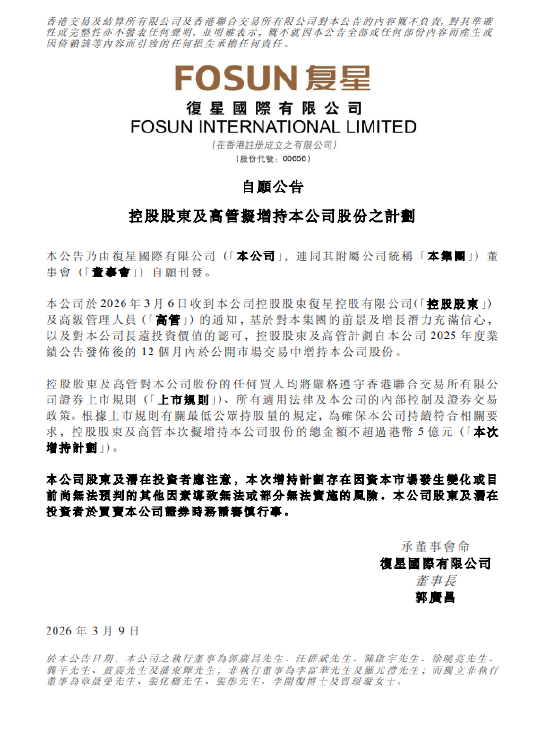
复星国际控股股东及高管拟增持公司股份 总额不超5亿港元 管理层明确百亿利润目标不变
Xin Lang Cai Jing· 2026-03-09 01:40
Core Viewpoint - Fosun International (00656.HK) announced a plan to repurchase up to HKD 500 million of its shares within 12 months after the release of its 2025 annual results, following a previous announcement to buy back up to HKD 1 billion in shares, aimed at boosting market confidence [1][3][8] Group 1: Share Buyback and Management Communication - The share buyback plan is based on the company's judgment of its long-term development prospects [3][8] - On March 8, prior to the buyback announcement, the company held an investor conference call where management reiterated its commitment to a strategic direction focused on "streamlining and concentrating on core businesses" [3][8] - Management indicated that a one-time non-cash impairment charge would help solidify the financial statements and create conditions for future profit release, maintaining confidence in achieving a profit target of HKD 10 billion over the next three to five years [3][8] Group 2: Financial Performance and Impairment Charges - On March 6, the company issued a profit warning, projecting a net loss attributable to shareholders of approximately RMB 21.5 billion to RMB 23.5 billion for the 2025 fiscal year, primarily due to one-time non-cash impairment charges related to certain real estate projects and goodwill from non-core businesses [4][9] - The company stated that the ongoing downturn in the real estate sector has led to impairment signs in some projects, prompting significant asset impairment provisions [5][9] - Management emphasized that these impairment charges are accounting adjustments and do not affect the overall operations and cash flow of the company [5][10] Group 3: Core Business Growth and Future Outlook - Despite the anticipated accounting losses, several core subsidiaries of Fosun have reported growth in their 2025 operating data [6][11] - In the pharmaceutical sector, Fosun Pharma (600196.SH, 02196.HK) reported revenue of RMB 29.393 billion and a net profit of RMB 2.523 billion for the first three quarters of 2025 [6][11] - The insurance segment showed positive results, with Fosun Portugal Insurance achieving a Standard & Poor's A rating and a net profit of EUR 1.7 million, up 11.7% year-on-year [6][11] - Domestic insurance operations, including Fosun United Health Insurance and Fosun Baodexin Life Insurance, reported significant revenue and profit growth, with the latter's net profit increasing over 450% [6][11] - Management remains confident in achieving the HKD 10 billion profit target within three to five years and aims to reduce total liabilities to below RMB 60 billion, indicating a new development cycle starting in 2026 [6][11]


复星国际(00656)控股股东及高管拟增持不超过5亿港元 管理层明确百亿利润目标不变
智通财经网· 2026-03-09 01:36
Core Viewpoint - Fosun International plans to enhance shareholder confidence through share buybacks and management's commitment to increase holdings, signaling a focus on long-term growth despite recent financial losses [1][2][4] Group 1: Shareholder Actions - Fosun International's controlling shareholder and executives will increase their holdings by up to HKD 500 million within 12 months after the 2025 annual results announcement [1] - The company plans to repurchase shares in the open market for a total amount not exceeding HKD 1 billion from the 2025 results announcement until the 2026 annual general meeting [1] Group 2: Financial Performance and Strategy - Fosun International anticipates a significant loss of approximately RMB 215 billion to RMB 235 billion for the fiscal year 2025, primarily due to one-time non-cash impairment charges [2] - The company is strategically focusing on its core businesses by exiting non-core assets and has implemented a "slimming down" strategy to improve asset quality and operational performance [2][4] Group 3: Core Business Growth - The core sectors of Fosun, including healthcare and insurance, are showing improved asset and profit quality, with significant revenue growth reported in the pharmaceutical sector [4][5] - Fosun Pharma reported a revenue of RMB 29.393 billion and a net profit of RMB 2.523 billion for the first three quarters of 2025, marking a year-on-year increase of 25.5% [4] - The insurance segment also demonstrated strong performance, with Fosun's Portuguese insurance achieving a net profit of EUR 1.7 million, up 11.7% year-on-year [5][6] Group 4: Future Outlook - Management expressed confidence in achieving a profit target of RMB 10 billion over the next three to five years while optimizing financial structure and reducing total liabilities below RMB 60 billion [6] - The company is entering a new development cycle in 2026, with a positive outlook for future growth [6]
复星国际控股股东及高管拟增持不超过5亿港元 管理层明确百亿利润目标不变
Zhong Jin Zai Xian· 2026-03-09 01:29
Core Viewpoint - Fosun International plans to enhance shareholder confidence through share buybacks and management's commitment to increase holdings, signaling a focus on long-term growth despite recent financial losses due to asset impairment [1][2][4] Group 1: Shareholder Actions - On March 6, Fosun International announced that its controlling shareholders and executives would increase their holdings by up to HKD 500 million within 12 months after the 2025 annual results announcement [1] - The company also plans to repurchase shares in the open market for a total amount not exceeding HKD 1 billion from the 2025 results announcement until the 2026 annual general meeting [1] Group 2: Financial Performance and Strategy - Fosun International issued a profit warning on March 6, projecting a loss of approximately RMB 21.5 billion to RMB 23.5 billion for the fiscal year 2025, primarily due to one-time non-cash impairment charges [2] - The company is focusing on its core businesses and has initiated a strategy of "streamlining and focusing on main operations," which includes significant asset impairment to improve transparency and asset quality [2][4] Group 3: Core Business Growth - The core sectors of Fosun, including healthcare and insurance, are showing positive growth, with Fosun Pharma reporting revenue of RMB 29.393 billion and a net profit of RMB 2.523 billion for the first three quarters of 2025, a year-on-year increase of 25.5% [4] - In the insurance sector, Fosun's Portuguese insurance received an A rating from S&P, with a net profit of EUR 1.7 million for the first three quarters of 2025, reflecting an 11.7% increase [5][6] Group 4: Future Outlook - Management expressed confidence in achieving a profit target of RMB 10 billion over the next three to five years while optimizing financial structure and reducing total liabilities to below RMB 60 billion [6] - The company anticipates entering a new development cycle in 2026, with a strong focus on growth and profitability [6]
朝闻国盛:如何看待油价对债市冲击
GOLDEN SUN SECURITIES· 2026-03-09 01:17
Group 1: Oil Price Impact on Debt Market - The current oil price increase has limited impact on the debt market, with the main trend being bank-led allocation. After the quarter-end, this trend may become more pronounced [11] - Rising prices have not driven improvements in corporate profitability, and monetary policy is unlikely to respond effectively to external price changes, resulting in limited overall impact on interest rates [11] - Financing demand remains insufficient, leading to increased deposits and decreased loan growth, which creates a loose funding environment and constrains interest rate ceilings [11] Group 2: Fiscal Policy Observations - The 2026 fiscal revenue budget growth rate is slightly increased, while expenditure growth remains stable. The fiscal revenue growth target for 2026 is set at 2.2%, significantly lower than the nominal GDP growth rate [13] - The expenditure budget for 2026 is projected to grow by 4.4%, indicating a steady fiscal spending approach [13] Group 3: Coal and Energy Market Insights - Brent crude oil prices surged by 27.88% to $92.69 per barrel, while Newcastle coal prices increased by 15.61% to $137 per ton, driven by geopolitical tensions and supply constraints [18] - The demand for coal is expected to rise as countries shift towards coal power for energy security, particularly in East Asia, which may push Asian coal prices higher [18] - Investment recommendations include focusing on companies like China Coal Energy, Yanzhou Coal Mining, and China Shenhua Energy [18] Group 4: Real Estate Market Analysis - The 2026 government work report emphasizes a stable approach to real estate policies, with a focus on maintaining market stability and supporting major projects [24] - The report indicates that the fiscal policy will continue to support consumption and investment in human resources, with a significant amount of special bonds expected to be used for land acquisition [24] - Investment suggestions include real estate development companies such as Greentown China, China Overseas Land & Investment, and Poly Developments [25] Group 5: Textile and Apparel Sector - Bosideng is expected to achieve a revenue growth of 4-5% for FY2026, driven by effective cost management and product optimization [28] - The company anticipates a slight increase in gross margin due to structural improvements, with net profit growth expected to outpace revenue growth [28] - Investment outlook remains positive, with a "buy" rating maintained based on projected earnings growth [29]
非银金融机构行为更新专题验证“存款搬家”居民财富的视角
Guoxin Securities· 2026-03-09 00:35
Investment Rating - The report maintains an "Outperform" rating for the banking sector, insurance, and brokerage firms, highlighting specific companies such as China Merchants Bank, Ningbo Bank, Ping An Insurance, China Pacific Insurance, Industrial Securities, and East Money [4][3]. Core Insights - The "deposit migration" narrative is expected to influence capital market funding from the second half of 2025, continuing into the first quarter of 2026, driven by the expiration of high-interest fixed deposits and a shift in residents' risk preferences towards higher-yielding assets [1][11]. - Approximately 80-90% of maturing deposits are expected to remain in the banking system, with only about 10-20% potentially flowing into asset management products, which could lead to an increase of 6-13 trillion yuan in asset management products [1][23]. - The report emphasizes a "strong equity, stable debt" asset allocation strategy, indicating that while risk assets will receive incremental funding, overall liquidity in the financial system will remain stable [1][11]. Summary by Sections Deposit Migration - The narrative of "deposit migration" is reshaping asset allocation, with funds moving from low-yield deposits to riskier assets like wealth management, funds, and insurance [11][21]. - The report estimates that 64 trillion yuan of high-interest deposits will mature in 2026, with a significant portion expected to flow into wealth management products [18][21]. Wealth Management and Insurance - Wealth management products are projected to be the primary channel for absorbing outflows from fixed deposits, as they align with the risk preferences of depositors [29][33]. - Insurance, particularly dividend insurance, is positioned to capture a portion of the migrating deposits, offering a blend of security and potential returns [41][50]. Public Funds - The growth of "fixed income plus" and Fund of Funds (FOF) products reflects a shift in investor preferences towards more balanced risk-return profiles in a low-interest environment [51][52]. - Active equity funds have seen limited expansion, with investors showing a preference for stable returns and lower volatility, leading to a structural change in the public fund market [52][53]. Brokerage Firms - Brokerage channels are increasingly focusing on ETF and index-linked products, catering to a client base that prefers low-cost, transparent investment options [54][55]. - The demand for bond ETFs is rising, indicating a shift in institutional client preferences towards efficient fixed-income asset allocation tools [58][59].




地缘冲突冲击全球航运,美国政府推200亿美元海上再保险计划
21世纪经济报道· 2026-03-08 15:24
Core Viewpoint - The article discusses the significant impact of the recent military actions by the US and Israel against Iran, leading to the cancellation of war insurance for vessels operating in the Gulf region, which has resulted in increased operational costs for shipping companies and a surge in oil prices [1][3]. Group 1: Military Actions and Insurance Impact - The US and Israel launched a large-scale military operation against Iran, causing a sharp deterioration in regional security and prompting several maritime insurers to cancel war insurance for vessels operating in the Gulf starting March 5 [1]. - The cancellation of war insurance has led to a substantial increase in operational costs for shipping companies that frequently navigate the Gulf region, particularly affecting oil tanker operations in the Strait of Hormuz, a critical route for global oil transport [1][3]. - Following the military actions, Brent crude oil prices surged by 9.26% and NYMEX crude oil prices increased by 12.67% on March 6, both surpassing the $90 per barrel mark, with forecasts suggesting potential rises to $100 or even $150 per barrel if the situation does not stabilize [1][3]. Group 2: Reinsurance Plan - In response to the escalating situation, the Trump administration announced a $20 billion reinsurance plan aimed at ensuring the safe passage of oil tankers and other maritime vessels through the Strait of Hormuz [1][3]. - The reinsurance plan, approved by President Trump, will provide rolling reinsurance coverage for losses up to $20 billion, focusing initially on hull, machinery, and cargo insurance for eligible vessels [3]. - The US International Development Finance Corporation (DFC) has identified preferred insurance partners and is coordinating closely with the Treasury Department and Central Command to implement the reinsurance plan [3]. Group 3: Importance of Reinsurance Mechanism - The article highlights the critical role of reinsurance in the maritime insurance market, particularly for high-risk and high-coverage war insurance, as insurers typically rely on the reinsurance market to enhance their underwriting capacity and diversify risks [4]. - The introduction of the reinsurance plan is expected to improve insurers' willingness to underwrite war risks, which have become increasingly challenging to price due to the nature of correlated risks associated with conflict escalation [4]. - Insurers may raise premiums in response to increased war risks, and if they find it impossible to quantify these risks, they may suspend coverage altogether, indicating a significant challenge to traditional risk management mechanisms [4].

两千万心智障碍者在变老,两会代表委员:意定监护可能是“唯一出路”
第一财经· 2026-03-08 13:36
Core Viewpoint - The article discusses the challenges and potential solutions related to the "intended guardianship" system in China, particularly for families with mentally disabled children, highlighting the need for better support and resources in this area [4][6][9]. Group 1: Current Challenges - Approximately 40% of families with mentally disabled individuals cannot find relatives to take on guardianship responsibilities, leading to a "double elderly" care dilemma for families [7]. - There is a significant shortage of professional social guardianship organizations, with only three such organizations operating in Shanghai, despite the city's relatively advanced legal framework [8]. - The reliance on notarization for intended guardianship is problematic, as nearly 45% of notary offices have not handled such cases, and the services are concentrated in major cities [9]. Group 2: Legal and Institutional Gaps - The intended guardianship system is complicated by a lack of a unified information platform for guardianship agreements, which leads to "information islands" among various institutions [14]. - The absence of clear legal recognition for guardianship agreements in critical areas such as medical decisions and financial transactions creates barriers for families [15]. - There is a call for the establishment of a multi-layered support system that includes government subsidies, long-term care insurance, and family contributions to reduce the financial burden on families with special needs [16]. Group 3: Proposed Solutions - Recommendations include creating a national or provincial information registration and sharing platform for intended guardianship to streamline processes and improve accountability [14]. - The article suggests leveraging the expertise of insurance companies to provide tailored services for individuals with complex needs, thereby filling gaps in public service offerings [15]. - Expanding the coverage of long-term care insurance and implementing differentiated subsidies based on disability levels and care needs are proposed to enhance support for families [16].