黄金及贵金属

Search documents
港股午评:恒生指数涨0.75% 有色板块强势
2 1 Shi Ji Jing Ji Bao Dao· 2026-02-25 04:47
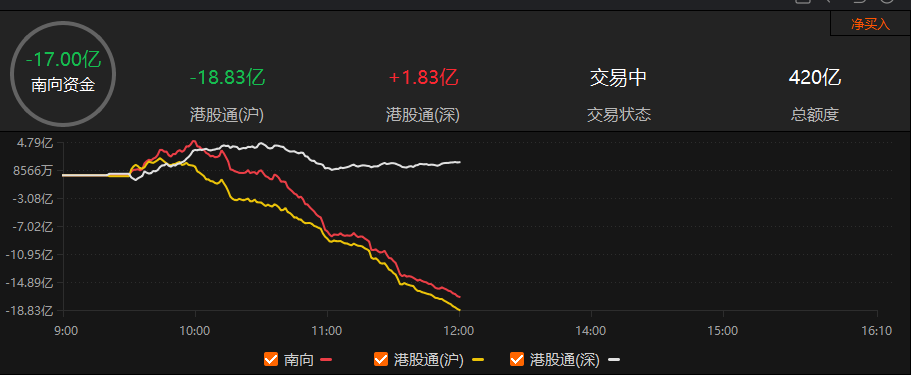
Market Performance - The Hong Kong stock market reversed its previous decline, with the Hang Seng Index rising by 0.75%, the National Enterprises Index increasing by 0.90%, and the Hang Seng Technology Index up by 0.34% [1]. Sector Performance - The metals sector showed strong performance, with gold and precious metals, general metals, and mining industries leading the gains. Notably, Chongqing Steel, New Mining Resources, and Long Resources saw increases of over 13% [1]. - Real estate stocks strengthened, with Country Garden rising by over 6%, and Longfor Group and China Resources Land both increasing by over 4% [1]. - The software services sector continued to struggle, with MINIMAX-WP dropping by over 11% and Zhiyuan falling by over 5% [1]. Capital Flow - In the early session, southbound funds recorded a net sell of 1.7 billion HKD, with the Shanghai Stock Connect seeing a net sell of 1.883 billion HKD, while the Shenzhen Stock Connect had a net buy of 183 million HKD [1].

港股收评:三大指数爆发!恒科指飙涨3.34%,科技、黄金股齐飞
Ge Long Hui· 2026-02-23 08:53
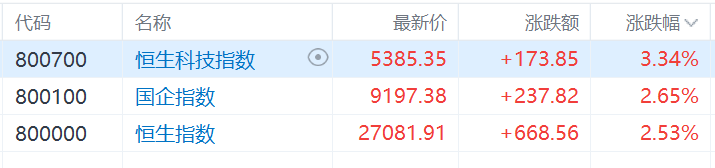
Market Overview - The Hong Kong stock market indices collectively rose, with the Hang Seng Index increasing by 2.53%, the Hang Seng China Enterprises Index by 2.65%, and the Hang Seng Tech Index by 3.34% [1][2]. Technology Sector - Major technology stocks saw significant gains, with Meituan rising over 5%, and JD.com, Alibaba, Xiaomi, Baidu, Kuaishou, and Tencent all increasing by over 3% [2][3]. - The optical communication sector led the gains, with Yangtze Optical Fibre and Cable rising over 14% [5]. Gold and Precious Metals - The gold and precious metals sector strengthened, with Tongguan Gold increasing over 12% and other companies like Zijin Mining and China Gold International also seeing gains [6][7]. Lithium Battery Sector - The lithium battery sector was active, with Ganfeng Lithium rising over 8%, and other companies like BYD and CATL also experiencing increases [8][9]. - UBS raised its lithium price forecast, citing growing demand from electric vehicles and energy storage [9]. Automotive Sector - The automotive sector saw notable increases, with companies like NIO, BYD, and Li Auto all rising [10][11]. - The China Passenger Car Association noted that the automotive industry is progressing towards a target of 20 million overseas sales, which could enhance China's global automotive position [11]. Insurance Sector - The insurance sector was active, with China People's Insurance Group rising nearly 4%, and other major insurers also seeing gains [12][13]. - According to a report, the insurance industry's investment balance is expected to continue growing rapidly, with a significant increase in stock investments anticipated by 2026 [13]. Robotics Sector - The robotics sector showed strong performance, with Wolong Materials rising over 8%, and other companies like SMIC and AAC Technologies also increasing [14][15]. - The Spring Festival Gala's robot performances are expected to boost public interest and confidence in the robotics industry [15]. Agricultural Sector - The agricultural sector faced declines, with Hualian International dropping nearly 8% and other companies following suit [16][17]. Individual Stock Highlight - InnoCare Technologies rose by 10.06%, reaching a market capitalization of HKD 620.44 million, following its announcement of a significant design integration with Google's AI hardware platform [18][22].
港股午盘|恒指涨0.43% 黄金板块活跃
Di Yi Cai Jing· 2026-02-11 07:06
Core Viewpoint - The Hang Seng Index closed at 27,299.62 points, up 0.43%, while the Hang Seng Tech Index rose by 1.1% to 5,510.82 points, indicating a positive market sentiment overall [1]. Group 1: Market Performance - The Hang Seng Index increased by 0.43% to reach 27,299.62 points [1]. - The Hang Seng Tech Index saw a rise of 1.1%, closing at 5,510.82 points [1]. Group 2: Sector Performance - The gold and precious metals sector, along with the automotive sector, showed active performance [1]. - The semiconductor and insurance sectors experienced weakness [1].
浦银国际:料港股今年约1.6万亿港元市值股份解禁 高峰在9月涉5,309亿港元
Zhi Tong Cai Jing· 2026-01-28 03:13
Core Viewpoint - In 2026, the Hong Kong stock market is expected to experience a wave of lock-up expirations, with a peak in September, while core sectors such as Information Technology, Consumer Discretionary, and Healthcare will see their peak expirations in March and April [1] Group 1: Market Impact - The report anticipates that the lock-up expirations will not lead to a significant market downturn, provided that the upward trend in the Hong Kong stock market continues and liquidity remains ample [1] - However, stocks with a high lock-up ratio may face price pressure before and after the expiration [1] Group 2: Stock Selection - The company has identified 60 stocks that may face substantial selling pressure in the next 12 months due to the upcoming lock-up expirations [1] - For fundamentally strong companies, irrational declines triggered by lock-up expirations may present medium to long-term investment opportunities [1] Group 3: Lock-up Scale - It is estimated that approximately HKD 1.6 trillion worth of shares will be unlocked in the Hong Kong stock market in 2026, with monthly unlock amounts exceeding HKD 100 billion for six months [1] - September is highlighted as a critical time for the market, with an expected unlock of HKD 530.89 billion (totaling 44.62 billion shares), accounting for 32.6% of the annual total and equivalent to 31% of the total market capitalization of related companies and 113% of the free float market capitalization [1] Group 4: Sector Analysis - The Gold and Precious Metals sector has the highest unlock scale and a significant proportion of circulating shares, while the core sectors of Information Technology, Consumer Discretionary, and Healthcare will see their unlock peaks in March and April, warranting attention to their supply pressure [1]
港股收评:恒指涨0.06%,黄金、有色资源股全线爆发
Ge Long Hui A P P· 2026-01-26 08:37
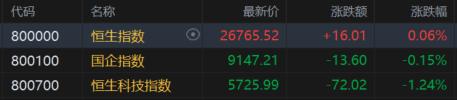
Market Overview - The Hong Kong stock market showed mixed performance with the Hang Seng Index slightly up by 0.06% to 26,765.52, while the Hang Seng China Enterprises Index fell by 0.15% to 9,147.21, and the Hang Seng Tech Index dropped significantly by 1.24% to 5,725.99 [1][2]. Sector Performance - Technology stocks experienced a downward trend, with major players like XPeng Motors down over 4%, NIO, Li Auto, SMIC, Kuaishou, and Baidu down over 3%, while Tencent and JD.com showed slight gains [4]. - Precious metals surged, with international gold prices surpassing $5,100 per ounce, leading to a significant rise in gold and silver stocks, notably China Silver Group which increased by over 19% [7][8]. - Energy stocks, including oil and coal, performed well, with China National Offshore Oil Corporation rising over 4% and China Shenhua Energy increasing by over 4% [9][10]. - The commercial aerospace sector faced declines, with Asia Pacific Satellite down over 11% and other related stocks following suit [6]. Individual Stock Movements - Notable gainers included China Silver Group (+19.12%), Shenglong International (+14.46%), and China Shenhua Energy (+4.42%) [11][12]. - Conversely, significant losers included Asia Pacific Satellite (-17.53%) and XPeng Motors (-4.17%) [5][6]. Investment Insights - Long-term outlook for energy stocks remains positive due to geopolitical uncertainties and rising oil demand forecasts, with IEA projecting an increase of 930,000 barrels per day in global oil demand by 2026 [9][10]. - The coal sector is expected to maintain a tight supply-demand balance over the next 3-5 years, with high-quality coal companies showing strong cash flow and dividend potential [10]. Capital Movements - Southbound funds recorded a net sell of HKD 826 million, with the majority coming from the Shanghai and Shenzhen stock connect [16]. Future Outlook - Analysts suggest that the Hong Kong market has the potential for valuation recovery and sentiment improvement, although upward momentum may be constrained by high global interest rates and limited expectations for rate cuts [18].
恒指跌0.99% 半导体板块走低
Mei Ri Jing Ji Xin Wen· 2026-01-19 04:19
Group 1 - The Hang Seng Index declined by 0.99% [1] - The Hang Seng Tech Index fell by 1.15% [1] - Sectors such as gold and precious metals, oil and gas, and general metals and minerals showed gains [1] Group 2 - The pharmaceutical and biotechnology, professional retail, and semiconductor sectors experienced declines [1]
股票市场概览:资讯日报:美国12月核心CPI升幅低于预期-20260114
Guoxin Securities Hongkong· 2026-01-14 06:04
Market Overview - The Hang Seng Index closed at 26,848, down 0.90% for the day, but up 4.75% year-to-date[3] - The S&P 500 Index closed at 6,964, down 0.19% for the day, with a year-to-date increase of 1.73%[3] - The Nikkei 225 Index rose by 3.10%, closing above 53,000 points for the first time, driven by expectations of domestic policy changes and fiscal stimulus[12] Sector Performance - Defensive sectors like pharmaceuticals, gold, and oil showed strong performance, with gold prices surpassing $4,630 per ounce, marking a historical high[9] - The biopharmaceutical sector saw significant gains, with WuXi AppTec's revenue expected to reach 45.456 billion yuan, a year-on-year increase of 15.84%[9] - Automotive stocks also rose, with companies like Li Auto and Great Wall Motors increasing by over 2% due to positive developments in EU electric vehicle export negotiations[9] Geopolitical and Economic Factors - Concerns over geopolitical risks have led to increased demand for safe-haven assets, contributing to the rise in gold and oil stocks[9] - The U.S. December Consumer Price Index (CPI) showed a year-on-year increase of 2.7%, aligning with market expectations and reinforcing predictions of potential interest rate cuts by the Federal Reserve in 2026[10][15] - The U.S. budget deficit for 2025 is projected to narrow to approximately $1.7 trillion, the smallest in three years, due to increased tariff revenues[15]
港股午盘|恒指涨1.78% 黄金等板块领涨
Xin Lang Cai Jing· 2026-01-07 05:50
Core Viewpoint - The Hang Seng Index rose by 1.78% to 26,815.69 points, while the Hang Seng Tech Index increased by 2.21% to 5,868.24 points, indicating a positive market trend driven by specific sectors [1] Sector Performance - The leading sectors included gold and precious metals, general metals and minerals, and other financial sectors, which showed significant gains [1] - Conversely, the consumer retail, information technology equipment, and industrial support sectors experienced declines [1]
金十数据全球财经早餐 | 2025年12月30日
Jin Shi Shu Ju· 2025-12-29 23:08
Group 1 - The U.S. stock market experienced declines, with the Dow Jones down 0.51%, S&P 500 down 0.35%, and Nasdaq down 0.5% [4] - Tesla shares fell by 3.2%, while Micron Technology rose by 3.4% and Nvidia dropped by 1% [4] - The Hong Kong stock market opened high but closed lower, with the Hang Seng Index down 0.71% and a trading volume of 224.5 billion HKD [5] Group 2 - The A-share market showed mixed results, with the Shanghai Composite Index up 0.04%, marking a nine-day winning streak, while the Shenzhen Component and ChiNext Index fell by 0.49% and 0.66% respectively [6] - The total trading volume in the A-share market was 2.14 trillion CNY, a decrease of 20.9 billion CNY from the previous trading day [6] - The commercial aerospace sector continued to perform strongly, with several stocks experiencing consecutive gains [6] Group 3 - Gold prices fell sharply by 4.43% to 4,331.98 USD/oz, while silver prices dropped by 8.87% to 72.14 USD/oz [7] - WTI crude oil rose by 1.55% to 57.75 USD/barrel, and Brent crude oil increased by 1.27% to 61.22 USD/barrel [7] - The U.S. dollar index decreased by 0.059% to 98.01 points [7]

102家企业扎堆港股上市!新经济唱主角,港交所改革藏着哪些密码
Sou Hu Cai Jing· 2025-12-28 09:18
Core Insights - The Hong Kong IPO market has seen a significant surge in 2025, with 102 companies listed and net fundraising reaching HKD 238.2 billion, more than doubling compared to the same period last year, with expectations to hit USD 36 billion for the year [1][21] Group 1: Market Performance - The average daily trading volume in the Hong Kong stock market increased to HKD 240.2 billion in the first half of the year, showing a notable rise from the previous year [7] - 75% of new stocks have either increased in price or remained stable, with 16 stocks seeing cumulative gains exceeding 100% and 27 companies experiencing subscription multiples in the thousands [7] Group 2: Sector Contributions - Key sectors driving fundraising include industrial engineering, gold and precious metals, automotive, pharmaceutical biotechnology, and software services, collectively raising over HKD 130 billion [3] - Retail and consumer IPOs have surged, becoming the most numerous this year, indicating a shift towards new consumption enterprises [3] Group 3: IPO Dynamics - 27 companies opted for privatization and delisting, while 4 voluntarily withdrew their listing applications, and 30 companies had their listing status canceled by the exchange, indicating a rapid market turnover [5] - The top ten IPOs raised a total of HKD 154.7 billion, accounting for more than half of the total annual fundraising, with major mainland companies like CATL and Zijin Mining each raising over HKD 10 billion [9] Group 4: Regulatory Changes - The Hong Kong Stock Exchange has implemented several reforms to attract companies, including the introduction of a special listing mechanism for technology companies and lowering the market cap threshold for special technology listings [11] - The exchange has also optimized the listing approval process, resulting in significant fundraising increases for biotech companies [11] Group 5: Investor Sentiment - There has been a noticeable shift in investor behavior, with more funds directed towards IPO subscriptions rather than traditional savings or insurance products, contributing to the market's vibrancy [13] - Concerns have arisen regarding the backlog of 319 listing applications and the quality of materials submitted by intermediaries, prompting regulatory scrutiny [15] Group 6: Future Outlook - Predictions indicate that the A+H share model will continue to thrive, with the return of Chinese concept stocks and special technology companies being significant contributors [19] - Potential challenges include a wave of lock-up expirations for newly listed companies, which may lead to large shareholder sell-offs, although the overall impact may be mitigated by improving macroeconomic conditions [19][22]