
玩具

Search documents
港股收盘 | 恒指收跌0.09% 生物医药股表现亮眼 新消费概念走势分化
Zhi Tong Cai Jing· 2025-10-16 08:57
Market Overview - Concerns over tariffs have led to a decline in Hong Kong stocks, with the Hang Seng Index closing down 0.09% at 25,888.51 points and a total turnover of HKD 275.43 billion [1] - The Hang Seng Tech Index fell 1.18%, indicating weakness in the technology sector, while the Hang Seng China Enterprises Index saw a slight increase of 0.09% [1] Blue-Chip Stocks Performance - Pop Mart (09992) continued its upward trend, closing up 5.57% at HKD 288.2, contributing 17.6 points to the Hang Seng Index [2] - Morgan Stanley upgraded Pop Mart's investment rating to "Overweight," raising the target price from HKD 300 to HKD 320, citing attractive valuation and upcoming catalysts [2] - Other notable blue-chip performances included New Oriental-S (09901) up 8.86% and BYD Electronic (00285) up 5.01%, while Xiaomi Group-W (01810) and SMIC (00981) faced declines of 3.6% and 2.76%, respectively [2] Sector Highlights - Large technology stocks showed weak performance, with Xiaomi down 3.6%, Tencent down 1.12%, and Alibaba down 0.25% [3] - Coal and banking stocks performed well, with China Coal Energy (601898) rising over 7% and Agricultural Bank of China up nearly 3% [3] - The pharmaceutical sector continued to rise, with notable gains from Xuan Bamboo Biotechnology-B (02575) up 10.27% and Yiming Oncology-B (01541) up 5.13% [3] New Consumption Trends - The new consumption sector showed mixed results, with Lao Pu Gold (06181) up 6.21% and Pop Mart (09992) up 5.57%, while Giant Bio (02367) fell 15.31% [4] - Morgan Stanley highlighted the brand value enhancement of Lao Pu Gold, naming it a top pick in the Chinese consumer sector [4] Dividend Stocks Activity - Dividend stocks were active, with China Coal Energy (01898) up 7.26% and Agricultural Bank of China (01288) up 2.98% [5] - The market is shifting focus towards geopolitical risks, corporate earnings fundamentals, and policy effects, with a potential rotation towards value and dividend stocks [5] Apple-Related Stocks - Apple-related stocks saw some gains, with BYD Electronic (00285) up 5.01% and Hong Teng Precision (06088) up 3.05% [6] - Recent visits by Apple executives to key suppliers in China indicate ongoing collaboration and investment in the region [6] Notable Stock Movements - Yunji (02670) debuted with a significant rise of 26.05%, closing at HKD 120.5, indicating strong market interest [7] - Think Academy (01769) surged 26.48% after announcing a share issuance to enhance educational quality and fund AI projects [8] - Fenbi (02469) rose 7.09% following strong sales of its AI-driven exam preparation system [9] - Sanhua Intelligent Control (002050) fell 6.13% after clarifying rumors about large robot orders were unsubstantiated [10] - Hong Kong Telecom-SS (06823) declined 4.37% due to potential operational license revocation in the U.S. based on national security concerns [11]

港股收评:恒生指数跌0.09%,恒生科技指数跌1.18%
Xin Lang Cai Jing· 2025-10-16 08:40
Core Viewpoint - The Hong Kong stock market experienced a slight decline, with the Hang Seng Index falling by 0.09% and the Hang Seng Tech Index dropping by 1.18% [1] Sector Performance - The life sciences tools and home goods sectors showed strong performance, while the automotive and containers & packaging sectors faced significant declines [1] Individual Stock Movements - Notable gainers included: - China Coal Energy (601898) up by 7.26% - Laopuqin Gold up by 6.21% - ZTE Corporation up by 5.86% - Pop Mart up by 5.57% - China Life Insurance (601628) up by 4.82% - Kangfang Biologics up by 4.75% - Significant decliners included: - Sanhua Intelligent Control (002050) down by 6.13% - Giant Bio down by 15.31% - Remarkable stock performances included: - Yaojie Ankang-B up by 46.34% - Zhongqing Co. up by 19.1% [1]
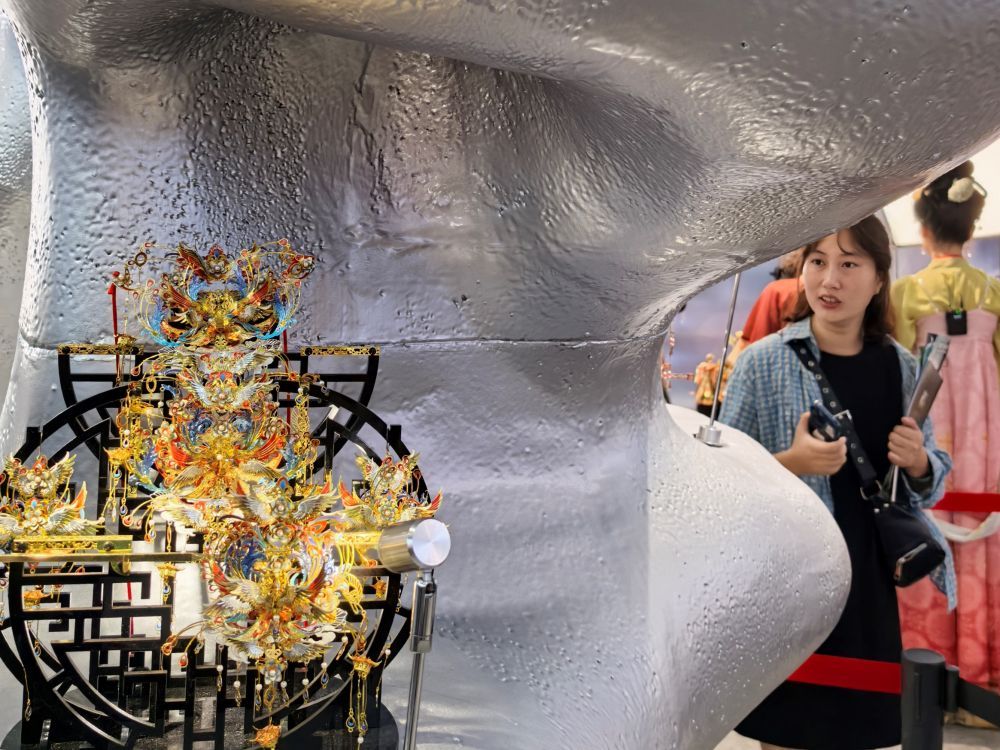
创新力充沛、包容力深厚、适应力顽强――中国玩具展上看中国企业“三力”
Xin Hua She· 2025-10-16 07:50
Core Insights - Dongguan is establishing an AI toy industrial park in Chashan, covering 140,000 square meters, to integrate AI technologies into the toy industry [1][2] - The toy industry in Dongguan produces 85% of China's trendy toys and 25% of global anime derivatives, with an annual growth rate of 12% over the past three years [1][2] - Disney announced over 2,000 licensed products related to the upcoming movie "Zootopia 2," showcasing the collaboration with Chinese companies [2][4] Group 1 - The AI toy industrial park aims to attract AI technology firms and teams for developing proprietary cultural products [2] - Dongguan's initiative reflects a broader trend in the Chinese toy industry to respond to domestic and international market challenges through high-quality development [2][4] - The toy exhibition featured over 1,500 products from nearly 150 Chinese toy licensing partners, highlighting the innovation and adaptability of the industry [4] Group 2 - In 2024, China's toy retail market is projected to grow, with a total retail value of 97.85 billion yuan, a 7.9% increase from the previous year [6] - The export value of toys (excluding games) is expected to be $39.87 billion in 2024, showing a slight decline of 1.7% year-on-year [4] - The share of trendy toys in the overseas market has increased from 3% to 18% over the past five years, indicating a significant shift in market dynamics [4]

群兴玩具10月15日获融资买入487.50万元,融资余额1.74亿元
Xin Lang Cai Jing· 2025-10-16 01:28
Core Viewpoint - The financial performance of Qunxing Toys shows a mixed picture with significant revenue growth but a substantial net loss in the first half of 2025, indicating potential challenges in profitability despite increasing sales [2]. Financing and Trading Activity - On October 15, Qunxing Toys had a trading volume of 83.34 million yuan, with a net financing purchase of 0.78 million yuan after 4.10 million yuan in repayments, resulting in a total financing and margin balance of 17.4 million yuan [1]. - The current financing balance of 17.4 million yuan represents 4.00% of the circulating market value, which is below the 40th percentile level over the past year, indicating a low financing level [1]. - There were no short-selling activities on October 15, with a short balance of 0.00 yuan, placing it in the 90th percentile level over the past year, suggesting a high level of short-selling potential [1]. Business Performance - For the first half of 2025, Qunxing Toys reported a revenue of 176 million yuan, reflecting a year-on-year growth of 38.40%, while the net profit attributable to shareholders was a loss of 17.06 million yuan, a significant decline of 158.63% compared to the previous period [2]. - The company’s main revenue sources include liquor sales (80.56%), intelligent computing business (10.32%), and property leasing and management services (9.12%) [1]. Shareholder and Dividend Information - As of June 30, 2025, the number of shareholders for Qunxing Toys was 37,400, a decrease of 12.04% from the previous period, while the average circulating shares per person increased by 16.21% to 15,825 shares [2]. - Since its A-share listing, Qunxing Toys has distributed a total of 60.21 million yuan in dividends, with no dividends paid in the last three years [3]. - Notably, the fund "Caitong Value Momentum Mixed A" has exited the top ten circulating shareholders as of June 30, 2025 [3].

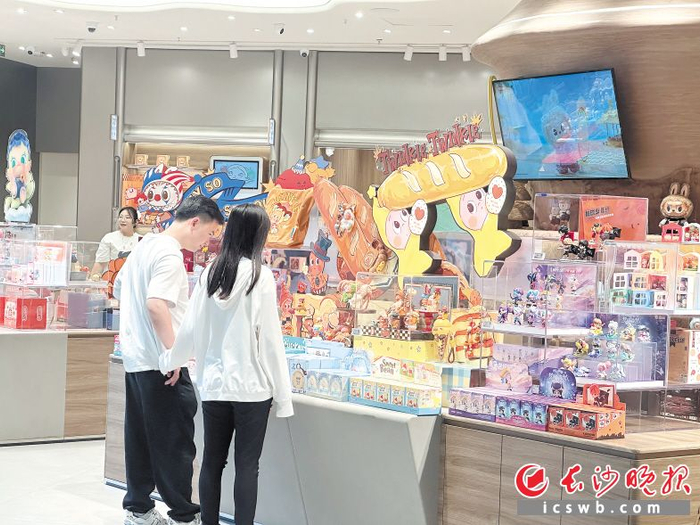
中国潮玩“跑赢”迪士尼|经济观察
Chang Sha Wan Bao· 2025-10-15 23:43
Core Insights - In the first half of 2025, Pop Mart achieved revenue of 13.876 billion RMB, surpassing Disney's toy business to become the second-largest player in the global toy industry, only behind Lego [1] - Pop Mart's success is attributed to its unique business model that relies on popular IPs and a strong social media presence, rather than traditional storytelling and content-driven strategies [7][8] Revenue and Market Position - Pop Mart's revenue of 13.876 billion RMB in the first half of 2025 marks a significant milestone, allowing it to overtake Disney in the toy sector [1] - The company's stock price has increased by over 165% in the past year, driven by the popularity of its IP "Labubu" [7] Product Demand and Market Dynamics - New product launches often sell out quickly, with significant price increases in the secondary market; for example, a blind box originally priced at 1,272 RMB is reselling for 1,900 RMB, reflecting a 49% increase [3] - The offline stores are experiencing similar demand, with many products out of stock and no immediate restock plans [4][5] Innovation and Business Strategy - Pop Mart has shifted from a content-driven IP development model to a data-driven approach, focusing on user engagement and real-time market feedback to optimize product design [8] - The company has successfully created emotional connections with consumers through its IPs, allowing them to express their identities and emotions through the products [9]
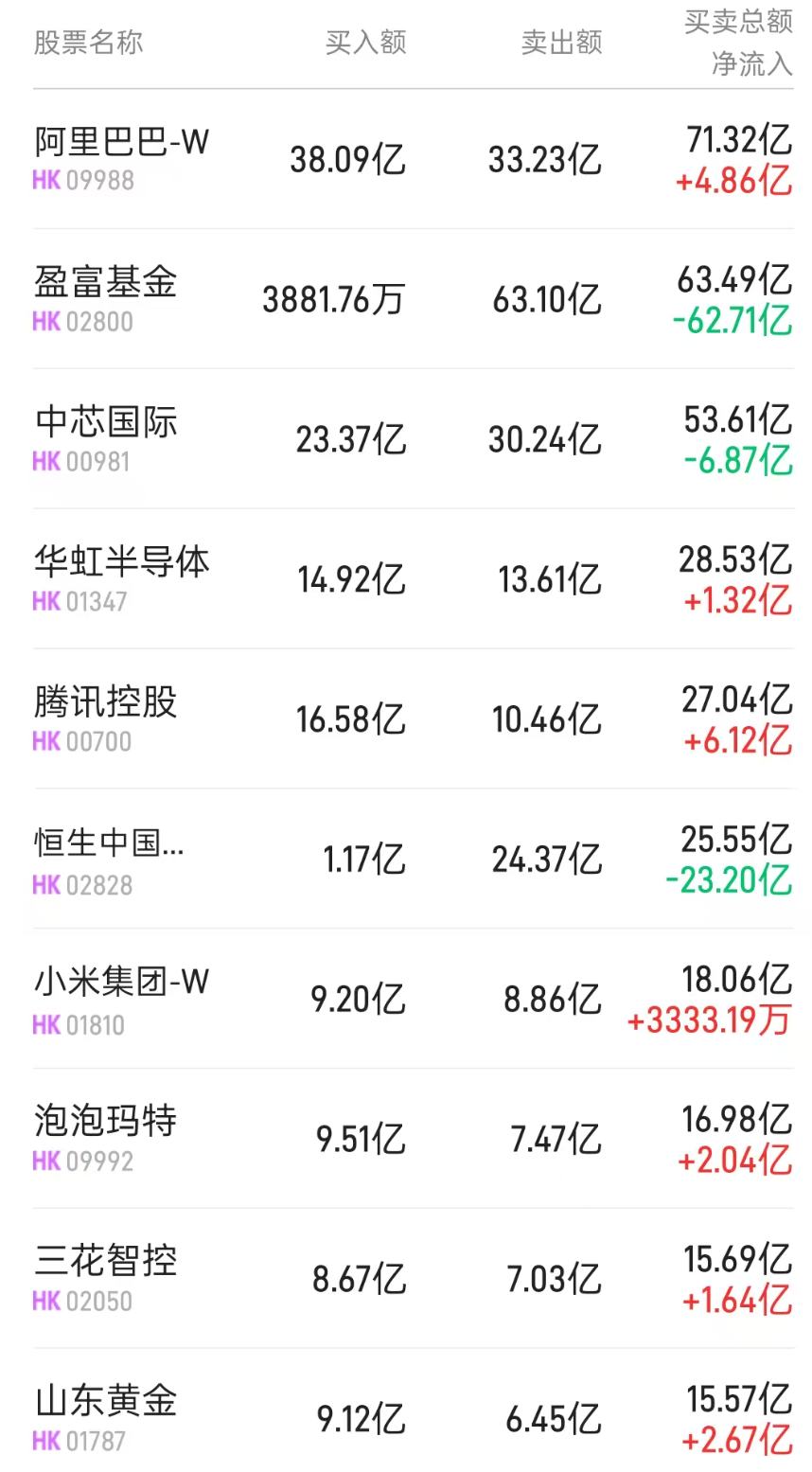
北水成交净卖出54.43亿 内资再度加仓科网股 抛售盈富基金超85亿港元
Zhi Tong Cai Jing· 2025-10-15 21:24
Core Insights - The Hong Kong stock market experienced significant net selling from northbound capital, totaling HKD 54.43 billion, with the Shanghai-Hong Kong Stock Connect seeing a net sell of HKD 63.1 billion and the Shenzhen-Hong Kong Stock Connect a net buy of HKD 8.66 billion [2] Group 1: Stock Performance - Alibaba-W (09988) was the most actively bought stock, with a net inflow of HKD 38.09 billion, while it had a total buy amount of HKD 71.32 billion and sell amount of HKD 33.23 billion [3] - Semiconductor stocks showed divergence, with Hua Hong Semiconductor (01347) receiving a net buy of HKD 4.45 billion, while SMIC (00981) faced a net sell of HKD 6.42 billion [6] - Xiaomi Group-W (01810) saw a net buy of HKD 2.96 billion, supported by promotional activities and new product launches [7] Group 2: Company Announcements - Shandong Gold (01787) announced an expected net profit for the first three quarters between HKD 3.8 billion and HKD 4.1 billion, representing a year-on-year increase of 83.9% to 98.5% [8] - Tencent (00700) is expected to report stable performance in its upcoming Q3 earnings, with total revenue and profit anticipated to meet or exceed expectations [7] - The semiconductor sector is expected to benefit from increased domestic production capabilities and rising prices in memory chips, creating investment opportunities [6]




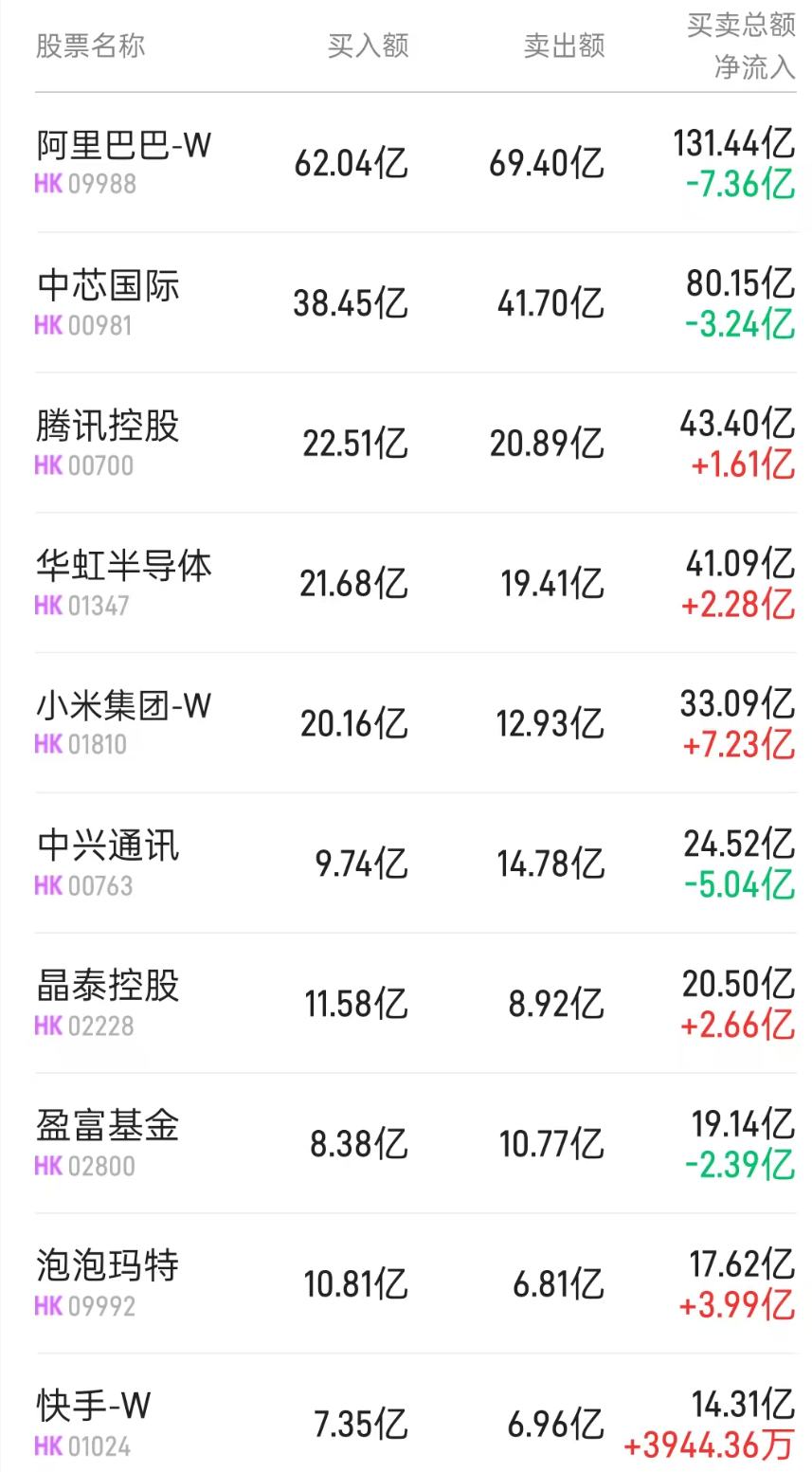
北水成交净买入86.03亿 北水继续抛售芯片股 逢低抢筹小米超9亿港元
Zhi Tong Cai Jing· 2025-10-15 21:24
Group 1: Market Overview - On October 14, the Hong Kong stock market saw a net inflow of 8.603 billion HKD from northbound trading, with 4.973 billion HKD from Shanghai and 3.631 billion HKD from Shenzhen [2] - The most bought stocks included Southern Hang Seng Technology (03033), Xiaomi Group-W (01810), and Tencent (00700), while the most sold stocks were SMIC (00981), Alibaba-W (09988), and Innovent Biologics (01347) [2] Group 2: Stock Performance - Alibaba-W had a net outflow of 7.36 billion HKD, while SMIC experienced a net outflow of 3.241 billion HKD [3] - Tencent saw a net inflow of 1.611 billion HKD, with total buy and sell amounts of 22.51 billion HKD and 20.89 billion HKD respectively [3] - Xiaomi Group-W continued to decline, with a net inflow of 9.23 billion HKD despite safety concerns regarding its electric vehicle [6] Group 3: Sector Analysis - Semiconductor stocks faced significant selling pressure, with Huahong Semiconductor (01347) and SMIC (00981) experiencing net outflows of 1.1 billion HKD and 9.57 billion HKD respectively [8] - The semiconductor industry is under scrutiny due to recent developments affecting control over companies, highlighting the urgency for self-sufficiency in the supply chain [8] - The AI and pharmaceutical sectors are gaining attention, with companies like Crystal Tech Holdings (02228) being recognized for their innovative approaches in robotics and AI in drug development [7]
美国为何发起自杀式攻击,帝国的疯狂教给世界最后一课
Sou Hu Cai Jing· 2025-10-15 13:48
Group 1 - The core argument is that the tariffs imposed by the Trump administration have negatively impacted the U.S. economy, leading to increased costs for businesses and consumers, market volatility, and disruptions in the global supply chain [1][3][11] - The root cause of the current situation in the U.S. is long-standing social issues, including wealth concentration and increasing inequality, which have left many citizens feeling abandoned by the system [3][11] - Trump's tariff policies, initiated in 2018, aimed to combat unfair trade practices but resulted in retaliatory measures from other countries, adversely affecting U.S. farmers and manufacturers [5][9] Group 2 - The tariffs led to significant cost increases for American consumers, with estimates indicating that tariffs imposed in 2018 alone cost U.S. companies and consumers an additional $51 billion [9][11] - Despite the intention to reduce the trade deficit, the tariffs have not achieved this goal; instead, the trade deficit has increased due to higher import costs without a corresponding improvement in exports [9][11] - The economic policies have contributed to a decline in U.S. global influence, with a shift towards isolationism and protectionism, which threatens democratic values and accelerates the de-dollarization process [13][18] Group 3 - The long-term outlook is pessimistic, with expectations of continued trade friction and potential inflation resurgence, leading to increased business failures and a search for alternative trade partners by allies [17][18] - The article emphasizes the need for continuous investment in education and public welfare to prevent societal division and political crises, highlighting the responsibility of elites to address inequality [15][18]

永金证券晨会纪要-20251015
永丰金证券· 2025-10-15 09:01
Market Overview - The US stock market showed signs of stabilization after fluctuations, with technology stocks continuing to weaken due to US-China trade tensions [7] - Gold prices reached a new high, with spot gold rising to $4,179.7 per ounce as safe-haven investments surged [7] - The yield on 10-year US Treasury bonds fell to 3.9976%, increasing expectations for interest rate cuts [7] Key International News - SoftBank's PayPay plans to IPO in the US by December, with a valuation expected to exceed 3 trillion yen (approximately 153.4 billion HKD) [9] - Concerns over the US-China trade war continue, impacting market sentiment, with the Dow Jones dropping 615 points at one point before recovering [9] - Major US banks reported strong earnings, with JPMorgan's Q3 profit up 11.59% year-on-year, Goldman Sachs up 38.8%, and Citigroup up 15.9% [9] Key Economic Data - China's consumer price index (CPI) for September showed a year-on-year decrease of 0.2%, while the producer price index (PPI) fell by 2.3% [19] - The Eurozone's industrial production for August decreased by 1.6% month-on-month and by 0.1% year-on-year [19] Company Analysis - The report highlights the performance of specific companies, such as: - **Blucactus (325)**: Reported revenue of RMB 1.338 billion for H1 2025, a year-on-year increase of 27.9%, driven by increased sales of building block toys and new product launches [21] - **China Merchants Bank (3968)**: Leading in retail finance and wealth management, with stable growth in retail deposits and loans, contributing to steady profit sources [21] - **Weichai Power (2338)**: Expected Q3 revenue of approximately RMB 55.894 billion, a year-on-year growth of 13%, with improved profitability due to a recovery in the heavy truck market [21] Stock Performance - The Hang Seng Index closed at 25,441.35, down 448.13 points or 1.73%, marking a decline of 1,846 points (6.7%) over seven consecutive trading days [13] - The Hang Seng Technology Index fell by 3.62%, while the Hang Seng China Enterprises Index decreased by 1.55% [13]
长沙毅星昂玩具有限公司成立 注册资本5万人民币
Sou Hu Cai Jing· 2025-10-15 05:14
天眼查App显示,近日,长沙毅星昂玩具有限公司成立,法定代表人为朱尧成,注册资本5万人民币, 经营范围为一般项目:玩具销售;互联网销售(除销售需要许可的商品);玩具、动漫及游艺用品销售;电 子产品销售;文具用品零售;文具用品批发;专业设计服务;塑料制品销售;工艺美术品及礼仪用品销售(象 牙及其制品除外);母婴用品销售;木制玩具销售;技术服务、技术开发、技术咨询、技术交流、技术转 让、技术推广(除依法须经批准的项目外,自主开展法律法规未禁止、未限制的经营活动)。 ...