啤酒

Search documents
中金2026年展望 | 食品饮料:筑底接近尾声,聚焦高质量增长
中金点睛· 2025-12-17 23:54
Core Viewpoint - The food and beverage industry is experiencing a new normal with a weak overall consumption environment, emphasizing high quality-price ratios, functionality, health, and emotional consumption trends. The liquor industry continues to face weak demand, while snacks and beverages show better performance. The industry is expected to maintain a weak recovery with strong differentiation, relying on product innovation, fragmented channel layouts, and expanding consumer demographics [2][3][10]. Liquor Industry - The liquor industry is undergoing significant adjustments due to weak demand and new regulations, with expectations for a turning point in the first half of 2026 as the supply-demand balance improves. The impact of policies on demand is expected to weaken, leading to a gradual recovery in consumption [6][7]. - The strategic focus of liquor companies has shifted from inventory pressure to exploring new growth areas, such as targeting younger consumers and embracing new retail channels. This shift is expected to lead to a clearer upward trend in financial reports by 2026 [8][9]. - High-end liquor is anticipated to lead the overall recovery, benefiting from brand loyalty and the resumption of business activities. The mid-range segment may face challenges but is also expected to see some recovery [9]. Snack and Beverage Industry - The overall demand for snacks is stabilizing at a low level, with a focus on quality-price ratios and emotional value. The snack industry is expected to continue expanding, particularly in channels like bulk snacks and membership supermarkets [11][12]. - The beverage industry is benefiting from health trends, with a notable increase in demand for low-sugar and functional drinks. The market for instant retail is also growing, with significant sales increases in snack brands through platforms like Meituan [21][22]. - The competition in the beverage sector is expected to remain intense, but price competition is easing, allowing for improved profit margins for leading companies [22][23]. Dairy and Frozen Food Industry - The dairy industry is experiencing a recovery in operational performance, with expectations for improved profitability as raw milk prices stabilize. The demand for liquid milk is projected to stabilize in 2026, with a potential turning point in the raw milk supply-demand balance [33][34][37]. - The frozen food industry is facing pressure from weak demand but is seeing a stabilization in competition. Companies are focusing on product innovation and new channel development to improve profitability [42][43]. Condiments and Health Products - The condiment industry is expected to see stable demand in 2025, with a focus on product upgrades and innovation from leading companies. The overall competitive landscape is anticipated to become less aggressive as inventory levels normalize [44][48]. - The health product sector is experiencing a shift towards online sales and long-tail brand growth. Leading brands are expected to stabilize their market share through channel expansion and product diversification [55][56].


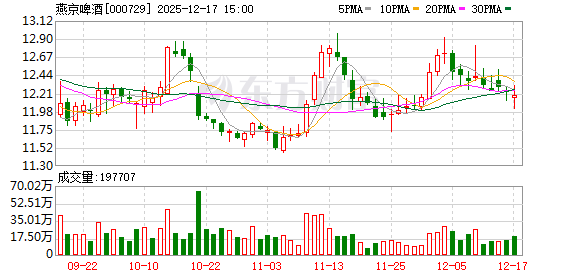
燕京啤酒党委书记、董事长耿超: 推动可持续发展理念深度融入经营实践
Zheng Quan Shi Bao· 2025-12-17 19:50
Group 1 - The core viewpoint of the articles highlights the recognition of the Chairman of Yanjing Beer, Geng Chao, as an ESG pioneer at the 19th Listed Company Value Forum, emphasizing his strategic vision for the company's sustainable development [2] - Geng Chao has proposed a "second entrepreneurship, revitalizing Yanjing" strategy, defining the "14th Five-Year Plan" period as a strategic restructuring phase for the company, with clear goals outlined in the "Five Battles, Five Victories" strategy [2] - The company has actively embraced and implemented ESG principles, aiming to improve governance, operational efficiency, and innovation quality, while integrating sustainable development into its business practices [2] Group 2 - In 2025, Yanjing Beer achieved an upgrade in its Wind ESG rating from A to AA, ranking 4th in the beverage industry, and its Huazheng ESG rating improved from BBB to AA, indicating a leading position in the domestic beer industry [3] - The company has received over 20 honors, including "Best Practice Case for Sustainable Development of Listed Companies" and "ESG Excellent Case in Governance" among others, showcasing its commitment to sustainability [3] - The 2024 Sustainable Development Report will feature an independent third-party verification statement for the first time, enhancing transparency and communication regarding the company's sustainable development progress [2]

新质生产力三重演进 共促企业价值提升
Zheng Quan Shi Bao· 2025-12-17 19:27
Core Viewpoint - The "New Quality Productivity" is fundamentally reshaping corporate growth logic and creating new avenues for development, emphasizing the need for companies to leverage rapidly growing AI tools to enhance self-awareness and capabilities, thereby transforming new quality productivity into corporate value [1] Group 1: Empowerment through New Quality Productivity - New quality productivity is essential for high-quality development, as highlighted in the 15th Five-Year Plan, and serves as a critical focus for enterprises [2] - Companies can enhance core competitiveness through systematic upgrades, efficiency revolutions, and value reconstruction, shifting from isolated breakthroughs to ecological competition [2] Group 2: Three Evolutionary Paths - The industrial logic of new quality productivity involves three evolutionary paths: traditional industry replacement and upgrade, integration and growth of emerging industries, and forward-looking layout of future industries [3] - The application of artificial intelligence in the industrial sector has already generated tangible value, linking various production stages and facilitating a growth path of "replacement-integration-leap" for domestic enterprises [3][4] Group 3: Industry-Specific Insights - In the pharmaceutical sector, AI significantly reduces the time required for new drug development from years to mere months, as exemplified by companies like Yabton Chemical [5] - Consulting firms are increasingly required to utilize data more effectively to gain client trust in the AI era, leading to the establishment of vertical models for enhanced data application [5] - The traditional Chinese medicine sector is also embracing AI to improve production control, quality inspection, and sales transparency [5] Group 4: Challenges in Implementation - The fast-moving consumer goods (FMCG) sector faces unique challenges in digitalization due to product variety and market constraints, yet companies are committed to strengthening their digital core strategies [6] - Data security remains a significant concern, as AI enhances management efficiency but poses risks during data exchange processes [6] - The industrial X-ray intelligent detection industry encounters dual challenges in hardware and software, necessitating continuous updates in material design and theoretical calculations [6] Group 5: Integration and Innovation - The difficulty of achieving integration in industries is highlighted, with a focus on understanding the industry thoroughly before implementing digital twin technologies [7] - Companies must embrace advanced technologies while being mindful of their financial health, as innovation should aim to create a value loop rather than being an end in itself [7] - The development of new quality productivity fundamentally relies on human involvement, encouraging a culture of creativity among younger employees to foster value creation [7]

重庆啤酒20251217
2025-12-17 15:50
Summary of the Conference Call for Chongqing Brewery Industry Overview - The beer industry is experiencing stable consumption in Q4 2025, slightly better than the low point of the previous year, but with minimal impact on the overall annual performance [2][3] - Major brands like Carlsberg, Lebao, Fenghua Xueyue, and Wusu saw sales growth in the first three quarters of 2025, while Chongqing and Dali brands experienced a decline [2][4] Key Points and Arguments - **Sales Performance**: Q4 typically accounts for only 10-11% of annual sales, making its impact on overall performance limited. The current year's Q4 performance is slightly better than last year's low point, but overall changes are minimal [3] - **Product Pricing Strategy**: The company is focusing on the 8-10 RMB price range due to consumer preference for cost-effective products, leading to a reduction in higher-priced beer offerings [2][8] - **Cost Management**: Rising aluminum prices have increased the cost of two-piece cans, but overall costs are manageable. A forecast for 2026 indicates an improvement in comprehensive costs compared to 2025 [5][15] - **Product Innovation**: The introduction of new products, such as 500ml Wusu and various one-liter packaging, has contributed positively to the average selling price (ASP) [6][16] - **Market Expansion**: The company plans to expand into non-direct drinking channels, including new retail and instant retail, to capture untapped markets [2][11] - **Channel Dynamics**: As of Q3 2025, sales from direct channels accounted for approximately 44%, while non-direct channels made up about 56%. This reflects a shift in consumer purchasing behavior [11][12] Additional Important Insights - **Brand Influence**: In non-direct channels, brand influence and trust are crucial for consumer repurchase. The expansion of national modern retail platforms presents new opportunities [12] - **Production Adjustments**: The company is optimizing production layouts to address supply chain challenges, including converting factories for small-batch craft beer production [5][16] - **Regional Performance**: Growth has been noted in the northwest and southern regions, while competition remains fierce in the central market, leading to declines in sales in Sichuan and Yunnan [17] - **Future Strategies**: In markets with high market share, the company aims to optimize resources and enhance operational efficiency through innovative products and marketing strategies [18] - **Beverage Business Outlook**: The beverage sector is competitive, and the company is not rushing to expand but rather focusing on improving overall capacity utilization and profit margins through strategic product launches [19] - **Craft Beer Development**: The craft beer brand Jing A is expanding its product line and business in Beijing, with plans for gradual nationwide promotion [20] This summary encapsulates the key insights and strategic directions discussed during the conference call, highlighting the company's current performance, market strategies, and future outlook in the beer industry.

燕京啤酒(000729) - 000729燕京啤酒投资者关系管理信息20251217
2025-12-17 10:42
Group 1: Strategic Achievements - The "14th Five-Year Plan" is a crucial strategic restructuring period for Yanjing Beer, focusing on transformation and strong brand development, resulting in continuous growth in key economic indicators for five consecutive years [2][3] - The implementation of a major product strategy has effectively upgraded the product structure, with significant improvements in operational efficiency and development quality [2][3] Group 2: Transformation Initiatives - The company views transformation as essential for survival and development, emphasizing ideological, governance, organizational, operational, production, marketing, research and development, and cultural changes to enhance management effectiveness and team vitality [2][3] - A robust organizational mechanism has been established to activate internal motivation and vitality, marking growth and transformation as key themes during the "14th Five-Year Plan" [2][3] Group 3: Major Product Strategy - Yanjing Beer is committed to advancing the major product strategy centered around Yanjing U8, increasing the proportion of mid-to-high-end products, which has positively impacted product structure optimization and profitability [4] - The Yanjing U8 has received widespread consumer acclaim, maintaining strong growth since its launch, and is recognized as one of the most promising national products in recent years [4] Group 4: ESG Governance and Management - The company integrates ESG principles into its development strategy and operations, establishing a "green brewing-responsible supply chain-value co-creation" system to promote sustainable and high-quality development [5][6] - Achievements include certifications in ESG management, compliance management, innovation management, and anti-bribery management systems, reflecting a significant upgrade in governance capabilities [6]
一款“不存在”的中国啤酒,是怎么在海外火起来的?
创业邦· 2025-12-17 10:19
以下文章来源于刺猬公社 ,作者刺猬公社编辑部 刺猬公社 . 互联网内容行业观察与研究 来源丨 刺猬公社(ID:ciweigongshe) 这批进口货的名字简单又普通:宜昌啤酒。 相信我,你没看错。如果有天早上醒来我看到青岛进口青岛啤酒的新闻,大概是这世界运行出了 bug 。但宜昌不远万里进口宜昌啤酒的故事,却真实发生了。 宜昌啤酒,这瓶在哈萨克斯坦生产,并在俄语地区广受欢迎的 " 中国啤酒 " ,经历了海外的 " 土生 土长 " ,终于在去年完成自己的寻根之旅,回到它的汉语名字所代表的故乡。而这到底是怎么回事? 宜昌啤酒经常出现在俄语背景中。图源Instagram 别说老外,就是中国人逛莫斯科或阿斯塔纳的超市,在货架上看到这样一瓶啤酒,第一眼也丝毫不会 怀疑它的 " 中国血统 "—— 两个汉字印得比所有国产啤酒都大,下面还用红色楷体字中文标注着 " 传统酿造 " ,再配上标志性的大绿棒子,伏拉夫来了都得感叹一句:我们中国真是太厉害了。 作者丨毛巾 编辑丨陈梅希 图源丨Midjourney 2024 年 11 月 29 日,一批特殊的货物经历了 7 天 4000 余公里的长途跋涉,从哈萨克斯坦阿拉木 图市出发, ...
非白酒板块12月17日跌0.44%,惠泉啤酒领跌,主力资金净流出8600.13万元
Zheng Xing Xing Ye Ri Bao· 2025-12-17 09:00
Group 1 - The non-liquor sector experienced a decline of 0.44% compared to the previous trading day, with Huichuan Beer leading the drop [1] - The Shanghai Composite Index closed at 3870.28, up by 1.19%, while the Shenzhen Component Index closed at 13224.51, up by 2.4% [1] Group 2 - In terms of capital flow, the non-liquor sector saw a net outflow of 86.0013 million yuan from main funds, while retail investors contributed a net inflow of 66.0641 million yuan [2] - Speculative funds recorded a net inflow of 19.9372 million yuan into the non-liquor sector [2]


帝亚吉欧将向朝日出售东非啤酒集团65%股份
Jin Rong Jie· 2025-12-17 08:48
Core Viewpoint - Diageo announced an agreement to sell its 65% stake in East African Breweries and its shares in Kenya's UDVK to Asahi, with a net gain of $2.3 billion expected after taxes and transaction costs. The deal is anticipated to be completed in the second half of 2026 [1]. Group 1 - Diageo's sale includes a 65% stake in East African Breweries and shares in UDVK [1] - The expected net proceeds from the transaction are $2.3 billion after tax and transaction costs [1] - The completion of the transaction is projected for the second half of 2026 [1]

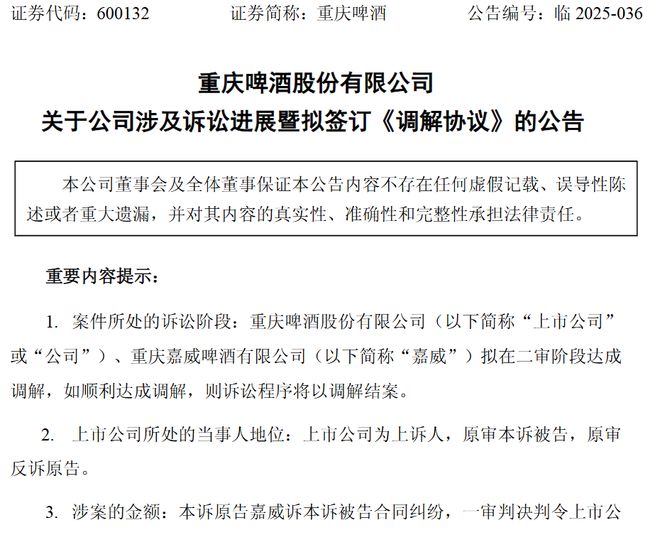
重庆啤酒与嘉威啤酒18年纠纷拟1亿元和解
Zhong Guo Jing Ying Bao· 2025-12-17 06:52
Core Viewpoint - Chongqing Brewery is in the process of reaching a settlement with Jiawei Brewery to resolve an 18-year dispute, potentially concluding the litigation that began in October 2023 with a claim amounting to 353 million yuan [1][2]. Group 1: Legal Proceedings and Settlement - The lawsuit initiated by Jiawei Brewery in October 2023 involves a claim of 353 million yuan, with the first-instance judgment favoring Jiawei Brewery in March 2025 [1]. - The dispute originated from a strategic cooperation agreement signed in 2007 and a 20-year product distribution framework agreement established in 2009, which restricted Jiawei Brewery to produce only the "Shancheng" brand beer [1]. - Following the first-instance ruling, Chongqing Brewery expressed disagreement and plans to appeal, asserting compliance with the agreements and denying any additional compensation obligations [2]. Group 2: Financial Implications of the Settlement - The proposed settlement includes a one-time payment of 100 million yuan (excluding tax) by Chongqing Brewery to Jiawei Brewery for all price difference settlements up to December 31, 2025 [2]. - Chongqing Brewery plans to reverse a previously recorded liability of 254 million yuan and will recognize a new liability of approximately 217 million yuan, which is expected to increase the company's total profit by 37.11 million yuan and net profit attributable to shareholders by 19.08 million yuan for the year 2025 [3]. - The settlement agreement stipulates that from 2026 to 2028, Chongqing Brewery will purchase 142,600 hectoliters of beer annually from Jiawei Brewery at a price of 4,000 yuan per hectoliter, potentially generating annual revenue of 570 million yuan for Jiawei Brewery if production targets are met [3]. Group 3: Strategic Outlook - Industry experts suggest that the short-term financial outlay by Chongqing Brewery may lead to long-term benefits, including alleviating profit pressure and stabilizing operations, allowing the company to focus on high-end products and market penetration [3]. - The settlement may also provide Chongqing Brewery with strategic flexibility regarding the "Shancheng" brand and Jiawei's production capacity, enabling potential future actions such as closure, acquisition, or replacement of assets [3].

重庆啤酒或与嘉威啤酒和解 一亿元了结18年纠纷
Zhong Guo Jing Ying Bao· 2025-12-17 06:25
Core Viewpoint - Chongqing Brewery and Jiawei Brewery are in the process of reaching a settlement to resolve an 18-year-long dispute, which involves a lawsuit initiated by Jiawei Brewery in October 2023, claiming 353 million yuan in damages [1][5]. Group 1: Legal Dispute Background - The lawsuit stems from a strategic cooperation agreement signed in 2007 and a 20-year product distribution framework agreement signed in 2009, which stipulated that Jiawei Brewery could only produce "Shancheng" brand beer and that all products must be distributed by Chongqing Brewery [5]. - Jiawei Brewery accused Chongqing Brewery of failing to include relevant products in the distribution agreement, leading to significant losses, and claimed that the annual production of "Shancheng" beer had plummeted from 1 million tons to 80,000 tons since the acquisition by Carlsberg [5][6]. Group 2: Settlement Agreement - The proposed settlement includes a one-time payment of 100 million yuan (excluding tax) from Chongqing Brewery to Jiawei Brewery for all price difference settlements up to December 31, 2025, and agreements on product distribution cooperation from 2026 to 2028 [6][7]. - Chongqing Brewery plans to reverse a previously recorded liability of 254 million yuan and will recognize a new liability of approximately 217 million yuan, which is expected to increase the total profit for 2025 by 37.11 million yuan and net profit attributable to shareholders by 19.08 million yuan [6][7]. Group 3: Future Business Implications - From 2026 to 2028, Chongqing Brewery is set to purchase 142,600 hectoliters of beer annually from Jiawei Brewery at a price of 4,000 yuan per hectoliter, with a compensation mechanism for any shortfall in actual sales [7]. - This agreement is projected to generate annual revenue of 570 million yuan for Jiawei Brewery if Chongqing Brewery meets its production and procurement commitments [7]. - Industry experts suggest that this settlement allows Chongqing Brewery to alleviate short-term profit pressures while stabilizing operations and providing strategic flexibility for future brand management and capacity decisions [7].