水产养殖

Search documents
汕头首个“风渔融合”海洋牧场投产
Nan Fang Ri Bao Wang Luo Ban· 2025-09-12 07:45
Core Viewpoint - The first "Marine Wind Power + Marine Ranch" integration project in Shantou, named "Sheng Tang No. 1," has been put into operation by China Datang Corporation, showcasing advancements in marine farming and renewable energy integration [1] Project Details - "Sheng Tang No. 1" has a span of 38 meters and a height of 56.5 meters, with a total weight of approximately 1,760 tons [1] - The project features a cultivation water volume of 13,600 cubic meters and is designed to withstand super typhoons of up to level 16 [1] Technical Features - The project utilizes a suction bucket foundation, which is characterized by no need for pile driving, quick installation, and economic environmental benefits [1] - This foundation provides a stable base while allowing for the overall mobility of the marine ranch [1]
广东珠未来珍珠有限公司成立 注册资本500万人民币
Sou Hu Cai Jing· 2025-09-12 06:47
Core Viewpoint - Guangdong Zhuwai Pearl Co., Ltd. has been established with a registered capital of 5 million RMB, focusing on various aspects of aquaculture and jewelry manufacturing and sales [1] Company Summary - The company is engaged in the aquaculture of pearls, purchasing and selling aquatic products, and retailing of seafood [1] - It also involves the sale of primary agricultural products, initial processing of edible agricultural products, and sales of agricultural by-products [1] - The company has a wide range of activities including jewelry manufacturing, wholesale, retail, and recycling services [1] Industry Summary - The company operates in the aquaculture and jewelry sectors, with a focus on both traditional and internet-based sales channels [1] - It is involved in the production and operation of genetically modified aquatic seedlings, indicating a modern approach to aquaculture [1] - The company also provides various technology services, including internet technology and information technology consulting [1]
亩产突破7000斤!中山鱼塘的“升级密码”
21世纪经济报道· 2025-09-12 01:30
Core Viewpoint - The article highlights the significant advancements in fish farming in Zhongshan, Guangdong, particularly focusing on the production of "Crispy Fish" (脆肉鲩), which has seen a steady increase in yield and value due to improved animal nutrition techniques and smart farming practices [1][3]. Group 1: Production and Yield - Zhongshan is a key area for aquaculture in China, with a notable production of "Crispy Fish" that not only serves the domestic market but also exports internationally [1]. - Fish farmers in Zhongshan have achieved an average yield of over 7,000 pounds per acre, with some farms reporting yields exceeding 8,000 pounds per acre through high-density farming practices [3][9]. - The region has developed a detailed production chain for grass carp, with specific areas dedicated to different growth stages, ensuring a steady supply of quality fish [3]. Group 2: Nutritional Management - The nutritional needs of grass carp vary significantly at different growth stages, necessitating precise control over feed composition to optimize growth and minimize costs [3][4]. - Advanced data analytics and IoT technology are employed to monitor pond conditions and adjust feeding strategies dynamically, leading to a reduction in feed costs by 15%-20% and minimizing environmental impact [4][5]. Group 3: Innovative Farming Models - The introduction of high-end puffed feed combined with high-density farming has provided new pathways for efficiency and profitability in grass carp farming [6][7]. - Farmers are utilizing a selective breeding approach to convert standard grass carp into "Crispy Fish," enhancing market value and profitability [7][9]. Group 4: Comprehensive Support Systems - A full-chain service system has been established to support farmers, addressing common challenges in technology, product availability, and market access [10]. - The integration of resources from seedling cultivation to feed production and fish sales has created a robust aquaculture industry in Zhongshan, enabling thousands of farmers to benefit from technological advancements [10].



“科技配方”有多牛?中山鱼塘变身“疗养院”,亩产翻七倍
2 1 Shi Ji Jing Ji Bao Dao· 2025-09-11 15:29
Core Insights - Guangdong is a significant region for aquaculture in China, with Zhongshan's crispy fish becoming a distinctive industry, achieving stable annual production growth and expanding both domestic and international markets [1] Group 1: Production and Yield - The average yield of over 7,000 pounds per acre has become the norm for local fish farmers, with the transformation of grass carp into crispy fish providing additional value [1] - Farmers like Li Quanfu and Li Jianhua have achieved an average yield exceeding 7,000 pounds per acre through precise nutritional management and scientific farming methods [1][2] Group 2: Nutritional Management - Zhongshan has developed a refined production chain for grass carp, with different regions specializing in various growth stages, ensuring optimal nutritional needs are met [2] - The establishment of a comprehensive database by Haida Group allows for precise assessment of grass carp's nutritional requirements at different growth stages, enhancing feed efficiency [2] Group 3: Technological Integration - Big data technology is utilized for dynamic adjustments in aquaculture, with IoT devices monitoring water temperature, oxygen levels, and fish growth, optimizing feeding strategies accordingly [3] - This precision management approach has reduced feed costs by 15%-20% and minimized pollution from leftover feed, promoting ecological protection alongside farming efficiency [3] Group 4: Farming Models and Services - The introduction of high-end puffed feed and high-density farming models has provided new pathways for efficiency and profitability in Zhongshan's grass carp aquaculture [3][4] - A complete service system supports farmers by providing quality seedlings, feed, and technical guidance, facilitating participation in the industry and collaborative development [5] Group 5: Industry Transformation - The transition from grass carp to crispy fish involves selecting larger individuals for specialized farming, significantly increasing the success rate and market value [4] - The integration of high-density farming and advanced management techniques has led to substantial increases in production, with some farms achieving yields of over 8,000 pounds per acre [5]
“科技配方”有多牛?中山鱼塘变身“疗养院” 亩产翻七倍
2 1 Shi Ji Jing Ji Bao Dao· 2025-09-11 15:17
Core Insights - Guangdong is a significant region for aquaculture in China, with a focus on the production of the unique "Crispy Fish" variety, which has seen steady growth in both domestic and international markets [1] - The local aquaculture industry has achieved a dual breakthrough with average yields exceeding 7,000 pounds per acre and increased product value through advanced animal nutrition techniques [1][2] - The integration of precise nutritional formulas, smart monitoring, and high-density farming has addressed industry challenges and enhanced the overall value chain of aquaculture in Zhongshan [1][4] Group 1: Nutritional Precision and Farming Techniques - Farmers in Zhongshan have adopted precise nutritional management, achieving an average yield of over 7,000 pounds per acre by understanding the nutritional needs of grass carp at different growth stages [2][3] - The region has developed a tiered production chain for grass carp, supplying over 30% of the national fry stock and focusing on different weight categories for market demands [2] - The use of big data and IoT devices allows for real-time monitoring and dynamic adjustments in feeding strategies, reducing feed costs by 15%-20% and minimizing environmental impact [3] Group 2: Innovative Farming Models - The introduction of a "high-end puffed feed + high-density farming" model has provided new pathways for efficiency and profitability in Zhongshan's grass carp aquaculture [4] - High-density farming practices have been implemented, with over 700 fry per acre, leading to yields exceeding 8,000 pounds per acre while maintaining fish health through scientific management [5] - A comprehensive service system has been established to support farmers, addressing common industry challenges and facilitating resource integration from fry cultivation to feed production and fish sales [5]
喜提“国际护照”,固城湖螃蟹“爬”向海外市场
Nan Jing Ri Bao· 2025-09-11 00:03
Group 1 - Jiangsu Huahai Seed Industry Technology Co., Ltd. has obtained export qualification for crabs, becoming the only company in Nanjing with this qualification, allowing for international trade [1][2] - The company has established a comprehensive ecological breeding technology and management system, focusing on "good varieties, ecology, nutrition, standardization, and branding," and has received multiple awards for its products [1][2] - Huahai Seed Industry implements a traceability system for its crabs, ensuring each crab has a "digital ID" for full-process control and traceability [1][2] Group 2 - The export qualification allows Huahai Seed Industry to engage in the production, processing, and storage of specific plants and animals for international markets [2] - The company collaborates with research institutions to apply new technologies in breeding, feed development, ecological farming, quality testing, and brand sales, achieving full self-control and management [2] - The crab farming area in Gaochun remains stable at over 200,000 acres, forming a complete industrial chain with a total output value exceeding 100 billion yuan, contributing significantly to the local economy [3]
从深海到健康,中挪产业合作迎新机遇
Bei Jing Shang Bao· 2025-09-10 14:22
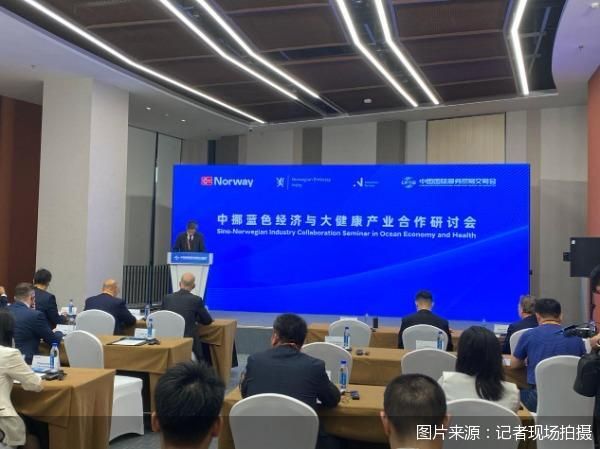
Group 1: Blue Economy and Health Industry Cooperation - The China-Norway Blue Economy and Health Industry Cooperation Seminar was successfully held during the 2025 China International Service Trade Fair, focusing on themes such as blue economy, marine technology, agricultural technology, health industry, and sustainable development [1] - A cooperation agreement was signed between China Road and Bridge Corporation and Norway's Pure Salmon Technology, expanding collaboration in aquaculture and infrastructure [1][7] Group 2: Service Industry and Trade Growth - The service industry has become a new engine for global economic growth, with its share of global GDP rising to 68% and service trade growth outpacing goods trade, increasing from 20.6% in 2013 to 25% in 2023 [2] - Beijing has implemented over 70 national breakthrough policies and attracted more than 8,000 foreign enterprises, utilizing over $66 billion in foreign investment, accounting for 8.4% of the national total [2][3] Group 3: Nutritional Health Food Market Potential - The nutritional health food industry in China is experiencing high-quality development, with market size growing from 99.3 billion yuan in 2013 to 328.3 billion yuan in 2023, a compound annual growth rate of 13%, and expected to exceed 800 billion yuan by 2027 [4] - In the first half of 2025, China's nutritional health food trade totaled $6.233 billion, with imports reaching $3.981 billion, reflecting a year-on-year growth of 10.3% and 10.5% respectively [4] Group 4: Import Trends and Consumer Demand - Norway ranked 16th among countries exporting nutritional health foods to China in the first half of 2025, with a trade total of $5.616 million, showing a year-on-year decline of 8.1% [4] - The Chinese market for imported cross-border health products has formed five core segments, with Norwegian brands holding significant positions in the cardiovascular and oral beauty sectors [5] Group 5: Green Agriculture and Sustainable Development - China Road and Bridge Corporation aims to establish a "green granary" in collaboration with Pure Salmon Technology, focusing on sustainable aquaculture and infrastructure development [6][8] - The partnership will involve creating a demonstration project for Atlantic salmon aquaculture in China, integrating advanced Norwegian technologies in automated feeding and fish disease diagnosis [8]
2025服贸会|从深海到健康,中挪产业合作迎新机遇
Bei Jing Shang Bao· 2025-09-10 14:05
Group 1: Blue Economy and Health Industry Cooperation - The China-Norway Blue Economy and Health Industry Cooperation Seminar was successfully held during the 2025 China International Service Trade Fair, focusing on themes such as blue economy, marine technology, agricultural technology, health industry, and sustainable development [1] - A cooperation agreement was signed between China Road and Bridge Corporation and Norway's Pure Salmon Technology, expanding collaboration in aquaculture and infrastructure [1][7] Group 2: Service Industry and Trade Growth - The service industry and service trade have become new engines for global economic growth, with the service sector accounting for 68% of global GDP and service trade's share rising from 20.6% in 2013 to 25% in 2023, projected to exceed 40% by 2040 [3] - Beijing has implemented over 70 national breakthrough policies and attracted more than 8,000 foreign enterprises, with actual foreign investment exceeding $66 billion, representing 8.4% of the national total [3][4] Group 3: Nutritional Health Market Potential - The Chinese nutritional health food industry is in a high-quality development phase, with market size growing from 99.3 billion yuan in 2013 to 328.3 billion yuan in 2023, a compound annual growth rate of 13%, and expected to exceed 800 billion yuan by 2027 [5] - In the first half of 2025, China's nutritional health food trade totaled $6.233 billion, with imports reaching $3.981 billion, showing a year-on-year growth of 10.5% [5] Group 4: Cross-Border Health Products and Consumer Demand - The cross-border health product market in China has formed five core segments, with Norwegian brands holding significant positions in the cardiovascular and oral beauty sectors [6] - The health literacy of Chinese consumers is improving, reaching 31.87% in 2024, enhancing awareness of key ingredients like DHA and EPA, which benefits the market for high-quality Norwegian health products [6] Group 5: Green Agriculture and Sustainable Development - The cooperation between China Road and Bridge Corporation and Pure Salmon Technology aims to establish a green aquaculture demonstration project focused on Atlantic salmon, aligning with China's food security strategy [8] - The partnership will leverage Norwegian technology in automated feeding, AI fish disease diagnosis, and intelligent farming platforms, promoting sustainable practices in marine resource utilization [8]
16.77万吨!中国人今年预计吃掉这么多大西洋三文鱼
2 1 Shi Ji Jing Ji Bao Dao· 2025-09-10 07:09
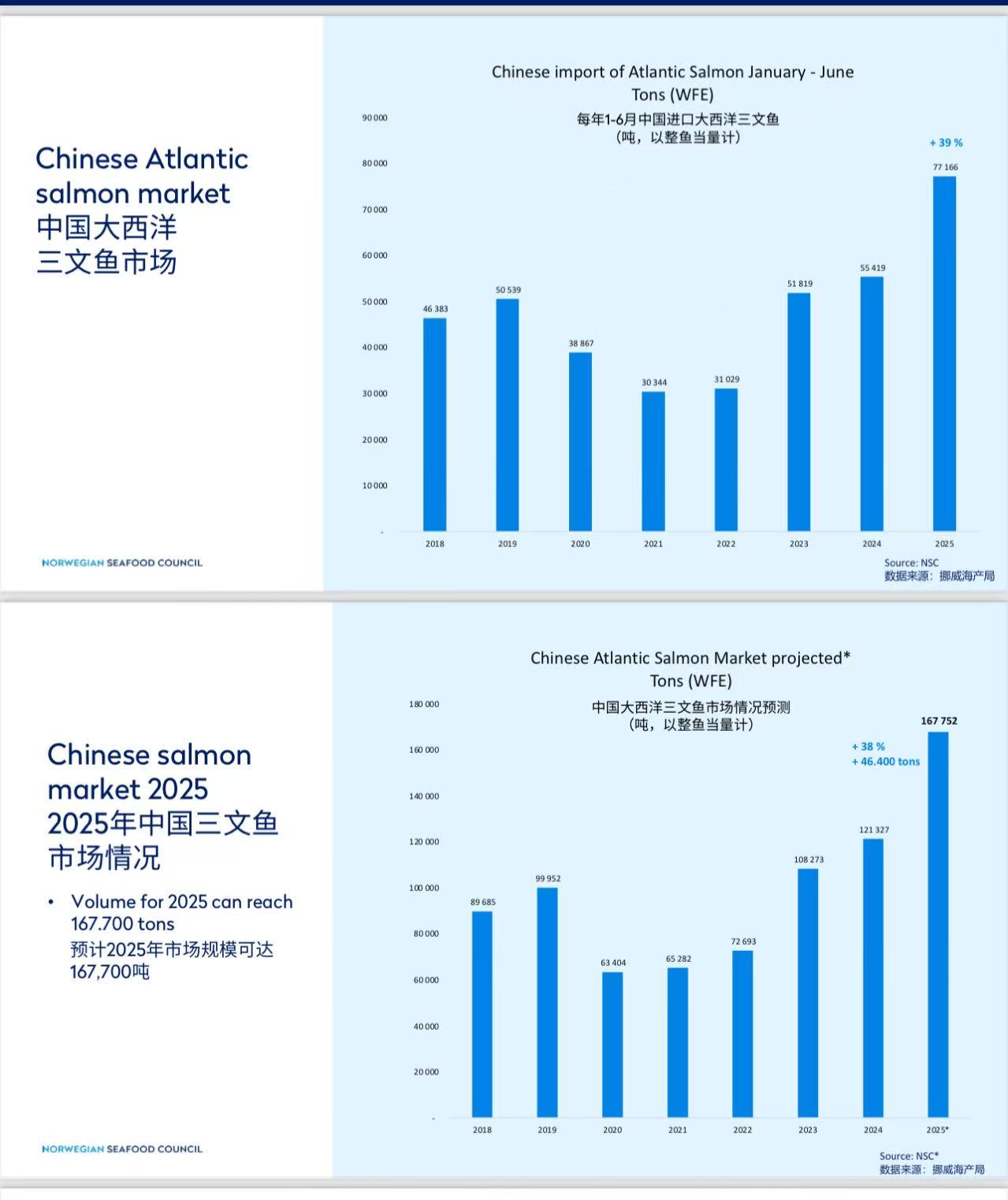
Core Insights - The Chinese Atlantic salmon market is projected to reach 167,700 tons by 2025, indicating significant growth potential [1] - Norway has become the largest exporter of Atlantic salmon to China, with exports increasing by 120% year-on-year from January to August this year [1][8] - The market share of Norwegian salmon in China has surged from 39% at the beginning of the year to 71% by June, marking the highest level in 15 years [8] Market Growth - As of the first quarter of this year, China has become the sixth largest export market for Atlantic salmon globally, with the fastest growth among the top ten markets [1] - From January to June, China's imports of Atlantic salmon increased by 39%, reaching 77,166 tons, with expectations to hit 167,752 tons by the end of the year [1] - By the second quarter of 2025, China is expected to surpass Brazil and Spain, ranking as the sixth largest consumer of Atlantic salmon globally with 129,472 tons [1] Industry Dynamics - The demand for salmon is driven by the expansion of e-commerce and new retail channels, creating a hybrid consumption model that includes both offline and digital platforms [8] - New retail chains specializing in fresh salmon, such as Shanghai Jingzhe Catering Management Co., are experiencing explosive growth, with 50-80 new stores opening monthly [8] - The Norwegian Seafood Council plans to increase its investment strategy in China by 70%, focusing on digital platforms and collaboration with local industry partners [8]

活力中国调研行丨湖北潜江大个儿“炮头虾”正“四季速达”你的餐桌
Yang Shi Xin Wen Ke Hu Duan· 2025-09-07 06:20
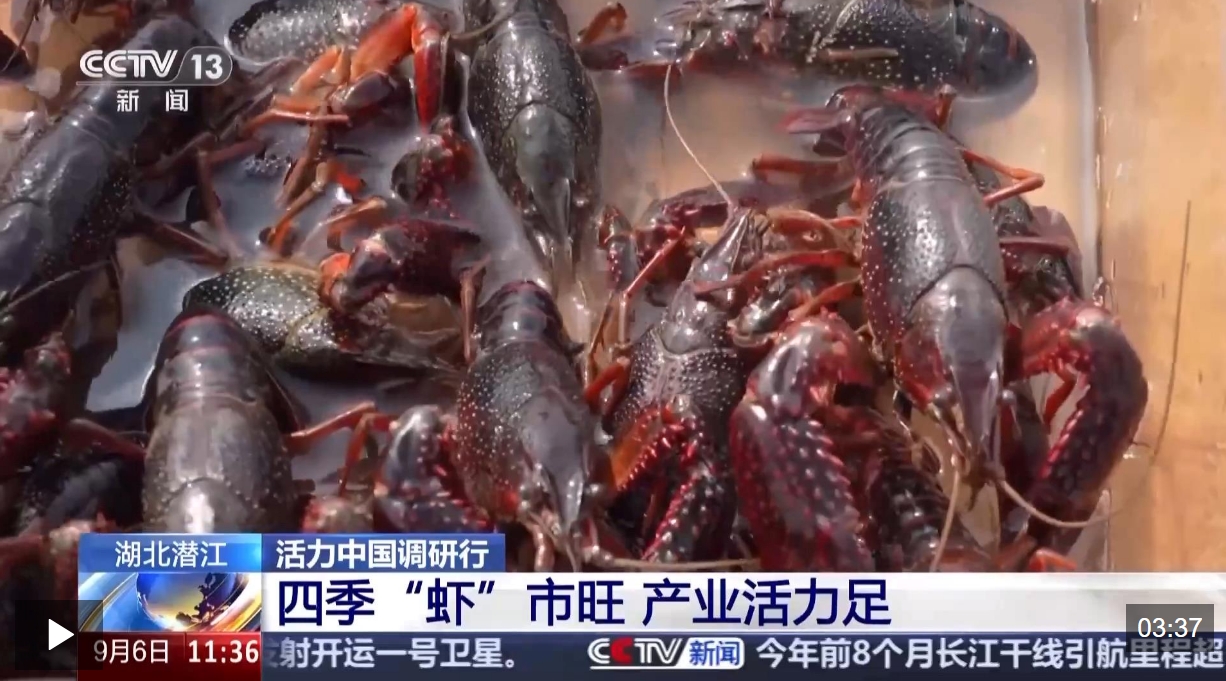
Core Viewpoint - The "Four Seasons Shrimp" farming model in Qianjiang, Hubei, has revitalized the local crayfish industry, allowing for year-round production and sales, thus increasing farmers' income and enhancing the entire industry chain [2][6][10]. Group 1: Farming Model and Economic Impact - The "Four Seasons Shrimp" model enables farmers to cultivate crayfish throughout the year, addressing the previous seasonal gaps in production and sales [6][10]. - Farmers can now earn income during the autumn and winter months, which was previously a downtime, allowing them to stay home and spend more time with their families [8][10]. - The price of winter crayfish is nearly double that of summer crayfish, significantly boosting farmers' annual income by approximately 100% [8][10]. Group 2: Industry Chain Development - The crayfish industry in Qianjiang has developed a complete supply chain, from fry supply to finished product sales, including both primary and deep processing, and online and offline sales [14]. - The area dedicated to crayfish farming has reached over 900,000 acres, with a target of 100,000 acres for winter crayfish farming, aiming for a production volume of 32,000 tons [10][14]. - The establishment of the largest crayfish trading center, known as "China Shrimp Valley," has facilitated efficient logistics, allowing crayfish to be delivered quickly to markets across the country [12][14]. Group 3: Market Trends and Consumer Preferences - The introduction of the "Four Seasons Shrimp" model has kept the market vibrant even during traditionally slow periods, with increased demand for winter crayfish in major cities like Shanghai and Shenzhen [12][16]. - Innovative cooking methods for crayfish, such as lemon bubble shrimp and durian shrimp, have gained popularity among consumers, further driving market growth [16].