
创新药

Search documents
午评:沪指涨1.07%收复4000点,创业板指涨2.15%,脑机接口、创新药概念股掀涨停潮,全市场超4000只个股上涨
Jin Rong Jie· 2026-01-05 03:48
Market Performance - The A-share market experienced a significant increase, with the Shanghai Composite Index recovering above 4000 points, closing at 4011.45, up 1.07% [1] - The Shenzhen Component Index rose by 1.87% to 13777.32, while the ChiNext Index increased by 2.15% to 3272.07 [1] - The total trading volume in the Shanghai and Shenzhen markets reached 16357.79 billion, with over 4000 stocks rising [1] Sector Highlights - The insurance sector led the market, with stocks like New China Life Insurance rising over 8%, reaching a historical high [3] - The insurance industry reported a total premium income of 57629 billion for the first 11 months of 2025, a year-on-year increase of 7.6% [3] - The semiconductor sector saw a collective surge, with stocks like Jiangbolong rising over 14% due to a worsening DRAM supply shortage, with contract prices expected to rise by up to 50% in Q1 2026 [3] - The innovative drug sector was active, with stocks like Guanhao Bio hitting the daily limit, supported by the approval of 76 innovative drugs in 2025, a historical high [3] Analyst Insights - CITIC Securities highlighted that balancing external and internal demand will be a major expectation for 2026, suggesting a trend towards taxing external demand and subsidizing internal demand [4] - Huatai Securities noted that overseas Chinese stocks' performance positively impacts investor sentiment, although geopolitical issues may create short-term volatility [4] - CITIC Jiantou indicated that post-holiday, investor risk aversion is easing, leading to a more active search for opportunities, with a high probability of continued upward trends in A-shares [4]






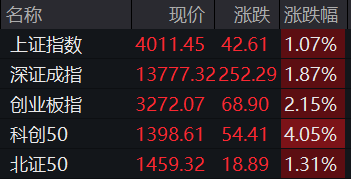
午评:沪指涨1.07%重回4000点 人脑工程概念掀涨停潮
Zheng Quan Shi Bao Wang· 2026-01-05 03:40
Core Viewpoint - The three major indices in the Chinese stock market opened higher and showed strong performance, with the Shanghai Composite Index surpassing 4000 points for the first time in 34 trading days, indicating a positive market sentiment and investor confidence [1] Market Performance - The Shanghai Composite Index rose by 1.07% at midday, while the Shenzhen Component Index increased by 1.87%, and the ChiNext Index gained 2.15% [1] - The market saw a surge in various sectors, particularly in brain engineering, insurance, semiconductor, innovative pharmaceuticals, and commercial aerospace [1] Sector Highlights - The brain engineering concept experienced a wave of stocks hitting the daily limit, with over 20 stocks including Sanbo Brain Science, Xiangyu Medical, Meihao Medical, and Aipeng Medical reaching the limit [1] - The insurance sector showed strong performance, with New China Life Insurance and China Pacific Insurance both reaching historical highs [1] - The storage chip concept also saw gains, with stocks like Zhaoyi Innovation and Yunhan Chip City hitting the daily limit [1] - The innovative pharmaceutical sector rose, with stocks such as Zhaoyan New Drug, Fuyuan Pharmaceutical, and Lepu Medical also reaching the limit [1] - The commercial aerospace sector remained active, with stocks like Reco Defense, Goldwind Technology, and Fenghuo Communication hitting the daily limit [1] Sector Performance - The leading sectors in terms of gains included insurance, healthcare, semiconductors, and the internet [1] - Conversely, sectors that experienced declines included hotel and catering, tourism, public transportation, and Hainan Free Trade [1]
港股通创新药ETF嘉实(520970)涨超5%!2025年我国批准上市的创新药达76个,创历史新高!
Jin Rong Jie· 2026-01-05 03:37
Group 1 - The core viewpoint of the news is that the A-share and Hong Kong markets are experiencing a collective rise, with the Shanghai Composite Index surpassing 4000 points, indicating positive market sentiment [1] - The Hong Kong Stock Connect innovative drug index increased by 3.85%, with notable individual stock performances such as Zhaoyan New Drug rising over 11% and Tigermed and Kelun-Bio rising over 6% [1] - According to a report by Changjiang Securities, Zhaoyan New Drug is expected to see a 60% year-on-year growth in offshore outsourcing orders in 2024, driven by domestic safety evaluation demand recovery and resource scarcity [1] Group 2 - The China National Medical Products Administration reported that 76 innovative drugs have been approved for market in China by 2025, setting a historical record [1] - The total amount of authorized transactions for innovative drugs in China has exceeded $130 billion, with over 150 transactions, also a historical high [1] - Currently, China's pipeline of new drugs accounts for approximately 30% of the global total, ranking second worldwide [1] Group 3 - The Hong Kong Stock Connect innovative drug ETF managed by Harvest (520970) has a management and custody fee of 0.60% per year, making it suitable for both retail investors as a long-term investment tool and for professional investors seeking flexible trading options [2]
新华基金赵强:以ROIC为锚逆向抄底源杰科技,算力+科技全链条布局拒绝短期博弈
Sou Hu Cai Jing· 2026-01-05 03:35
Group 1 - The core viewpoint of the articles highlights the significant rise in the Shanghai and Shenzhen stock indices in 2025, driven by policy support, capital inflow, and sectoral benefits, with the Shanghai Composite Index reaching 3963.68 points and the Shenzhen Component Index at 13603.89 points as of December 26 [2] - The China Securities Regulatory Commission has implemented reforms such as the Sci-Tech Innovation Board and expanded Sci-Tech bonds to promote deep integration of technology and capital, resulting in 102 strategic emerging industry companies entering the A-share market in 2025 [2] - Northbound capital significantly increased its holdings in the electronics and communications sectors in Q3, with the electronics sector's market value rising by 67.78% quarter-on-quarter, contributing to the index's rise [2] Group 2 - Fund manager Zhao Qiang's investment strategy focuses on a high-quality stock selection system anchored by ROIC, emphasizing long-term value over short-term speculation [3] - Zhao Qiang's funds, such as Xinhua Strategy Selected Stock A, achieved returns of 78.52% in 2025, benefiting from a focus on high-growth sectors like communications and electronics, which saw returns of 81.7% and 45.9% respectively [2][3] - The Xinhua Preferred Dividend Mixed A fund has shown exceptional performance with a year-to-date return of 74.66% and a total return of 1243.24% since inception, attributed to Zhao Qiang's unique investment strategy and precise industry allocation [6] Group 3 - The Xinhua Trend Leading Mixed Fund also performed well, with a year-to-date return of 77.93% and a total return of 452.98% since inception, driven by a focus on technology innovation and high-quality companies [19] - Key holdings in the fund include Ding Tong Technology and Maiwei Bio, both of which have shown significant price increases, with Ding Tong Technology's stock price rising by 210% during the holding period [10][7] - The fund's strategy includes dynamic adjustments to the portfolio, increasing exposure to high-quality companies while avoiding high-volatility risks, enhancing the overall risk management of the portfolio [15][20] Group 4 - The investment philosophy emphasizes capturing structural opportunities in technology and high-end manufacturing sectors, with a focus on companies with ROIC exceeding 15% [6][7] - The fund manager's approach includes a diversified investment across different segments of the technology chain, such as chip design and equipment manufacturing, to mitigate concentration risk [15] - The strategy of "value as an anchor, trend as a sail" has proven effective in navigating the structural market conditions of 2025, providing a replicable reference model for long-term investors [31]

港股医药领跑市场,持续看好创新药及创新产业链,2026年仍将是创新药的“数据验证年”
Mei Ri Jing Ji Xin Wen· 2026-01-05 03:16
Group 1 - The core viewpoint of the articles highlights a significant surge in the Chinese innovative drug sector, with license-out transactions exceeding $130 billion, marking a year-on-year increase of over 150% and surpassing 50% of the global total for the first time [1] - The cash flow generated from business development (BD) and the IPO boom is providing ample funding for research and development, which is crucial for the industry's future growth [1] - Three main driving forces for the industry in 2026 are identified: commercialization realization, clinical data validation, and improvement of payment systems, which are expected to usher in a new era of "value realization" [1] Group 2 - The Hang Seng Medical ETF (159892) focuses on innovative drugs, CXO, and related industries, benefiting from the advantages of the Hong Kong Stock Exchange's 18A system, which covers numerous innovative targets [2] - The ETF is expected to continue its valuation recovery trend under the catalysts of innovative drug exports and commercial insurance directories [2]
2025年我国已批准上市创新药数量创历史新高,港股创新药50ETF(513780)盘中涨超5%
Xin Lang Cai Jing· 2026-01-05 03:05
Group 1 - The A-share market experienced a collective rise on the first trading day of 2026, with significant gains in sectors such as medical services and CRO [1] - The Hong Kong Innovation Drug Index surged by 3.86%, with notable individual stock performances including Zhaoyan New Drug up 11.32% and Tigermed up 7.07% [1] - The Hong Kong Innovation Drug 50 ETF saw a 5.30% increase, with a cumulative rise of 67.18% over the past year as of December 31, 2025 [1] Group 2 - In 2025, China approved 76 innovative drugs for market entry, significantly surpassing the 48 approved in 2024, marking a historical high [1] - The total value of innovative drug licensing transactions in China exceeded $130 billion in 2025, with over 150 transactions, also a record high [1] - Open Source Securities highlighted the emergence of multiple doubling stocks in various pharmaceutical segments driven by innovation, particularly in chemical preparations, biological products, and CXO sectors [2] Group 3 - The Hong Kong Innovation Drug 50 ETF tracks the Hong Kong Innovation Drug Index, which has a current P/E ratio of 31.23, indicating it is at a historical low compared to the past three years [2] - The index includes leading companies such as WuXi Biologics and Innovent Biologics, with nearly 90% weight in biological products and chemical pharmaceuticals, facilitating efficient investment in the high-volatility Hong Kong innovation drug sector [2] - The fund has established off-market connection funds for investors to maintain focus on the sector [2]
新年首日风向标,暖风劲吹港股!“港股ETF三剑客”520880、513770、159131悉数大涨超3.5%
Mei Ri Jing Ji Xin Wen· 2026-01-05 02:53
2026年首个交易日,A股、港股喜迎开门红,其中,港股互联网、港股创新药、港股芯片硬科技的 表现尤为惊艳。热门ETF方面,重仓互联网龙头的港股互联网ETF(513770)跳空高开,强势大涨超4% 突破年线;高弹性港股通创新药ETF(520880)强势走高现涨逾4%;全市场首只聚焦"港股芯片"产业链 的港股信息技术ETF(159131)场内价格涨逾3.5%。 银河证券认为,2026年港股总体有望震荡上行。国内外货币政策宽松背景下,外资和南向资金均有 望继续保持净流入趋势。在加快科技创新、新一轮供给侧改革、扩大内需等利好政策带动下,港股上市 公司盈利水平有望实现实质性提升,市场将迎来盈利与估值均上涨的格局。行情主线方面,在"十五 五"时期科技自立自强水平大幅提高的目标下,科技创新将是港股投资的一大主线。港股科技估值修复 空间仍大,龙头业绩有望呈现高景气特征。中信证券表示,AI依然是港股互联网板块估值上行的核心 催化。 港股互联网ETF(513770)及其联接基金(017125)被动跟踪中证港股通互联网指数,重仓阿里巴 巴-W、腾讯控股、小米集团-W等互联网龙头,前10大持仓汇聚AI云计算、大模型+各领域AI应用公 ...
2025股基冠军李进:用“时代感” 投资斩获超额收益
2 1 Shi Ji Jing Ji Bao Dao· 2026-01-05 02:49
21世纪经济报道记者李域 2025年落下帷幕,公募基金成绩单出炉,主动权益基金交出了亮眼的业绩答卷。 翻开融通产业趋势的季报,超额收益来源清晰可见,AI、新消费与创新药。李进将其归结为一种"时代感"的投资。 "巨大的投资收益往往来源于需求大幅扩张、产业规模快速增长的领域。"李进表示,他的日常工作聚焦于追踪社会变迁与产业演进,着力寻找 存在阶段性市场效率缺失、需求尚未得到充分满足的行业。因此,他对成长性行业抱有更高关注度,对这些方向投入更多研究精力,并保持持 续紧密的跟踪。 李进于2023年3月开始担任基金经理,当时就将投资组合全面聚焦于人工智能方向。彼时,市场对该趋势仍存疑虑,但李进判断人工智能代表 一次重大的技术进步,其影响可能超越互联网。其核心依据源于ChatGPT所展现出的用户增长态势——用户量从零到一亿仅用时一个月,如此 高速的扩张历程前所未有。 在形成初步判断后,他开展了产业链验证。自2023年初起,通过调研,观察到光模块等环节出现"每周爆单"的现象,进一步印证了人工智能产 业的真实景气度,从而确立了该方向的配置决策。 2023年年中,他关注到家庭成员开始使用含有胶原蛋白成分的化妆品,由此切入对该细 ...

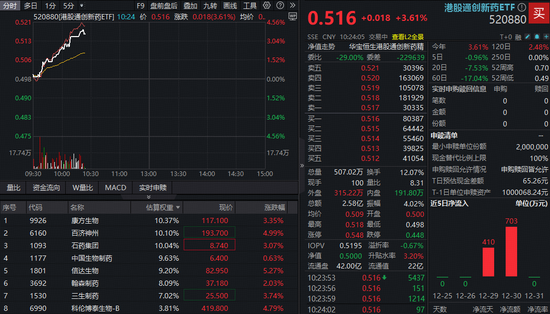
久违爆发!港股通创新药ETF(520880)急速飙升4%!国家药监局:2025年我国创新药对外授权超1300亿美元
Xin Lang Cai Jing· 2026-01-05 02:33
Core Viewpoint - The Hong Kong Stock Connect innovative drug sector experienced a significant rally, with leading stocks such as BeiGene and Innovent Biologics rising nearly 5% and over 5% respectively, indicating strong market interest in innovative pharmaceuticals [1][7]. Group 1: Market Performance - The Hong Kong Stock Connect innovative drug ETF (520880) opened with a continuous rise, peaking at over 4% increase, with a trading volume of 258 million yuan, surpassing the previous trading day's total [1][8]. - Major stocks in the innovative drug sector, including BeiGene, Innovent Biologics, and CSPC Pharmaceutical Group, saw increases of nearly 5% and over 3% respectively, reflecting a positive market sentiment [1][7]. Group 2: Regulatory and Market Developments - The National Medical Products Administration reported that 76 innovative drugs were approved for market in China in 2025, significantly exceeding the 48 approved in 2024, marking a historical high [1][10]. - The total value of authorized transactions for innovative drugs in China exceeded $130 billion in 2025, with over 150 transactions, also setting a new record [1][10]. Group 3: Investment Insights - Analysts from Zhongyou Securities suggest that the maturity of clinical data will be a key driver for the innovative drug market in 2026, with business development (BD) expected to enhance the competitiveness of domestic new drugs [3][10]. - The current period is viewed as an optimal configuration window for the Hong Kong Stock Connect innovative drug sector, following a three-month adjustment that began in September 2025 [3][10]. - The Hong Kong Stock Connect innovative drug ETF (520880) and its associated funds track the Hang Seng Hong Kong Stock Connect Innovative Drug Select Index, which boasts significant advantages such as comprehensive coverage of innovative drug companies and a high concentration of leading firms [3][10]. Group 4: ETF Composition - The top ten holdings in the Hong Kong Stock Connect innovative drug ETF account for over 72% of the total weight, highlighting the dominance of leading companies in the sector [4][11]. - Key constituents include BeiGene (11.51% weight), Innovent Biologics (10.19%), and China Biologic Products (9.47%), among others, indicating a strong representation of major players in the innovative drug market [4][11]. Group 5: Alternative Investment Options - For investors seeking exposure to innovative drugs while mitigating volatility, the unique A-share drug ETF (562050) is recommended, which focuses on the top 50 A-share pharmaceutical companies, balancing innovative drugs with traditional Chinese medicine [4][12].
港股创新药概念股持续反弹,歌礼制药涨近10%
Xin Lang Cai Jing· 2026-01-05 02:12
Group 1 - The Hong Kong stock market's innovative drug concept stocks are experiencing a continuous rebound, with notable increases in share prices [1] - Specifically, Gilead Sciences-B has risen nearly 10%, while Zhaoyan New Drug has increased by over 8% [1] - Other companies such as Tigermed, Innovent Biologics, and CSPC Pharmaceutical Group have also seen their stock prices rise significantly [1]