稀土

Search documents
商务部:已批准部分稀土出口通用许可申请
财联社· 2025-12-18 08:09
Core Viewpoint - The Chinese government has implemented export controls on rare earth-related items, and some exporters have begun to meet the basic requirements for applying for general licenses [1] Group 1 - The Ministry of Commerce spokesperson He Yadong provided updates on the export controls for rare earth-related items during a routine press conference [1] - Chinese authorities have communicated policies to exporters, and with accumulated experience, some exporters have preliminarily met the requirements for general license applications [1] - A number of general license applications from Chinese exporters have been received and approved [1]


商务部:已批准部分稀土出口通用许可申请
Yang Shi Xin Wen Ke Hu Duan· 2025-12-18 07:54
在今天(18日)下午召开的商务部例行新闻发布会上,新闻发言人何亚东针对稀土相关物项出口管制的 最新进展进行回应。商务部新闻发言人何亚东表示,对稀土相关物项实施出口管制以来,中方主管部门 向中国出口商进行了政策宣介,随着相关出口和合规经验的积累,部分中国出口商已初步达到申请通用 许可的基本要求。据我所知,目前已收到并批准了部分中国出口商提交的通用许可申请。 (文章来源:央视新闻客户端) ...
不到24小时,欧盟从中国收到两条消息,一好一坏,就看欧盟怎么选
Sou Hu Cai Jing· 2025-12-18 04:12
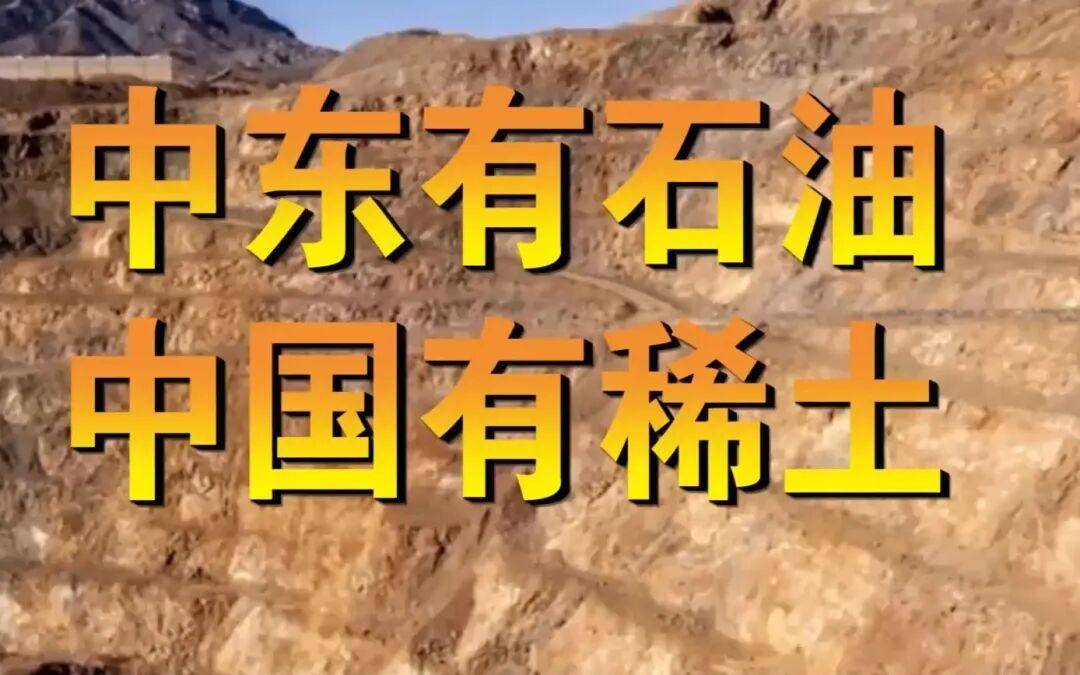
Group 1 - The EU is experiencing anxiety regarding its rare earth supply, despite a temporary easing of trade tensions between China and the US, as China has relaxed its export controls on rare earths to the US and started purchasing US soybeans [1] - The European Commission's Trade and Economic Security Commissioner, Šefčovič, stated that China has begun issuing longer-term rare earth export licenses, allowing European companies to access these critical minerals, but this does not mean a complete restoration of supply [1][3] - The licenses issued by China are valid for one year, indicating that China still maintains a dominant position in the global rare earth supply chain, leaving the EU in a precarious position [1][5] Group 2 - The EU's recent experience of receiving a one-year rare earth export license from China is seen as a stroke of luck, given China's absolute control over the rare earth supply, which is more significant than the control Middle Eastern countries have over oil [3] - Following the issuance of the rare earth licenses, China announced anti-dumping investigations against EU pork products, indicating ongoing trade tensions and a fragile relationship between China and the EU [3][7] - China's actions reflect its strategy to maintain autonomy in trade relations, emphasizing that while it can sell rare earths, it will respond to any actions by the EU that it perceives as harmful to its interests [5][7]

默克尔预言应验,27国“枪口”瞄准中国,欧洲正滑向“第三世界”
Sou Hu Cai Jing· 2025-12-18 03:10
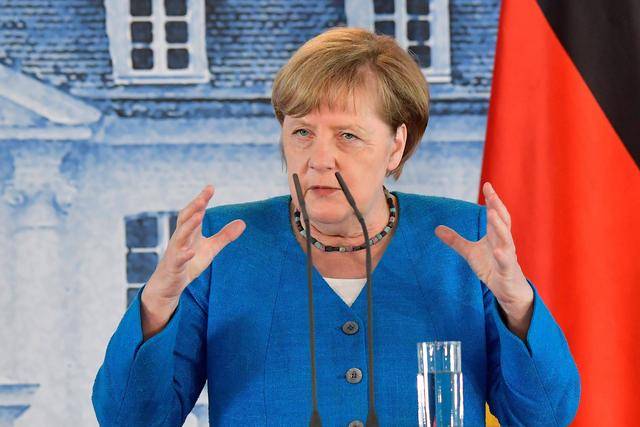
本文内容均引用权威资料结合个人观点进行撰写,文末已标注文献来源,请知悉。 当初,默克尔那句"与中国断绝经济关系没有任何好处"被当成老派政客的顾虑。 现在,欧洲正尝到这场"战略自主"博弈的苦果。27个国家跟着美国对中国动手,结果自己掉进了深坑。 图 | 德国前总理默克尔 欧盟于2025年对来自中国的电动车征收最高45.3%的关税。电动汽车本就是欧洲推进"绿色转型"的主要 力量,现在却被当成打击对象。 法国、德国很多车企高层私下里都表示,这不是为了保护本土企业,而是让它们更加难以生存。欧洲的 新能源计划曾经雄心勃勃,但是现在已经走向了自我封锁。 与此同时,中国并没有硬碰硬,而是重新启动了与中国欧盟之间关于最低价格机制的谈判。一边反击一 边留有谈判的空间,这才是成熟的处理方式。 欧盟方面,越来越多的政策对中国进行限制,对本国人的税收增加,执行起来十分混乱,行业协会多次 抗议都没有用。 图 | 欧盟委员会主席冯德莱恩 2026年7月1日起生效的新规中规定,所有进入欧盟且价值低于150欧元的小包裹都需要另外支付3欧元。 打击的目标就是Temu、Shein这些中国的电商平台。 但是对消费者来说,以前20欧元可以买到的小商 ...
美国想摆脱对中国的依赖,打算给稀土定个最低价,但英国说:我们先不掺和
Sou Hu Cai Jing· 2025-12-17 19:01
Core Viewpoint - Rare earths are essential resources for high-tech and advanced technologies, with China dominating global production and refining capabilities [2][4]. Group 1: Western Actions on Rare Earths - The West is increasingly focused on rare earths, with the EU discussing price floors and potential tariffs on Chinese exports to stimulate local investment [2][4]. - The U.S. has provided price guarantees to domestic rare earth companies as part of a broader defense investment strategy [2][4]. - Australia and Canada are also considering measures to enhance their rare earth sectors, including foreign investment scrutiny [2][4]. Group 2: UK's Strategic Position - The UK currently sources only 6% of its critical minerals domestically and aims to meet 10% of its needs through local mining and 20% through recycling by 2035 [4]. - A lithium processing project in Northern England is expected to start soon, targeting a production capacity of at least 50,000 tons by 2035 [4]. - The UK has allocated up to £50 million to support its critical minerals strategy, reflecting a cautious approach rather than a blind follow of other Western nations [4][5]. Group 3: Challenges in Supply Chain Development - China's dominance in the rare earth sector, with approximately 70% of global mining and 90% of refining capacity, poses significant challenges for the West in diversifying supply sources [4][6]. - Rebuilding a competitive rare earth supply chain is a long-term and complex endeavor, requiring substantial time, technology, funding, and market patience [4][6]. - The West's current initiatives highlight a pressing desire to reduce reliance on China, but they also reveal shortcomings in resource, cost, and technology integration [6].
2025年12月17日稀土主流产品价格弱稳 氧化铽均价下跌3万元/吨
Jin Rong Jie· 2025-12-17 10:43
Group 1 - The core viewpoint of the article indicates that the rare earth market is experiencing weak stability, with prices of major products showing slight declines [1] - The average price of praseodymium and neodymium oxide is 577,000 CNY/ton, down by 400 CNY/ton; the average price of praseodymium and neodymium metal is 698,900 CNY/ton, down by 3,400 CNY/ton; the average price of dysprosium oxide is 1,401,000 CNY/ton, down by 400 CNY/ton; and the average price of terbium oxide is 6,211,700 CNY/ton, down by 30,000 CNY/ton [1] - The market for praseodymium and neodymium remains stagnant, with limited downstream purchasing and ongoing cautious sentiment among traders [1] Group 2 - The heavy rare earth market is seeing a slight increase in demand, particularly for dysprosium oxide, which has led to a rise in market activity [1] - Overall, the atmosphere in the rare earth market remains subdued, and prices are expected to continue their weak stability trend, with a recommendation to pay more attention to the heavy rare earth market [1] - The A-share market shows some performance in rare earth permanent magnet concept stocks, with notable price increases and trading volumes for several companies [1]
大反转,全线暴涨
Ge Long Hui· 2025-12-17 10:31
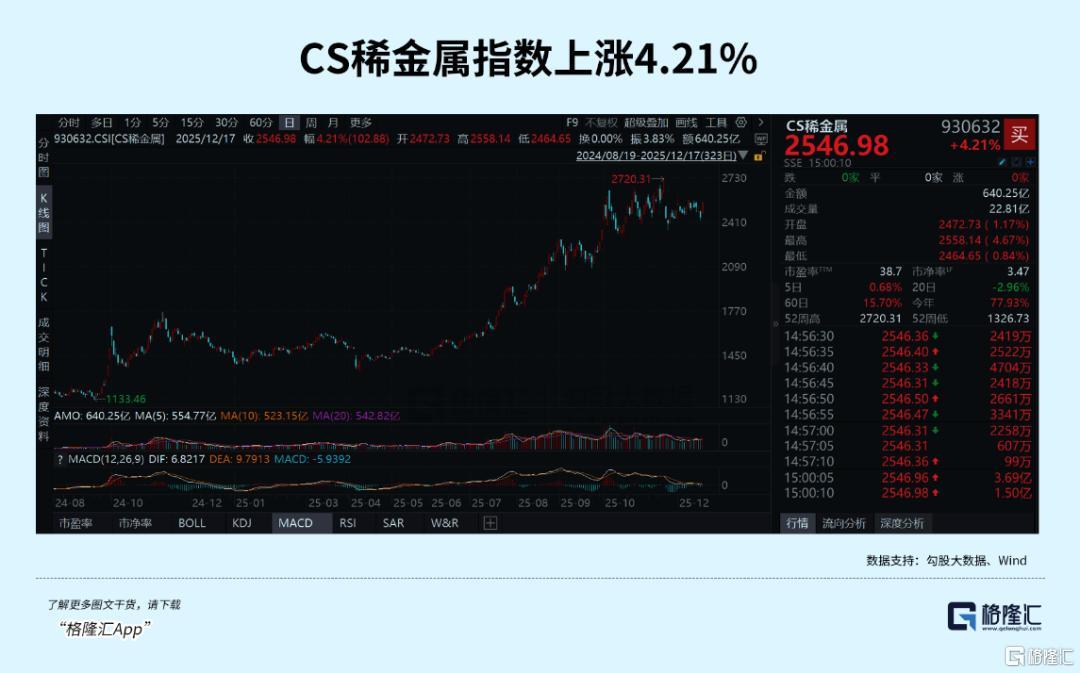
Core Viewpoint - The technology sector has rebounded strongly after a series of declines, with the lithium mining sector showing particularly impressive gains, indicating a potential new industrial cycle reversal [1][3]. Group 1: Supply and Price Dynamics - The lithium mining sector is experiencing tightening supply, leading to significant price increases, with lithium carbonate futures rising over 6% in a single day [4]. - The price of lithium carbonate has stabilized and begun to recover, reaching a range of 95,000 to 100,000 yuan per ton by December 2025, after hitting a low of 80,000 yuan per ton [7][10]. - The global supply of lithium resources is expected to be reduced by approximately 15% compared to earlier forecasts, prompting major lithium companies to slow down capital expenditures and delay new capacity releases [10]. Group 2: Demand Growth - Demand for lithium remains robust, driven primarily by the electric vehicle market, which is projected to see sales of over 13 million units in China by 2025, a year-on-year increase of about 20% [13]. - New demand sources, such as energy storage, are emerging rapidly, with global shipments of lithium batteries for energy storage expected to grow by over 40% year-on-year in 2025 [13]. - The development of new technologies, including eVTOL and robotics, is anticipated to create substantial future demand for lithium batteries, further driving the market [17][19]. Group 3: Financial Performance - The lithium mining sector has shown signs of recovery, with 21 listed companies in the sector reporting a combined revenue of 142.436 billion yuan in the first three quarters of 2025, a year-on-year increase of 13.9% [11]. - Net profit for these companies reached 12.453 billion yuan, reflecting a significant year-on-year growth of 135.02%, reversing previous negative growth trends [11]. - Despite a slight decline in gross margin, net margin has improved, indicating a positive shift in financial performance within the sector [11]. Group 4: Investment Opportunities - The lithium mining sector has undergone significant valuation adjustments, with many companies' stock prices down over 70% from their peaks, presenting potential value opportunities [22]. - The sector is currently at a critical transition point, with supply-side reductions and clear growth paths in demand driven by energy storage and emerging technologies [23]. - The CS Rare Metals Index, which includes a high concentration of lithium and other strategic metals, has attracted over 2 billion yuan in net inflows this year, highlighting investor interest in the sector [26].
伍德麦肯兹:五大趋势重塑全球能源资源格局
Zhong Guo Hua Gong Bao· 2025-12-17 06:01
其三,英国北海油气资产遭遇严重价值折损。因两年半内五次调整财税体系且监管政策不明,该地区油 气资产隐含长期油价(ILTOP)仅约40美元/桶,较经合组织(OECD)70美元/桶的平均水平折价40%,投资 者信心崩塌,资本投入停滞。 中化新网讯 近日,伍德麦肯兹发布最新《地平线》报告称,2025年,五大趋势重塑了全球能源资源领 域,其背后是地缘格局变动、产业战略重构与技术迭代加速的共同驱动。 其一,美国LNG实现颠覆性逆转。短短10年间,美国从LNG进口国蜕变为全球最大出口国,预计2030 年其LNG产量将占全球30%;同时美国还领跑全球油气生产,产量占全球五分之一,远超沙特和俄罗 斯。 其二,稀土成全球贸易核心焦点。稀土广泛应用于可再生能源、高端武器、半导体等关键领域,仅磁体 用途就占其总需求近半。 其四,欧洲石化产业出现大规模产能清退。为减排推进的去工业化,导致欧洲乙烯产能持续关停,2022 年至2027年相关产能退出每年造成40亿美元的总附加值损失。 其五,AI成为电力需求增长的核心引擎。数据中心半数运营成本来自电力,电价成为AI竞争关键变 量。美国电力市场受AI驱动,2030年前电力需求复合增长率将达2 ...
中国稀土12月16日获融资买入8555.68万元,融资余额20.13亿元
Xin Lang Cai Jing· 2025-12-17 05:39
Core Viewpoint - The Chinese rare earth market experienced a decline, with a 3.86% drop in share price on December 16, leading to a trading volume of 1.275 billion yuan. The financing data indicates a net outflow in financing activities for the company, suggesting a cautious sentiment among investors [1]. Financing and Trading Data - On December 16, the financing buy amount for Chinese rare earth was 85.56 million yuan, while the financing repayment was 112 million yuan, resulting in a net financing outflow of 26.80 million yuan. The total financing and securities balance reached 2.029 billion yuan [1]. - The financing balance of 2.013 billion yuan accounts for 4.40% of the circulating market value, which is above the 60th percentile level over the past year, indicating a relatively high financing level [1]. - In terms of securities lending, 67,000 shares were repaid, while 29,100 shares were sold on December 16, amounting to a selling value of 1.2548 million yuan. The remaining securities lending volume was 357,000 shares, with a balance of 15.39 million yuan, which is below the 50th percentile level over the past year, indicating a lower level of securities lending [1]. Company Performance - As of November 10, the number of shareholders for Chinese rare earth reached 254,200, an increase of 2.14%, while the average circulating shares per person decreased by 2.09% to 4,174 shares [2]. - For the period from January to September 2025, the company reported a revenue of 2.494 billion yuan, reflecting a year-on-year growth of 27.73%. The net profit attributable to shareholders was 192 million yuan, showing a significant year-on-year increase of 194.67% [2]. Dividend and Shareholder Information - Since its A-share listing, Chinese rare earth has distributed a total of 346 million yuan in dividends, with 124 million yuan distributed over the past three years [3]. - As of September 30, 2025, the top ten circulating shareholders included Hong Kong Central Clearing Limited, which held 29.0694 million shares, an increase of 9.4669 million shares from the previous period. Additionally, the Southern CSI 500 ETF and the Jiashi CSI Rare Earth Industry ETF were noted as new shareholders [3].

稀土价格|稀土价格阴跌整理
Xin Lang Cai Jing· 2025-12-17 04:42
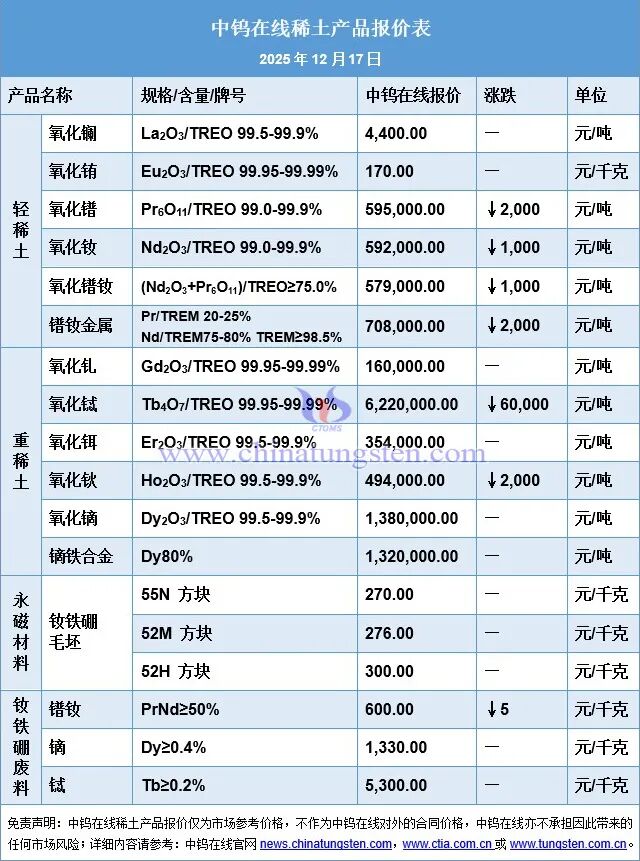
Core Viewpoint - The rare earth market is experiencing a downward trend, with prices for various products declining due to weak demand from downstream users and a lack of confidence among suppliers [5][6]. Price Overview - On December 17, 2025, the prices for various rare earth products were reported, with notable declines in several categories: - Praseodymium oxide (Pr6011) decreased by ¥2,000 to ¥595,000 per ton - Neodymium oxide (Nd2O3) decreased by ¥1,000 to ¥592,000 per ton - Dysprosium oxide (Dy2O3) decreased by ¥60,000 to ¥6,220,000 per ton - Terbium oxide (Tb4O7) decreased by ¥2,000 to ¥494,000 per ton [1][4]. Market Sentiment - The light rare earth market is facing challenges despite some companies maintaining essential procurement due to strong production cost support. The ongoing decline in heavy rare earth prices has negatively impacted the market, leading to rational price adjustments by suppliers [2][5]. - The mid-heavy rare earth market is characterized by a "buy high, not low" sentiment, with tight cash flow among downstream enterprises and an abundance of market supply, resulting in stagnant demand [6].