
资产管理

Search documents
日本两年期国债拍卖遇冷、收益率应声上扬 市场押注央行加大加息力度
Zhi Tong Cai Jing· 2025-12-25 07:39
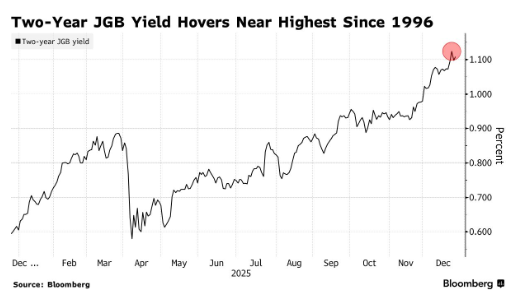
Group 1 - The demand for Japan's two-year government bonds is weak, leading to an increase in yields for this maturity, with the auction bid-to-cover ratio recorded at 3.26, lower than the previous 3.53 and the 12-month average of 3.65 [1] - The two-year government bond yield rose by 1 basis point to 1.11%, while the ten-year government bond futures opened high but subsequently declined [1] - The Bank of Japan recently raised its policy interest rate to the highest level in 30 years, but the governor did not provide clear guidance on future rate paths, contributing to a weaker yen and rising bond yields [1] Group 2 - The two-year government bond yield reached its highest level since 1996 earlier this week, while the ten-year breakeven inflation rate hit a record high since 2004 [3] - Japan's Finance Minister warned that the government has the freedom to take decisive measures against exchange rate fluctuations that do not align with economic fundamentals, which has somewhat eased the yen's depreciation and rising yield trend [3] - Investors are closely monitoring the bond issuance plan related to the fiscal year 2026 budget, which is expected to be approved by the cabinet soon, with suggestions to increase the issuance of two-year, five-year, and ten-year bonds while reducing the issuance of ultra-long-term bonds [3]

国家市场监管总局发布4项资产管理国家标准
Zhong Guo Xin Wen Wang· 2025-12-25 07:14
Group 1 - The National Market Supervision Administration has approved the release of four national standards for asset management, focusing on digital transformation and cultural digital assets [1][2] - Two standards, "Digital Reference Architecture for Asset Management" and "Digital Maturity Model for Asset Management," provide guidance on enhancing the digital construction level of asset management for various organizations [1] - The "Digital Maturity Model" consists of five capability elements and 17 capability domains, defining five maturity levels: initial, process, lean, leading, and ecological, to assist in identifying and improving digital maturity [1] Group 2 - The "Implementation Guidelines for Cultural Digital Asset Transactions" and "Value Assessment Guidelines for Cultural Digital Assets" focus on standardizing transactions and measuring the value of cultural digital assets to enhance the influence of Chinese culture [2] - The "Implementation Guidelines" offer guidance on transaction subjects, objects, processes, and quality assurance, aiming to improve transparency and security in cultural digital asset transactions [2] - The "Value Assessment Guidelines" provide recommendations on assessment objects, influencing factors, methods, institutions, and procedures, serving as an objective reference for transaction activities [2]
国金资管:2026年权益资产或将成配置主战场,债市将维持宽幅震荡
Xin Hua Cai Jing· 2025-12-25 07:06
Group 1 - The core viewpoint is that in 2026, equity investment opportunities are expected to become the main battlefield for asset allocation, while the bond market is likely to continue a wide fluctuation pattern in yields [1][2] - Current liquidity and regulatory environments are improving, with long-term capital inflows continuing, driven by breakthroughs in the technology sector and structural economic highlights, which may create structural investment opportunities [1] - In equity quantitative strategies, the overall strategy depth is continuously improving, and despite market volatility and declining trading volumes, the excess returns of quantitative strategies are expected to demonstrate new breakthroughs, indicating their continued allocation value in 2026 [1] Group 2 - In the bond market outlook, it is anticipated that proactive fiscal policies will continue to exert influence, with inflation expectations gradually rising, but the downward space for bond market interest rates may be limited due to increased institutional behavior disturbances [2] - The central bank is likely to maintain liquidity easing to support the implementation of fiscal policies, indicating that the bond market yields may continue to experience wide fluctuations [2] - Regarding CTA (Commodity Trading Advisor) investment strategies, the company holds a neutral outlook due to the current market lacking comprehensive trend opportunities similar to past large-scale investments or extensive monetary easing, with the risk-reward ratio needing further observation [2]
多家机构预期2026年美元资产吸引力减弱 金价继续上涨
Xin Hua Wang· 2025-12-25 06:40
Group 1 - The core viewpoint of the articles indicates a sustained trend in using gold to hedge against risks associated with dollar-denominated assets, with expectations for gold prices to rise further by 2026 [1] - Analysts from Schroders highlight that the U.S. is facing "policy uncertainty, fiscal fragility, and increasing investor doubts about the long-term role of U.S. Treasuries and the dollar," making gold a preferred choice for asset diversification due to its safe-haven properties and low correlation with traditional assets [1] - Goldman Sachs projects that by the end of 2026, gold prices could reach approximately $4,900 per ounce, driven by strong structural demand from central bank purchases and cyclical support from potential Federal Reserve rate cuts [1] - JPMorgan forecasts that gold prices may rise to $5,055 per ounce by the fourth quarter of 2026, with potential further increases up to $6,000 per ounce, emphasizing a clear long-term trend of gold allocation by official reserves and investors [1] - Forbes notes that global trade tensions initiated by the U.S., the rise of "de-dollarization" transactions to avoid dollar depreciation, increased demand for gold from private investors and cryptocurrency funds, and ongoing central bank purchases are significant drivers for the upward movement of gold prices [1] Group 2 - Reuters reports that the U.S. dollar index has declined by 9% since the beginning of 2025, potentially marking its worst annual performance in eight years [2] - The market widely anticipates that the new Federal Reserve chairman may lean towards a dovish monetary policy stance, which could further weaken the dollar and reduce the attractiveness of dollar-denominated assets for investors [2]

多家机构预期2026年美元资产吸引力减弱 金价继续上涨
Xin Hua Wang· 2025-12-25 06:38
Group 1 - Multiple international financial institutions predict a continued trend of using gold to hedge against risks associated with dollar-denominated assets, with gold prices expected to rise further by 2026 [1] - Schroders analyst Patrick Brenner highlights that the U.S. is facing "policy uncertainty, fiscal fragility, and increasing investor doubts about the long-term role of U.S. Treasuries and the dollar," making gold a preferred choice for asset diversification due to its safe-haven properties and low correlation with traditional assets [1] - Goldman Sachs forecasts that gold prices will reach approximately $4,900 per ounce by the end of 2026, driven by strong structural demand from central bank purchases and cyclical support from potential Federal Reserve rate cuts [1] - JPMorgan anticipates that gold prices could rise to $5,055 per ounce by Q4 2026, with the possibility of further increases to $6,000 per ounce, indicating a clear long-term trend of gold allocation by official reserves and investors [1] - Forbes notes that global trade tensions initiated by the U.S., the rise of "de-dollarization" transactions to avoid dollar depreciation, increased demand for gold from private investors and cryptocurrency funds, and ongoing central bank purchases are significant drivers for the upward movement of gold prices [1] Group 2 - The U.S. dollar index has declined by 9% since the beginning of 2025, potentially marking its worst annual performance in eight years [2] - The market widely expects that the new Federal Reserve chairman may lean towards a dovish monetary policy stance, which could further weaken the dollar and reduce the attractiveness of dollar-denominated assets for investors [2]
多家机构预期2026年美元资产吸引力减弱金价继续上涨
Xin Hua Wang· 2025-12-25 06:38
Group 1 - The core viewpoint of the articles indicates a sustained trend of using gold to hedge against risks associated with dollar-denominated assets, with expectations for gold prices to rise further by 2026 [1] - Analysts from Schroders highlight that the U.S. is facing "policy uncertainty, fiscal fragility, and increasing investor doubts about the long-term role of U.S. Treasuries and the dollar," making gold a preferred choice for asset diversification due to its safe-haven properties and low correlation with traditional assets [1] - Goldman Sachs predicts that by the end of 2026, gold prices will reach approximately $4,900 per ounce, driven by strong structural demand from central bank purchases and cyclical support from potential Federal Reserve rate cuts [1] - JPMorgan forecasts that gold prices could rise to $5,055 per ounce by the fourth quarter of 2026, with potential further increases up to $6,000 per ounce, citing a clear long-term trend of gold accumulation by official reserves and investors [1] - Forbes notes that global trade tensions initiated by the U.S., the rise of "de-dollarization" transactions to avoid dollar depreciation, increased demand for gold from private investors and cryptocurrency funds, and ongoing central bank purchases are significant drivers for the upward movement of gold prices [1] Group 2 - The U.S. dollar index has declined by 9% since the beginning of 2025, potentially marking its worst annual performance in eight years [2] - The market widely anticipates that the new Federal Reserve chair may adopt a dovish monetary policy stance, which could further weaken the dollar and reduce the attractiveness of dollar-denominated assets for investors [2]
多家机构预期2026年黄金价格或进一步上涨
Xin Hua She· 2025-12-25 06:37
Group 1 - Multiple international financial institutions predict a continued trend of using gold to hedge against risks associated with dollar-denominated assets, with gold prices expected to rise further by 2026 [1] - Schroders analyst Patrick Brenner highlights that the U.S. is facing "policy uncertainty, fiscal fragility, and increasing investor doubts about the long-term role of U.S. Treasury and the dollar," making gold a preferred choice for asset diversification due to its safe-haven properties and low correlation with traditional assets [1] - Goldman Sachs forecasts that gold prices will reach approximately $4,900 per ounce by the end of 2026, driven by strong structural demand from central bank purchases and cyclical support from potential Federal Reserve rate cuts [1] Group 2 - JPMorgan anticipates that gold prices could rise to $5,055 per ounce by Q4 2026, with potential further increases up to $6,000 per ounce, indicating a clear long-term trend of official reserves and investor allocations towards gold [1] - Forbes notes that global trade tensions initiated by the U.S., the rise of "de-dollarization" transactions to avoid dollar depreciation, increased demand for gold from private investors and cryptocurrency funds, along with ongoing central bank purchases, are significant drivers for the upward movement of gold prices [1] - The U.S. dollar index has declined by 9% since the beginning of 2025, potentially marking its worst annual performance in eight years, with expectations that the new Federal Reserve chair may adopt a dovish monetary policy stance, further weakening the dollar and reducing the attractiveness of dollar-denominated assets [2]
应对低利率与波动:资深大咖详解黄金理财配置策略
Xin Lang Cai Jing· 2025-12-25 04:05
Core Insights - The international gold price surged from approximately $2600 per ounce at the beginning of 2025 to around $4100 per ounce by November, marking a nearly 60% increase and setting 47 historical highs [1] - Experts at the 21st Century Financial Annual Conference emphasized the importance of incorporating gold into asset allocation frameworks and shifting from short-term trading to long-term planning [1] Group 1: Macro Drivers of Gold Prices - The current rise in gold prices is supported by two main factors: increased global central bank gold purchases and growth in gold ETF holdings [2] - Global central bank gold purchases have increased for 13 consecutive years, with a significant surge in 2022-2024, totaling 634 tons in the first three quarters of 2025 [2] - As of the third quarter of 2025, global gold ETF holdings increased by 619 tons, setting a historical record and contributing significantly to the rise in gold prices [2] - The macroeconomic environment indicates a transition from high interest rates to a potential rate cut in the U.S., alongside inflation pressures and risks to U.S. debt purchasing power, highlighting gold's value as a "hard currency" [2] Group 2: Investment Tools and Strategies - Gold ETFs are recognized as a convenient investment tool, with the Huaan Gold ETF holding approximately 99 tons as of November 2025 [3] - The advantages of gold ETFs include close tracking of spot gold prices and transparent fees, but they also exhibit high volatility, requiring investors to have strong market judgment [3] - Innovative multi-asset strategies, such as those offered by banks, provide diversified investment options beyond single gold assets, like the "Stable Gold" series from Zhao Yin Wealth Management [4] - The "Stable Gold" product combines bonds, gold, and quantitative neutral strategies to hedge risks and enhance return stability, catering to investors seeking lower-risk multi-asset portfolios [4] Group 3: "Gold+" Asset Allocation Concept - The "Gold+" asset allocation concept is gaining traction, defined as multi-asset portfolios that allocate 5% to 10% (and in some cases up to 30%) of gold [5] - The core value of "Gold+" lies in leveraging gold's stability to enhance overall portfolio resilience and risk management [6] - Historical data shows that gold often performs well during corrections in traditional stock-bond portfolios, providing effective risk buffering for investors [6] Group 4: Common Questions on Gold Investment Services - Experts suggest that investing in gold is always timely, advocating for gold to be included as a foundational asset rather than focusing on short-term entry points [7] - The choice between directly buying ETFs or opting for "Gold+" investment services depends on individual risk tolerance and expertise, with ETFs being suitable for experienced investors [8] - Recommendations indicate that gold should constitute 5% to 20% of an overall asset portfolio, with a gradual investment approach being more prudent [8] - The "Gold+" strategy enhances portfolio safety due to gold's low correlation with traditional assets, effectively reducing overall asset volatility [8]
中国长城资产支持民企重获新生
Jin Rong Shi Bao· 2025-12-25 03:09
Core Viewpoint - The article highlights the role of China Great Wall Asset Management Co., Ltd. in supporting the restructuring of Beijing Huafu Engineering Co., Ltd., emphasizing the importance of cooperation between state-owned and private enterprises in promoting sustainable development along the Belt and Road Initiative [1][5]. Group 1: Company Background and Challenges - Huafu Engineering, established in 1985 as a Sino-American joint venture, faced a severe debt crisis since 2018, leading to halted projects and potential bankruptcy, affecting over 400 creditors and nearly 7 billion yuan in debts [2]. - The restructuring of Huafu is crucial not only for the company but also for the stability of the local economy and the protection of the rights of its employees [2][3]. Group 2: Role of China Great Wall Asset Management - As the largest creditor, China Great Wall Asset Management closely monitored Huafu's operations and supported its recovery efforts, facilitating communication with government bodies and potential investors [3]. - The company played a pivotal role in ensuring the stability of Huafu's operations during the restructuring process, laying the groundwork for future technological development and market expansion [3]. Group 3: Green Development Initiatives - With Huafu back on track, China Great Wall Asset Management, as its second-largest shareholder, is focused on promoting green development through effective corporate governance and support for environmentally friendly technologies [4]. - Huafu's strengths lie in its advanced biodegradable plastic technology (PBAT) and phosphogypsum utilization technology, which contribute to environmental sustainability and economic benefits [4]. Group 4: Cooperation Between State-Owned and Private Enterprises - The collaboration between China Great Wall Asset Management and Huafu exemplifies the synergy of state-owned financial strength and private sector technical expertise, enabling both parties to explore overseas markets effectively [5]. - This partnership reflects the broader strategy of integrating finance, technology, and industry to support the restructuring of troubled enterprises and enhance their competitiveness in the global market [5].

超2100亿元!REITs市场加速扩容 银行理财布局新蓝海
Zhong Guo Jing Ying Bao· 2025-12-25 03:04
中经记者 郝亚娟 夏欣 上海 北京报道 在政策推动下,我国REITs市场持续扩容,吸引越来越多机构投资者积极参与。 多类机构入场 当前,银行理财、私募基金、期货、信托等机构纷纷布局REITs,投资策略日趋多元。 瑞思不动产金融研究院院长朱元伟指出,公募REITs定位为"固收+"类补充资产,兼具4%~5%派息率和 二级市场流动性,可优化理财组合风险收益比。在经济增速放缓、利率下行的背景下,REITs作为类"固 收+"资产,长期配置价值凸显。 渤银理财方面指出,REITs通过证券化创新将不动产投资转化为标准化金融产品,以"定期分红机制+资 产增值潜力"为核心特点,为投资者打开了参与商业地产、基础设施等领域的便捷通道,成为多元资产 配置的重要补充。但需要注意的是,受不动产市场周期、利率环境及管理运营等因素影响,REITs价格 也会随之波动。 信银理财方面告诉记者,投资REITs有四方面考虑: 一是收益性与稳定性的平衡。REITs强制高比例分红的特性,在当前低利率环境下提供了具有吸引力的 当期现金流。无论是产权类的租金收入还是经营权类的收费现金流,都构成了产品收益的"压舱石"。 二是战略性价值与风险分散价值。REIT ...