
生物制药

Search documents
中国创新药BD交易进入“后签约时代” 争议解决或成行业必修课
2 1 Shi Ji Jing Ji Bao Dao· 2026-02-10 23:15
Core Insights - The Chinese innovative drug industry is entering a new decade of development in 2025, with a significant increase in business development (BD) transactions, reaching a total value of $135.655 billion and 157 transactions, both setting historical records, indicating the growing global appeal of Chinese innovative drugs [1] - Milestone payments from previously established collaborations are beginning to materialize, providing cash flow relief for companies and marking substantial progress in global development [1] - However, potential risks associated with BD collaborations are emerging, including the premature termination of agreements and disputes leading to arbitration or litigation, signaling a need for caution in the industry [1] Industry Trends - The surge in BD transactions in 2025 is driven by the long-accumulated innovative potential of China's biopharmaceutical sector, with expectations for continued growth in cross-border transactions between China and the US/Europe [2] - The BD trend began in 2022, but many companies have not yet experienced the full lifecycle of BD transactions, leading to potential undisclosed issues in long-term performance [2] - The period from 2026 to 2028 may see an increase in BD disputes, as the industry transitions from rapid growth to a more regulated and mature phase [2] Financial Highlights - In May 2025, a record-breaking upfront payment of $12.5 billion was secured by a collaboration between Sangamo Therapeutics and Pfizer, with potential total payments reaching $48 billion [3] - In July 2025, China National Pharmaceutical Group announced a $300 million milestone payment from Merck for a collaboration on a PD-1/VEGF dual antibody [3] - In October 2025, a $250 million milestone payment was triggered for a collaboration between SystImmune and Bristol-Myers Squibb, marking the largest single milestone payment for an ADC asset disclosed in China [3] Payment Structures - The "upfront payment + milestone + sales royalty" model remains the dominant approach for Chinese companies in BD transactions, but only 22% of biopharmaceutical companies achieved milestone events by mid-2025, a decrease from previous years [4] - Among 128 transactions with at least one milestone node, 45% did not generate any revenue, highlighting the uncertainty of milestone payment realizations [4] - Increasing the proportion of upfront payments to secure immediate cash flow has become a consensus among companies to mitigate risks [4] Contractual Strategies - Companies are advised to enhance negotiation strategies by creating competitive environments and optimizing milestone payment terms to reduce ambiguity and disputes [5][6] - Specific, quantifiable conditions for milestone payments should be established to minimize subjective interpretations and risks of disputes [5] - The interrelation of contractual terms should be considered to avoid imbalances in rights and obligations, which could lead to significant disagreements during project execution [6] Legal Considerations - The potential for a wave of litigation in the BD sector is rising, driven by long-term contracts and various uncertainties affecting performance [7] - Companies often prioritize commercial negotiations to resolve disputes, but if unsuccessful, they must rely on the agreed dispute resolution mechanisms, emphasizing the importance of precise contract language [7][8] - Early identification of dispute trajectories and effective crisis management can significantly influence the outcome of legal proceedings [8] Future Outlook - As of January 2026, 17 BD transactions have occurred, totaling $133.61 billion, with significant projects continuing to emerge [9] - The ADC sector, small nucleic acid drugs, and in vivo CAR-T therapies are expected to be key areas for BD transactions in the next 1-2 years, with a shift in focus towards clinical data validation [10] - The industry is moving towards a more mature and regulated phase, with an emphasis on risk awareness and compliance as essential elements for successful cross-border BD initiatives [10]

器官芯片,守护人类健康的新选项
Xin Hua Ri Bao· 2026-02-10 21:49
Core Viewpoint - The U.S. Environmental Protection Agency (EPA) is accelerating its policy to end all mammal testing by 2035, shifting toxicology assessments from animal models to human cell-based methods, organ-on-a-chip technology, artificial intelligence, and high-throughput in vitro testing [1] Group 1: Organ-on-a-Chip Technology - Organ-on-a-chip technology is gaining attention as a non-animal testing method, with a notable team led by Gu Zhongze at Southeast University successfully commercializing their research over a decade [1][2] - The organ-on-a-chip system mimics human organ functions using human stem cells, allowing for the cultivation of miniaturized organs like "mini hearts" that can beat autonomously for over 180 days [2][3] - The accuracy of organ-on-a-chip technology in detecting drug hepatotoxicity exceeds 90%, compared to 50-60% for traditional animal testing, revolutionizing drug development processes [3] Group 2: Collaboration and Applications - The collaboration between Gu Zhongze's team and companies like Hengrui Medicine has led to the successful screening of over 120 compounds in just eight months, a feat difficult to achieve with animal models [3][4] - The technology also enables the cultivation of "mini tumors," providing personalized drug testing platforms for cancer patients, thus facilitating tailored treatment strategies [4] Group 3: Innovation and Industrialization - Gu Zhongze's team has established a cross-disciplinary approach to overcome challenges in biocompatibility, 3D microstructure processing, and long-term cell culture, leading to the formation of a domestic organ-on-a-chip technology system [5][6] - The establishment of the Southeast University Suzhou Medical Device Research Institute in 2017 has laid the groundwork for the industrialization of organ-on-a-chip technology, resulting in the creation of Aiweide Biotechnology Co., Ltd. [6] - Aiweide has formed partnerships with leading domestic pharmaceutical companies, providing organ-on-a-chip products and services to over 200 enterprises and research institutions [6] Group 4: Challenges and Future Directions - Despite advancements, the organ-on-a-chip industry faces challenges such as the need for continuous technological breakthroughs and the establishment of industry standards [8][9] - The complexity of constructing organ-on-a-chip systems requires specialized skills, and the lack of standardized methods hinders data comparability across different laboratories [9] - The Chinese government has recognized organ-on-a-chip technology as a strategic research direction, encouraging more investment and research in this field [9]
蔡磊:为别人活,争一口气
Zhong Guo Qing Nian Bao· 2026-02-10 21:40
Core Viewpoint - The article highlights the journey of Cai Lei, a patient with ALS, who, despite his deteriorating health, is actively working to advance research and treatment options for ALS patients, demonstrating resilience and leadership in the face of adversity [2][4][22]. Group 1: Personal Struggles and Innovations - Cai Lei's ALSFRS-R score has dropped to single digits, indicating severe loss of bodily functions, requiring constant care and assistance for basic activities [2]. - He relies on an eye-tracking device to communicate and work for over 10 hours daily, showcasing his determination to remain engaged despite physical limitations [3][16]. - In 2025, he successfully collaborated with Haier and JD Health to customize 1,000 respiratory machines for ALS patients, reducing costs by approximately 80% [3][12]. Group 2: Research and Development Efforts - Cai Lei's initiative led to the establishment of the "Jianyu Mutual Aid Home" platform, connecting over 18,000 ALS patients and facilitating drug research and clinical trials [6][7]. - The platform has enabled collaboration with hundreds of scientists, resulting in nearly 300 drug pipelines and over 30 entering clinical stages, a significant increase compared to the previous 30 years [7][19]. - Despite advancements for specific genetic types of ALS, there remains no cure for sporadic ALS, highlighting the ongoing challenges in the field [7][18]. Group 3: Financial and Operational Challenges - The high costs associated with rare disease research pose significant challenges, with drug development requiring billions in funding and often resulting in failures [19][20]. - Cai Lei has invested personal assets into the research, emphasizing the need for sustainable funding models beyond charitable contributions [18][20]. - The team has conducted extensive research to validate over 1,000 potential treatments, aiming to save patients from unnecessary financial burdens [8][12]. Group 4: Community and Social Impact - Cai Lei's efforts have not only focused on research but also on creating a supportive community for ALS patients, fostering hope and resilience among peers [6][22]. - His public advocacy has raised awareness about ALS, significantly increasing media attention and public interest in the disease [22][24]. - The narrative emphasizes the importance of collective action and community support in addressing the challenges faced by ALS patients [13][24].


药明生物(2269.HK):业绩修复与平台化能力强化推动经营表现持续提升
Ge Long Hui· 2026-02-10 21:06
Core Viewpoint - The company is expected to see continuous performance recovery in 2025, with stable revenue and profit growth anticipated to extend into 2026, driven by enhanced platform capabilities and an optimized project structure [1][2]. Group 1: Performance Outlook - The company forecasts double growth in revenue and profit for 2025, supported by global network expansion and digital transformation initiatives [1]. - Revenue and profit growth rates for 2025E-2027E are projected at 13.4%/18.9%/18.4% and 10.7%/18.6%/16.7%, respectively [1]. Group 2: Project Growth and Quality - In 2025, the company plans to add 209 comprehensive projects, bringing the total to 945, with approximately two-thirds being complex molecules such as bispecific antibodies and ADCs [2]. - The bispecific antibody segment is the fastest-growing and most profitable, contributing nearly 20% of revenue with over 120% year-on-year growth [2]. - By the end of 2025, the company will have 74 clinical phase III projects and 25 commercial production projects, supporting future revenue growth [2]. Group 3: Global Expansion and Strategic Investments - About half of the new projects signed in 2025 are from the U.S., as the company continues to build strategic hubs in the U.S., Singapore, and Qatar [3]. - Significant investments are being made in the U.S., including a 36,000L bulk liquid capacity in Worcester, Massachusetts, expected to be operational by 2028 [3]. - The target price has been raised to HK$54.23, reflecting a P/E ratio of 49 times for 2026, indicating potential for further valuation growth [3].
益方生物科技(上海)股份有限公司第二届董事会2026年第一次会议决议公告
Shang Hai Zheng Quan Bao· 2026-02-10 19:02
Group 1 - The company held its second board meeting on February 10, 2026, where it approved several key proposals, including adjustments to its fundraising investment structure [1][2][4] - The board approved the addition of a new sub-project "YF550" under the "New Drug Research and Development Project" while maintaining the total investment amount unchanged [2][12] - The board also approved the establishment of a "Market Value Management System" to enhance investor returns and protect investor interests [5][6] Group 2 - The company plans to increase funding for the D-2570 project, a TYK2 inhibitor for treating autoimmune diseases, by approximately 23,210.95 million RMB to support ongoing clinical trials [16][24] - Additional funding of 4,720.00 million RMB will be allocated for the clinical research of YF087, a candidate drug in the preclinical stage [18][25] - The company will also invest 4,290.00 million RMB in YF550, another candidate drug, to prepare for its Phase I clinical trial [19][25] Group 3 - The adjustments in funding are aimed at optimizing resource allocation and ensuring that the investment aligns with the company's research and development strategy [23][26] - The market for autoimmune disease treatments is projected to grow significantly, with the global market expected to reach approximately 194.8 billion USD by 2030, indicating a strong demand for innovative therapies [27][28] - The company is focusing on developing drugs that target unmet clinical needs, particularly in the areas of autoimmune diseases and gout, which are seeing rising patient numbers [29][30]

益方生物拟调整募投项目内部投资结构,聚焦核心管线研发
Xin Lang Cai Jing· 2026-02-10 19:00
Core Viewpoint - The company has approved an internal restructuring of its fundraising investment projects to optimize the investment structure for its "new drug research and development projects" while keeping the total fundraising amount unchanged [1] Investment Structure Adjustment - The company will add the preclinical candidate drug "YF550" as a sub-project and reallocate funds among various sub-projects [1] - An additional investment of 232.1095 million yuan will be allocated to the oral TYK2 inhibitor D-2570 project to advance clinical trials for multiple autoimmune diseases, including psoriasis and ulcerative colitis [1] - New investments of 47.2 million yuan, 42.9 million yuan, and 20 million yuan will be made for the preclinical projects YF087, YF550, and exploratory research, respectively [1] - Funding for the URAT1 inhibitor D-0120 project will be reduced by 342.2095 million yuan [1] Strategic Focus - The adjustments aim to concentrate resources on core pipelines with faster research and development progress and greater market potential to enhance funding efficiency and accelerate product development [1] - The proposal is subject to approval at the company's shareholder meeting [1]
Incyte(INCY) - 2025 Q4 - Earnings Call Transcript
2026-02-10 14:02
Financial Data and Key Metrics Changes - Total revenues for Q4 2025 reached $1.51 billion, a 28% increase year-over-year, while full-year revenues totaled $5.14 billion, up 21% year-over-year [5][30] - Net sales in Q4 were $1.22 billion, representing a 20% increase compared to the prior year, with full-year net sales at $4.35 billion, also up 20% year-over-year [6][30] - GAAP R&D expenses for Q4 were $611 million, a 31% increase from the prior year, with full-year R&D expenses at $2.05 billion [30] - GAAP SG&A expenses for Q4 were $390 million, increasing 19% year-over-year, with full-year SG&A expenses at $1.38 billion, up 11% year-over-year [30] Business Line Data and Key Metrics Changes - Core business sales excluding Jakafi totaled $1.26 billion, a 53% increase versus 2024, with significant contributions from Opzelura, Niktimvo, and Monjuvi [6][10] - Jakafi sales in Q4 were $828 million, a 7% increase year-over-year, with full-year sales at $3.093 billion, an 11% increase [7] - Opzelura's Q4 net sales were $207 million, up 28%, with full-year sales at $678 million, a 33% increase [9] - Hematology and oncology product sales in Q4 were $187 million, up 121% year-over-year, with full-year sales at $583 million, an 83% increase [10] Market Data and Key Metrics Changes - The U.S. market for Opzelura in atopic dermatitis (AD) is growing at nearly 20% year-over-year, while the vitiligo market is growing in the mid-teens [46] - The pediatric launch of Opzelura AD is annualizing around $30 million, indicating strong market uptake [9][46] - The international sales for Opzelura in vitiligo doubled to $130 million in 2025, with expectations for continued growth [9] Company Strategy and Development Direction - The company aims to transition its core business and pipeline, with multiple assets moving from early to late-stage development, targeting MPNs, pancreatic cancer, colorectal cancer, and hidradenitis suppurativa (HS) [4][5] - The company anticipates significant growth in its core business, potentially matching Jakafi's current size by 2030, driven by upcoming product launches [13] - The company is focused on expanding its hematology portfolio and advancing novel therapies in myeloproliferative neoplasms [18] Management's Comments on Operating Environment and Future Outlook - Management expressed confidence in the company's growth trajectory, highlighting a strong foundation for an inflection point in 2026 and beyond [5] - The company expects total revenues for 2026 to be between $4.77 billion and $4.94 billion, representing a 10%-13% increase from the prior year [32] - Management emphasized the importance of execution in orchestrating product launches and managing multiple phase three trials [35] Other Important Information - The company has submitted regulatory applications for Jakafi XR, Opzelura for moderate AD, and povorcitinib for HS in Europe [5] - The company plans to initiate 14 pivotal trials across seven assets by the end of 2026, reflecting a robust pipeline [14][17] Q&A Session Summary Question: Thoughts on CALR pivotal programs and dosing strategies - Management is discussing dosing strategies with the FDA to address differential potency across CALR mutations and is confident in their approach [39][40] Question: Opzelura uptake and average usage - The AD business is growing at nearly 20% year-over-year, with significant contributions from the pediatric launch and international markets [46][47] Question: Monjuvi's opportunity in front-line DLBCL - Monjuvi is positioned as an addition to R-CHOP, with a focus on a broad patient population, and management is optimistic about its competitive edge [54][55] Question: Opzelura in PN and FDA recommendations - The FDA recommended an additional trial for Opzelura in PN due to mixed results from previous studies, but there is no read-through to HS [62][66] Question: Updates on mCALR bispecific and V617F programs - The mCALR bispecific program is accelerating, and management is optimistic about the V617F program's potential to address a significant patient population [72][75]

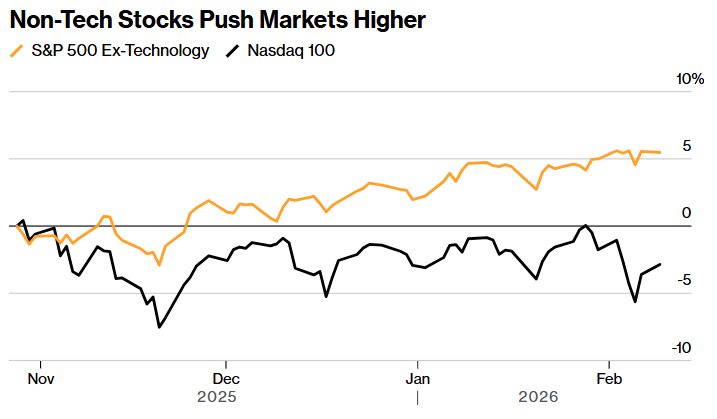
美股开启“资金大轮动”:AI概念波动引焦虑,“非科技”板块受青睐
Zhi Tong Cai Jing· 2026-02-10 13:57
Group 1 - The technology sector's previous strong upward momentum in the US stock market has turned into a volatile journey, prompting investors to seek stability in traditional economic companies, leading to a shift of funds from the AI industry to materials, energy producers, and consumer goods manufacturers [1] - Since late October, non-tech stocks have driven gains in their respective sectors, including Southwest Airlines (LUV.US) up 72%, lithium producer Albemarle (ALB.US) up 71%, Moderna (MRNA.US) up 65%, and logistics giant C.H. Robinson (CHRW.US) up 56% [1] - Roth's Chief Technical Strategist JC O'Hara noted that excluding tech stocks, the S&P 500 index is expected to rise by 6% by May, indicating a positive outlook for sectors outside technology [1] Group 2 - Wall Street has generally accepted the view of diversifying investments, but last week's tech stock sell-off raised questions about this perspective, although computer and software companies led a rebound [3] - Bank of America’s Savita Subramanian highlighted that the average holding of S&P 500 constituents, excluding the seven major tech giants, is 20% lower than their index weight, with only 10% of funds holding these stocks [3] - The trend is shifting from selling tech stocks to diversifying portfolios that are overly weighted in tech, with a focus on traditional economic stocks [4] Group 3 - Morgan Stanley's data indicates that the median earnings growth for Russell 3000 constituents is expected to be 11% this year, the strongest growth in four years, with the S&P 500 information technology sector down 6.7% since October 28, while energy and materials sectors have risen 23% and 17%, respectively [4] - O'Hara emphasized that the current trend is not merely about selling tech stocks but addressing how to diversify portfolios that are heavily weighted in tech [4] - Concerns remain about the tech sector's struggles, as declines in major tech companies like Amazon, Microsoft, Alphabet, and Meta Platforms have negatively impacted the Nasdaq 100 index [4] Group 4 - 22V Research's Jeffrey Jacobson expects the Nasdaq 100 ETF to continue underperforming compared to other sectors, as funds continue to withdraw from these crowded stocks after years of excess returns [5] - Jacobson noted that aggressive capital expenditure plans from Alphabet and Microsoft have pressured their stock prices, suggesting investors consider hedging strategies against large-cap stock risks [5] - O'Hara stated that while holding tech products remains beneficial, other sectors are also benefiting from a strong industrial revival [5]
信达生物(01801):CSIWM 个股点评:又一里程碑交易
citic securities· 2026-02-10 13:50
Investment Rating - The report does not explicitly provide an investment rating for Innovent Biologics [4]. Core Insights - Innovent Biologics announced a milestone deal with Eli Lilly on February 8, 2026, granting overseas rights to certain oncology and immunology pipeline assets, receiving an upfront payment of $350 million and potential milestone payments of up to $8.5 billion [4][5]. - This transaction is viewed positively, reinforcing the recognition of Innovent's R&D capabilities by global pharmaceutical companies, which is a significant differentiator in the Chinese biotech sector [6]. - The company is expected to release at least nine Phase I/II data assets in oncology, cardiovascular/metabolic diseases, and autoimmune diseases between 2026 and early 2027, which could unlock substantial option value [6]. Summary by Sections Company Overview - Innovent Biologics is a China-based biopharmaceutical company with a global perspective, focusing on the comprehensive development and commercialization of innovative drugs [10]. Recent Developments - The deal with Eli Lilly involves early development led by Innovent from proof of concept to Phase II, after which Eli Lilly will handle late-stage development and commercialization outside China [5]. - The assets involved in this transaction are undisclosed clinical projects, and the number of projects is fewer than the 11 preclinical assets involved in a previous deal between Hengrui Medicine and GSK [5]. Financial Performance - Innovent's product sales for Q4 2025 reached 3.3 billion yuan, representing a year-on-year growth of over 60%, exceeding market consensus expectations [6]. Catalysts - Key catalysts for 2026 include updates on proof of concept data for IBI363 in frontline non-small cell lung cancer and the initiation of multiple global Phase III projects led by Takeda [7].
20cm速递|JPM大会揭示创新机遇,创业板医药ETF国泰(159377)收红
Mei Ri Jing Ji Xin Wen· 2026-02-10 13:47
Group 1 - The JPM 2026 conference revealed innovative opportunities in the pharmaceutical and medical device sectors, particularly in the IO plus field where the trend of using VEGF dual antibodies in multiple indications is becoming established [1] - There is a focus on multinational corporations (MNCs) and leading biotech companies developing dual antibodies and combinations with monoclonal antibodies targeting other immune-related sites [1] - In the ADC (Antibody-Drug Conjugate) area, attention is drawn to first-in-class (FIC) products for large indications, new indications for major products, and advancements in dual toxin/new toxin ADC technologies, which are leading directions for domestic innovative drugs [1] Group 2 - The ETF Guotai (159377) tracks the innovative pharmaceutical index (399275), which has a daily price fluctuation limit of 20%, and selects listed companies engaged in biopharmaceuticals, chemical pharmaceuticals, traditional Chinese medicine, and medical services [2] - The index emphasizes the R&D investment and technological leadership of constituent companies, focusing on high-growth potential in the pharmaceutical health sector [2] - The ETF aims to reflect the overall performance of listed companies related to innovative biopharmaceuticals [2]
