投资银行

Search documents
招商证券王大为: 解码A股并购新周期 四大战略领域重塑价值坐标
Zheng Quan Shi Bao· 2025-10-27 21:24
"从延长产业链到切入新赛道,并购重组已然成为上市公司实现高质量发展的'助推器'。"近日,招商证 券投资银行委员会并购业务部负责人王大为在接受证券时报记者采访时表示,当前并购业务的机遇主要 来自政策红利与产业升级的共振。 中小市值企业并购领跑 自去年9月"并购六条"实施以来,全市场新增重大资产重组交易超过200单。政策工具创新也在释放市场 活力,已有案例显示,股份对价分期支付、简易审核程序等机制显著提升了交易效率,特别是市值超百 亿元且信息披露优质的公司享受到了审核流程精简的红利。 在王大为看来,当前A股并购交易的驱动因素主要有三类:一是战略转型,传统企业通过并购切入新赛 道;二是产业链延伸,上市公司通过横向或纵向整合强化核心竞争力;三是培育第二增长曲线,通过注 入优质资产拓展盈利增长点。 根据公开市场数据,按证监会二级行业统计,计算机、通信和其他电子设备制造业上市公司的重大资产 重组数量居于首位。不同规模的上市公司均有参与,但中小型市值企业(20亿—120亿元)表现得尤为 活跃,"因为既有扩张需求,又具备灵活决策机制"。 基于实操经验,王大为还勾勒了"最受买方青睐的资产"画像——首先,在行业属性上,高技术装备 ...

美国GDP增速预测:三季度1.4%,前三季度1.7%,2025年全年1.7%
Sou Hu Cai Jing· 2025-10-27 10:06
Economic Growth Overview - The U.S. economy demonstrated resilience in the first half of 2025, with a year-on-year growth of 2% in Q1 and 1.8% in Q2, resulting in a solid growth rate of 1.9% for the first half [1] - The strong performance is primarily attributed to robust private consumption, supported by a healthy labor market and rising wage growth, despite pressures from the interest rate environment [3] Trade and External Demand - The external trade environment remains complex, with a restrained execution of tariff policies alleviating some tensions in the global trade system, creating conditions for U.S. companies to maintain a "not too bad" external demand environment [3] - However, a subtle shift in economic momentum is observed, with a clear slowdown from 2% growth in Q1 to 1.8% in Q2, indicating a gradual deceleration [3] Economic Forecasts - Bloomberg's survey reflects a 1.7% growth forecast, capturing the collective wisdom of financial market participants, which is based on current economic data and short-term trends [3][4] - The Federal Reserve's more cautious 1.6% growth prediction highlights its role as an economic "gatekeeper," focusing on risk management and maintaining policy credibility [6][7] Risk Management Perspectives - The divergence in growth forecasts illustrates different risk management philosophies, with market participants prioritizing growth opportunities while the Federal Reserve emphasizes systemic risk prevention [7] - The Fed's conservative growth outlook serves as a forward guidance tool, aiming to temper market optimism and create space for future policy adjustments [7] Structural Risks - Key risks facing the U.S. economy include uncertainties in tariff policies, which could lead to cautious corporate investment decisions and potential distortions in global trade flows [8] - Structural changes in the labor market post-pandemic, such as shifts in labor participation rates and wage growth dynamics, are also concerning, with potential implications for economic growth [10] Economic Outlook for H2 2025 - Projections for the second half of 2025 suggest a slowdown in growth, with Q3 expected to be around 1.4% and Q4 maintaining approximately 1.5%, leading to an annual growth rate close to 1.7% [11] - This trajectory aligns with the Federal Reserve's narrative of a "soft landing," but achieving this balance between growth and inflationary pressures remains challenging [11] Conclusion - The U.S. economy is at a critical turning point, transitioning from pandemic-induced volatility to a more normalized growth phase, characterized by uncertainty and complexity [12] - Understanding the underlying logic behind market optimism and policy caution is crucial for investors and policymakers, emphasizing the need for flexibility and an open mindset in navigating potential scenarios [12][13]


下一个希腊?IMF警告:美国债务率将飙破143%!
Hua Er Jie Jian Wen· 2025-10-27 07:00
Core Insights - The U.S. government's debt burden is accelerating, projected to surpass that of Italy and Greece for the first time this century, with total debt as a percentage of GDP expected to reach 143.4% by 2030, an increase of over 20 percentage points from current levels [1][3][6] - The U.S. budget deficit is forecasted to remain above 7% of GDP annually until 2030, making it the highest among all wealthy nations tracked by the IMF [1][2] - In contrast, Italy and Greece are expected to see a decline in their government debt ratios by the end of the century due to strict budget deficit controls [2][3] U.S. Debt Trajectory - The U.S. total government debt as a percentage of GDP has been below that of Italy and Greece since the early 2000s, but this trend is reversing [3] - The Congressional Budget Office (CBO) predicts that the upward trend in U.S. debt will continue for decades, despite the country's status as the issuer of the global reserve currency [2][3] Political and Economic Context - The rapid expansion of the U.S. federal deficit occurred during the Biden administration, with limited progress noted during the Trump administration in addressing the issue [3][4] - Political dynamics in the U.S. complicate efforts to reduce the deficit, as both major parties are resistant to significant fiscal changes [4] Italy's Fiscal Discipline - Italy's government, under Prime Minister Giorgia Meloni, has received praise from foreign investors for its efforts to reduce the budget deficit, with a projected deficit of 3% of GDP this year, down from 8.1% when Meloni took office [4][5] - Italy is expected to achieve a primary surplus of 0.9% of GDP this year, exceeding initial forecasts [4][5] Rating Upgrades and Economic Recovery - DBRS Morningstar upgraded Italy's sovereign rating from "A low" to "BBB high," attributing this to improved public finance efforts supported by over €200 billion from the EU recovery plan [5] - Italy's labor market recovery and improved tax collection, partly due to increased digital payment usage, have also contributed to its fiscal improvements [5] Sustainability Concerns - Despite the U.S. having a lower net government debt level compared to Italy, concerns about the sustainability of U.S. fiscal policy are rising due to the continuous upward trajectory of debt [6] - Experts suggest that any assumptions about the sustainability of U.S. fiscal conditions must consider various economic factors, including productivity growth and tax revenues [6]
卖美债买黄金“中长期并非明智之举”!大摩利率团队:美债终会“闪耀”的
Hua Er Jie Jian Wen· 2025-10-27 01:27
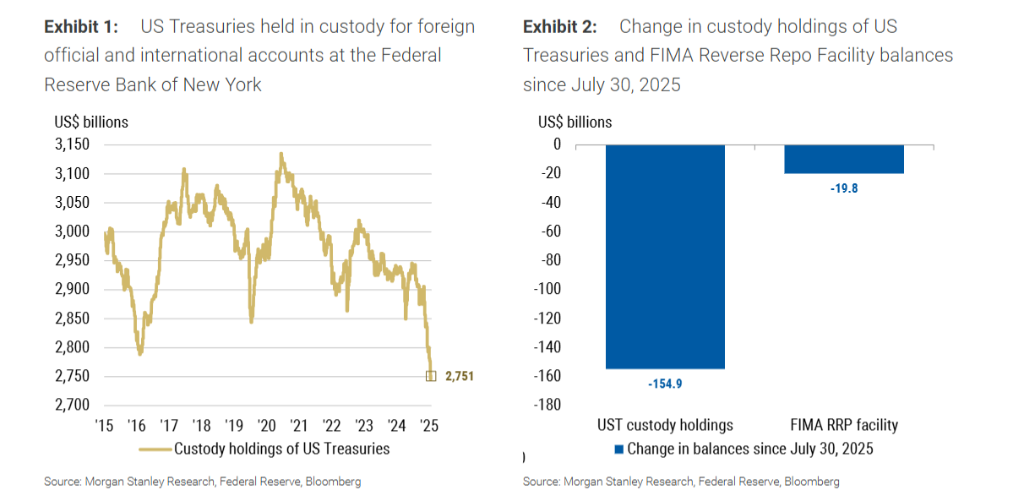
Core Viewpoint - A trend of "selling bonds and buying gold" has emerged, but Morgan Stanley maintains that U.S. Treasuries are a superior long-term choice [1][15] Group 1: Market Dynamics - Foreign official investors have significantly altered their asset allocation, with U.S. Treasuries held in custody by the New York Fed declining by nearly $155 billion from July 30 to October 22, 2025 [1] - During the same period, gold prices surged over 25%, suggesting that foreign official investors may have used proceeds from selling U.S. Treasuries to purchase gold [2] Group 2: Performance Analysis - Despite potential selling pressure, the U.S. Treasury market remains robust, with Treasuries performing well since July [5] - Historical data indicates that gold has underperformed U.S. Treasuries over any given decade in the past 50 years, with specific examples showing gold's negative returns during certain periods [6] Group 3: Volatility Considerations - The report highlights that gold's total return volatility is significantly higher than that of intermediate U.S. Treasuries, making it a questionable choice for central banks focused on managing short- to medium-term Treasury indices [9] Group 4: Long-term Trends - Morgan Stanley expresses no concern over the reduction of U.S. Treasuries held by foreign official investors, noting it as a long-term trend that has seen the proportion of Treasuries held by these investors drop from 41% in mid-2014 to 16% currently [10] - The report emphasizes that the environment for holding U.S. Treasuries is becoming increasingly attractive due to rising economic activity risks, with expectations for lower terminal interest rates from the Federal Reserve [12] Group 5: Investment Recommendations - Morgan Stanley suggests that investors should prepare for an upcoming "shining moment" for U.S. Treasuries, reiterating several trading recommendations, including going long on 5-year U.S. Treasuries and steepening the yield curve [15]

高盛提出了石油空头面临的“关键问题”
Goldman Sachs· 2025-10-27 00:31
Investment Rating - The report indicates a bearish sentiment in the oil market, particularly with significant short positioning in Brent Crude [3][5]. Core Insights - Crude oil prices have surged following the announcement of sanctions on Russian oil giants by the Trump administration, raising questions about future price movements [1][13]. - Managed Money shorts in Brent Crude reached a 90% rank on a two-year lookback, indicating a strong bearish posture among traders [3][5]. - The report highlights that the recent price movements and trader behaviors suggest a potential for larger covering flows if the recent price increase holds [16][18]. Summary by Sections - **Market Reaction**: Following the sanctions on Russian oil producers, December Brent crude saw an intraday high increase of 5.5% on October 23rd, with significant movements in spreads and open interest [13][11]. - **Trader Positioning**: The Commitment of Traders data shows a substantial amount of Managed Money short positions, with a cumulative increase of $3.3 billion over four weeks [3][5]. - **Market Dynamics**: The report notes that the rolling six-month correlation between Managed Money spreads and front-term structure remains negative, indicating that shorts dominate the market [10]. Additionally, reports of India reducing purchases of Russian oil have contributed to market unease [10].

“这是一段震荡的去杠杆行情”_,但散户仍占主导;_高盛
Goldman Sachs· 2025-10-27 00:31
Investment Rating - The report indicates a cautious outlook on the retail sector amidst a choppy de-grossing market environment, suggesting that retail remains a dominant force despite the volatility [1][3]. Core Insights - Retail trading activity has surged, with retail investors accounting for over 16% of the total volume in S&P 500 stocks, marking a five-year high [7][9]. - The market is increasingly narrative-driven, with traders seeking compelling stories and catalysts to guide their investments [8][12]. - The volume of stocks executed by off-exchange venues, such as those serving retail platforms like Robinhood, is projected to reach 50% of total trading volume for the first time this year [9][12]. - Individual amateur investors are gravitating towards lightly regulated markets, with OTC Markets seeing an average monthly trading volume of approximately $59 billion, nearing the peak levels observed during the meme-stock frenzy [12][9]. - The report highlights a divergence in risk appetite, with retail investors remaining risk-seeking while institutional investors have adopted a more cautious stance [13][15]. Summary by Sections Trading Activity - On a recent trading day, 25.2 billion shares were traded across US equity exchanges, significantly above the year-to-date average of 17.2 billion shares [3][4]. - The top 10 stocks by trading volume accounted for approximately 8 billion shares, or 32% of the total market volume, with a majority being penny stocks favored by retail investors [4][7]. Market Sentiment - The current market sentiment is characterized by a high level of gross leverage and constrained net positions, indicating a cautious approach among institutional investors [22][23]. - The report notes that the unprofitable tech sector is experiencing a sharp correction, with some stocks, like Beyond Meat, showing significant reversals [28][29]. Earnings and Economic Indicators - Overall earnings remain supportive, but market reactions to earnings reports are becoming increasingly critical, as investors appear to be taking profits during the earnings season [29][31]. - The bond market has stabilized despite ongoing fiscal excess, with both nominal and real yields compressing at the long end, which is seen as bullish for equity multiples [33][34].
外资机构:对中国经济社会发展充满信心
中国基金报· 2025-10-26 12:01
Core Viewpoint - Foreign institutions express confidence in China's economic and social development during the "15th Five-Year Plan" period, as highlighted by the recent Fourth Plenary Session of the 20th Central Committee [2][10]. Group 1: Focus on Technology and Innovation - The session emphasizes accelerating high-level technological self-reliance and strengthening the modern industrial system, indicating a shift towards an ecosystem-driven strategy and increased support for industries to enhance productivity rather than just scale [4]. - Key macro themes include building a modern industrial system, accelerating technological innovation, and developing a strong domestic market, with a focus on intelligent, green, and integrated development [4][6]. - Research and development spending is projected to grow at a compound annual growth rate of over 7%, aiming for over 3.2% of GDP by 2030, translating to approximately 5.5 trillion to 6.0 trillion yuan [4]. Group 2: Expanding Domestic Demand and High-Level Opening Up - The session indicates a shift towards prioritizing policies that address structural challenges and enhance domestic demand, with a focus on improving social welfare and consumption [8][9]. - The strategy includes a commitment to expanding domestic demand while promoting new supply and creating new demand, linking consumption policies closely with social safety nets and public service access [8][9]. - The plan also aims to expand high-level opening up, maintaining a multilateral trade system and enhancing international cooperation, which is crucial given the ongoing trade tensions [9]. Group 3: Economic Growth Projections - By 2035, the goal is for significant improvements in economic, technological, and defense capabilities, with per capita GDP expected to reach between 25,000 to 30,000 USD [11][12]. - The projected annual GDP growth rate for the "15th Five-Year Plan" period is estimated to be between 4.5% and 5.0%, with a focus on synchronizing per capita income growth with GDP growth [12].

美股破顶高盛警告回调风险上升
Ge Long Hui A P P· 2025-10-25 13:26
Core Viewpoint - The U.S. stock market is facing an increased risk of a pullback, as indicated by Goldman Sachs, which suggests that the risk appetite has dropped to near neutral levels, significantly lower than the summer's supportive state for the market [1] Group 1: Market Conditions - All three major U.S. stock indices reached new highs on Friday, but Goldman Sachs warns of rising pullback risks [1] - The likelihood of a market sell-off is higher than the potential for significant upward movement, prompting a recommendation for investors to increase hedging tools against potential downturns [1] Group 2: Global Exposure and Implications - The International Monetary Fund (IMF) highlights that global exposure to U.S. stocks is at a record level, suggesting that a correction in the U.S. market could have severe consequences [1] - If the U.S. stock market experiences a downturn comparable to the internet bubble burst, American households could face a loss of over $20 trillion (approximately 156 trillion HKD) in wealth [1]
如何看待本轮金银的大跌?
对冲研投· 2025-10-25 10:05
Group 1 - The article discusses the bullish outlook for copper prices over the next 3 to 6 months, with expectations to test historical highs near $10,900 per ton [3] - COMEX-LME arbitrage is a focal point, with Goldman Sachs predicting a tightening effect on the physical market outside the U.S. due to positive arbitrage conditions [3] - U.S. copper inventories have increased significantly, with current levels around 750,000 tons, leading to expectations of additional copper inflow into the U.S. [3] Group 2 - The article examines the state of silver inventories at LBMA, noting that 83% of the total 24,581 tons are locked in ETFs, leaving only 4,200 tons available [6] - There is a significant concern regarding the actual availability of silver for delivery, as much of the remaining inventory may be tied up in private or institutional holdings [6][7] - The article highlights the rising leasing rates for silver, indicating a potential shortage in the market, with estimates suggesting that LBMA may owe the market around 2,070 tons of silver due to ongoing consumption [7] Group 3 - The article analyzes the recent volatility in gold prices, noting a 5.7% drop that is statistically significant, occurring at a frequency much higher than expected [12][13] - It emphasizes that the gold market is not as stable as perceived, with historical data showing frequent large fluctuations [13] - The article suggests that the recent sell-off may lead to a healthier market as speculative positions are cleared out [13][14] Group 4 - The article outlines investment opportunities in various sectors, including bullish positions in commodities like iron ore and palm oil due to tightening supply and policy expectations [15] - Conversely, it identifies bearish opportunities in gold and silver, driven by weak demand and potential price corrections [16] - The article also discusses the structural shift in capital towards the Chinese stock market, predicting a gradual bull market supported by policy measures and low valuations [19][20][21] Group 5 - The article highlights the impact of the Russia-Ukraine conflict on commodity markets, particularly precious metals, with expectations of reduced demand if peace negotiations progress [28][29] - It notes that the geopolitical situation has led to increased central bank purchases of gold, reflecting concerns over currency risks [29] - The article concludes that despite potential short-term declines, the long-term outlook for precious metals remains positive due to ongoing geopolitical uncertainties [29]

美联储降息还有悬念,周五这份报告成最后变数,亿万资金严阵以待
Sou Hu Cai Jing· 2025-10-25 07:47
Group 1 - The upcoming CPI data for September is highly anticipated due to its direct impact on living costs and market reactions [2][4] - The recent government shutdown has led to a lack of key economic data, creating uncertainty in the financial markets [4][5] - Analysts expect the CPI to rise by 3.1% year-over-year, with core CPI also projected at 3.1%, marking the highest level since January [8] Group 2 - Analysts are closely examining the details of the CPI report, including potential price stability in used cars and rising insurance costs [10] - Concerns have been raised about the accuracy of the CPI data collection process during the government shutdown, which could affect the reliability of the report [12] - The CPI report will significantly influence the Federal Reserve's interest rate decision, with expectations for a 0.25% rate cut unless inflation exceeds expectations [14] Group 3 - Despite uncertainties, the underlying strength of the U.S. economy remains, with corporate earnings generally exceeding expectations and a projected GDP growth of 4% for Q3 [16] - The Federal Reserve's ongoing accommodative policies are expected to support the market, and any short-term volatility from CPI data may present strategic buying opportunities [16] - The focus on CPI data reflects broader anxieties about future uncertainties, but maintaining a long-term perspective is advised for financial decision-making [18]