
装备制造

Search documents
重庆机电午前涨近5% 旗下重庆康明斯、重庆日立能源受益于数据中心和电网建设
Xin Lang Cai Jing· 2026-02-12 03:57
Group 1 - Chongqing Machinery and Electric (02722) saw a nearly 6% increase in stock price, currently up 4.51% at HKD 2.78, with a trading volume of HKD 34.35 million [1] - Cummins reported strong operational performance for Q4 and the full year, despite a weak North American truck market, with record sales and profitability driven by its distribution and power systems divisions [1] - Cummins' Q4 revenue is projected to be USD 8.5 billion, a 1% increase year-over-year, with net profit expected to reach USD 593 million, compared to USD 418 million in the same period of 2024 [1] Group 2 - Industrial Securities highlighted Chongqing Machinery and Electric as a leading equipment manufacturing enterprise under Chongqing State-owned Assets, with stakes in Chongqing Cummins and Chongqing Hitachi Energy [1] - Chongqing Cummins is the only large-bore engine manufacturer for Cummins in China, benefiting from the growth of large-bore engines and data centers [1] - Chongqing Hitachi Energy primarily produces transformers rated at 220kV and above, benefiting from the construction of overseas high-voltage power grids, indicating strong growth potential for both subsidiaries in the coming years [1]
为地方经济社会发展提供坚实支撑——中央企业在山西奋力创新积极作为
Xin Lang Cai Jing· 2026-02-12 03:45
Core Viewpoint - Central enterprises are playing a crucial role in supporting the high-quality development of Shanxi by leveraging their strengths in various sectors, including energy security, infrastructure, and technological innovation [1][2]. Group 1: Central Enterprises' Contributions - Central enterprises are actively collaborating with Shanxi to enhance energy security, upgrade industries, and improve transportation networks, contributing to a series of successful outcomes in the region [2]. - The Daqin Railway has achieved a normalized transportation capacity of 450 million tons per year, facilitating the supply of coal and ensuring national energy security [1][3]. Group 2: Strategic Cooperation and Development - Shanxi has positioned itself as a welcoming environment for central enterprises, encouraging investment and collaboration to drive traditional industry upgrades and foster new industries [3]. - The establishment of strategic partnerships between Shanxi and central enterprises has led to significant investments and project developments, enhancing the region's economic foundation [3]. Group 3: Infrastructure and Transportation - The Taiyuan Railway Bureau has completed the construction of the pre-fabricated box beams for the Xiongxin High-speed Railway, which will connect Shanxi with the Beijing-Tianjin-Hebei region, improving the national high-speed rail network [4]. - Central enterprises are enhancing the logistics capabilities in Shanxi, facilitating the movement of coal and manufactured goods, thereby supporting local industries [4]. Group 4: Energy Supply and Green Transition - Central enterprises are committed to ensuring energy supply while promoting a green transition in Shanxi, with significant investments in clean energy projects such as wind and solar power [6][7]. - The State Grid's construction of the Dazhou-Huailai-Tianjin South ultra-high voltage project will add 770 kilometers of clean energy transmission capacity, enhancing Shanxi's energy export capabilities [6]. Group 5: Technological Innovation and Modernization - Central enterprises are driving technological advancements in Shanxi, focusing on high-end manufacturing, digital technology, and ecological protection to support the development of a modern industrial system [8][10]. - Companies like CRRC Dalian are implementing digital transformation initiatives, achieving a system integration rate of 94% and enhancing their manufacturing capabilities [8]. Group 6: Digital Infrastructure and Rural Development - Shanxi Mobile is advancing digital rural construction by creating platforms for governance and smart agriculture, promoting e-commerce and logistics in rural areas [9]. - Central enterprises are investing in digital infrastructure, including 5G networks and computing centers, to support various sectors and enhance the region's digital economy [10].
港股异动 | 重庆机电(02722)早盘涨近6% 旗下重庆康明斯、重庆日立能源受益于数据中心和电网建设
智通财经网· 2026-02-12 02:55
Group 1 - Chongqing Machinery and Electric (02722) saw a nearly 6% increase in early trading, currently up 4.51% at HKD 2.78, with a transaction volume of HKD 21.8864 million [1] - Cummins reported strong operational performance in Q4 and for the full year, despite a weak North American truck market, with record sales and profitability driven by its distribution and power systems divisions [1] - Cummins' Q4 revenue for 2025 is projected to be USD 8.5 billion, a 1% increase year-over-year, with net profit expected to reach USD 593 million compared to USD 418 million in the same period of 2024 [1] Group 2 - Industrial Securities highlighted Chongqing Machinery and Electric as a leading equipment manufacturing enterprise under Chongqing State-owned Assets, with stakes in Chongqing Cummins and Chongqing Hitachi Energy [1] - Chongqing Cummins is the only large-bore engine manufacturer for Cummins in China, benefiting from the growth of large-bore engines and data centers [1] - Chongqing Hitachi Energy primarily produces transformers rated at 220kV and above, benefiting from the construction of overseas high-voltage power grids, indicating strong growth potential for both subsidiaries in the coming years [1]
构筑通道 开拓新局
Shan Xi Ri Bao· 2026-02-12 00:59
Core Viewpoint - The article emphasizes that Shaanxi is overcoming its limitations in openness to drive high-quality development and become a model for the western region of China [2][4][16]. Group 1: Policy Empowerment and Support - Shaanxi is actively implementing policies to support foreign trade enterprises, with the Chen Cang District providing nearly 2 million yuan in subsidies to help businesses expand internationally [3]. - The province has established a comprehensive support system that addresses key challenges faced by enterprises in logistics and customs, enhancing their ability to navigate international markets [3][4]. - The "Shan Yao Global" initiative has facilitated significant cooperation agreements, including a total of 160 million yuan in contracts with clients from Poland, Turkey, India, and Kazakhstan [3]. Group 2: Trade and Market Expansion - Shaanxi's foreign trade resilience has improved, with the province's import and export volume reaching 244.51 billion yuan in 2025, a year-on-year increase of 7.5%, surpassing the national growth rate of 4.6% [4]. - The province is shifting from simple product sales to brand and model exports, as seen with companies like Yalan Bedding, which has established a presence in the high-end hotel market in South Korea [4]. Group 3: Infrastructure and Logistics Development - The operation of the China-Europe Railway Express (Xi'an) has significantly enhanced Shaanxi's logistics capabilities, with a total of 6,037 trains operated in 2025, marking a 21.1% increase [9]. - The establishment of the China-Xi'an Kazakhstan terminal has reduced port transfer times from several days to just 3 hours, boosting the number of cross-Caspian trains [9][10]. - Shaanxi is developing a multi-modal transport network that integrates land and air logistics, facilitating smoother domestic and international circulation [10]. Group 4: Tourism and Cultural Exchange - In 2025, Shaanxi received 926,700 inbound tourists, a remarkable increase of 98.14%, highlighting the province's strong international appeal in tourism [12]. - The expansion of the "visa-free" policy has contributed to the rising popularity of Shaanxi as a travel destination [12]. Group 5: Innovation and Economic Growth - Shaanxi is focusing on building a multi-layered open platform system, including free trade zones and comprehensive bonded zones, to enhance its open economy [13][14]. - The province's free trade zones account for 70% of its total import and export trade, despite occupying less than 1/1700 of the land area [15]. - The provincial government aims to achieve greater breakthroughs in reform and high-level openness, positioning Shaanxi as a key player in the global economy [15][16].
宁波精达项目获浙江省科技进步奖二等奖 产学研协同攻关高端冲压装备技术
Zheng Quan Ri Bao Wang· 2026-02-11 12:16
Core Viewpoint - Ningbo Jinda has been recognized for its innovative capabilities in the field of precision stamping equipment, receiving the 2024 Zhejiang Provincial Science and Technology Progress Award for its project on "Key Technologies and Applications of Wide Table Ultra-Precision High-Speed Stamping Equipment Design and Manufacturing" [1] Group 1 - The award reflects the company's commitment to innovation and research and development investment [1] - The project was developed in collaboration with several companies and universities, including Ningbo Zhenyu Technology, Dongfang Electric, Zhuhai Yingboer Electric, Zhejiang University, and Zhejiang University of Science and Technology [1] - The project serves as a reference case for joint research and development within the regional industrial chain, promoting deeper industrial collaborative innovation [1] Group 2 - The company plans to continue focusing on core technology breakthroughs in the equipment industry and enhance collaboration with upstream and downstream customers [1] - There is an emphasis on accelerating the transformation of cutting-edge technological achievements to improve the company's core competitiveness through technological innovation and industrial chain collaboration [1]

天秦装备披露股份减持进展,临时股东会审议治理议案
Jing Ji Guan Cha Wang· 2026-02-11 09:49
Group 1 - The company Tianqin Equipment (300922) recently disclosed progress on share repurchase and reduction, and held an extraordinary shareholders' meeting to review related governance proposals [1] - The share reduction plan period is from December 8, 2025, to March 7, 2026, with 781,800 shares remaining available for reduction as of January 31, 2026 [1] - The company held its first extraordinary shareholders' meeting of 2026 on January 13, 2026, to review proposals for changes in registered capital and amendments to the company’s articles of association, which may impact the governance structure [1] Group 2 - Recent market data indicates that on February 9, 2026, the company's stock price experienced volatility, increasing by 2.14% in a single day [1]
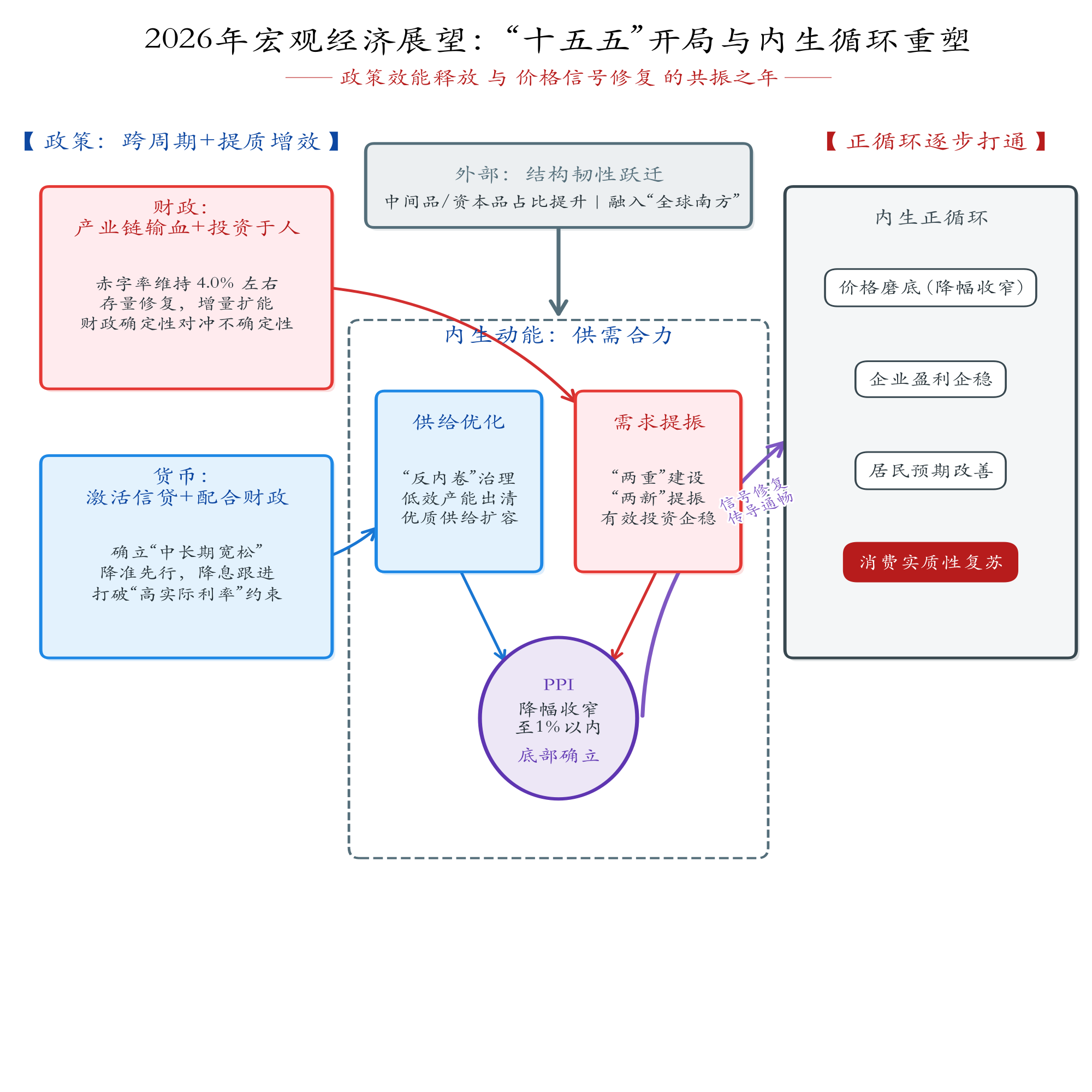
五矿信托:2026年宏观经济与大类资产配置展望
Jin Rong Jie· 2026-02-11 02:43
Core Viewpoint - The macroeconomic outlook for 2026 indicates a significant restructuring of macroeconomic policies, focusing on long-term stability and structural adjustments rather than merely smoothing short-term fluctuations. The year marks a transition towards quality-driven growth and a proactive transformation of the economy [1][4]. Group 1: Macroeconomic Policy - Fiscal policy will maintain a high intensity, with a deficit rate expected to remain between 4.0% and 4.2%, translating to approximately 5.9 trillion yuan in deficit. This aims to boost effective demand and facilitate the transition between old and new growth drivers [6][7]. - Monetary policy is set to shift towards "moderate easing," with expectations of a reserve requirement ratio cut in the first quarter and interest rate reductions in the second quarter, aimed at stimulating credit demand and supporting fiscal efforts [10][12]. Group 2: Investment Dynamics - Fixed asset investment is projected to recover, with growth rates expected to rise to 3.0%-3.5%. Infrastructure investment will be the main driver, anticipated to grow by around 5.5%, supported by fiscal measures [13][15]. - Manufacturing investment is expected to remain resilient, with a growth rate of about 5.0%, as companies shift focus from expansion to upgrading capabilities, aided by a structural shift towards high-value intermediate and capital goods [15]. Group 3: Consumption Trends - Consumer spending is expected to transition from stimulus-driven growth to normalized growth, with retail sales growth projected at 4.0%-4.5%. Durable goods consumption will stabilize, while service consumption is anticipated to become the largest incremental growth area, driven by policy support [17]. Group 4: External Trade and Balance - China's export structure is evolving from "end-product manufacturing" to "industrial base," enhancing export resilience. The export growth rate is expected to remain around 5.5%, supported by a shift towards high-value products [21][24]. - The focus on deepening cooperation with emerging markets will facilitate a transition from simple product exports to a model of "technology + capacity," which is expected to provide a solid foundation for maintaining export growth [24].

天津经开区:从能源破局到百亿投建 传统园区的零碳转型样本
Xin Lang Cai Jing· 2026-02-10 23:13
Core Viewpoint - The Tianjin Economic and Technological Development Zone (TEDA) is advancing towards becoming a national-level zero-carbon park by 2030, focusing on transforming its existing industrial energy systems to achieve low-carbon goals while maintaining economic stability [1][2][3]. Group 1: Zero-Carbon Park Development - TEDA has been selected as one of the first national-level zero-carbon parks, with a construction plan to be completed by 2030 [1][2]. - The park will implement a five-year plan to guide the development of the zero-carbon park, emphasizing the need for a systematic energy supply-side transformation [4][5]. - The core indicator for the zero-carbon park is to achieve a carbon emission of no more than 0.2 tons per ton of standard coal consumed, alongside a clean energy consumption rate exceeding 50% [7][8]. Group 2: Energy System Transformation - The transformation will focus on upgrading the existing energy supply system rather than starting from scratch, which presents unique challenges due to the complexity of the current industrial ecosystem [3][6]. - The park plans to close existing coal-fired boilers to significantly reduce carbon emissions, which is a key strategy to meet the core indicator [5][6]. - Investment for the low-carbon transformation is projected to reach a scale of around 100 billion yuan, targeting the "source, network, load, and storage" aspects of the energy system [8][9]. Group 3: Corporate Participation and Support - Corporate engagement is crucial for the success of the zero-carbon park, with varying motivations among companies, such as compliance with international carbon regulations and customer demands for low-carbon supply chains [10][12]. - The park has established a management mechanism that combines incentives and constraints to encourage companies to meet energy-saving targets, with support for those exceeding their goals [12][13]. - Companies are encouraged to build energy management centers and connect to online monitoring systems to enhance energy efficiency and carbon management [12][13].
关于四川省2025年国民经济和社会发展计划执行情况及2026年计划草案的报告
Si Chuan Ri Bao· 2026-02-10 22:26
Core Viewpoint - The report outlines the execution of the 2025 National Economic and Social Development Plan in Sichuan Province, highlighting significant achievements and setting the stage for the 2026 plan, emphasizing high-quality development and strategic initiatives for economic growth. Group 1: 2025 Economic and Social Development Plan Execution - The GDP reached 67,665.3 billion yuan, growing by 5.5%, meeting the expected target [3] - Fixed asset investment (excluding farmers) decreased by 2.4%, falling short of the expected target due to declines in real estate and infrastructure investments [3] - Retail sales of consumer goods increased by 5.1%, exceeding the expected target [4] - Total import and export volume was 10,318.1 billion yuan, meeting the expected target [5] - Local general public budget revenue reached 5,853.9 billion yuan, growing by 3.9%, surpassing the expected target [6] - Urban residents' per capita disposable income grew by 4.4%, meeting the expected target [7] - Rural residents' per capita disposable income increased by 5.6%, meeting the expected target [8] - Consumer prices decreased by 0.3%, meeting the expected target [9] - Urban employment increased by 1.073 million, exceeding the expected target by 223,000 [10] - The urbanization rate of the permanent population is expected to exceed 61%, increasing by about 1 percentage point from the previous year, roughly meeting the expected target [11] - Grain production reached 732.5 billion jin, exceeding the expected target by 75 million jin [13] Group 2: Economic and Social Development Situation - The regional coordinated development pattern has been optimized, with significant progress in the Chengdu-Chongqing economic circle [14] - The "Five Districts Common Prosperity" development strategy has been advanced, with key projects achieving substantial investment [15] - County economies have shown significant improvement, with 39 underdeveloped counties receiving targeted support [16] - Domestic demand has been steadily increasing, with consumption policies stimulating growth [17] - Key projects have accelerated implementation, with a high completion rate of provincial key projects [18] - Innovation capabilities have significantly improved, with the establishment of high-level innovation platforms and successful technology breakthroughs [19][20] - The traditional industries are undergoing rapid transformation and upgrading, with significant growth in key sectors [22] - New and future industries are being rapidly developed, with a focus on emerging technologies [23] - A new service system is being actively constructed, with notable growth in the service sector [24] Group 3: Market Vitality and Economic Environment - The environment for private economic development is steadily improving, with significant growth in private sector contributions to GDP [26][27] - State-owned enterprise reforms have shown significant results, with increased revenue and strategic restructuring [28] - Digital infrastructure development is advancing, with initiatives to enhance data utilization and government services [29] Group 4: High-Level Opening Up - The opening channels and platforms are becoming increasingly complete, with enhanced logistics and transportation networks [30] - The scale of the open economy is stabilizing and improving, with significant growth in foreign trade and investment [31][32] Group 5: Urban-Rural Integration and Environmental Protection - New urbanization is accelerating, with significant improvements in urban infrastructure and rural revitalization efforts [33][34] - Ecological environment quality is improving, with successful implementation of environmental protection measures [36][37] Group 6: Social Welfare and Public Services - Employment and income growth measures have been effective, with significant increases in disposable income and job creation [38][39] - Public service systems are becoming more robust, with improvements in healthcare, education, and social security [40] Group 7: Safety and Risk Management - Food and energy security measures are being effectively implemented, ensuring stable supply chains [41] - Risk prevention and control measures are in place, addressing financial and operational risks [42]
注入源源不断红色动能,打造苏陕协作标杆园区
Xin Lang Cai Jing· 2026-02-10 22:10
Core Viewpoint - The Danyang Economic Development Zone Party Committee has strengthened cooperation with the Fuping High-tech Zone in Weinan City, Shaanxi Province, promoting industrial development through a model of integrating party building with industry and talent cultivation, resulting in significant achievements in the "District within a Park" initiative [1][2] Group 1: Industrial Development - The Danyang Economic Development Zone Party Committee has focused on characteristic industries, promoting deep processing and cultural tourism integration of products like goat milk cheese and persimmon [2] - The establishment of three major industrial clusters in dairy products, traditional Chinese medicine, and equipment manufacturing has been prioritized, with leading enterprises like Shengtang Dairy being introduced to form a complete industrial chain from breeding to sales [2] - In 2025, the park plans to introduce six new projects and has over 20 projects in reserve [2] Group 2: Community Engagement and Support - The Danyang Economic Development Zone Party Committee has initiated a "pairing" activity among towns, villages, and communities, establishing partnerships between three community party organizations and three village party organizations in Fuping [2] - A total of 3.882 million yuan has been allocated for over 20 livelihood projects, including the renovation of a convenience service center and the repair of water-damaged roads [2] - Community party organizations have actively participated in charitable activities, with significant donations made for cultural projects and infrastructure improvements [2]