
天然气

Search documents
美国2025年LNG出口突破1亿吨
Zhong Guo Hua Gong Bao· 2026-01-06 04:01
Core Insights - The United States is projected to export 111 million tons of LNG in 2025, becoming the first country to exceed the 100 million tons mark in annual exports, leading Qatar by nearly 20 million tons and increasing by approximately 23 million tons compared to 2024, solidifying its position as the world's largest LNG supplier [1] Group 1: Export Growth - The growth in LNG exports is primarily driven by the commissioning of new projects, such as the Plaquemines LNG project, which achieved an annual shipment volume of 16.4 million tons after commencing exports [1] - U.S. export terminals maintained high utilization rates throughout the year, with December 2025 setting a monthly export record of 11.5 million tons [1] Group 2: Market Dynamics - Europe remains the main destination for U.S. LNG, as the region continues to replace Russian gas and meet winter demand, with approximately 9 million tons shipped to Europe in December 2025 alone [1] - Turkey's LNG purchases surged at the end of the year, with the volume of U.S. LNG bought in December 2025 exceeding that of the entire Asian market [1] - Egypt has also emerged as a significant buyer due to domestic supply shortages [1] Group 3: Industry Transformation - In less than a decade, the U.S. has transformed from a net LNG importer to a country that supplies about one-quarter of the global LNG trade, driven by flexible contracts, offshore pricing models, and abundant shale gas resources, making U.S. LNG products highly attractive to buyers seeking supply security [1] Group 4: Future Developments - Additional LNG capacity in the U.S. is set to come online in 2026, with the Plaquemines project aiming to reach full production, and several smaller projects continuing to increase output [2] - The first production line of the Golden Pass LNG project is also expected to begin production later this year [2]
维尔利、中油合能共推生物天然气跨区域消纳
Zhong Guo Hua Gong Bao· 2026-01-06 03:15
Core Viewpoint - The collaboration between Weili and China National Petroleum Corporation (CNPC) marks a significant step in the utilization of biogas resources in China, establishing a model for cross-regional consumption of biogas from production to application [1] Group 1: Project Details - Weili has signed a cooperation agreement with CNPC's Sichuan New Energy Development Co., focusing on the purchase and sale of approximately 11 million cubic meters of biogas green rights from a biogas resource utilization project [1] - This project represents the first case in China where biogas is utilized across regions from production to application [1] Group 2: Production Capacity and Goals - Weili currently operates nine biogas projects with a total production capacity nearing 10 million cubic meters per year [1] - The company aims to achieve a daily production target of 1 million cubic meters of biogas within the next 2 to 3 years [1] Group 3: Future Collaboration - Experts from CNPC's Southwest Oil and Gas Field Company proposed various collaboration opportunities with Weili, including joint investments, product distribution, green gas trading, certification, and technology development [1] - Both parties plan to leverage their respective strengths in technology, resources, and market channels to promote the large-scale application of biogas, contributing to low-carbon transformation in urban and industrial sectors [1]

胜通能源复牌再度涨停 斩获13连板
Zheng Quan Shi Bao Wang· 2026-01-06 02:11
Core Viewpoint - The stock of Victory Energy (001331) has reached a new high with a 13-day consecutive limit-up, closing at 50.94 yuan per share, with over 30,000 hands of limit-up orders [1] Group 1: Stock Performance - Victory Energy's stock has significantly deviated from the market and industry indices, showing large short-term fluctuations and a high risk of speculation [1] - The company has issued a warning that its stock price is severely misaligned with its fundamental business performance, indicating a potential for rapid decline in the future [1] Group 2: Business Operations - The company does not engage in any robotics-related business; its main operations remain focused on the procurement, transportation, and sales of liquefied natural gas [1] - There have been no significant changes in the company's operations, and the acquirer has no plans for asset restructuring or major business changes in the next 12 months [1] Group 3: Financial Considerations - The acquirer, Seven Teng Robotics, is using its own and self-raised funds for the acquisition, but the approval for the self-raised funds is still pending, introducing uncertainty regarding its success [1] - Investors are advised to be cautious and make rational investment decisions due to the potential risks highlighted in the announcement [1]
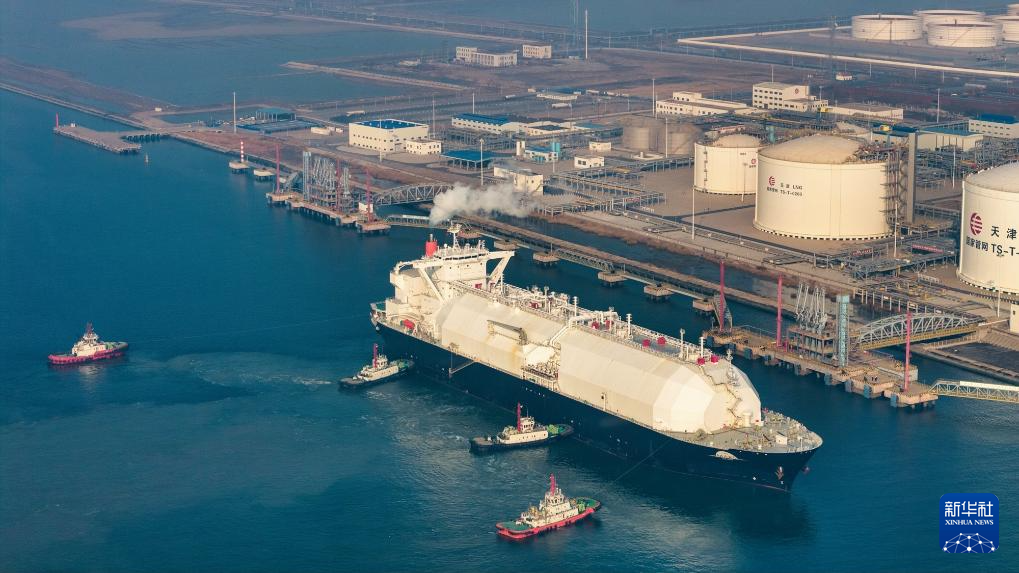
国家管网集团天津LNG接收站迎新年首船
Xin Hua Wang· 2026-01-06 00:50
C m ACC b t lena 新增加 参考 13:4 4 LNG 天 章 LNG WHR TS-T-0205 t 新目前 新聞 外交 NAME FRE ii (日 1 8 LSB BBS 15-T-CB03 INNET t a lett the (含 天 津 球葡 TS-T- IT FREE NO 2020 46 新聞 新聞 參 ...

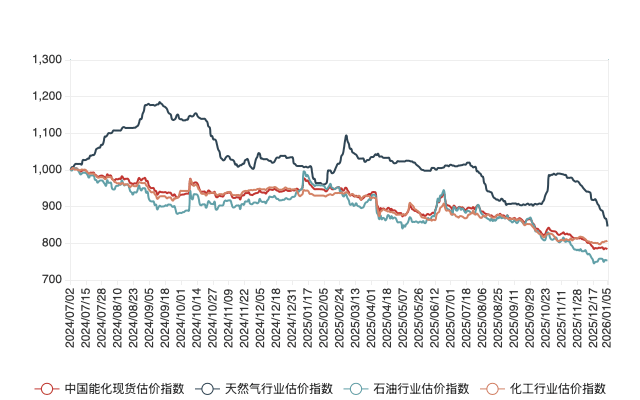
1月5日中国能化现货估价指数(CECSAI)较前一工作日下跌0.18%
Sou Hu Cai Jing· 2026-01-06 00:21
Core Viewpoint - The overall domestic energy and chemical spot price index in China has shown a slight decline, with mixed performance across different sectors, indicating a cautious market sentiment and ongoing demand primarily driven by necessity [7]. Group 1: Overall Index Performance - As of January 5, 2026, the China energy and chemical spot price index is reported at 784.33 points, down 1.38 points from the previous working day, reflecting a decrease of 0.18%. Compared to the base period (July 2, 2024), it has decreased by 215.67 points, or 21.57% [1]. Group 2: Sector-Specific Index Performance - The oil industry price index stands at 753.88 points, showing a slight increase of 0.24 points, or 0.03% from the previous day [2]. - The natural gas industry price index is at 845.82 points, down 20.71 points, or 2.39% from the previous day [3]. - The chemical industry price index is reported at 807.03 points, with an increase of 1.44 points, or 0.18% from the previous day [4]. Group 3: Price Changes in Key Products - In the oil sector, the price of imported crude oil at Shandong port is 3120 yuan per ton, down 26 yuan, or 0.83% from the previous period [8]. - Gasoline prices in various regions show mixed results, with a decrease of 40 yuan in East China and an increase of 15 yuan in Shandong province [8]. - Diesel prices have decreased across several regions, with a notable drop of 90 yuan in Shandong province [8]. - The price of liquefied petroleum gas in Dongying has increased by 165 yuan, or 3.90% [9]. - In the chemical sector, the price of propylene in Shandong province has increased by 60 yuan, or 1.05% [9]. - The price of methanol in Inner Mongolia has increased by 22 yuan, or 1.23% [9]. Group 4: Market Dynamics - The overall energy and chemical spot price index has experienced a slight decline, with the oil and chemical sectors showing minor gains while natural gas prices are under pressure due to supply and weather factors [7]. - The market remains cautious, with downstream procurement primarily driven by essential needs, and a prevailing wait-and-see sentiment among market participants [7].
【环球财经】卡塔尔与埃及签署谅解备忘录 计划2026年向埃及供应至多24船液化天然气
Xin Hua Cai Jing· 2026-01-05 23:13
Group 1 - QatarEnergy signed a memorandum of understanding with the Egyptian Ministry of Petroleum and Mineral Resources to supply up to 24 shipments of liquefied natural gas (LNG) to Egypt by summer 2026 [1] - The LNG will be delivered to Egypt's Sohna and Damietta ports, aligning with Egypt's strategy to diversify gas supply and ensure domestic demand [1] - QatarEnergy is currently operating in six offshore blocks in the Mediterranean Sea and plans to increase investments in Egypt over the next five years, including drilling multiple exploration wells [1] Group 2 - Egypt has been working to increase oil and gas production and diversify import sources to meet the growing domestic demand [1] - As of August 2025, Egypt's natural gas production is projected to be 4.1 billion cubic feet per day, with expectations to rise to 6.6 billion cubic feet per day by 2027 [1]
天津:国家管网天津LNG接收站迎来新年首船液化天然气
Xin Lang Cai Jing· 2026-01-05 20:49
Core Viewpoint - The arrival of the "Mars" LNG carrier at the Tianjin LNG receiving station marks the commencement of LNG unloading operations for the year 2026, indicating a significant development in the LNG supply chain for the region [1]. Group 1 - The "Mars" LNG carrier is transporting 64,400 tons of LNG, highlighting the scale of LNG imports being handled by the Tianjin receiving station [1]. - This event represents the first LNG unloading operation at the national pipeline's Tianjin LNG receiving station for the year 2026, showcasing the station's operational capabilities [1].

安徽省天然气开发股份有限公司可转债转股结果暨股份变动公告
Shang Hai Zheng Quan Bao· 2026-01-05 20:26
Core Viewpoint - The announcement details the conversion results and share changes related to the "Wantiang Gas" convertible bonds, highlighting the total amount converted and the remaining unconverted bonds. Group 1: Convertible Bond Issuance Overview - The company issued 9.30 billion yuan worth of convertible bonds on November 8, 2021, with a face value of 100 yuan per bond, totaling 930,000 bonds [3] - The bonds were listed on the Shanghai Stock Exchange on December 10, 2021, under the name "Wantiang Convertible Bonds" with the code "113631" [3] - The conversion period for these bonds is from May 12, 2022, to November 7, 2027, with an initial conversion price of 11.12 yuan per share [3] Group 2: Conversion Status - As of December 31, 2025, the total amount converted from "Wantiang Convertible Bonds" is 334,121,000 yuan, resulting in 48,325,575 shares, which is 10.27% of the total shares before conversion [2][6] - From October 1, 2025, to December 31, 2025, an additional 244,043,000 yuan of bonds were converted, leading to 35,835,357 shares, accounting for 7.62% of the total shares before conversion [2][6] Group 3: Unconverted Bonds - As of December 31, 2025, there remains 595,879,000 yuan of unconverted "Wantiang Convertible Bonds," which represents 64.07% of the total issuance [2][7] Group 4: Share Capital Changes - The announcement includes details on share capital changes due to the conversion of bonds, although specific figures are not provided in the document [8]

国家管网天津LNG接收站迎来新年首船液化天然气
Xin Lang Cai Jing· 2026-01-05 13:30
Core Viewpoint - The Tianjin LNG receiving station of the National Pipeline Network welcomed its first liquefied natural gas (LNG) shipment of the year, marking a significant operational milestone for the facility in 2026 [1] Group 1 - The "Mars" vessel, carrying 64,400 tons of LNG, safely docked at the National Pipeline Network Group's Tianjin LNG receiving station [1]
停牌核查完成,胜通能源1月6日起复牌
Bei Jing Shang Bao· 2026-01-05 13:01
公告显示,胜通能源股票价格自2025年12月12日至2025年12月29日期间价格涨幅为213.97%,期间多次 触及股票交易异常波动情形。 胜通能源表示,公司主营业务及基本面未发生重大变化,不存在应披露而未披露的重大信息。公司不涉 及机器人相关业务,公司主营业务仍为液化天然气采购、运输及销售,未发生重大变化,收购方不存在 未来十二个月内的资产重组计划,收购方不存在未来12个月内对上市公司及其子公司的资产和业务进行 出售、合并、与他人合资或合作的计划,或上市公司拟购买或置换资产的重组计划,收购方不存在未来 36个月内通过上市公司借壳上市的计划或安排。 北京商报讯(记者 马换换 王蔓蕾)1月5日晚间,胜通能源(001331)披露公告称,公司就股票交易波 动情况进行了核查。鉴于相关核查工作已完成,公司股票将于1月6日起复牌。 ...