
新能源车

Search documents
新能源收评 | 狂掀涨停潮!创业板新能源ETF华夏(159368)飙涨10%,新能源车ETF(515030)涨超8%
Ge Long Hui A P P· 2025-09-05 07:47
Core Viewpoint - The renewable energy sector is experiencing a significant surge, driven by technological advancements, increased demand for energy storage, and supportive policies, leading to a rebound in stock prices and ETF performance [1][2]. Group 1: Market Performance - The Shanghai Composite Index has returned to 3,800 points, with the ChiNext Index rebounding by 6.55%, recovering the previous three-day decline of 6.09% [1]. - Key stocks in the renewable energy sector, such as XianDai Intelligent and Yangguang Electric, saw substantial gains, with XianDai Intelligent hitting the daily limit and Yangguang Electric and Yiwei Lithium Energy rising over 16% [1]. - ETFs with high exposure to renewable energy, including the Huaxia New Energy ETF, surged by 10.9%, while the New Energy Vehicle ETF increased by 8.34% [1]. Group 2: Industry Dynamics - The renewable energy industry is witnessing a positive shift, particularly in the lithium battery sector, with a favorable production outlook for September and a surge in orders for domestic energy storage cell manufacturers due to explosive growth in overseas demand [1][2]. - Solid-state battery technology has seen continuous breakthroughs this year, leading to expectations of increased orders in the market [1][2]. - The "2025-2026 Action Plan for Stable Growth in the Electronic Information Manufacturing Industry" aims to support high-end manufacturing and promote high-quality development in sectors like photovoltaics [2]. Group 3: Financial Projections - The lithium battery sector is projected to see revenue and net profit growth of 13.78% and 28.07%, respectively, in the first half of 2025, indicating an improvement in performance [2]. - The Huaxia New Energy ETF is the first in the market to track the ChiNext New Energy Index, covering the entire renewable energy industry, including batteries, photovoltaics, and semiconductors [2]. - The New Energy Vehicle ETF, with a scale of 4.962 billion yuan, is the largest in its category, featuring key stocks from upstream resource leaders to downstream vehicle manufacturers [2].

港股科技ETF(513020)涨超2%,资金抢筹,连续4日吸金超1.4亿元
Mei Ri Jing Ji Xin Wen· 2025-09-05 06:21
Group 1 - The core viewpoint indicates that with the increasing expectation of interest rate cuts by the Federal Reserve and a more accommodative external environment, the Hong Kong stock market is expected to strengthen in the future [1] - Recent performance shows that the Hong Kong stock market has lagged behind the A-share market, but the overall valuation of the Hang Seng Index and the Hang Seng Technology Index is more reasonable [1] - The solid fundamentals of the constituent stocks in the Hong Kong market support the continued upward movement of the market [1] Group 2 - The industry distribution in the Hong Kong stock market shows a higher proportion of growth stocks in technology and pharmaceuticals, providing a structural advantage over the A-share market [1] - The improving sentiment in AI internet and innovative pharmaceuticals suggests that the Hong Kong stock market may catch up in trading, with further room for valuation increases [1] - The Hong Kong Technology ETF (code: 513020) tracks the Hong Kong Stock Connect Technology Index (code: 931573), which selects up to 50 quality companies from the technology sector listed within the Stock Connect range [1] Group 3 - The index covers multiple sub-sectors including Internet, biomedicine, new energy vehicles, and chips, aiming to reflect the overall performance of core technology enterprises in the Hong Kong market [1] - These companies not only hold advantages in the domestic market but also possess strong expansion capabilities in overseas markets [1] - Investors without stock accounts can consider the Cathay China Securities Hong Kong Stock Connect Technology ETF Initiated Link C (015740) and Link A (015739) [1]
新能源强势领涨市场,新能源车ETF(159806)、创业板新能源ETF(159387)双双涨超4%
Mei Ri Jing Ji Xin Wen· 2025-09-05 05:58
Group 1 - The core viewpoint of the article highlights the issuance of a growth action plan for the electronic information manufacturing industry, aiming for an average annual revenue growth rate of over 5% in lithium battery and related fields by 2026 [1] - Data from the National Energy Administration indicates that from January to July, China's newly installed renewable energy capacity reached 283 million kilowatts, accounting for nearly 60% of the total installed capacity nationwide [1] - Zhongyuan Securities notes that the current A-share market is benefiting from a favorable environment characterized by intertwined domestic and foreign policy benefits and ample liquidity, with significant improvements in market funding conditions [1] Group 2 - The article mentions that the interbank market funding rates remain stable, and the trading volume in both stock exchanges has consistently exceeded 2 trillion yuan in recent days [1] - There is a net inflow of global allocation funds into the A-share market, with household savings accelerating their shift towards the capital market, creating a continuous source of incremental funds [1] - The article anticipates a steady and fluctuating short-term market, emphasizing the need to closely monitor changes in policies, funding conditions, and external markets, while suggesting short-term investment opportunities in the new energy, consumer, and securities sectors [1]
锂电池爆发,新能源车ETF(515030)大涨5%,厦钨新能涨超15%
Mei Ri Jing Ji Xin Wen· 2025-09-05 05:41
Group 1 - The core viewpoint of the news is the significant surge in the new energy sector, particularly in areas such as power batteries, lithium batteries, solid-state batteries, energy storage, and photovoltaics, following the release of a new action plan aimed at stabilizing growth in the electronic information manufacturing industry [1] - As of September 5, the New Energy Vehicle ETF (515030) rose by 5.18%, with notable increases in stocks such as Tianhua New Energy (over 16%), Xiamen Tungsten (over 15%), and others reaching their daily limit [1] - The newly issued "Action Plan for Stabilizing Growth in the Electronic Information Manufacturing Industry 2025-2026" emphasizes high-quality development in the photovoltaic sector and aims to eliminate low-price competition, guiding local governments in the orderly layout of the photovoltaic and lithium battery industries [1] Group 2 - Zhongyuan Securities recommends focusing on three investment themes for the fourth quarter: the promotion of "anti-involution" policies benefiting industry leaders, companies with long-term R&D investments and market share growth, and opportunities related to solid-state battery investments [1] - The New Energy Vehicle ETF (515030) is currently the largest in the market, tracking the CSI New Energy Vehicle Index (399976) and heavily weighted towards lithium batteries, which account for 67% of its composition [2]





固态电池继续走强,新能源车ETF(515030)涨超4%,先导智能领涨
Mei Ri Jing Ji Xin Wen· 2025-09-05 04:38
Group 1 - The A-share market showed slight fluctuations on September 5, with solid-state battery-related concepts performing strongly, particularly the New Energy Vehicle ETF (515030) which rose by 4.44% [1] - Leading stocks such as Xiandao Intelligent surged over 19%, Hangke Technology increased by over 14%, and other companies like Duofluor, Xiamen Tungsten, Mengguli, Tianhua New Energy, and Guoxuan High-Tech also saw gains [1] - Orders for solid-state battery production equipment have surged, with total new and existing orders from several leading equipment companies exceeding 30 billion yuan, reflecting a year-on-year increase of 70% to 80% [1] Group 2 - According to research from Caitong Securities, breakthroughs in solid-state battery technology since 2025 have led multiple automakers to plan for the adoption of all-solid-state batteries around 2027, accelerating the industry's industrialization process [1] - The gradual establishment of pilot production lines and the restart of lithium battery expansion cycles are expected to improve the fundamentals of equipment companies, with a positive outlook on the resonance between industry cycles and technological advancements [1] - The New Energy Vehicle ETF (515030) is currently the largest themed ETF in the market, tracking the CSI New Energy Vehicle Index (399976) and selecting stocks from listed companies involved in lithium batteries, charging piles, and new energy vehicles, with batteries accounting for 48.3% of the total [1]

鑫椤锂电一周观察 |从9月锂电排产看碳酸锂走势
鑫椤锂电· 2025-09-05 01:28
Core Viewpoint - The article discusses the current trends in the lithium battery market, particularly focusing on the price movements of lithium carbonate and the production capacity of various materials, indicating a stable demand despite price fluctuations [1][4]. Lithium Carbonate Market - Since late August, the domestic lithium carbonate market has seen a gradual decline in prices, returning to around 75,000 yuan per ton, as the market adjusts to a more reasonable level [1]. - The production of lithium batteries in August increased by approximately 7% month-on-month, with most materials showing production growth between 6-8% [1]. - The impact of mining rights adjustments in Jiangxi and Qinghai is expected to be less than anticipated, but it positively contributes to balancing short-term supply and demand [1]. - Chile's lithium carbonate exports fell by 19.2% month-on-month in August, and there are signs of reduced shipments from major Australian ports, providing some support for lithium carbonate prices [1]. Lithium Battery Material Market Lithium Carbonate - The latest prices for lithium carbonate as of September 4 are: - Battery-grade 99.5%: 74,000-76,000 yuan/ton - Industrial-grade 99.2%: 72,500-73,500 yuan/ton [5]. Ternary Materials - The ternary materials market has seen a slight price decline, with high-nickel production decreasing while medium-nickel production continues to grow [6]. - The latest prices for ternary materials as of September 4 are: - 5-series single crystal: 125,000-131,000 yuan/ton - 8-series 811 type: 143,000-148,000 yuan/ton [6]. Phosphate Iron Lithium - The phosphate iron lithium market remains stable, with a projected production increase of about 5% month-on-month in September [7]. - The latest prices for phosphate iron lithium as of September 4 are: - Power type: 33,600-35,000 yuan/ton - Energy storage type: 32,600-33,200 yuan/ton [7]. Anode Materials - The anode materials market shows continued production growth, with good sales performance in the power sector [8]. - The latest prices for anode materials as of September 4 are: - Natural graphite high-end products: 50,000-65,000 yuan/ton - High-end artificial graphite: 31,800-64,800 yuan/ton - Mid-range artificial graphite: 24,700-38,700 yuan/ton [8]. Separator Market - The separator market has seen a slight price increase, with major companies agreeing to slow down production expansion [9]. - The latest prices for separators as of September 4 are: - Wet method base film 9μm: 0.55-0.85 yuan/square meter - Dry method base film 16μm: 0.35-0.50 yuan/square meter [9]. Electrolyte Market - The electrolyte market has experienced a slight price increase, with production expected to reach new highs in September [10]. - The latest prices for electrolytes as of September 4 are: - Lithium hexafluorophosphate electrolyte: 54,500-58,500 yuan/ton - Power ternary electrolyte: 19,200-23,600 yuan/ton - Power phosphate iron lithium electrolyte: 15,000-21,000 yuan/ton [10]. Lithium Battery Demand Battery Market - The domestic lithium battery market is performing well, with good production conditions in September, primarily driven by the power sector [11]. - The latest prices for lithium batteries as of September 4 are: - Square ternary power cell: 0.38-0.45 yuan/Wh - Square lithium iron phosphate power cell: 0.26-0.355 yuan/Wh [11]. New Energy Vehicles - The total sales of the domestic automotive market reached 514,000 units, with new energy vehicle sales at 285,000 units, reflecting a penetration rate of 55.4% [12]. - In August, BYD's sales in Europe surpassed Tesla's, with BYD selling 373,600 units overall, including 80,000 exports [13]. Energy Storage - The energy storage cell market is performing well, with all production capacities fully utilized [14]. - Recent strong demand for energy storage systems has been noted in markets such as the Middle East and Eastern Europe, with significant projects underway [14].


“不及预期”的比亚迪,隐形的“另一半”
Hu Xiu· 2025-09-04 23:41
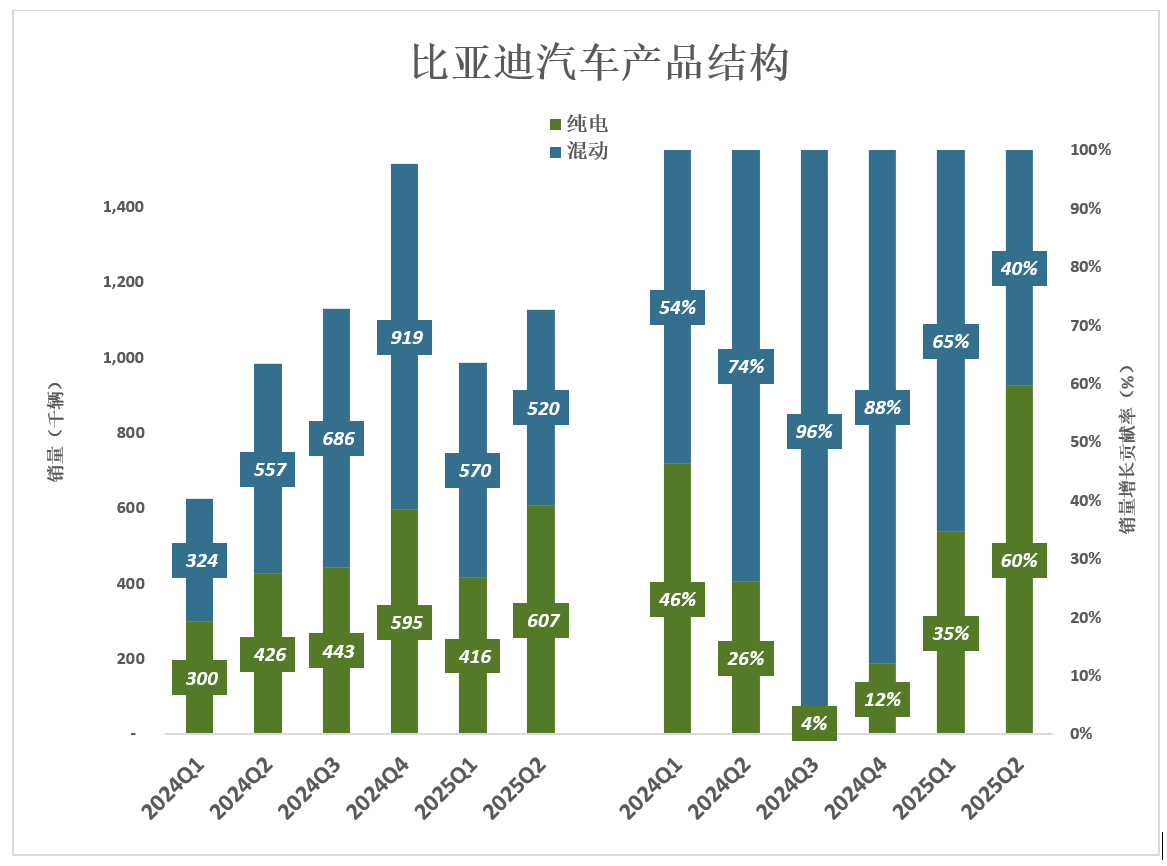
Core Viewpoint - BYD's performance in H1 2025 shows revenue growth but faces market challenges, leading to negative capital market expectations and a decline in A-share prices [2][12]. Financial Performance - In H1 2025, BYD reported revenue of 371.28 billion, a year-on-year increase of 23.3%, and a net profit of 15.51 billion, up 13.8% [1]. - Operating cash flow for H1 2025 was 31.83 billion, reflecting a significant increase of 124.5% year-on-year [1][18]. - BYD's gross profit from vehicle sales in H1 2025 was 61.6 billion, a 20.7% increase, while Tesla's gross profit decreased by 28.2% [12]. Sales and Market Dynamics - BYD's dual strategy of pure electric and plug-in hybrid vehicles has been crucial for maintaining its position as a global leader in new energy vehicle sales [5]. - In 2023, BYD's pure electric and plug-in hybrid sales reached 1.575 million and 1.438 million units, respectively, with pure electric vehicles contributing 57% to sales growth [3]. - The sales contribution of plug-in hybrids surged in 2024, reaching 83.9% in Q3, but the trend reversed again in 2025 with pure electric vehicles leading sales growth [3][4]. R&D and Technological Advancements - BYD's R&D investment in H1 2025 was 30.88 billion, a 53.5% increase, significantly higher than Tesla's R&D expenditure [36]. - BYD has introduced several key technologies, including the "Heavenly Eye" intelligent driving system and the fifth-generation DM technology, which boasts low fuel consumption [36][6]. Debt and Financial Health - As of June 2025, BYD's debt-to-asset ratio was 71.1%, a decrease of 3.6 percentage points from the end of 2024 [20]. - BYD has effectively managed its interest-bearing debt, which accounted for only 3.6% of total liabilities as of June 2025 [24]. Market Position and Competitive Landscape - BYD's vehicle sales gross profit margin is significantly higher than Tesla's, with a gross profit margin of 21% compared to Tesla's 17.1% in H1 2025 [12]. - The perception of BYD as a technology company is growing, with its valuation based on its status as a new energy vehicle giant, while its technological advancements are often overlooked [38]. Charging Infrastructure and Innovations - BYD's "Megawatt Fast Charging" technology aims to revolutionize the charging ecosystem, significantly reducing charging times and improving site utilization [53][56]. - The company is collaborating with various partners to expand its charging network, which is expected to enhance its competitive edge in the market [58].

一图看懂蔚来二季报
市值风云· 2025-09-04 10:10
Core Viewpoint - The article highlights the significant recovery of NIO in the second quarter, driven by the successful launch of new brands, leading to a 25.6% year-on-year increase in vehicle deliveries [3][4]. Group 1: Sales Performance - In Q2, total vehicle deliveries reached 72,056 units, marking a year-on-year increase of 25.6% and a quarter-on-quarter increase of 71.2% [5]. - The breakdown of deliveries includes 47,132 units from the NIO brand, 17,081 units from the Ladao brand, and 7,843 units from the Firefly brand [5]. - August sales hit a record high of 31,305 units, representing a year-on-year increase of 55.2% compared to July's 21,017 units, which saw a 25.2% year-on-year increase [7][16]. Group 2: Financial Performance - Total revenue for Q2 was 19.01 billion yuan, up 9.0% from 17.45 billion yuan in Q2 2024 [8]. - Automotive revenue increased to 16.14 billion yuan, a 2.9% rise from 15.68 billion yuan [8]. - The gross margin for complete vehicles decreased to 10.3%, down 1.9 percentage points from 12.2% [8]. - Operating loss narrowed to 4.91 billion yuan from 5.21 billion yuan, a reduction of 5.8% [8]. Group 3: Growth Drivers - The introduction of new brands, specifically Ladao and Firefly, contributed 170% of the quarterly growth, despite a decline in NIO brand sales [6]. - Revenue growth was attributed to increased delivery volumes and a significant rise in income from used cars and technology services [8]. - The narrowing of losses was driven by cost reduction, efficiency improvements, and organizational optimization [8]. Group 4: Future Outlook - For Q3, the delivery guidance is set between 87,000 and 91,000 units, indicating a year-on-year increase of 40.7% to 47.1% [14]. - Total revenue guidance for Q3 is projected to be between 21.81 billion and 22.88 billion yuan, reflecting a year-on-year increase of 16.8% to 22.5% [14].

跑输大盘!新能源车要歇歇脚?私募这样看
Zhong Guo Zheng Quan Bao· 2025-09-04 09:41
Group 1 - The A-share new energy vehicle sector has recently experienced a pullback after a strong performance, influenced by the realization of favorable policy news [1][3] - Leading stocks in the sector, such as BYD, SAIC Motor, and CATL, have shown signs of weakness despite previous gains [6][7] - The new energy vehicle sector index has outperformed major indices like the CSI 300 and Shanghai Composite Index, with increases of 3.44%, 15.79%, and 44.61% for November, the fourth quarter, and the year-to-date, respectively [7] Group 2 - Multiple private equity firms remain optimistic about the new energy vehicle sector, viewing it as a key driver for China's automotive industry and energy conservation efforts [2][10] - The recent issuance of the "New Energy Vehicle Industry Development Plan (2021-2035)" is expected to have a long-term positive impact on the sector, promoting electric vehicle adoption and cost reductions [8][9] - The market sentiment around new energy vehicles is currently strong, with expectations for continued interest from institutional investors, particularly in leading companies like BYD and Great Wall Motors [9][10] Group 3 - The new energy vehicle sector is anticipated to become a major focus for investors, potentially emerging as the fourth popular sector after consumption, technology, and pharmaceuticals [2][10] - The sector's growth is driven by unexpected demand increases and a target of 20% penetration for new energy vehicles by 2025, compared to the current 5% [10] - Investment opportunities are seen in both the midstream and upstream segments of the industry, with a focus on components and traditional automakers' technological advancements [11]





港股科技ETF(513020)盘中回调超2%,资金抢筹,近10日吸金超4.4亿元
Mei Ri Jing Ji Xin Wen· 2025-09-04 06:07
Group 1 - The core viewpoint indicates that with the increasing expectation of interest rate cuts by the Federal Reserve and a more accommodative external environment, the Hong Kong stock market is expected to strengthen in the future [1] - Recent performance shows that the Hong Kong stock market has lagged behind the A-share market, but the overall valuation of the Hang Seng Index and the Hang Seng Technology Index is more reasonable [1] - The solid fundamentals of the constituent stocks in the Hong Kong market support the continued upward movement of the market [1] Group 2 - The industry distribution in the Hong Kong stock market shows a higher proportion of growth stocks in technology and pharmaceuticals, providing a structural advantage over the A-share market [1] - The improving sentiment in AI internet and innovative pharmaceuticals suggests that the Hong Kong stock market may catch up in trading, with further room for valuation increases [1] - The Hong Kong Technology ETF (code: 513020) tracks the Hong Kong Stock Connect Technology Index (code: 931573), which selects up to 50 quality companies from the technology sector listed within the Stock Connect range [1] Group 3 - The index covers multiple sub-sectors including Internet, biomedicine, new energy vehicles, and chips, aiming to reflect the overall performance of core technology enterprises in the Hong Kong market [1] - These companies not only hold advantages in the domestic market but also possess strong expansion capabilities in overseas markets [1] - Investors without stock accounts can consider the Cathay China Securities Hong Kong Stock Connect Technology ETF Initiated Link C (015740) and Initiated Link A (015739) [1]