
纺织

Search documents
光大期货交易内参2025/8/7
Guang Da Qi Huo· 2025-08-07 13:24
Report Industry Investment Rating No relevant content provided. Core Viewpoints of the Report - The stock market has risen recently due to long - term expectations of fiscal policy shift and inflation recovery, mid - term anti - involution policies and infrastructure investment, and short - term capital inflows and improved enterprise deposit and loan data. The bond market is expected to show a repair trend. Precious metals are supported by "interest rate cut expectation" and "geopolitical uncertainty". Most commodities are expected to show a wide - range or weak - range oscillation trend [2][3][4] - Different commodities are affected by various factors such as supply and demand, policies, and geopolitical events, and their price trends vary. For example, steel products are affected by production, inventory, and policy expectations; copper is affected by tariffs and inventory; and energy products are affected by supply, demand, and price adjustments [6][15][23] Summary by Category Financials Stock Index - The A - share market rose yesterday with the Wind All - A up 0.72% and a turnover of 1.76 trillion yuan. The rise is attributed to long - term, mid - term, and short - term logics. It is advisable to wait for clearer policies and market trends before adjusting positions [2] - The treasury bond futures showed different trends. The short - term bond market is expected to repair, and short - term treasury bonds are expected to be strong [3] Precious Metals - Gold and silver prices fell overnight. Gold is in a window supported by "interest rate cut expectation" and "geopolitical uncertainty" and is expected to maintain a strong trend. Low - buying and holding silver is a good strategy [4] Mineral, Steel, Coal, and Coke Rebar - The rebar futures fluctuated narrowly, and the spot price rose slightly. The supply - demand pressure increased, but policy expectations and rumors boosted market sentiment. The short - term is expected to be oscillatory and slightly strong [6] Iron Ore - The iron ore futures price fell. The global iron ore shipment decreased, and the demand weakened. The short - term price is expected to oscillate [7][8] Coking Coal - The coking coal futures rose. The supply is affected by inspections, and the demand is strong. The short - term is expected to oscillate widely [9] Coke - The coke futures rose. The supply increased, and the demand was stable. The short - term is expected to oscillate widely [10] Manganese Silicon - The manganese silicon futures strengthened. Market news boosted confidence, and the demand increased. The short - term is expected to oscillate widely [11][12] Ferrosilicon - The ferrosilicon futures strengthened. Cost support is strong, and the fundamentals have little contradiction. The short - term is expected to oscillate widely [13] Non - ferrous Metals Copper - Copper prices rose slightly. The macro situation is complex, and the demand is insufficient. The price may be weak, but the "Golden September" expectation restricts the decline [15][16] Nickel & Stainless Steel - Nickel and stainless steel prices were affected by market sentiment. The fundamentals changed little, and the short - term is expected to oscillate [17] Alumina, Aluminum, and Aluminum Alloy - Alumina, aluminum, and aluminum alloy prices rose. The supply of alumina is expected to increase, and the aluminum price may face downward pressure. The short - term is expected to oscillate [18][19] Industrial Silicon and Polysilicon - Industrial silicon and polysilicon prices rose. Pay attention to the policy implementation and the opportunity of shorting SI and longing PS [20] Lithium Carbonate - The lithium carbonate futures rose, and the spot price fell. The supply is expected to increase slightly, and the demand is expected to increase. The short - term focus is on production uncertainties [21] Energy and Chemicals Crude Oil - Crude oil prices fell. The market is affected by sanctions and price adjustments. The price is under upward pressure and is expected to oscillate weakly [23] Fuel Oil - Fuel oil prices rose slightly. The supply is sufficient, and the demand may weaken. The short - term is expected to oscillate weakly [24] Asphalt - Asphalt prices rose slightly. The inventory decreased, and the demand is expected to improve. The short - term is expected to oscillate [25][26] Rubber - Rubber prices showed different trends. The supply is increasing, and the demand is stable. The short - term is expected to oscillate widely [27] PX, PTA, and MEG - PX, PTA, and MEG prices rose. The cost is under pressure, and the demand has resilience. The short - term price trends vary [28][29] Methanol - Methanol prices are expected to oscillate. The inventory is expected to accumulate, but the increase is not significant [30] Polyolefins - Polyolefin prices are affected by supply and demand and cost. The short - term upward space is limited [31] Polyvinyl Chloride - PVC prices showed different trends. The fundamentals improved slightly. The short - term is expected to oscillate weakly [32][33] Urea - Urea prices strengthened. The supply increased, and the demand slowed down. The short - term is expected to oscillate weakly [34] Soda Ash - Soda ash prices showed different trends. The supply and demand are stable. The short - term is expected to oscillate widely [35] Glass - Glass prices were weak. The supply was stable, and the demand declined. The short - term is expected to oscillate widely [36][37] Agricultural Products Protein Meal - CBOT soybeans fell, while domestic protein meal prices rose. The supply is sufficient, and the inventory is expected to peak. The strategy is to go long on soybean meal and participate in positive spreads [39] Oils - BMD palm oil fell, while domestic oils were strong. The supply and demand data will be released, and the strategy is to go long and sell put options [40] Live Pigs - Live pig futures rose, and the spot price fell. The supply pressure and policy support coexist. The short - term is expected to oscillate [41][42] Eggs - Egg futures rose, and the spot price fell. The short - term fundamentals are bearish, but there is a possibility of seasonal rebound [43] Corn - Corn futures rebounded, and the spot price was weak. The short - term is expected to face resistance, and the medium - term is expected to be weak [44] Soft Commodities Sugar - The domestic sugar sales data is good, but the spot price is down. The external market is weak. The domestic market is expected to be weak [46] Cotton - ICE cotton fell, while domestic cotton rose slightly. The international market focuses on macro factors, and the domestic market is supported by inventory. The 01 contract is expected to be stable in the short - term and strong in the long - term [47]
【广发宏观郭磊】出口超预期降低基本面风险
郭磊宏观茶座· 2025-08-07 11:29
Core Viewpoint - July exports increased by 7.2% year-on-year, surpassing the growth rates of 5.7% in Q1 and 6.2% in Q2, driven by global trade dynamics and base effects [1][5][6] Export Performance - Exports to the US decreased by 21.7% year-on-year, while exports to ASEAN remained stable at around 16-17%. Exports to the EU, Latin America, and Africa accelerated, with exports to Africa reaching 42.4% year-on-year [1][8] - The overall export growth is supported by a low base effect from July 2023, which saw a decline of 14.3% [7] Product Analysis - Traditional labor-intensive products (textiles, bags, clothing, toys) showed a combined decline of 1.3% year-on-year. In contrast, high-end equipment exports, such as automobiles and integrated circuits, maintained strong growth rates of 18.6% and 29.2% respectively [2][9][11] - Traditional electronic products like mobile phones and automatic data processing equipment experienced significant declines of 21.8% and 9.6% respectively [10] Economic Outlook - The GDP growth rate for the first half of the year was 5.3%. Factors expected to slow down growth in the second half include a new round of real estate sales decline and the exhaustion of "export rush" effects [4][13] - The import growth rate rose to 4.1% in July, with significant increases in imports of crude oil, refined oil, copper, and integrated circuits, indicating a rise in raw material demand [12]


美对印关税再增至50%,已落后的印度股市会面临新调整吗?
Di Yi Cai Jing· 2025-08-07 08:07
Group 1: Tariff Impact - The U.S. has announced an additional 25% tariff on imports from India, raising the total tariff rate to 50%, making India one of the countries with the highest tariffs imposed by the U.S. [1] - Analysts predict that the Indian stock market will face adjustment pressure, particularly in sectors such as oil, pharmaceuticals, textiles, footwear, and jewelry, which are expected to be the most affected [1][4] Group 2: Market Reaction - The Indian benchmark SENSEX index opened lower but quickly rebounded, stabilizing with a decline of about 0.2%, while the Nifty 50 index also showed a similar pattern [3] - Market participants believe the initial muted response may be due to expectations that India has sufficient time for negotiations, with some analysts suggesting the tariff increase may be more symbolic than substantive [3][4] Group 3: Long-term Outlook - If the trade relationship with the U.S. deteriorates, especially amid slowing economic growth, investors may adopt a cautious long-term outlook on the Indian stock market [4] - Foreign investors sold $2 billion worth of Indian stocks in July and an additional $900 million in August, indicating a trend of withdrawal from the Indian market [4] Group 4: Sector-Specific Impacts - Approximately 20% of India's export goods (accounting for 2% of GDP) are directed towards the U.S., with sectors like gems and jewelry, apparel, footwear, textiles, and chemicals being the most vulnerable [6] - The pharmaceutical sector, despite being perceived as resilient, has seen significant declines, with the NSE Nifty pharmaceutical index breaking key technical support levels [7]

美对印关税再增至50%,已落后的印度股市会面临新调整吗?这些板块最受打击
Di Yi Cai Jing· 2025-08-07 07:42
Group 1 - Analysts believe that the Indian stock market will face adjustment pressure due to the U.S. imposing an additional 25% tariff on Indian imports, raising the total tariff rate to 50% [1][4] - The sectors most affected include oil, pharmaceuticals, textiles, footwear, and jewelry, as these industries are closely tied to U.S. trade [1][6] - Foreign investors sold $2 billion worth of Indian stocks in July and an additional $900 million in August, indicating a trend of capital outflow amid rising uncertainties [4][5] Group 2 - The Indian economy has approximately 20% of its export goods (2% of GDP) directed towards the U.S., making it vulnerable to the new tariffs [6] - The pharmaceutical sector has seen significant declines, with the NSE Nifty pharmaceutical index breaking key technical support levels, indicating potential further declines [7] - Companies like Reliance Industries may face pressure if India succumbs to U.S. demands to limit oil purchases from Russia, which could impact refining margins [6]

悦达投资以“两新一智”模式推进转型
Zheng Quan Ri Bao Zhi Sheng· 2025-08-07 06:41
Group 1 - The core viewpoint of the articles highlights Jiangsu Yueda Investment Co., Ltd.'s transformation strategy, focusing on the "two new and one smart" model, which emphasizes the development of new energy and new materials while upgrading traditional businesses [1][2] - The company is actively expanding its new energy projects, with plans to achieve a cumulative installed capacity of 1GW to 2GW over the next three years, including the successful grid connection of the 378MW and 150MW photovoltaic projects [1] - Yueda Investment's traditional business, particularly in textiles, is undergoing digital transformation and smart upgrades, leading to significant increases in sales of green products, with a 66.8% year-on-year growth in functional yarn sales and a 59.9% increase in green cotton sales in 2024 [2] Group 2 - The company is also making strides in its investment business, with expected contributions of over 100 million yuan from projects like the Beijing-Shanghai Expressway and Chenjiagang Power Plant in 2024 [2] - Yueda Investment is positioned to evolve from a traditional industry operator to a "green sustainable development company," leveraging its complete new energy industry chain and resources in Yancheng to contribute to regional economic transformation and national energy strategies [2]

全国外贸十强市又变了!这座小城一直在默默发财...
Sou Hu Cai Jing· 2025-08-07 05:35
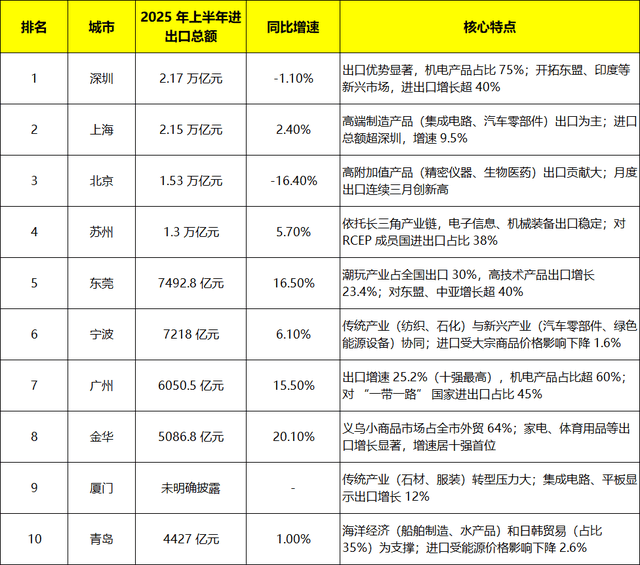
Core Insights - The top ten foreign trade cities in China for the first half of 2025 have been released, showcasing a stable position for leading cities while new contenders are emerging [1] Group 1: Trade Performance - Shenzhen ranks first with a total import and export value of 2.17 trillion yuan, accounting for 9.9% of the national foreign trade value, despite a slight decline of 1.1% year-on-year [2][3] - Shanghai follows closely with 2.15 trillion yuan, showing a year-on-year increase of 2.4%, with a notable 9.5% growth in imports [2][3] - Beijing's trade value is 1.53 trillion yuan, down 16.4% year-on-year, but it has seen three consecutive months of record-high exports [2][3] - Suzhou's trade reached 1.3 trillion yuan, growing by 5.7%, benefiting from the Yangtze River Delta industrial chain [2][3] Group 2: Sector Contributions - Dongguan's trade value is 749.28 billion yuan, with a significant year-on-year growth of 16.5%, driven by the trendy toy industry, which accounts for 30% of national exports [4][5] - Ningbo's trade reached 721.8 billion yuan, growing by 6.1%, with traditional industries collaborating with emerging sectors [4][5] - Guangzhou's trade value is 605.05 billion yuan, with the highest export growth rate of 25.2%, supported by machinery and electrical products [4][5] - Yiwu's trade reached 508.68 billion yuan, growing by 20.1%, with the small commodity market playing a crucial role [4][5] Group 3: Market Dynamics - The competition between Shenzhen and Shanghai for the top position is expected to continue, influenced by global demand recovery in the second half of the year [6] - The combined trade value of Shanghai, Suzhou, Ningbo, and Jinhua exceeds 4.7 trillion yuan, representing 21.6% of the national total [5][6] - Emerging markets are becoming the main growth drivers, with significant increases in trade with ASEAN and Central Asia [5][6]
悦达投资(600805.SH):乘“双碳”战略东风,筑“两新一智”转型发展新标杆
Xin Lang Cai Jing· 2025-08-07 01:57
Core Viewpoint - The company, Yueda Investment, is leading the transformation of state-owned enterprises through a "two new and one smart" development model, focusing on new energy, new materials, and intelligent upgrades, capitalizing on the opportunities presented by the "dual carbon" strategy and the acceleration of market-oriented reforms in the new energy sector [1][5]. Group 1: New Energy Business - Yueda Investment is well-prepared to capitalize on the new energy market, with the city of Yancheng projected to have 61% of its electricity from new energy sources by 2024, and a complete photovoltaic industry chain exceeding 90% [2]. - The company has successfully connected its first 378MW fish-solar complementary photovoltaic project to the grid in 2024, with plans for a 150MW project to be fully operational by August 2025 [2]. - The gross profit margin for the company's new energy power and heat sales business is 46.37%, significantly higher than traditional business margins, with a target of achieving 1-2GW of cumulative installed capacity over the next three years [2]. Group 2: Business Synergy - The company's growth is supported by the synergy between its traditional, new energy, and investment businesses, creating a unique competitive advantage [3]. - In addition to photovoltaic projects, Yueda Investment is expanding in wind and energy storage, with projects like the 49MW wind power project and a 160MW/320MWh shared energy storage project in collaboration with state-owned enterprises [3]. - The traditional textile business has seen significant improvements through digital transformation, with green product sales increasing by 66.8% for functional yarns and 59.9% for green cotton products in 2024 [3]. Group 3: Market Expansion and Investment - The company is extending its specialized vehicle business into the sanitation service sector, with 20 operational projects and a contract value of 250 million yuan in 2024 [4]. - Yueda Investment is actively developing its tractor business, with 17 new overseas dealers and a target of exporting 1,320 units in 2024 [4]. - The investment business is stable, with projected investment income and cash dividends exceeding 100 million yuan in 2024, contributing to the overall financial health of the company [4]. Group 4: Future Outlook - The collaboration between local government, state-owned enterprises, and listed companies enhances Yueda Investment's competitiveness in the new energy sector [5]. - The company is transitioning from a traditional industrial operator to a "green sustainable development company," leveraging Yancheng's complete new energy industry chain to drive growth in the dual carbon era [5].
山东:民营经济高质量发展突出贡献单位和个人受表彰
Zhong Guo Fa Zhan Wang· 2025-08-06 22:42
近年来,山东全省上下以习近平新时代中国特色社会主义思想为指导,深入学习贯彻习近平总书记关于 民营经济的重要论述,认真贯彻落实党中央、国务院决策部署和省委、省政府工作要求,优化民营经济 发展环境,提振民营企业发展信心,不断促进全省民营经济持续、健康、高质量发展。广大民营企业和 民营经济人士探索开拓、锐意进取,坚守主业、做强实业,在稳定增长、促进创新、增加就业、改善民 生等方面发挥了重要作用,成为山东发展不可替代的重要力量,为奋力开创新时代社会主义现代化强省 建设作出重大贡献,涌现出一大批突出贡献企业、突出贡献集体和突出贡献个人。 中国发展网讯 记者尹明波、高杨报道 经山东省委、省政府批准,省发展改革委、省工业和信息化厅日 前发布《关于表彰山东省民营经济高质量发展突出贡献奖获奖单位和人员的通报》,决定授予山东魏桥 创业集团有限公司等80 家企业"山东省民营经济高质量发展突出贡献企业"称号,授予省纪委监委第二 监督监察室等50个集体"山东省民营经济高质量发展突出贡献集体"称号,授予李登海等99名个人"山东 省民营经济高质量发展突出贡献个人"称号。 通报旨在表彰先进、树立典型,增强民营企业和民营经济人士的获得感、荣誉 ...
爱科农机、南通瑶华:上半年出口“一带一路”增势好
Sou Hu Cai Jing· 2025-08-06 05:42
本文由 AI 算法生成,仅作参考,不涉投资建议,使用风险自担 【上半年江苏对"一带一路"国家进出口1.39万亿,多家企业出口增长】今年上半年,江苏省对共建"一 带一路"国家进出口1.39万亿元,同比增长9.5%。 近日,爱科农业机械有限公司生产车间发动机产线全 速运转,一批约430万元的拖拉机将出口吉布提。该产线年产3万台发动机,有6 - 7种型号供海外客户选 择。 随着"一带一路"国家农业机械化需求增长,爱科农机出口市场拓宽。常州海关助力其成为AEO高 级认证企业,享优先通关等便利。今年1 - 6月,其对"一带一路"国家出口量占总出口量60%,同比增 15%。 江苏企业深耕"一带一路"市场,从"卖产品"到"建生态",纺织等产业出口规模增长。南通瑶华纤 维有限公司一批105吨棉短绒纸浆近日发往泰国。 该公司负责人称需提升通关效率稳定客源。如东海关 助力其用便利化措施,加快通关。今年1 - 6月,其出口"一带一路"国家货值超3400万元,同比增 82.43%。 ...
上半年江苏对共建“一带一路”国家进出口1.39万亿元 同比增长9.5%
Zheng Quan Shi Bao Wang· 2025-08-06 04:07
近日,走进爱科(常州)农业机械有限公司(以下简称"爱科农机")的生产车间,发动机产线正在全速运 转。一批货值约430万元的拖拉机即将出口吉布提。 "近年来市场竞争激烈,客户对发货时效性要求更高,在发展新客户时,我们需要提升货物出口的通关 效率来稳定客户源。"公司负责人鲍爱明表示,得益于口岸营商环境的提升,企业能够更好地应对风 险,如东海关助力企业综合运用"提前申报""抵港直装"等便利化措施,加快通关速度,保障交付周期的 同时降低了物流成本。今年1—6月份,该企业出口共建"一带一路"国家市场货值超3400万元,同比增长 82.43%。 "这条产线可年产3万台发动机,根据不同的排放标准,目前仅发动机就有6—7种型号可供海外客户选 择。"公司高级生产经理章海涛介绍道。随着共建"一带一路"国家市场对农业机械化需求的持续增长, 爱科农机的"出海路"也在不断拓宽,拖拉机和相关零配件成功在阿根廷、阿联酋等国家打开销路。 为助力企业更好地"走出去",南京海关所属常州海关加大技术性贸易壁垒应对力度,强化产业政策对 接,指导爱科农机成为海关AEO高级认证企业。成为AEO企业后,爱科农机享受到优先通关、减少查 验频次等便利化措施, ...