
贸易

Search documents
中信金属收盘上涨1.52%,滚动市盈率16.08倍,总市值426.79亿元
Jin Rong Jie· 2025-08-20 10:41
Group 1 - The core viewpoint of the articles highlights that CITIC Metal's stock price closed at 8.71 yuan, with a PE ratio of 16.08, marking a new low in 325 days, and a total market capitalization of 42.679 billion yuan [1] - CITIC Metal operates primarily in the trade of metals and mineral products, being the largest supplier of niobium products globally and holding an 80% market share in China's niobium market [1] - The company is positioned among the top copper concentrate trading enterprises in China, with future growth expected from investments in Las Bambas and Aifenhao, enhancing its market share and international influence in copper concentrate [1] Group 2 - As of the first quarter of 2025, only one institution holds shares in CITIC Metal, with a total of 747,100 shares valued at 0.06 million yuan [1] - The latest financial results for the first quarter of 2025 show CITIC Metal achieved a revenue of 28.249 billion yuan, a year-on-year increase of 5.28%, and a net profit of 571 million yuan, reflecting a significant year-on-year increase of 268.89% [1] - The sales gross margin for the company stands at 2.01% [1]

南京商旅收盘上涨6.64%,滚动市盈率121.64倍,总市值38.39亿元
Sou Hu Cai Jing· 2025-08-20 10:15
Group 1 - The core viewpoint of the articles highlights the performance and valuation of Nanjing Commercial Travel, with a current stock price of 12.36 yuan, up 6.64%, and a rolling PE ratio of 121.64, marking a new low in 23 days [1] - The total market capitalization of Nanjing Commercial Travel is 3.839 billion yuan, with the average industry PE ratio at 50.87 and the median at 41.36, placing the company at the 34th position in the industry ranking [1][2] - As of March 31, 2025, the number of shareholders for Nanjing Commercial Travel is 30,086, a decrease of 906 from the previous count, with an average holding value of 352,800 yuan and an average shareholding of 27,600 shares [1] Group 2 - The main business of Nanjing Commercial Travel includes commercial trade and tourism, with key products such as textiles, machinery, chemical raw materials, metal materials, non-metallic ores, tourism services, and general retail [1] - The latest quarterly report for Q1 2025 shows a revenue of 191 million yuan, a year-on-year decrease of 7.98%, and a net profit of 3.5138 million yuan, down 80.03%, with a sales gross margin of 22.30% [1]

中电港收盘下跌1.84%,滚动市盈率63.10倍,总市值170.60亿元
Jin Rong Jie· 2025-08-20 08:43
Company Overview - China Electric Port's closing price on August 20 was 22.45 CNY, down 1.84%, with a rolling PE ratio of 63.10 times and a total market value of 17.06 billion CNY [1] - The company operates in the electronic components distribution sector, providing design chain services, supply chain collaboration, and industrial data services, with main products including memory, processors, analog devices, and RF/wireless connections [1] Financial Performance - For Q1 2025, the company reported revenue of 17.47 billion CNY, a year-on-year increase of 49.01%, and a net profit of 84.56 million CNY, up 64.99%, with a gross profit margin of 2.66% [1] Shareholder Information - As of August 10, 2025, the number of shareholders for China Electric Port was 85,119, a decrease of 2,803 from the previous count, with an average holding value of 352,800 CNY and an average shareholding of 27,600 shares [1] Industry Comparison - The average PE ratio for the trade industry is 50.87 times, with a median of 41.36 times, placing China Electric Port at the 29th position within the industry [2] - The company's static PE ratio is 71.97 times, and its price-to-book ratio is 3.21 times [2]
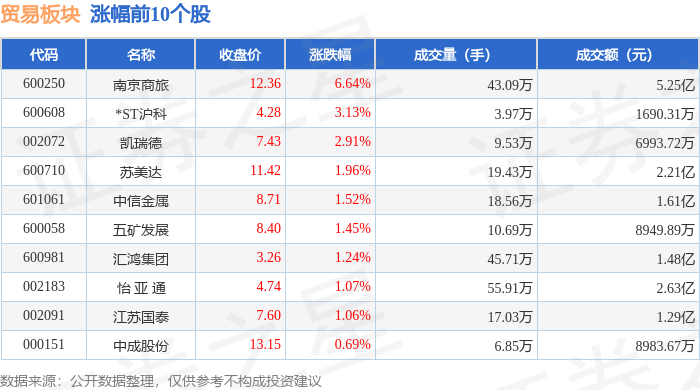
贸易板块8月20日涨1.5%,南京商旅领涨,主力资金净流入3127.91万元
Zheng Xing Xing Ye Ri Bao· 2025-08-20 08:41
Group 1 - The trade sector increased by 1.5% on August 20, with Nanjing Shanglv leading the gains [1] - The Shanghai Composite Index closed at 3766.21, up 1.04%, while the Shenzhen Component Index closed at 11926.74, up 0.89% [1] - Nanjing Shanglv's stock price rose by 6.64% to 12.36, with a trading volume of 430,900 shares and a transaction value of 525 million yuan [1] Group 2 - The net inflow of main funds in the trade sector was 31.28 million yuan, while retail funds experienced a net outflow of 6.83 million yuan [1] - Nanjing Shanglv had a main fund net inflow of 42.36 million yuan, accounting for 8.07% of its total [2] - The stock of *ST PA saw a 3.13% increase, with a trading volume of 39,700 shares and a transaction value of 16.90 million yuan [1]

苏豪弘业涨0.00%,成交额7762.99万元,近5日主力净流入-1767.08万
Xin Lang Cai Jing· 2025-08-20 07:26
8月20日,苏豪弘业涨0.00%,成交额7762.99万元,换手率2.89%,总市值26.95亿元。 异动分析 期货概念+知识产权保护+跨境电商+创投+化肥 1、公司是弘业期货第二大股东,持股16.31%;弘业期货已在中国香港联交所主板上市。 2、公司控股子公司江苏爱涛文化产业有限公司参股江苏文化产权交易所有限公司,目前持有其28%的 股权。 3、根据2024年年报:依托亚马逊等平台开展出口零售,通过"HollyHOME""DOEWORKS"等自有品 牌,实现终端消费者直连,利润源自商品差价扣除成本及费用。 4、公司投资1200万持有江苏弘瑞科技投资公司24%的股份。弘瑞科技是江苏省第一家投向生物医药领 域创投公司(基金)。 5、子公司江苏省化肥工业有限公司注册的"苏化"牌肥料,在苏北拥有生产基地,产品广受农民好评。 公司广泛地为省内各氮肥、磷肥、复合肥生产企业提供生产原辅材料、备品备件及销售产品。 来源:新浪证券-红岸工作室 区间今日近3日近5日近10日近20日主力净流入-878.88万-937.08万-1767.08万-1036.44万-6075.57万 主力持仓 主力没有控盘,筹码分布非常分散,主力成交 ...

2.58万亿元,内地城市首位!
Shen Zhen Shang Bao· 2025-08-20 06:28
Core Insights - Shenzhen's foreign trade has shown resilience in 2023, with total imports and exports reaching 2.58 trillion yuan in the first seven months, maintaining the same level as the previous year and ranking first among mainland cities in foreign trade [1] - In July alone, Shenzhen's total trade value was 415.94 billion yuan, marking a 6.2% increase, with exports hitting a record monthly high of 255.62 billion yuan, up 4.7% [1] - The main trade method remains general trade, accounting for 54.9% of total trade value, while bonded logistics and processing trade also contributed significantly [1] Trade Performance - Exports of mechanical and electrical products reached 1.17 trillion yuan, growing by 4.4% and representing 74.7% of total exports [2] - Key traditional electronic consumer products, such as computers and audio-video equipment, saw exports of 179.51 billion yuan and 50.27 billion yuan, respectively, with growth rates of 10.8% and 5.5% [2] - Strategic emerging industries, including lithium batteries and pure electric passenger vehicles, experienced substantial export growth of 37.9% and 21.7% [2] Import Dynamics - Imports of mechanical and electrical products totaled 836.56 billion yuan, increasing by 14.7% and making up 82.1% of total imports [2] - Integrated circuits were a significant import category, amounting to 454.69 billion yuan with a growth of 19.6% [2] - Imports of computer components, primarily graphics cards and servers, surged by 47.8%, totaling 184.4 billion yuan [2] Market Diversification - Shenzhen has made progress in diversifying its markets, with trade to Hong Kong, Taiwan, the EU, South Korea, and Japan collectively reaching 1.22 trillion yuan, a 10% increase, accounting for 47.2% of total trade [1] - Private enterprises remain the backbone of Shenzhen's foreign trade, with a total import and export value of 1.8 trillion yuan, representing 69.8% of the total [1]
湛江鑫鸿昇贸易有限公司成立 注册资本10万人民币
Sou Hu Cai Jing· 2025-08-20 05:17
天眼查App显示,近日,湛江鑫鸿昇贸易有限公司成立,法定代表人为陈俊宇,注册资本10万人民币, 经营范围为(仅销售预包装食品)(仅销售预包装食品)食品销售食品互联网销售许可项目:食品销 售;酒类经营;烟草制品零售;食品互联网销售。(依法须经批准的项目,经相关部门批准后方可开展 经营活动,具体经营项目以相关部门批准文件或许可证件为准)一般项目:食品销售(仅销售预包装食 品);食品互联网销售(仅销售预包装食品);初级农产品收购;食用农产品批发;食用农产品零售; 日用品批发;日用品销售;日用百货销售;日用杂品销售;农副产品销售;新鲜蔬菜零售;新鲜水果零 售;新鲜蔬菜批发;互联网销售(除销售需要许可的商品);保健食品(预包装)销售;技术服务、技 术开发、技术咨询、技术交流、技术转让、技术推广;鞋帽零售;鞋帽批发;服装服饰零售;专业设计 服务;五金产品零售;办公设备销售;办公设备耗材销售。(除依法须经批准的项目外,凭营业执照依 法自主开展经营活动)。 ...
美国扩大钢铝关税范围 贸易商措手不及
Sou Hu Cai Jing· 2025-08-20 04:10
Core Viewpoint - The U.S. Department of Commerce has unexpectedly added 407 products to its list of steel and aluminum derivative products subject to a 50% tariff, impacting various industries and trade operations [1][4]. Group 1: Scope and Impact - The newly added products include wind turbines and components, mobile cranes, bulldozers, rail vehicles, furniture, compressors, and pumps, among hundreds of others [4]. - The announcement took effect on August 18, with many traders caught off guard due to the lack of prior notification, affecting ongoing shipments [4]. - The new tariffs are expected to increase the overall effective tariff rate in the U.S. by approximately 1 percentage point, impacting over $200 billion in imports from the previous year [5]. Group 2: Strategic Changes and Compliance Burden - The inclusion of a wide range of products indicates a strategic shift in the regulatory approach to steel and aluminum derivatives, with implications for compliance and supply chain management [5]. - Companies will now need to provide detailed information regarding the weight of aluminum, customs value percentages, and the countries of casting/smelting, significantly increasing compliance burdens [5]. - The total value of goods affected by metal tariffs is estimated to reach around $328 billion, potentially exacerbating inflationary pressures on already rising prices [5].
商务部研究院的培训,涉及出口管制、跨境AML
制裁名单· 2025-08-20 01:56
Core Viewpoint - The article announces a specialized training program on export control and cross-border anti-money laundering compliance, aimed at helping enterprises enhance their risk identification and prevention capabilities in a complex global regulatory environment [2][3]. Training Content - **Export Control and Economic Sanctions** - Review of global export control and economic sanctions hotspots, analysis of the current situation, and future trends [2] - Overview of China's Export Control Law, including its jurisdiction, measures, and legal responsibilities [2] - Introduction to international export control mechanisms such as the Wassenaar Arrangement and Nuclear Suppliers Group [3] - Study of export control policies from the US and EU, including EAR, ITAR, and OFAC sanctions, and their impact on China [3] - Analysis of secondary sanctions case studies and response strategies [3] - Practical construction of export control compliance systems, including risk assessment, internal controls, training, and auditing mechanisms [3] - **Cross-Border Anti-Money Laundering and Counter-Terrorism Financing** - Analysis of the new Anti-Money Laundering Law and FATF's fifth round of international evaluation standards, focusing on the obligations of financial institutions and enterprises [3] - Practical operations for customer due diligence and transaction monitoring, including identity verification and reporting of large and suspicious transactions [3] - Screening for sanction risks and list management through compliance tools, establishing monitoring and updating mechanisms [3] - Case studies on cross-border transaction risks related to anti-money laundering and sanctions [3] - **Coordinated Compliance for Export Control and Anti-Money Laundering** - Building collaborative mechanisms and policy linkages, including regulatory agency cooperation models and dual-track compliance frameworks for enterprises [4] - Information sharing and technological integration for tracking cross-border funds and logistics, and upgrading list management systems [4] - Practical collaborative models and experiences, such as cooperation modes at the China-Vietnam border and high-risk country management in the EU [4] Target Audience - The training is aimed at personnel from local commerce bureaus, economic cooperation bureaus, financial regulatory bureaus, the People's Bank, foreign exchange administration, and related staff from free trade zones and border cooperation zones [5] - It also targets compliance, legal, risk management, international business, and card center staff from financial institutions, as well as relevant personnel from manufacturing and trading enterprises, trade associations, law firms, accounting firms, and consulting companies [5] Fees and Other Information - The training fee is set at 5,980 yuan per person, which includes teaching, materials, and venue costs [5] - Accommodation is arranged according to the Ministry of Finance's standards, with costs borne by participants [5] - Registration details and payment instructions are provided, with a deadline for registration [6]
中信金属收盘下跌1.38%,滚动市盈率15.84倍,总市值420.42亿元
Jin Rong Jie· 2025-08-19 11:02
Group 1 - The core viewpoint of the articles highlights the performance and market position of Zhongxin Metal, which closed at 8.58 yuan with a PE ratio of 15.84 times, significantly lower than the industry average of 49.11 times [1][2] - Zhongxin Metal's total market capitalization is 42.042 billion yuan, ranking 16th in the trade industry based on PE ratio [1][2] - The company specializes in the trade of metals and mineral products, being the largest supplier of niobium products in China with an 80% market share [1] Group 2 - As of the first quarter of 2025, only one institution holds shares in Zhongxin Metal, with a total of 747,100 shares valued at 0.06 million yuan [1] - The latest financial report for the first quarter of 2025 shows a revenue of 28.249 billion yuan, a year-on-year increase of 5.28%, and a net profit of 571 million yuan, reflecting a significant year-on-year increase of 268.89% [1] - The company's gross profit margin stands at 2.01% [1]