
纺织品服装

Search documents
A股突发!600735,被证监会立案!明起停牌
Zhong Guo Ji Jin Bao· 2026-02-25 13:45
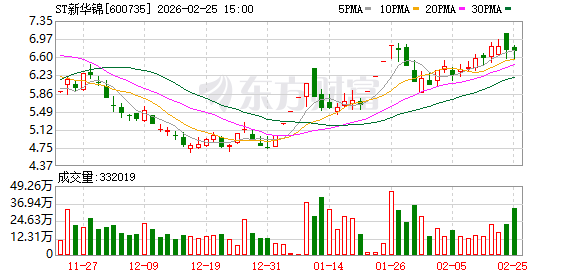
Core Viewpoint - ST Xinhua Jin and its actual controller Zhang Jianhua are under investigation by the China Securities Regulatory Commission (CSRC) for suspected violations of information disclosure laws, leading to a suspension of trading for the company's stock starting February 26, 2026, for a period not exceeding two months [2][4][10]. Group 1: Investigation and Compliance Issues - The CSRC issued a notice of investigation to ST Xinhua Jin and Zhang Jianhua on February 25, 2026, due to suspected violations of information disclosure laws [4]. - The company has been under scrutiny since January 21, 2026, when it received a regulatory letter from the Shanghai Stock Exchange regarding the bankruptcy restructuring of its controlling shareholder [4][6]. - The ongoing investigation highlights the compliance risks faced by ST Xinhua Jin, which have now become a significant concern for investors [3]. Group 2: Financial Performance and Risks - ST Xinhua Jin reported a revenue of 1.637 billion yuan for 2024, a decrease of 30.97% year-on-year, and a net loss of 134 million yuan, marking the end of several years of profitability [7]. - The company anticipates a net loss of between 95 million yuan and 142 million yuan for 2025, primarily due to asset impairment tests and provisions for goodwill and inventory [9]. - As of February 25, 2026, the company confirmed that it had not recovered 406 million yuan of non-operating funds occupied by its controlling shareholder and related parties, which represents 33% of the company's net assets [10]. Group 3: Stock Suspension and Potential Delisting - The Shanghai Stock Exchange has mandated a trading suspension for ST Xinhua Jin due to the overdue rectification of the occupied funds, which poses a direct threat to the company's listing status [10][11]. - If the company fails to rectify the fund occupation within the two-month suspension period, it will face a risk warning upon resuming trading, and further non-compliance could lead to delisting [11]. - As of the last trading day before the suspension, ST Xinhua Jin's stock was priced at 6.73 yuan per share, with a total market capitalization of 2.886 billion yuan [12].


加纳提议构建对美贸易投资合作框架 呼吁关税灵活与差异化待遇
Shang Wu Bu Wang Zhan· 2026-01-13 15:21
Core Viewpoint - Ghana has proposed a structured trade and investment cooperation framework to enhance bilateral trade, promote export growth, and attract more U.S. investments into key sectors of the Ghanaian economy [1]. Group 1: Trade and Investment Framework - The initiative was announced following high-level talks between Ghana's Minister of Trade and Industry, Elizabeth Ofosu-Agyare, Ghana's Ambassador to the U.S., Victor Smith, and U.S. Trade Representative, Jamieson Greer [1]. - The discussions focused on Ghana's efforts to deepen economic cooperation with the U.S., emphasizing the establishment of a framework to support export growth and attract U.S. investments in critical economic sectors [1]. Group 2: Tariff Flexibility and AGOA - The meeting assessed the impact of recent U.S. tariff measures on Ghana's market access under the African Growth and Opportunity Act (AGOA) and discussed subsequent negotiations regarding the renewal of the AGOA program [1]. - Ghana highlighted the need for tariff flexibility and differentiated treatment to support industrial growth, value addition, and job creation, particularly in key sectors such as textiles, apparel, and cocoa processing [1]. Group 3: Strategic Position in AfCFTA - The discussions underscored Ghana's strategic position within the African Continental Free Trade Area (AfCFTA) and how this agreement could position Ghana as a key gateway for deepening U.S.-Africa commercial relations [1][2].
PTA存在去库预期
Qi Huo Ri Bao· 2025-12-24 23:31
Group 1: Market Overview - PTA futures have shown strong performance, with the main contract rising to around 5000 yuan/ton, driven by expectations of an optimized supply-demand structure in the polyester industry chain for 2026 [1] - The market sentiment is turning bullish towards the end of the year due to the anticipated supply-demand dynamics [1] Group 2: Supply Dynamics - In 2026, there will be a production vacuum for PTA with no new capacity additions, allowing for potential recovery in processing fees [1] - The PX market is expected to face tight supply in the first half of next year due to no new capacity and seasonal maintenance in Q2, which may strengthen processing fees for both PX and PTA [1] - As of the end of 2025, the total capacity of mainstream PTA facilities is approximately 93.25 million tons, with an average capacity utilization rate of about 78%, a decrease of 2 percentage points compared to the same period last year [1] Group 3: Demand Dynamics - Domestic textile and apparel exports have been affected by US-China trade tensions, with a 1.6% year-on-year decline in export value from January to October this year [2] - Textile yarn exports have seen a slight increase of 0.9%, while clothing and accessories exports have decreased by 3.8%, indicating a widening decline [2] - Domestic demand for textiles and apparel is expected to grow steadily, with conservative operational attitudes in the weaving sector and low inventory levels [2] Group 4: Future Outlook - The PTA market is projected to maintain a dual increase in supply and demand in 2026, with demand growth expected to outpace supply growth, leading to continued inventory depletion [2] - It is anticipated that the processing fees for PTA will rebound in 2026, ranging between 100 to 400 yuan/ton, while the main PTA futures contract price is expected to operate between 4400 to 6000 yuan/ton, with opportunities to buy on dips around 4500 yuan/ton in the first half of the year [2]
棉花周报(10.20-10.24)-20251027
Da Yue Qi Huo· 2025-10-27 05:44
Report Summary 1. Report Industry Investment Rating No information is provided in the report regarding the industry investment rating. 2. Core Viewpoints - This week, cotton continued to fluctuate and rebound. The previous price was oversold, and with the new cotton coming onto the market and China - US negotiations in progress, the bearish sentiment has eased [4]. - Currently, new cotton is about to be listed in large quantities. The previous bearish news has been gradually digested, and the purchase price of seed cotton has slightly increased. The futures main contract 01 continued to fluctuate and rebound [5]. - Bullish factors include a slight increase in the purchase price of seed cotton and a year - on - year decrease in commercial inventory [6]. - Bearish factors include ongoing trade negotiations, high export tariffs to the US, a decline in overall foreign trade orders, increased inventory, the upcoming large - scale listing of new cotton, and weak consumption during the "Golden September and Silver October" period [7]. 3. Summary by Directory 3.1 Previous Day Review - This week, cotton continued to fluctuate and rebound. The national cotton output is expected to be 728000 tons, with Xinjiang hitting a new high. According to the ICAC September report, the output and consumption in the 2025/2026 season are both 25.5 million tons. The USDA September report shows that the output in the 2025/2026 season is 25.622 million tons, consumption is 25.872 million tons, and the ending inventory is 15.925 million tons. In September, textile and clothing exports were $24.42 billion, a year - on - year decrease of 1.4%. China's cotton imports in September were 100000 tons, a year - on - year decrease of 18.7%; cotton yarn imports were 130000 tons, a year - on - year increase of 18.18%. According to the Ministry of Agriculture's October forecast for the 2025/2026 season, the output is 6.36 million tons, imports are 1.4 million tons, consumption is 7.4 million tons, and the ending inventory is 8.22 million tons [4]. 3.2 Daily Tips - New cotton is about to be listed in large quantities, and the previous bearish news has been gradually digested. The purchase price of seed cotton has slightly increased, and the futures main contract 01 continued to fluctuate and rebound [5]. 3.3 Today's Focus - Bullish factors: a slight increase in the purchase price of seed cotton and a year - on - year decrease in commercial inventory [6]. - Bearish factors: ongoing trade negotiations, high export tariffs to the US, a decline in overall foreign trade orders, increased inventory, the upcoming large - scale listing of new cotton, and weak consumption during the "Golden September and Silver October" period [7]. 3.4 Fundamental Data - **USDA Global Production and Sales Forecast (September)**: In the 2025/2026 season, the total global cotton output is expected to be 25.622 million tons, consumption is 25.872 million tons, and the ending inventory is 15.925 million tons. Different countries have different production, consumption, import, and inventory trends [13][14]. - **ICAC Global Cotton Supply - Demand Balance Sheet**: In the 2025/2026 season, the global output is 2.59 million tons, an increase of 40000 tons (+1.6%); consumption is 2.56 million tons, basically flat; the ending inventory is 1.71 million tons, an increase of 26000 tons (+1.6%); the global trade volume is 970000 tons, an increase of 36000 tons (+3.9%) [15]. - **Ministry of Agriculture's Forecast for the 2025/2026 Season**: The output is 6.36 million tons, imports are 1.4 million tons, consumption is 7.4 million tons, and the ending inventory is 8.22 million tons [4]. 3.5 Position Data No information is provided in the report regarding position data.
棉花周报(9.8-9.12)-20250915
Da Yue Qi Huo· 2025-09-15 05:33
Report Industry Investment Rating No relevant information provided. Core View of the Report - Cotton prices weakened in a volatile manner this week, with the main contract oscillating below 14,000. The start of the "Golden September" was not ideal, leading to a decline in market confidence. There are significant differences in the market during the "Golden September and Silver October" peak season, and the textile and clothing export data in August was not satisfactory. With new cotton about to be listed, the hedging pressure has increased [5][6]. - There are both positive and negative factors in the market. Positive factors include a reduction in previous Sino - US mutual tariffs and a year - on - year decrease in commercial inventory, along with an enhanced expectation for the consumption peak season of "Golden September and Silver October". Negative factors include the postponement of trade negotiations, high current export tariffs to the US, a general decline in foreign trade orders, increased inventory, and the upcoming large - scale listing of new cotton [7]. Summary by Directory 1. Previous Day's Review - Cotton prices weakened in a volatile manner this week, with the main contract oscillating below 14,000. The start of the "Golden September" was not ideal, leading to a decline in market confidence. The ICAC September report predicted a 2025/26 annual output of 25.5 million tons and consumption of 25.5 million tons. The USDA September report predicted a 2025/26 annual output of 25.622 million tons, consumption of 25.872 million tons, and an ending inventory of 15.925 million tons. In August, textile and clothing exports were $26.54 billion, a year - on - year decrease of 5%. In July, China imported 50,000 tons of cotton, a year - on - year decrease of 73.2%, and 110,000 tons of cotton yarn, a year - on - year increase of 15.38%. The Ministry of Agriculture predicted a 2025/26 annual output of 6.25 million tons, imports of 1.4 million tons, consumption of 7.4 million tons, and an ending inventory of 8.23 million tons [5]. 2. Daily Prompt - During the "Golden September and Silver October" peak season, there are significant differences in the market. The textile and clothing export data in August was not satisfactory. New cotton is about to be listed, increasing the hedging pressure. The main 01 contract fell below 14,000, oscillating within the range of 13,800 - 14,000 during the day [6]. 3. Today's Focus No relevant information provided. 4. Fundamental Data - **USDA Global Supply and Demand Forecast (September)**: In 2025/26, the total global output is expected to be 25.622 million tons, with a month - on - month increase of 230,000 tons; consumption is expected to be 25.872 million tons, with a month - on - month increase of 184,000 tons; and the ending inventory is expected to be 15.925 million tons, with a month - on - month decrease of 168,000 tons [10][11]. - **ICAC Global Cotton Supply and Demand Balance Sheet**: In the 2025/26 annual, the global output is 2.59 million tons, a year - on - year increase of 40,000 tons (+1.6%); consumption is 2.56 million tons, basically unchanged; the ending inventory is 1.71 million tons, a year - on - year increase of 26,000 tons (+1.6%); and the global trade volume is 970,000 tons, a year - on - year increase of 36,000 tons (+3.9%) [12]. - **Ministry of Agriculture Data**: In 2025/26, the output is 6.25 million tons, imports are 1.4 million tons, consumption is 7.4 million tons, and the ending inventory is 8.23 million tons. The average domestic cotton 3128B price is expected to be in the range of 15,000 - 17,000 yuan/ton, and the Cotlook A index is expected to be in the range of 75 - 100 cents/pound [14]. 5. Position Data No relevant information provided.
棉花周报(9.1-9.5)-20250908
Da Yue Qi Huo· 2025-09-08 02:43
Report Industry Investment Rating No relevant content provided. Core Viewpoints - This week, the main cotton contract 01 fluctuated around 14,000. With the arrival of the "Golden September and Silver October" peak season, there are significant market differences. New cotton is about to be listed, increasing hedging pressure, and the main 01 contract will continue to fluctuate around 14,000. [5][6] - There are both positive and negative factors in the market. Positive factors include the reduction of previous mutual tariffs between China and the US, a year - on - year decrease in commercial inventory, and increased expectations for the "Golden September and Silver October" consumption peak season. Negative factors are the postponement of trade negotiations, currently high export tariffs to the US, an overall decline in foreign trade orders, increased inventory, and the upcoming large - scale listing of new cotton. [7] Summary by Directory 1. Previous Day Review (This part may be mis - named as "Previous Day" but actually contains weekly review) - The main cotton contract 01 fluctuated around 14,000 this week. [5] - ICAC September report: In the 2025/26 season, global cotton production is 25.5 million tons, and consumption is 25.5 million tons. USDA August report: In the 2025/26 season, production is 25.392 million tons, consumption is 25.688 million tons, and the ending inventory is 16.093 million tons. [5] - In July, textile and clothing exports were $26.77 billion, a year - on - year decrease of 0.1%. In July, China imported 50,000 tons of cotton, a year - on - year decrease of 73.2%, and imported 110,000 tons of cotton yarn, a year - on - year increase of 15.38%. [5] - The Ministry of Agriculture's August forecast for the 2025/26 season: production is 6.25 million tons, imports are 1.4 million tons, consumption is 7.4 million tons, and the ending inventory is 8.23 million tons. [5] 2. Daily Hints No relevant content provided. 3. Today's Focus No relevant content provided. 4. Fundamental Data - **USDA Global Cotton Supply, Demand, and Inventory Forecast (August)**: - Production: The total global production in August 2024/25 is 25.392 million tons, a month - on - month decrease of 391,000 tons and a year - on - year decrease of 2% or 551,000 tons. [12] - Consumption: The total global consumption in August 2024/25 is 25.688 million tons, a month - on - month decrease of 30,000 tons and a year - on - year increase of 0.4% or 60,000 tons. [12] - Imports: The total global imports in August 2024/25 are 9.489 million tons, a month - on - month decrease of 239,000 tons and a year - on - year increase of 2% or 193,000 tons. [13] - Exports: The total global exports in August 2024/25 are 9.489 million tons (same as imports in the balance). [13] - Ending Inventory: The total global ending inventory in August 2024/25 is 16.093 million tons, a month - on - month decrease of 742,000 tons and a year - on - year decrease of 2.4% or 247,000 tons. [13] - **Global Cotton Supply and Demand Balance Sheet (ICAC) for 2025/26**: - Global production is 2.59 million tons, an increase of 400,000 tons (+1.6%) year - on - year, mainly due to increased production in Brazil and stable planting areas in the Northern Hemisphere. [14] - Global consumption is 2.56 million tons, basically unchanged year - on - year. China's consumption accounts for 32% (8.2 million tons), and India's cotton - planting area accounts for 38% of the world's. [14] - Ending inventory is 1.71 million tons, an increase of 260,000 tons (+1.6%) year - on - year. The inventory - to - consumption ratio rises to 66.8%, indicating a loose supply. [14] - Global trade volume is 970,000 tons, an increase of 36,000 tons (+3.9%) year - on - year. Major exporters are Brazil (32% share) and the US (3.18 million tons), and major importers are Bangladesh (19% share). China relies on Brazilian cotton to ease trade frictions. [14] - The price forecast (Cotlook A Index) is 57 - 94 cents per pound (median 73 cents), with a narrower year - on - year fluctuation, reflecting the expected supply - demand balance. [14] - **China's Cotton Supply and Demand Forecast (Ministry of Agriculture) for 2025/26**: - Beginning inventory is 8.01 million tons, production is 6.25 million tons, imports are 1.4 million tons, consumption is 7.4 million tons, and ending inventory is 8.23 million tons. [16] - The average domestic cotton 3128B price is expected to be in the range of 15,000 - 17,000 yuan per ton, and the Cotlook A Index is expected to be in the range of 75 - 100 cents per pound. [16] 5. Position Data No relevant content provided.
狂砸138亿资金!百亿市值公司豪掷炒股理财!募投项目说停就停,股民:冲动是魔鬼,主业不香了?
雪球· 2025-08-24 01:51
Core Viewpoint - Jiangsu Guotai announced a massive investment plan totaling 138.3 billion RMB, which exceeds the company's total market value of 124 billion RMB, raising concerns among investors about the aggressive financial strategy [1][2][16]. Group 1: Investment Plans - The company plans to invest up to 120 billion RMB in entrusted wealth management and up to 18.3 billion RMB in securities investment, totaling 138.3 billion RMB [1][3][7]. - The securities investment will include various types such as new stock subscriptions, stock repurchases, and bond investments, with a specific allocation of 15 billion RMB for establishing a subsidiary dedicated to securities investment [5][7]. - The company aims to enhance the efficiency and effectiveness of idle funds while ensuring that daily operational needs are met [3][6]. Group 2: Project Termination - On the same day, Jiangsu Guotai announced the termination of a project to build a 400,000-ton lithium-ion battery electrolyte production facility, citing external conditions and intense market competition as reasons [9][11]. - The project had not yet commenced construction, and the company stated that this termination would not significantly impact its normal operations or current profits [11]. Group 3: Historical Performance and Market Context - Jiangsu Guotai's historical performance in securities investment has been poor, with cumulative losses exceeding 200 million RMB over the past two and a half years [14]. - Despite having ample funds, the company's aggressive investment strategy in the current bull market is seen as unusual, especially given the scale of the planned investments compared to its market value [16][14]. - The company’s core revenue still heavily relies on its textile and apparel business, which accounts for over 80% of its income [13].


江苏国泰拟138亿元“闲钱”投资理财 公司总市值仅124亿元
Jing Ji Guan Cha Wang· 2025-08-24 01:22
Group 1 - Jiangsu Guotai plans to use up to 12 billion yuan of idle funds for entrusted wealth management and up to 1.831 billion yuan for securities investment, totaling over 13.8 billion yuan [1] - The company aims to improve the efficiency and effectiveness of idle funds while ensuring daily operational needs are met [1] - The types of entrusted wealth management products include structured deposits, income certificates, large deposits, and reverse repos [1] Group 2 - In the first half of 2025, Jiangsu Guotai achieved revenue of approximately 18.597 billion yuan, a year-on-year increase of 5.48%, and a net profit of 545 million yuan, up 10.85% [2] - The company’s main businesses include supply chain services and chemical new energy, with textile and apparel revenue accounting for 84.96% of total revenue [2] - Jiangsu Guotai's subsidiary, RuTai New Materials, has a strong market position in the electrolyte industry and collaborates with major battery manufacturers [2] Group 3 - Jiangsu Guotai announced the termination of a planned investment in a 400,000-ton lithium-ion battery electrolyte project due to external conditions and industry changes [3] - The project, initially approved in December 2021 with a total investment of 1.54 billion yuan, was deemed unfeasible due to overcapacity and declining profitability in the electrolyte market [3] - The company is actively coordinating with the government regarding the land for the project [3]
南京商旅收盘上涨6.64%,滚动市盈率121.64倍,总市值38.39亿元
Sou Hu Cai Jing· 2025-08-20 10:15
Group 1 - The core viewpoint of the articles highlights the performance and valuation of Nanjing Commercial Travel, with a current stock price of 12.36 yuan, up 6.64%, and a rolling PE ratio of 121.64, marking a new low in 23 days [1] - The total market capitalization of Nanjing Commercial Travel is 3.839 billion yuan, with the average industry PE ratio at 50.87 and the median at 41.36, placing the company at the 34th position in the industry ranking [1][2] - As of March 31, 2025, the number of shareholders for Nanjing Commercial Travel is 30,086, a decrease of 906 from the previous count, with an average holding value of 352,800 yuan and an average shareholding of 27,600 shares [1] Group 2 - The main business of Nanjing Commercial Travel includes commercial trade and tourism, with key products such as textiles, machinery, chemical raw materials, metal materials, non-metallic ores, tourism services, and general retail [1] - The latest quarterly report for Q1 2025 shows a revenue of 191 million yuan, a year-on-year decrease of 7.98%, and a net profit of 3.5138 million yuan, down 80.03%, with a sales gross margin of 22.30% [1]

上半年我国纺织行业运行态势基本平稳
Zhong Guo Chan Ye Jing Ji Xin Xi Wang· 2025-08-18 00:48
Core Viewpoint - The textile industry in China is experiencing stable growth in the first half of the year, supported by a robust domestic demand market, despite facing challenges in exports and profitability [1][5]. Group 1: Industry Performance - The textile and chemical fiber industries' capacity utilization rates are 77.8% and 86%, respectively, higher than the national industrial average [1]. - The industrial added value of large-scale textile enterprises grew by 3.1% year-on-year, although the growth rate slowed by 1.5 percentage points compared to the previous year [1]. - Nine out of fifteen major textile product categories reported year-on-year production growth [1]. Group 2: Domestic Sales - The per capita clothing consumption expenditure of residents increased by 2.1% year-on-year, with a growth acceleration of 0.9 percentage points compared to the first quarter [2]. - Retail sales of clothing, shoes, and textile products in large retail enterprises grew by 3.1% year-on-year, an increase of 1.8 percentage points from the previous year [2]. - Online sales of clothing-related products rose by 1.4% year-on-year, surpassing the first quarter's growth rate of 1.5% [2]. Group 3: Export Performance - The total export value of textiles and clothing reached $143.98 billion, a year-on-year increase of 0.8% [3]. - Exports of intermediate products like chemical fiber and textile yarns grew by 1.8%, while clothing exports decreased by 0.2% to $73.46 billion due to weak overseas demand and tariff policies [3]. - Exports to the U.S. saw a decline of 5.3% year-on-year, while exports to markets like the EU, UK, South Korea, Canada, Pakistan, Chile, and Nigeria showed good growth [3]. Group 4: Investment and Profitability - Fixed asset investment in the textile, clothing, and chemical fiber industries grew by 14.5%, 27%, and 10.6% year-on-year, respectively, with acceleration in growth rates compared to the previous year [4]. - Revenue for large-scale textile enterprises decreased by 3% year-on-year, and total profits fell by 9.4% [4]. - The profit margin for large textile enterprises was 3%, down by 0.2 percentage points from the previous year, with asset turnover rates slowing due to inventory fluctuations [4]. Group 5: Future Outlook - The textile industry faces numerous uncertainties in the second half of the year, but the expanding domestic market is expected to drive high-quality development [5]. - The integration of cultural, health, and green consumption trends with the textile industry is anticipated to enhance the supply system's upgrade [5].