
网约车

Search documents
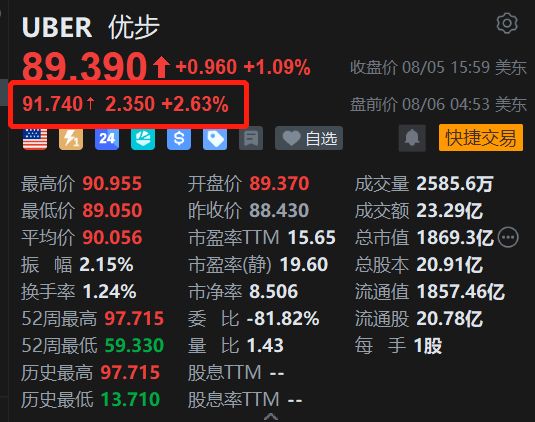
美股异动|优步盘前涨2.6% 即将公布Q2财报
Ge Long Hui· 2025-08-06 09:05
优步(UBER.US)美股盘前涨2.6%。消息上,优步计划在周三(今日)市场开盘前公布第二季度业绩。有机 构预计公司营收124.7亿美元入,高于去年同期的107亿美元;净利润13.4亿美元,而去年同期为10.2亿 美元。(格隆汇) | UBER 优步 | | | | --- | --- | --- | | 390 + +0.960 +1.09% | | 收盘价 08/05 15:59 美东 | | 91.740 + 2.350 +2.63% | | 盘前价 08/06 04:53 美东 | | 三 7 24 字 S 9 日 ♥ 白选 | | ● 快捷交易 | | 最高价 90.955 | 开盘价 89.370 | 成交量 2585.6万 | | 最低价 89.050 | 昨收价 88.430 | 成交额 23.29亿 | | 平均价 90.056 | 市盈率TTM 15.65 | 总市值 1869.3亿 (--) | | 振 幅 2.15% | 市盈率(静) 19.60 | 总股本 20.91亿 | | 换手率 1.24% | 市净率 8.506 | 流通值 1857.46亿 | | 52周最高 97.715 ...


高盛预警:电商外卖拖累,中国互联网巨头利润或现2022年二季度来首降
3 6 Ke· 2025-08-06 06:10
Core Insights - The focus of the upcoming Q2 earnings reports for Chinese internet giants will be on AI and food delivery services, with expectations of a mixed performance across companies [1][2] - Goldman Sachs predicts a 10% year-over-year decline in overall profits for the sector, marking the first drop since Q2 2022, primarily due to e-commerce and local service platform pressures [1][3] AI Cloud Business Growth - The AI cloud business is expected to see significant acceleration in growth, with Alibaba Cloud's revenue growth forecasted to increase from 18% in Q1 to 23% in Q2, although still below Google Cloud's 32% and Microsoft Azure's 39% [3] - This growth is driven by a surge in AI inference demand, with ByteDance processing 15 trillion tokens daily in June, compared to Alibaba's 4-5 trillion [3] - Major tech firms showcased advancements in AI at the World Artificial Intelligence Conference, which are anticipated to translate into revenue growth in the latter half of the year [3] Impact of Food Delivery Competition - Intense competition in the food delivery market is significantly impacting platform profits, with Alibaba's EBITA expected to decline by 16%, and Meituan and JD's EBIT forecasted to drop by 58% and 70%, respectively [1][5] - Alibaba's food delivery business is projected to incur losses of 11 billion yuan in Q2, increasing to 19 billion yuan in Q3, while JD's food delivery losses are expected to exceed 10 billion yuan [5] - The competition extends beyond traditional food delivery to instant shopping, with Alibaba and Meituan reporting peak order volumes of 15 million and 20 million, respectively [5] Performance Disparities Among Companies - Despite overall profit pressures, segments like gaming and ride-hailing are expected to show resilience, with Tencent projected to achieve an 11% revenue growth and a 15% adjusted EBIT increase [6][7] - Alibaba faces greater challenges, with a forecasted revenue growth of only 3% in Q1 and a 16% decline in adjusted EBIT, although customer management revenue is expected to grow by 11% [6] - Meituan anticipates a 16% revenue growth but a 58% drop in adjusted EBIT, while JD expects a 16% revenue increase but a 70% decline in adjusted EBIT [6] Stable Growth in Ride-Hailing - Didi is expected to maintain growth in a stable market environment, with a projected 8% revenue increase and a 32% rise in adjusted EBIT, reflecting operational leverage in the ride-hailing business [7]




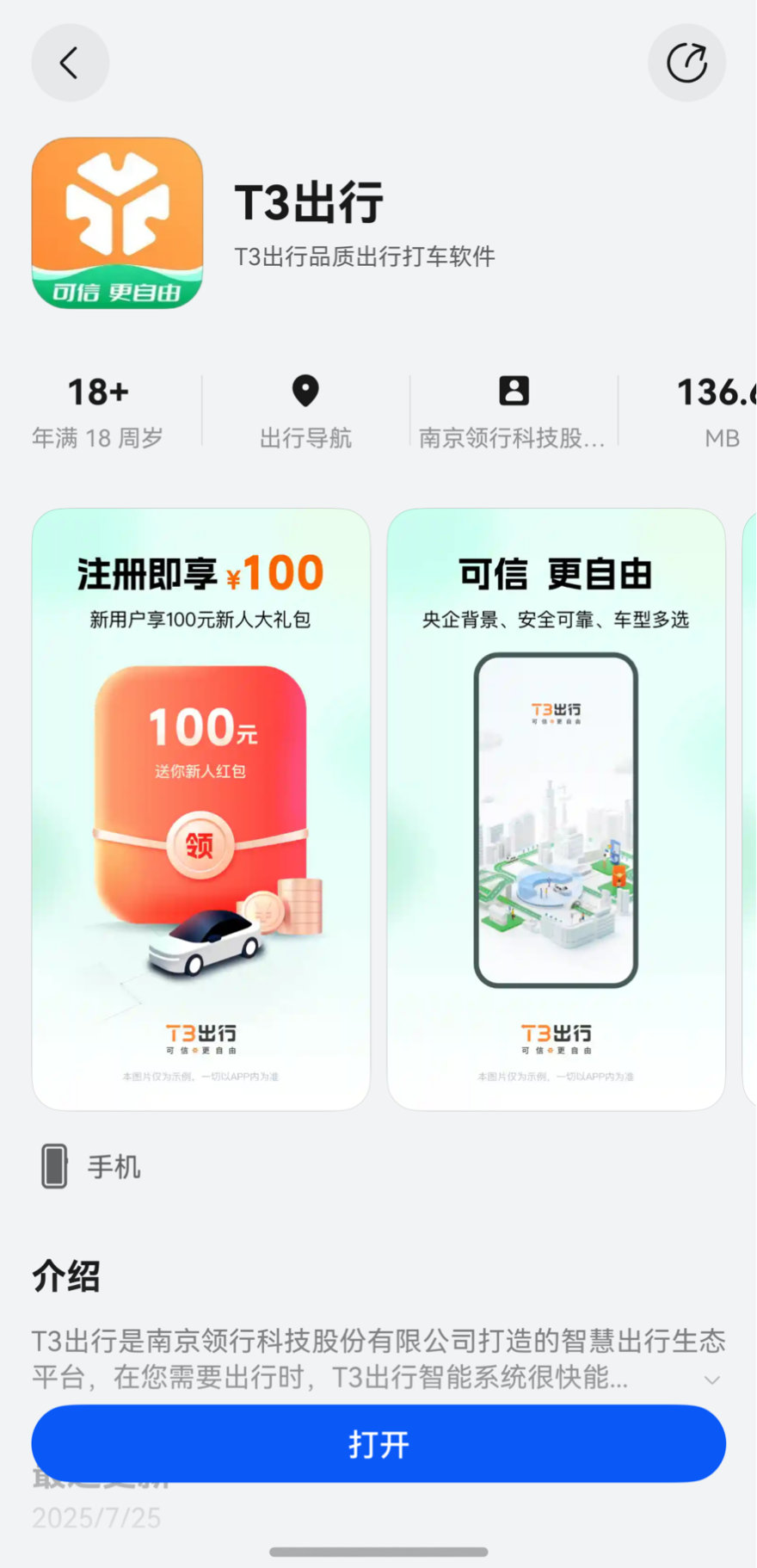
鸿蒙版T3出行再升级!司乘同显、截图反馈等功能上新,出行更省更安全!
Cai Fu Zai Xian· 2025-08-06 03:42
Core Viewpoint - The recent major update of the HarmonyOS version of T3 Travel enhances user experience with new features such as simultaneous display for drivers and passengers, and background recording, catering to diverse travel needs while ensuring safety and convenience [1][3]. Group 1: New Features - Simultaneous Display: Both drivers and passengers can access real-time route planning and traffic information before and during the trip [3]. - Background Recording: Users can enable in-car recording through the "Safety Center" for added security [3][6]. - Real-name Authentication: Users can undergo real-name verification in the "Safety Center" for improved safety assurance [6]. Group 2: Enhanced User Experience - Efficient Screenshot Feedback: The app allows users to take screenshots and quickly access the feedback page, streamlining the reporting process [8]. - Comprehensive Message Notifications: Important trip information is pushed through various channels, ensuring users do not miss critical alerts [8]. - Convenient One-Click Login: The app supports multiple login methods, including WeChat and mobile number, as well as direct login via Huawei account for quicker access [8]. Group 3: Market Position - T3 Travel is positioned as a leading all-scenario smart travel platform in China, fully covering core functions such as ride-hailing and corporate transportation on the HarmonyOS 5 system, emphasizing efficiency, safety, and cost-effectiveness for both individual and corporate users [8].
高盛:中国互联网巨头季报看点,AI云的增长有多快?外卖的拖累有多大?
美股IPO· 2025-08-06 02:25
Core Viewpoint - Goldman Sachs predicts a significant acceleration in AI cloud business growth in Q2, driven by surging demand for AI inference and rapid development of AI applications, while competition in the food delivery sector is expected to lead to a substantial decline in platform profits [1][3][4]. Group 1: AI Cloud Business Growth - The AI cloud business of Chinese internet giants is expected to see a notable acceleration in growth during Q2, with Alibaba Cloud's revenue growth forecasted to increase from 18% in Q1 to 23% in Q2 [5][6]. - Despite being lower than Google Cloud's 32% and Microsoft Azure's 39% growth rates, this increase indicates a positive trend driven by the surge in AI inference demand [6]. - In June, ByteDance's daily token processing reached 15 trillion, while Alibaba's was around 4-5 trillion, highlighting the rapid growth in AI inference demand [6][7]. Group 2: Impact of Food Delivery Competition - Intense competition in the food delivery market is significantly impacting the performance of transaction platforms [8]. - As a result, Alibaba's EBITA is expected to decline by 16% year-on-year, while Meituan and JD's EBIT are projected to drop by 58% and 70%, respectively [9]. - Goldman Sachs estimates that Alibaba's food delivery business incurred losses of 11 billion yuan in Q2, which is expected to expand to 19 billion yuan in Q3 [9]. Group 3: Performance Disparities Among Companies - The report anticipates a divergence in performance among major platforms, with gaming and ride-hailing sectors expected to show resilience [11]. - Tencent is projected to report a revenue growth of 11% in Q2, with adjusted EBIT growth of 15%, driven by strong performance in its gaming segment [11][12]. - Meituan is expected to see a revenue increase of 16%, but its adjusted EBIT is forecasted to plummet by 58% due to intensified competition in food delivery [12]. - JD is also expected to grow revenue by 16%, but its adjusted EBIT is anticipated to decline by 70% [12].

中国互联网巨头季报看点:AI云的增长有多快?外卖的拖累有多大?
Hua Er Jie Jian Wen· 2025-08-06 01:20
Core Viewpoint - The upcoming Q2 earnings reports of Chinese internet giants are expected to show a divergent performance, with overall profits projected to decline by 10% year-on-year, marking the first drop since Q2 2022, primarily due to the struggles in e-commerce and local service platforms, while AI cloud services and gaming sectors are anticipated to provide support for some companies [1] Group 1: AI Cloud Business Growth - The AI cloud business of Chinese internet giants is expected to see significant acceleration in growth during Q2, with Alibaba Cloud's revenue growth forecasted to increase from 18% in Q1 to 23%, although still lagging behind Google Cloud's 32% and Microsoft Azure's 39% [2] - This growth is driven by a surge in AI inference demand and rapid development of AI applications, with ByteDance processing 15 trillion tokens daily in June, while Alibaba processes around 4-5 trillion tokens [2][3] Group 2: Impact of Intense Competition in Food Delivery - Intense competition in the food delivery market is a major drag on platform profits, with Alibaba's EBITA expected to decline by 16%, and Meituan and JD's EBIT projected to drop by 58% and 70%, respectively [4] - Alibaba's food delivery business is estimated to incur losses of 11 billion yuan in Q2, which may expand to 19 billion yuan in Q3, while JD's food delivery business is expected to lose over 10 billion yuan in Q2 [4] - The competition extends beyond traditional food delivery to instant shopping, with Alibaba's peak daily order volume reaching 15 million and Meituan's at 20 million, further intensifying market rivalry [4] Group 3: Performance Divergence Among Platforms - Despite overall profit pressures, gaming and ride-hailing sectors are expected to show strong growth, with Tencent projected to achieve an 11% revenue increase and a 15% adjusted EBIT growth in Q2 [5] - JD is expected to report a 16% revenue growth, significantly outperforming the overall retail sector, but its adjusted EBIT is forecasted to decline by 70% [5][6] - Didi is anticipated to maintain growth in a stable market environment, with a projected 8% revenue increase and a 32% adjusted EBIT growth [6]

使用无证网约车,曹操出行关联公司杭州优行被处罚
Qi Lu Wan Bao Wang· 2025-08-05 12:21
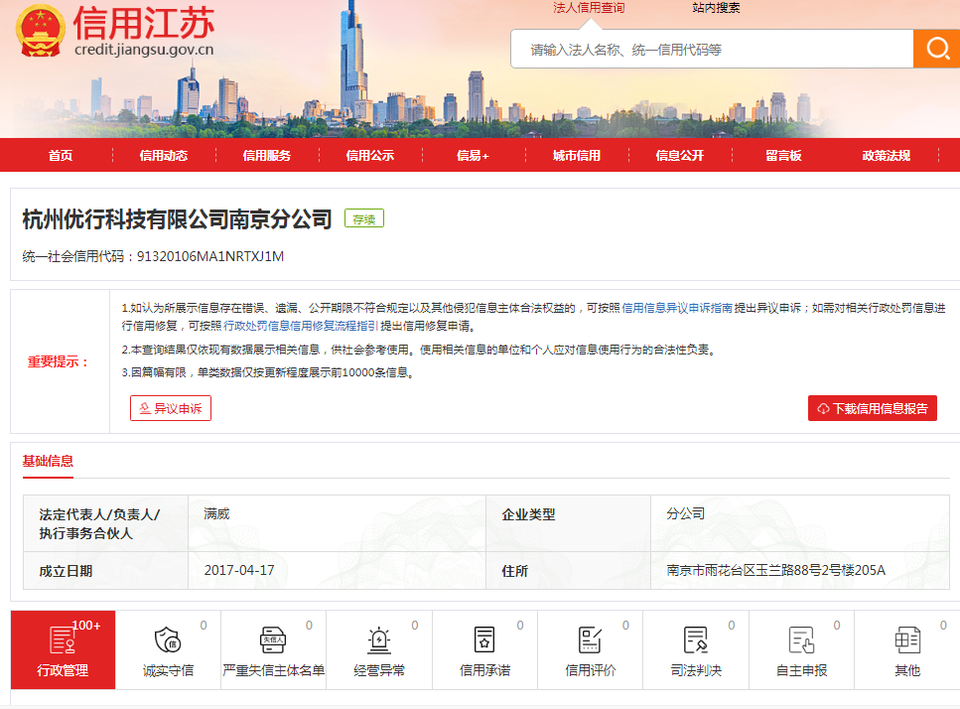
Core Viewpoint - The article reports on an administrative penalty imposed on Hangzhou Youxing Technology Co., Ltd. Nanjing Branch, a subsidiary of Cao Cao Travel, for operating vehicles without the required "Online Appointment Taxi Transport Certificate" [3][4]. Group 1: Administrative Penalty Details - The Nanjing Transportation Bureau fined Hangzhou Youxing Technology Co., Ltd. Nanjing Branch 5,000 yuan (approximately 0.5 million yuan) for providing services with vehicles that lacked the necessary certification [4]. - The violation was identified during an inspection on June 16, 2025, where it was found that a registered driver had operated a vehicle without the required certificate, resulting in 19 service orders being dispatched through the "Cao Cao Travel" app from June 13 to June 16, 2025 [3][4]. - The penalty was based on the "Interim Measures for the Management of Online Appointment Taxi Operating Services," specifically Article 35, Clause 1, Item (1) [4]. Group 2: Frequency of Violations - The administrative penalty information for Hangzhou Youxing Technology Co., Ltd. Nanjing Branch has reached a total of 51 entries, indicating a pattern of regulatory issues [5].
网经社刘俊斌:持续“内卷”不符合消费者 商家和国家利益 需引起重视
Sou Hu Cai Jing· 2025-08-05 02:14
Core Viewpoint - The platform economy is currently trapped in a cycle of "low-price competition" and "subsidy wars," necessitating a shift towards healthier development practices to avoid long-term negative impacts on profitability and sustainability [1][4]. Group 1: Negative Impacts of "Involution" - The ongoing "involution" in the platform economy, while providing short-term benefits to consumers, leads to reduced profit margins and risks to sustainable development for platforms [4]. - Involuntary participation in this competitive behavior can harm merchants' operations, potentially resulting in a decline in product quality, which contradicts market demands for value [4]. Group 2: Transitioning from "Traffic Involution" to "Value Creation" - Platform managers must recognize the risks of malicious competition and embrace social responsibility by enhancing service quality and protecting the interests of consumers and merchants [5]. - A shift away from low-price marketing strategies is essential, focusing on customer satisfaction and improving communication and service mechanisms in line with modern marketing principles [5]. Group 3: Balancing Government Regulation and Platform Autonomy - Government regulation is necessary to establish service norms and pricing guidelines, while platforms should operate autonomously within these frameworks [6]. - Continuous monitoring and correction of platform behaviors by the government are crucial to ensure compliance with relevant laws [6]. Group 4: Focus Areas for Investigation - The investigation will cover various sectors, including retail e-commerce platforms (e.g., JD.com, Taobao), local life services (e.g., Meituan), cross-border e-commerce (e.g., Amazon), ride-hailing services (e.g., Didi), and online travel platforms (e.g., Ctrip) [10][16].

1家1000辆,百度联手Lyft、Uber推动Robotaxi全球化
3 6 Ke· 2025-08-05 01:05
联手Uber之后,百度又和另一家网约车国际巨头Lyft达成了合作。 8月4日,百度官方宣布旗下萝卜快跑与网约车平台Lyft达成战略合作,萝卜快跑将通过Lyft平台在欧洲提供无人驾驶出行服务。 双方计划于2026年率先在德国和英国部署萝卜快跑第六代无人车,并在欧洲市场逐步扩大规模至数千辆,实现无人驾驶规模化落地。 这是近期萝卜快跑又一个重大国际化举措。 7月15日,百度宣布,和与全球最大的出行平台Uber达成战略合作,在全球多个市场部署数千台无人驾驶汽车。 不过,两项合作的初始合作目标市场不同。与Uber的合作,重点是亚洲和中东地区;与Lyft的合作,目标先是英国和德国,最终目标是欧洲。 2022年之前,Lyft能在全球网约车平台中排名第二,仅次于Uber。但是,滴滴凭借庞大的中国市场跻身第二之后,Lyft退居第三。但在北美市场,Lyft是仅 次于Uber的存在。 此次百度与之联手开拓欧洲,对于Lyft也是重大挑战。Lyft此前在欧洲并没有多少"地盘"。但是,4月份,Lyft收购了德国网约车平台 FreeNow。 FreeNow并不知名,但也是出自名门,是宝马和奔驰联手创建的出行平台。FreeNow给了Lyft ...



网约车聚合平台调查:“服务失序”频发 如何保障乘客权益
Zhong Guo Qing Nian Bao· 2025-08-04 22:45
Core Points - The article highlights ongoing issues with ride-hailing aggregation platforms, particularly regarding consumer complaints about service quality and lack of effective regulation [1][2][3] Summary by Sections Consumer Experiences - A consumer reported being charged additional fees by a driver after booking a ride through an aggregation platform, leading to a refund only after escalating the issue on social media [1] - Another consumer faced a cancellation fee while waiting for a driver who ultimately did not arrive, illustrating service reliability issues [4] - Complaints about drivers charging extra fees, such as highway tolls, without proper disclosure have been noted, indicating potential deceptive practices [5][6] Regulatory Environment - The Ministry of Transport has acknowledged the need for better regulation of ride-hailing platforms, emphasizing the importance of corporate responsibility and oversight [2] - Despite previous notifications aimed at improving management, issues related to consumer rights and service quality persist [3] Service Quality and Accountability - Many consumers report inadequate responses from platforms when issues arise, with platforms often deflecting responsibility to third-party companies [7] - The ambiguity in the legal responsibilities of aggregation platforms complicates consumer claims and rights [8] Industry Challenges - The business model of ride-hailing aggregation platforms, which acts as an "order supermarket," complicates the delineation of responsibilities between platforms and service providers [7] - The rapid growth of small and micro ride-hailing companies, facilitated by these platforms, has led to increased regulatory challenges and potential service quality declines [9][10] Recommendations for Improvement - Experts suggest that clearer definitions of responsibilities and enhanced dynamic regulation are necessary to transition the industry towards higher quality service [14][16] - Recommendations include establishing a shared information mechanism between transport authorities and platforms to improve oversight and accountability [16][17]

网约车空调费纷争如何解
Jing Ji Ri Bao· 2025-08-04 22:08
Core Viewpoint - The issue of drivers charging extra for air conditioning in ride-hailing services has sparked significant online debate, highlighting deeper structural problems within the industry [1] Group 1: Industry Regulations and Standards - Most ride-hailing platforms prohibit drivers from charging extra for air conditioning, aligning with regulations that require drivers to use air conditioning based on passenger requests [1] - The "Taxi Operation Service Specification" mandates that drivers should operate air conditioning according to passenger preferences, and many local transportation departments have reinforced this requirement [1] Group 2: Economic Pressures on Drivers - The ride-hailing industry is experiencing an oversupply of drivers, leading to income declines for many, exacerbated by intensified competition among platforms [1] - Despite some platforms offering heat subsidies, their limited effectiveness due to time restrictions and small amounts has not alleviated the financial pressures on drivers [1] Group 3: Recommendations for Improvement - To resolve driver-passenger conflicts, platforms should take responsibility by addressing regulatory gaps, such as exploring dynamic pricing mechanisms for air conditioning based on temperature and distance [2] - The industry should move towards refined operations rather than competing solely on low prices, ensuring clearer standards and fairer rules to enhance service quality and passenger experience [2]