
保险业

Search documents
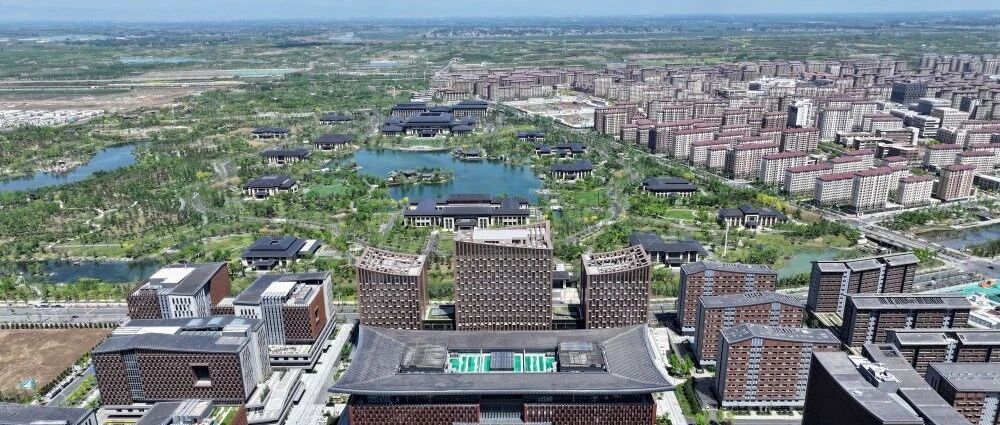
国务院批复:同意雄安高新区升级
21世纪经济报道· 2026-02-15 11:01
Core Viewpoint - The State Council of China has approved the upgrade of the Hebei Xiong'an High-tech Industrial Development Zone to a National High-tech Industrial Development Zone, aiming to enhance technological and industrial innovation while attracting high-end innovation resources [1]. Group 1: Development Zone Upgrade - The upgraded Hebei Xiong'an High-tech Industrial Development Zone will cover an area of 20.84 square kilometers, consisting of two blocks [1]. - The development zone is expected to focus on deep integration of technological and industrial innovation, actively engaging in major scientific project collaborations, and accelerating breakthroughs in key core technologies [1]. Group 2: Strategic Goals - The zone aims to become a significant source of independent and original innovation, an international high-end high-tech industrial cluster, and support the high-standard, high-quality development of the Xiong'an New Area [1]. - It will also enhance services for the coordinated development of the Beijing-Tianjin-Hebei region [1]. Group 3: Regulatory Compliance - The development zone must strictly implement land spatial planning and related regulations, ensuring compliance with environmental impact assessment systems [1]. - There are specific controls on project construction land indicators and a prohibition on commercial real estate development, except for a certain proportion of affordable rental housing [1]. Group 4: Management and Environment - There is a call for strengthened leadership and management to enhance the comprehensive functions of the development zone, along with a focus on resource and policy support [2]. - The initiative includes reforms in management systems to create a clear and efficient management mechanism, alongside promoting smart and green park construction to optimize the business environment [2].

建发集团副总经理邹少荣,任君龙人寿代董事长
Sou Hu Cai Jing· 2026-02-15 06:30
Group 1 - The former chairman Wang Wenhui of Junlong Life Insurance Co., Ltd. resigned due to personal reasons, effective from February 7, with Zou Shaorong taking over the chairman duties [1] - Zou Shaorong, born in 1976, holds a master's degree in law from Xiamen University and has held various positions within Xiamen Jianfa Group, including legal advisor and deputy general manager [3] - Junlong Life Insurance is jointly funded by Jianfa Group and a Taiwanese insurance company, each holding a 50% stake [3] Group 2 - The latest solvency report indicates that Junlong Life Insurance is projected to achieve an insurance business revenue of 2.638 billion yuan and a net profit of 376 million yuan by 2025 [3] - As of the end of Q4 2025, the company's core solvency adequacy ratio is 125.00%, and the comprehensive solvency adequacy ratio is 170.80%, with recent risk ratings at BBB level [3] - Under Wang Wenhui's leadership since June 2019, Junlong Life Insurance turned profitable after 11 years of losses, reporting a net profit of 8 million yuan in 2020 and further increasing to 31 million yuan in 2021 [3]

盛松成:降准优于降息,货币政策宜采取“小步走”模式
Shang Hai Zheng Quan Bao· 2026-02-15 03:43
Core Viewpoint - The current economic environment is characterized by a transition period, with a stable economic foundation but challenges in domestic demand, real estate adjustments, and bank net interest margins. The focus is on leveraging economic potential through policy support and reform innovation [1]. Group 1: Monetary and Fiscal Policy Coordination - The preference for "reducing reserve requirements over lowering interest rates" is based on the current low net interest margins of commercial banks, which makes significant interest rate cuts less feasible. This approach aligns with China's macroeconomic governance, where fiscal policy plays a leading role and monetary policy acts in support [2][3]. - The "gradual reduction in reserve requirements and interest rates" approach is recommended due to high uncertainty, allowing for a more measured monetary policy implementation that considers market feedback [3]. - China's average reserve requirement ratio is approximately 6.3%, indicating significant room for reduction compared to Western countries, where reserve requirements have been largely eliminated [4]. Group 2: Real Estate Market Stability - Recent policies aimed at stabilizing the real estate market include adjustments to housing purchase restrictions and lowering housing fund loan interest rates, resulting in a narrowing decline in key real estate indicators such as sales and funding [6][7]. - The key to stabilizing expectations in the real estate market lies in improving liquidity and addressing employment and income expectations, which are critical for demand recovery [7]. Group 3: Investment in Human Capital - The shift from "investment in physical assets" to "investment in human capital" is emphasized, with a focus on enhancing public services in education, healthcare, and social security to drive economic growth [8][9]. - The government aims to increase fiscal spending on social welfare, which currently accounts for less than 10% of GDP, compared to 10-20% in developed countries, indicating room for growth [10]. Group 4: Consumption Activation - Short-term measures such as fiscal transfer payments (e.g., consumption vouchers) are deemed more urgent and effective for boosting consumer spending, especially for low-income groups [11][12]. - Long-term strategies should include tax reforms and targeted subsidies to stimulate demand in service sectors like elder care and childcare, which have significant growth potential [13][14][16].
三部门发文推动低空保险高质量发展
Ren Min Ri Bao Hai Wai Ban· 2026-02-15 01:40
Core Viewpoint - The implementation of a mandatory insurance system for unmanned aerial vehicles (UAVs) is being accelerated to enhance the low-altitude insurance policy framework in China [1] Group 1: Policy Development - The National Development and Reform Commission, the Financial Regulatory Administration, and the Civil Aviation Administration of China have jointly issued guidelines to promote high-quality development of low-altitude insurance [1] - The guidelines emphasize the need to incorporate mandatory insurance requirements into the approval process for UAV flight activities [1] Group 2: Implementation Measures - There will be a strengthened verification of insurance coverage during flight operations management and a thorough check during accident handling [1] - A legal framework for mandatory UAV liability insurance will be established, defining basic liability scope and minimum coverage limits under controllable risk principles [1] Group 3: Insurance Supply Enhancement - The guidelines call for improving the supply and service capabilities of related insurance products, providing targeted insurance coverage for various application scenarios [1]
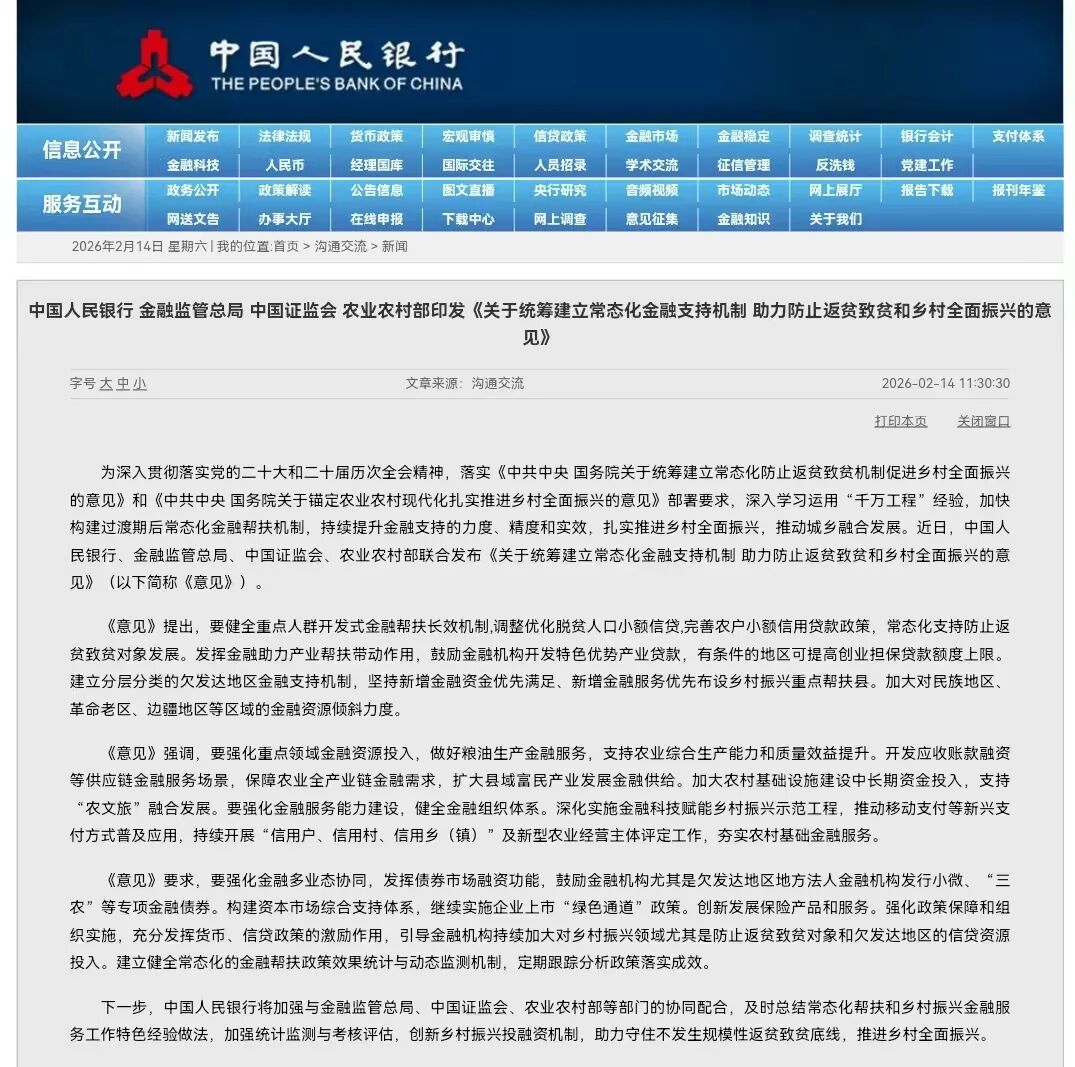
四部门发文:常态化金融支持机制助力乡村全面振兴
Xin Lang Cai Jing· 2026-02-14 21:57
Core Viewpoint - The People's Bank of China, along with financial regulatory bodies, has issued guidelines to establish a normalized financial support mechanism aimed at preventing poverty and promoting rural revitalization and urban-rural integration [1][2]. Group 1: Financial Support Mechanism - The guidelines propose a long-term financial support mechanism for key populations, optimizing microloans for impoverished individuals and enhancing credit policies for farmers [1]. - Financial institutions are encouraged to develop loans for specialized industries, with some regions allowed to increase the upper limit for entrepreneurial guarantee loans [1]. - A tiered financial support system for underdeveloped areas will be established, prioritizing new financial resources and services for key rural revitalization counties [1]. Group 2: Agricultural and Rural Development - The guidelines emphasize strengthening financial resource investment in key areas, particularly in grain and oil production, to enhance agricultural productivity and quality [2]. - Supply chain financial services, such as accounts receivable financing, will be developed to meet the financial needs of the entire agricultural industry chain [2]. - Increased long-term funding for rural infrastructure construction will support the integration of agriculture, culture, and tourism [2]. Group 3: Financial Services and Innovation - The guidelines call for enhanced financial service capabilities and the establishment of a robust financial organization system [2]. - The implementation of financial technology initiatives for rural revitalization will be deepened, promoting the adoption of mobile payment and credit evaluation systems [2]. - Financial institutions, especially local ones in underdeveloped areas, are encouraged to issue special financial bonds for small and micro enterprises and agriculture [2].
四部门重磅发文!支持特色农产品期货期权品种上市,继续稳步推进“保险+期货”
Qi Huo Ri Bao· 2026-02-14 14:23
Core Viewpoint - The People's Bank of China, along with other regulatory bodies, has issued guidelines to establish a normalized financial support mechanism aimed at preventing poverty and promoting rural revitalization, in line with the directives from the 20th National Congress of the Communist Party of China [1][4]. Group 1: Financial Support Mechanism - The guidelines emphasize the need to develop a long-term financial support mechanism for key populations, optimizing microcredit for impoverished individuals and supporting those at risk of falling back into poverty [4]. - Financial institutions are encouraged to create loans for specialized industries and increase the upper limit for entrepreneurial guarantee loans in eligible regions [4]. - A tiered financial support mechanism for underdeveloped areas will be established, prioritizing new financial resources for key rural revitalization counties [4]. Group 2: Investment in Key Areas - The guidelines stress the importance of financial resource allocation in key sectors, particularly in grain and oil production, to enhance agricultural productivity and quality [5]. - Supply chain financial services, such as accounts receivable financing, will be developed to meet the financial needs of the entire agricultural industry chain [4][5]. - There will be increased long-term funding for rural infrastructure projects and support for the integration of agriculture, culture, and tourism [4]. Group 3: Financial Innovation and Collaboration - The guidelines call for enhanced collaboration among various financial sectors, encouraging local financial institutions in underdeveloped areas to issue special bonds for small and micro enterprises and agriculture [5]. - A comprehensive capital market support system will be constructed, including the continuation of a "green channel" policy for company listings [5]. - The implementation of innovative insurance products and services will be promoted, alongside a monitoring mechanism to assess the effectiveness of financial support policies [5].

国家金融监督管理总局:2025年保险公司原保险保费收入6.1万亿元,同比增长7.4%
Cai Jing Wang· 2026-02-14 10:28
Core Insights - The National Financial Regulatory Administration released data on key regulatory indicators for the insurance industry for Q4 2025, showing significant growth in total assets and premium income [1] Group 1: Total Assets and Growth - By the end of Q4 2025, total assets of insurance companies and insurance asset management companies reached 41.3 trillion yuan, an increase of 15.1% from the beginning of the year [1] - Property insurance companies had total assets of 3.1 trillion yuan, growing by 7.5% year-on-year [1] - Life insurance companies reported total assets of 36.4 trillion yuan, reflecting a year-on-year growth of 15.4% [1] - Reinsurance companies' assets amounted to 857.3 billion yuan, with a growth of 3.5% [1] - Insurance asset management companies had total assets of 145.6 billion yuan, increasing by 14% [1] Group 2: Premium Income and Claims - The total original insurance premium income for 2025 was 6.1 trillion yuan, representing a year-on-year increase of 7.4% [1] - Claims and benefit payments amounted to 2.4 trillion yuan, which is a 6.2% increase compared to the previous year [1] - The number of new insurance policies issued reached 116.8 billion, marking a year-on-year growth of 12.6% [1] Group 3: Solvency Ratios - As of the end of Q4 2025, the average comprehensive solvency adequacy ratio for insurance companies was 181.1%, and the core solvency adequacy ratio was 130.4%, both exceeding regulatory standards [1] - Property insurance companies had solvency ratios of 243.5% and 212.7% for comprehensive and core solvency, respectively [1] - Life insurance companies reported solvency ratios of 169.3% and 115.0% [1] - Reinsurance companies had solvency ratios of 244.6% and 212.5% [1]
君龙人寿:王文怀辞任董事长 邹少荣代为履职
Xin Lang Cai Jing· 2026-02-14 05:04
观点网讯:2月14日,君龙人寿公告称,董事长王文怀因个人原因辞去董事及董事长职务,自2026年2月 7日起,由邹少荣代为履行董事长职责。 免责声明:本文内容与数据由观点根据公开信息整理,不构成投资建议,使用前请核实。 根据公开资料整理,君龙人寿为厦门建发集团与台湾人寿合资设立的中型寿险公司。 ...
四部门:统筹建立常态化金融支持机制,助力防止返贫致贫和乡村全面振兴
Xin Lang Cai Jing· 2026-02-14 05:03
Core Viewpoint - The document outlines a comprehensive framework for establishing a normalized financial support mechanism aimed at preventing poverty and promoting rural revitalization in China, emphasizing the need for targeted financial assistance and collaboration among various financial institutions and government bodies [1][4][18]. Group 1: Financial Support Mechanisms - The framework aims to enhance the long-term financial support mechanisms for key populations, including optimizing microcredit policies for impoverished individuals and ensuring continuous support for those at risk of falling back into poverty [1][4][5]. - Financial institutions are encouraged to develop loans for specialized industries and increase credit limits for entrepreneurial support in underdeveloped areas [2][5][6]. - A tiered financial support mechanism will be established for underdeveloped regions, prioritizing financial resources for key rural revitalization counties [7][8]. Group 2: Investment in Key Areas - The document emphasizes the importance of financial resources in enhancing agricultural production capacity and quality, particularly in grain and oil production [2][9]. - It calls for the development of supply chain financial services to meet the financial needs of the entire agricultural industry chain [2][10]. - There is a focus on expanding financial support for county-level industries and improving rural infrastructure through long-term funding [11][12]. Group 3: Financial Service Capacity Building - The framework highlights the need to strengthen the financial organizational system, ensuring that state-owned and commercial banks provide adequate support for rural revitalization [13][14]. - It encourages the development of diverse financial products tailored to the needs of different agricultural sectors and the promotion of digital transformation in financial services [14][15]. Group 4: Multi-Industry Financial Collaboration - Financial institutions are urged to leverage bond markets to raise stable, low-cost funds for local credit investments, particularly in underdeveloped areas [16][17]. - The document advocates for a comprehensive capital market support system to facilitate the listing and financing of rural enterprises [16][17]. Group 5: Policy Implementation and Monitoring - The framework stresses the importance of policy coordination and the need for continuous monitoring and evaluation of financial support policies to ensure their effectiveness [18][19]. - It encourages the documentation and dissemination of successful financial service practices to promote a favorable environment for rural revitalization efforts [18][19].
央行等四部门:统筹建立常态化金融支持机制 助力防止返贫致贫和乡村全面振兴
Zheng Quan Ri Bao Wang· 2026-02-14 04:27
Core Viewpoint - The People's Bank of China, along with other regulatory bodies, has issued guidelines to establish a normalized financial support mechanism aimed at preventing poverty and promoting rural revitalization, in line with the directives from the 20th National Congress of the Communist Party of China [1][2]. Group 1: Financial Support Mechanism - The guidelines propose the establishment of a long-term financial support mechanism for key populations, optimizing microcredit for impoverished individuals and enhancing credit policies for farmers [1][2]. - Financial institutions are encouraged to develop loans for specialized industries and increase the upper limit for entrepreneurial guarantee loans in eligible regions [1][2]. - A tiered financial support mechanism for underdeveloped areas will be established, prioritizing new financial resources for key rural revitalization counties [1][2]. Group 2: Agricultural and Rural Development - The guidelines emphasize the need for financial resources to be directed towards key areas, including grain and oil production, to enhance agricultural production capacity and quality [2]. - Supply chain financial services, such as accounts receivable financing, will be developed to meet the financial needs of the entire agricultural industry chain [2]. - There will be increased investment in rural infrastructure and support for the integration of agriculture, culture, and tourism [2]. Group 3: Financial Services and Innovation - The guidelines call for strengthening the financial service capacity and improving the financial organizational system [2]. - Financial institutions, particularly local ones in underdeveloped areas, are encouraged to issue special financial bonds for small and micro enterprises and agriculture [2]. - The guidelines advocate for the innovation of insurance products and services, as well as the establishment of a monitoring mechanism for the effectiveness of financial support policies [2][3]. Group 4: Collaboration and Implementation - The People's Bank of China will enhance collaboration with regulatory bodies to summarize effective practices in financial support and rural revitalization [3]. - There will be a focus on statistical monitoring and evaluation of the financial services provided for rural revitalization [3]. - The aim is to innovate financing mechanisms to prevent large-scale poverty and promote comprehensive rural revitalization [3].