
金融机构

Search documents
国内宏观和产业政策周观察(1006-1012):商务部公布境外相关稀土物项出口管制决定
Huafu Securities· 2025-10-12 12:46
Group 1: Core Insights - The report highlights a focus on deepening information infrastructure, AI integration, and regulatory adjustments in key sectors [8][9][12] - The Ministry of Industry and Information Technology emphasizes the advancement of 5G-A, ten-gigabit optical networks, and computing power facilities, while promoting the integration of AI with service-oriented manufacturing [9][12] - The automotive sector has updated energy-saving and new energy vehicle technology standards, along with a revised vehicle and vessel tax exemption directory, effective from January 1, 2026 [13] Group 2: Industry Policies - The report outlines the implementation of export controls on certain rare earth items by the Ministry of Commerce and the General Administration of Customs, effective from November 8, 2025 [7] - The transportation sector will impose special port fees on certain U.S.-related vessels starting October 14, 2025, as part of regulatory measures [14] - The financial sector is set to standardize the identification management of beneficial owners by financial institutions, aligning with international anti-money laundering standards [17] Group 3: Market Performance - The report tracks the performance of various sectors in the A-share market, with notable increases in sectors such as non-ferrous metals (+4.25%) and coal (+4.24%) [20][21] - The top ten concepts with the highest gains this week include nuclear power (+6.90%) and industrial gases (+6.07%), while the largest declines were seen in power batteries (-6.38%) and optical modules (-5.20%) [23][24]
央行:金融机构开展客户尽职调查时,应识别并核实客户受益所有人
Feng Huang Wang· 2025-10-11 12:41
Core Viewpoint - The People's Bank of China has drafted the "Management Measures for the Identification of Beneficial Owners of Financial Institutions (Draft for Comments)" to enhance anti-money laundering (AML) efforts and comply with international assessments [2][3] Group 1: Regulatory Framework - The draft measures apply to institutions required to conduct customer due diligence as per existing AML regulations [2] - The measures aim to refine the implementation of the Anti-Money Laundering Law and enhance the effectiveness of beneficial owner identification [2][3] Group 2: Identification Requirements - The draft specifies basic requirements and principles for financial institutions to identify and verify beneficial owners [3] - It emphasizes a risk-based approach, allowing simplified identification for low-risk clients [3] Group 3: Process and Responsibilities - The measures outline the identification and verification process, including the necessary identity and rights information to be collected [3] - A feedback mechanism is established to address discrepancies in identification, with clear standards for major and minor discrepancies [3]

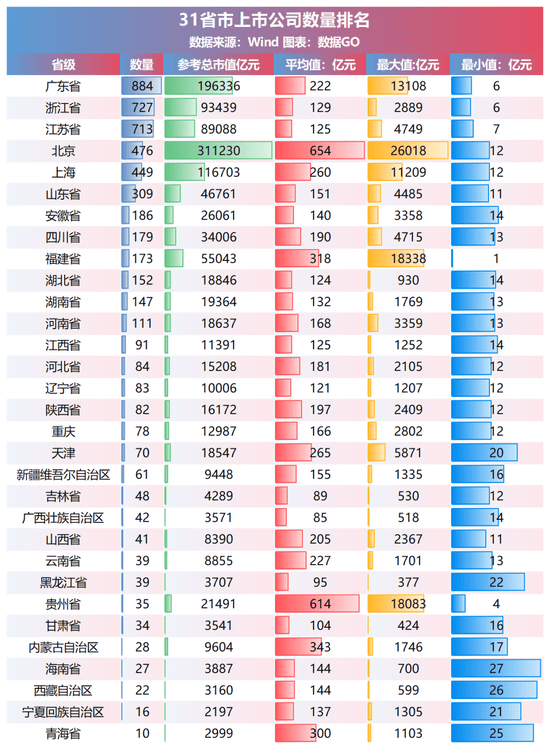
31省市上市公司数量排名:广东884家居首 头部企业带动效应显著
Sou Hu Cai Jing· 2025-10-05 00:15
Core Insights - The article highlights the significant disparities in the development of capital markets and company sizes across different regions in China, with coastal areas leading in the number of listed companies and total market capitalization [1][2][6]. Group 1: Number of Listed Companies - Guangdong (884), Zhejiang (727), and Jiangsu (713) are the top three provinces in terms of the number of listed companies, indicating a high level of economic activity and capital market participation in these eastern coastal regions [1]. - Western regions such as Qinghai (10), Ningxia (16), and Tibet (22) have significantly fewer listed companies, reflecting a gap in economic foundation and capital market engagement [1]. Group 2: Total Market Capitalization - Beijing leads with a total market capitalization of 311,230 billion, supported by numerous state-owned enterprises and leading tech companies, while Guangdong follows with nearly 200,000 billion, benefiting from a large base of companies [2][6]. - The presence of "super-large" listed companies in regions like Beijing (26,018 billion), Fujian (18,338 billion), and Guizhou (18,083 billion) significantly boosts regional total market capitalization [4]. Group 3: Average Market Value - Beijing (654 billion) and Guizhou (614 billion) have the highest average market values, indicating larger overall company sizes, while cities like Jilin (89 billion) and Guangxi (85 billion) show lower averages, suggesting smaller company sizes [3][9]. - The average values in municipalities such as Shanghai (260 billion) and Tianjin (265 billion) also reflect higher overall company quality [3]. Group 4: Extremes in Market Values - The maximum market value in Beijing (26,000 billion) and Shenzhen (13,000 billion) highlights the dominance of leading companies, while the minimum value in Fujian (1 billion) indicates the presence of very small companies [4][9]. - Regions like Hainan (27 billion) and Qinghai (25 billion) have relatively higher minimum values, suggesting a more stable lower limit for listed companies in these areas [4]. Group 5: Regional Disparities and City Effects - Major cities like Beijing, Shanghai, and Shenzhen dominate both the number of listed companies and total market capitalization, showcasing a "siphoning effect" where first-tier cities attract significant capital and industry resources [5][9]. - Emerging cities in the Yangtze River Delta and Pearl River Delta, such as Hangzhou (232) and Suzhou (225), are also performing well, indicating a trend of capital market growth driven by manufacturing and new industries [5][9]. Group 6: District-Level Insights - Core districts like Haidian (167), Pudong (158), and Nanshan (143) show a high concentration of listed companies, driven by technology and financial resources [10][12]. - Districts in the Yangtze River Delta and Pearl River Delta are forming clusters of listed companies due to industrial upgrades, while areas like Beijing's Xicheng and Dongcheng benefit from the presence of state-owned enterprises and financial institutions [12][15].
博芮投资|金融机构产品适当性管理办法
Xin Lang Ji Jin· 2025-09-23 10:20
Group 1 - The core viewpoint of the news is the introduction of the "Measures for the Management of Product Suitability by Financial Institutions," which aims to enhance consumer protection and regulate the suitability management obligations of financial institutions [4][5]. - The new regulations will take effect on February 1, 2026, and consist of five chapters and forty-nine articles [4]. - Financial institutions are required to understand both their products and their customers, ensuring that suitable products are sold through appropriate channels [4]. Group 2 - For investment products, financial institutions must classify risk levels and manage them dynamically, distinguishing between professional and ordinary investors, with special protections for ordinary investors [4]. - Insurance products will also be subject to classification and grading management, requiring financial institutions to conduct demand analysis and financial capability assessments for policyholders [4]. - The regulatory authority will enforce supervision and can impose administrative penalties on financial institutions and responsible personnel who violate suitability management regulations [4].

金融机构以绿色金融践行“双碳”战略
Zheng Quan Ri Bao· 2025-09-22 16:13
Core Viewpoint - The article emphasizes the significant role of green finance in China's economic transformation towards sustainability, highlighting its contribution to global green governance and the achievement of carbon neutrality goals. Group 1: Green Finance as a Key Driver - Green finance is a crucial component of China's strategy to build a financial powerhouse and is essential for promoting a comprehensive green transformation of the economy and society [1] - Financial institutions are pivotal in this process, acting as key players in facilitating the transition to a green economy [1] Group 2: Support for Green New Momentum - Financial institutions are increasingly adopting systematic approaches to support green new momentum, providing initial funding through green industry funds, private equity financing, and green credit for emerging green technology companies [2] - During the growth phase, they assist companies in accessing direct financing through IPO underwriting and sponsorship, directing funds towards R&D, capacity expansion, and market development [2] - For mature companies, they offer tools like green corporate bonds and asset-backed securities to ensure ongoing development and market position [2] Group 3: Innovation in Green Finance - Financial institutions are innovating to create a modern green finance ecosystem, focusing on product diversification to meet the varied needs of different market participants [3] - New financial products include green notes, green supply chain finance, ESG-themed investment products, carbon-neutral bonds, and sustainability-linked loans [3] - The use of digital technology is enhancing the efficiency and precision of green finance services, with AI and big data improving green identification and blockchain ensuring transparency in fund allocation [3] Group 4: Risk Management and International Cooperation - Financial institutions are integrating climate risk into their risk management frameworks, enhancing their ability to identify and respond to climate-related risks [4] - They are also engaging in international cooperation to share best practices and tackle global climate challenges collectively [4] - By strengthening risk management and fostering international collaboration, financial institutions are positioning themselves as responsible players in global climate governance [4]
新加坡华侨投资基金管理有限公司:美国就业市场显著降温,年轻人求职面临重重挑战
Sou Hu Cai Jing· 2025-09-22 09:31
Group 1 - The U.S. job market is experiencing a significant slowdown, with only 22,000 jobs added nationwide from July to August, indicating a much lower recruitment activity than previously expected [1][4] - The era of adding 200,000 jobs per month in the U.S. is considered over, with the current phase reflecting near stagnation in job growth, particularly impacting young job seekers [4][8] - The introduction of artificial intelligence (AI) is reshaping traditional labor demand, leading to a reduction in job opportunities for young employees, especially in software development and entry-level positions [4][8] Group 2 - The healthcare and retail sectors remain relatively stable for young job seekers, but there are warnings that even these industries may face weakened demand in the next six months [7] - Companies are adopting a cautious approach to hiring, reflecting a conservative stance in recruitment decisions due to the changing policy environment and economic outlook [7][8] - The Federal Reserve's recent decision to lower the federal funds rate by 25 basis points aims to stimulate hiring, but there are still risks of job market decline, with inflation remaining above the Fed's 2% target [9]

专访中国政法大学破产法与企业重组研究中心主任李曙光: 丰富破产制度工具箱 优化司法流程解退出难题
Zheng Quan Shi Bao Wang· 2025-09-18 23:12
Core Viewpoint - The revision of the Enterprise Bankruptcy Law, which has been in effect for 18 years, aims to modernize the bankruptcy legal framework, addressing practical challenges and enhancing the system's effectiveness in risk prevention and resolution [1][2]. Group 1: Key Features of the Revision - The revised draft expands from 12 chapters and 136 articles to 16 chapters and 216 articles, adding and modifying over 160 provisions to address shortcomings in the current law [2]. - The revision aims to improve the willingness to utilize bankruptcy procedures, enhance execution, and establish effective coordination between government and judicial bodies [2]. - New chapters on "merger bankruptcy" and "bankruptcy of financial institutions" have been introduced, enriching the bankruptcy legal toolkit [2]. Group 2: Financial Institution Bankruptcy - A dedicated chapter for "bankruptcy of financial institutions" has been added, recognizing the unique characteristics of financial institutions and their systemic importance [3]. - The scope of applicable institutions has been broadened to include trust companies, securities investment fund management companies, futures companies, and non-bank payment institutions, aligning with regulatory frameworks [3]. - Special rules for debt repayment have been established to protect financial consumers and the public, ensuring that financial stability funds have the same repayment priority as the entities they support [4]. Group 3: Risk Prevention and Coordination - The revision emphasizes the need for coordination between administrative measures and judicial bankruptcy processes, highlighting the importance of a comprehensive legal framework for financial risk management [5]. - Recommendations include modifying existing financial laws and establishing a unified legal framework for financial risk resolution [5]. Group 4: Optimization of Bankruptcy Procedures - The revision introduces mechanisms to enhance the efficiency of bankruptcy procedures, including a special pathway for small and micro enterprises [6]. - A new section specifically for small and micro enterprises aims to streamline the bankruptcy process, reducing costs and expediting case resolution [6]. - The special procedures for small enterprises allow for simplified management and quicker resolution timelines, ensuring a balance between creditor interests and the operational rights of business owners [6].
专访中国政法大学破产法与企业重组研究中心主任李曙光:丰富企业破产制度工具箱 优化小微企业司法流程
Zheng Quan Shi Bao Wang· 2025-09-17 13:40
Core Viewpoint - The draft amendment to the Enterprise Bankruptcy Law, proposed for the first time after 18 years, aims to modernize the bankruptcy legal framework, addressing practical challenges and enhancing the system's effectiveness in risk prevention and resolution [1][4]. Summary by Sections Current Legal Shortcomings - The existing bankruptcy law has significant limitations, including a narrow scope of application, an incomplete administrator system, and inadequate protection for creditor rights [2][3]. - Only 0.5% of companies were deregistered due to bankruptcy in 2024, indicating underutilization of the bankruptcy law [2]. Key Features of the Draft Amendment - The amendment expands the law from 12 chapters and 136 articles to 16 chapters and 216 articles, adding over 160 new and modified provisions [4]. - It emphasizes the importance of bankruptcy law as a fundamental tool for market exit and risk management, aiming to optimize the business environment and deepen supply-side structural reforms [4][5]. Financial Institutions - A new chapter specifically addressing the bankruptcy of financial institutions has been added, reflecting their unique characteristics and the need for differentiated arrangements [6][7]. - The amendment includes provisions for special debt repayment rules and enhances the connection between administrative risk management and judicial bankruptcy processes [6][7]. Small and Micro Enterprises - The draft introduces a special bankruptcy procedure for small and micro enterprises, aimed at improving efficiency and reducing costs associated with bankruptcy proceedings [10][11]. - This new procedure allows for quicker resolution of cases, with specific provisions for simplified management and expedited timelines [11]. Management and Oversight - The amendment strengthens the role and responsibilities of bankruptcy administrators, ensuring they operate independently while being supervised by creditors [15][16]. - A proposed "Bankruptcy Guarantee Fund" aims to address the issue of costs in bankruptcy cases where assets are insufficient to cover expenses [15][16]. Preventing "Debt Evasion" - New temporary measures are introduced to prevent debtors from transferring or hiding assets during the bankruptcy application process, enhancing the integrity of the proceedings [17][18]. - The draft also imposes strict obligations on debtors and their management to disclose financial information accurately and prohibits unnecessary expenditures during bankruptcy [18].
金融机构消费者权益保护监管评价办法修订
Zhong Guo Xin Wen Wang· 2025-09-12 11:56
Core Viewpoint - The revised "Regulatory Evaluation Measures for Consumer Rights Protection in Financial Institutions" aims to enhance consumer rights protection in the financial sector, aligning with the central government's directives to prioritize consumer interests [1][2]. Group 1: Evaluation Scope and Elements - The evaluation scope has been adjusted to include financial institutions legally established in China and regulated by the financial supervisory authority, now encompassing financial leasing companies and pension insurance companies [1]. - The evaluation elements have been optimized to include seven key factors: "system mechanism," "suitability management," "marketing behavior management," "dispute resolution," "financial education," "consumer services," and "personal information protection," guiding institutions to focus on critical areas of consumer protection [1][2]. Group 2: Evaluation Process and Coordination - The evaluation process has been refined into distinct phases: information collection, initial evaluation, re-evaluation, and review, with clear requirements for each phase to ensure rigor and seriousness in the evaluation work [2]. - The regulatory authority will enhance collaboration across different levels, increasing the evaluation score weight for primary branch institutions and allowing adjustments to evaluation indicators based on the characteristics of local financial institutions [2]. Group 3: Result Utilization - The revised measures stipulate that the regulatory authority should implement differentiated regulatory measures based on evaluation results, providing positive incentives for well-performing institutions and appropriate regulatory actions for those with poor evaluations [2].
金融监管总局修订发布《金融机构消费者权益保护监管评价办法》
Zheng Quan Shi Bao Wang· 2025-09-12 08:12
Core Viewpoint - The recent revision of the "Regulatory Evaluation Method for Consumer Rights Protection in Financial Institutions" aims to enhance the regulatory framework for consumer rights protection in the financial sector, ensuring better service and satisfaction for consumers [1] Group 1: Key Changes in the Evaluation Method - The evaluation scope has been adjusted to encompass a broader range of financial institutions [1] - The evaluation elements have been optimized to better reflect the needs of consumers [1] - The evaluation procedures have been improved for greater efficiency and clarity [1] Group 2: Implementation and Impact - The revision emphasizes strengthened collaboration between different regulatory levels [1] - The application of evaluation results has been deepened to ensure that consumer rights protection is integrated into all business operations [1] - The overall goal is to provide more convenient and warmer financial services to the public, enhancing consumer satisfaction and sense of gain [1]