
房地产

Search documents
韩国总统李在明警告多套房持有者:“最后的退出机会”
Xin Lang Cai Jing· 2026-02-02 23:52
Core Viewpoint - The South Korean government, led by President Lee Jae-myung, is committed to taking all necessary measures to combat real estate speculation and stabilize housing prices, urging multiple property owners to sell their assets before the expiration of a tax exemption policy in May [1] Group 1 - President Lee Jae-myung announced on his X platform that the government has sufficient policy tools to address real estate speculation [1] - The President advised multiple property owners to sell their properties immediately, labeling it as their "last chance" before the high capital gains tax exemption policy expires in May [1] - Recent statements from President Lee on social media indicate a consistent warning to multiple property owners against opposing government policies [1]
智通ADR统计 | 2月3日
智通财经网· 2026-02-02 22:23
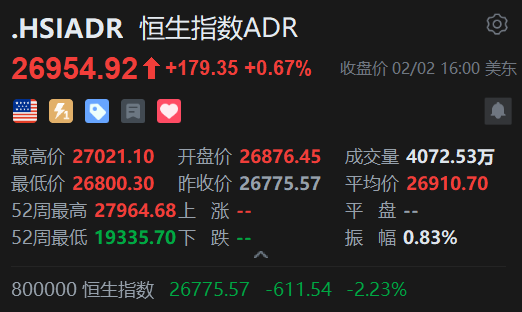
Market Overview - The Hang Seng Index (HSI) closed at 26,954.92, up by 179.35 points or 0.67% as of February 2, 16:00 Eastern Time [1] - The index reached a high of 27,021.10 and a low of 26,800.30 during the trading session, with a trading volume of 40.725 million shares [1] Major Blue-Chip Stocks Performance - HSBC Holdings closed at HKD 139.961, increasing by 3.91% compared to the Hong Kong close [2] - Tencent Holdings closed at HKD 595.694, down by 0.47% compared to the Hong Kong close [2] Stock Price Movements - Tencent Holdings: Latest price HKD 598.500, down by HKD 7.500 or 1.24% [3] - Alibaba Group: Latest price HKD 163.300, down by HKD 5.900 or 3.49% [3] - HSBC Holdings: Latest price HKD 134.700, down by HKD 1.900 or 1.39% [3] - AIA Group: Latest price HKD 89.050, down by HKD 1.300 or 1.44% [3] - Meituan: Latest price HKD 94.850, down by HKD 2.350 or 2.42% [3] - BYD Company: Latest price HKD 91.000, down by HKD 6.750 or 6.91% [3] - Kuaishou Technology: Latest price HKD 77.000, down by HKD 3.150 or 3.93% [3]





韩国经济副总理:经济复苏势头良好将推进资本市场与房地产政策改革
Shang Wu Bu Wang Zhan· 2026-02-02 16:01
(原标题:韩国经济副总理:经济复苏势头良好将推进资本市场与房地产政策改革) 据韩国《纽西斯》1月29日报道,韩国经济副总理兼财政经济部长具允哲当日在采访中总结了政府 过去8个月的经济工作成果,并阐述了未来政策方向。他指出,去年政府成立初期虽面临一季度经济负 增长等困难局面,但通过稳定心理、追加预算等措施,使经济增速从上半年的0.3%大幅升至下半年的 1.7%,并实现了2025年全年1%的增长,出口额突破7000亿美元,股市也创下历史新高。得益于半导体 行业快速复苏,2026年经济增长率有望达到2%。他同时也坦承,由于资产差距扩大、企业两极分化、 青年就业疲软等问题,普通民众的"体感经济"复苏仍然滞后,政府将着力出台更具包容性的政策。在政 策方面,政府将推进资本市场"胡萝卜加大棒"改革,一方面提高退市门槛清退不良企业,另一方面扩大 技术企业上市支持,推动市场先进化。关于房地产政策,明确将结束多套住房转让税优惠措施,并表示 将就强化财产保有税广泛听取民意,以改善资源分配结构并减轻政策执行过程中的社会负担。 ...
海南:全省商业用房购房贷款最低首付比例调整为不低于30%
Xin Lang Cai Jing· 2026-02-02 15:56
Core Viewpoint - The Hainan Provincial Market Interest Rate Pricing Self-Discipline Mechanism announced a policy adjustment regarding the minimum down payment ratio for commercial property loans, effective February 3, 2026, requiring a minimum down payment of 30% [1] Group 1: Policy Announcement - The policy aims to implement the decisions of the central government and adapt to new changes in the real estate market supply and demand [1] - The adjustment is based on the notice from the People's Bank of China and the National Financial Regulatory Administration regarding the minimum down payment ratio for commercial property loans [1] - The adjustment applies to 19 cities and counties in Hainan Province, setting the minimum down payment for commercial property loans at no less than 30% [1] Group 2: Implementation Details - Local commercial banks in Hainan can determine specific down payment ratios for each commercial property loan based on market principles and their operational conditions [1] - The policy reflects a tailored approach, allowing banks to consider customer risk profiles and other factors when setting down payment requirements [1]
地产经纬丨“量”在“价”先?上海二手房成交节前“反季”活跃
Xin Hua Cai Jing· 2026-02-02 15:09
Core Viewpoint - The Shanghai second-hand housing market is experiencing an unexpected surge in activity during the traditional off-peak season, driven by improved price-performance ratios and a shift in buyer sentiment towards lower-priced properties [1][3][5]. Group 1: Market Activity - From November 2025 to January 2026, the Shanghai second-hand housing market recorded nearly 23,000 transactions per month, totaling close to 70,000 homes sold in three months, breaking the traditional seasonal slowdown [2][3]. - The transaction volume in January 2026 increased significantly compared to the previous years, with a year-on-year growth of 39.4% compared to January 2024 and 23.4% compared to January 2025 [2]. Group 2: Price Dynamics - The average price of second-hand residential properties in Shanghai in January 2026 was 55,265 yuan per square meter, reflecting a month-on-month decline of 1.22% and a year-on-year decline of 7.61%, indicating a return to more reasonable price levels [3][4]. - Properties priced below 3 million yuan accounted for over 70% of transactions, with nearly half of the sales in January 2026 being below 2 million yuan [2][4]. Group 3: Investment Sentiment - The rental yield for certain older properties has increased, making them attractive for both living and investment purposes, with some areas showing yields as high as 3.0%, surpassing bank deposit rates [4][6]. - The current market is showing signs of a "bottoming" phase, with a significant reduction in the number of listings, indicating a shift in seller and buyer expectations [4][5]. Group 4: Future Outlook - There is a growing belief that the market may transition from "price-driven volume" to "stable volume and price," with conditions for price stabilization gradually being met [5][6]. - The real estate policy is shifting towards stabilizing expectations and shortening adjustment periods, with potential demand release expected in March 2026 as new quality land parcels are introduced [6].
行业出清与景气扩散:行业出清与景气扩散
SINOLINK SECURITIES· 2026-02-02 14:56
Group 1 - As of January 31, 2026, over 3,006 listed companies in A-shares disclosed their performance forecasts for 2025, representing 55.1% of all A-shares, slightly higher than 53.4% in 2024 [10][12] - The forecasted positive performance rate for 2025 is 36.7%, an increase of 3.3 percentage points from 2024, while the negative performance rate decreased from 66.2% in 2024 to 63.3% [14][15] - The proportion of companies expecting profit increases has risen significantly, with the share of profit-increasing companies reaching 21.1%, indicating a potential recovery in profit growth [15][18] Group 2 - The performance forecast rates for major indices such as CSI 300, ChiNext, and CSI 500 are around 60%, primarily driven by profit increases, indicating a recovery trend among large and mid-cap companies [18][19] - In contrast, the CSI 1000 index has a positive performance rate of only 37%, with a high proportion of companies still facing losses, reflecting weaker overall profitability [18][19] - The non-bank financial sector shows a high positive performance rate of 88%, with 72% of companies expecting profit increases, while the real estate sector has a low positive performance rate of only 18% [22][24] Group 3 - The analysis of performance changes indicates that AI, overseas exports, anti-involution, and price increases are the core growth drivers for over 40% of high-performing companies [22][24] - The performance of companies benefiting from AI is expanding beyond the tech sector into midstream manufacturing, while more industries are starting to gain from overseas exports [22][24] - The performance of companies in the anti-involution sector is expected to be a key area of focus for 2025, as they show a higher proportion of exceeding performance forecasts [22][24] Group 4 - The distribution of performance growth rates shows a rightward shift in the "U" shape curve, indicating an increase in companies experiencing recovery from difficulties [24][29] - The overall net profit growth rate for A-shares is projected to reach 29.6% year-on-year, with a median growth rate of 12.4%, suggesting a solidifying trend in profitability [29][32] - The fourth quarter of 2025 is expected to maintain high resilience in net profit growth, contrasting with the declines seen in previous years [29][32]
Palantir, AMD, Amazon and More Stocks with Earnings This Week
Benzinga· 2026-02-02 13:29
Earnings Overview - The first week of February features earnings reports from over 100 S&P 500 companies, including major players in hyperscale, pharmaceuticals, and consumer sectors [1] - Walt Disney Co. reported Q1 earnings with an EPS of $1.63, surpassing the $1.57 estimate, and revenue of $25.98 billion, exceeding the $25.74 billion estimate [2] - Palantir Technologies Inc. is expected to report earnings with a focus on commercial customer count and average revenue per customer, which are critical for assessing the adoption of its AI platforms [3] Company-Specific Insights - Disney's CEO Bob Iger plans to step down before his contract ends on December 31, with the board set to meet for a successor vote [2] - AMD is anticipated to report earnings of $1.32 per share on revenue of $9.67 billion, driven by the ramp-up of MI350 AI accelerators and gains in server CPU market share [4] - Google Cloud's performance will be closely monitored, particularly regarding the monetization of Gemini AI within search and YouTube, to maintain its competitive edge [7] Upcoming Reports - Companies reporting after the market close include Teradyne, NXP Semiconductors, and Simon Property Group [6] - Additional earnings reports are expected from Philip Morris International, Under Armour, and Centene Corp. on Friday [9]


1月深圳二手房录得量创近10个月新高
Xin Lang Cai Jing· 2026-02-02 12:49
对于新房市场,据深圳市房地产信息平台数据,1月新建商品房共成交3977套,环比下降27.0%,同比 下降41.7%;其中住宅成交2550套,环比下降11.5%,同比下降49.9%。深圳市房地产中介协会认为,从 短期市场运行逻辑来看,1月正值房企制定年度销售目标的调整期,阶段性去化压力减轻,楼盘推广节 奏有所放缓,这是导致新房成交量出现阶段性回落的核心原因。 深圳市房地产中介协会认为,1月深圳楼市延续回暖态势,实现开年稳中有进,一二手成交总量高位运 行,二手房成交创近10个月新高,核心区刚需与高端需求双旺;新房虽短期调整,但优质项目去化亮 眼,市场信心持续修复。当前市场回暖依托政策红利持续释放、深圳城市基本面韧性支撑与置业预期全 面改善的三重利好,筑底企稳基础牢固。展望后续,随着春节后置业"小阳春"到来,市场将延续稳中有 进、优质领跑的主基调,二手房成交热度与价格企稳趋势将进一步巩固,新房供给与成交逐步恢复,整 体市场将稳步步入健康回暖、量稳质升的良性发展轨道。 一般来说,1月并非房地产传统旺季。有分析人士指出,今年春节假期时间晚于往年,加之近期楼市政 策利好频出,使得2025年末以来的翘尾行情有所延长。对于全 ...
成交量维持高位 “北上深”1月份二手房市场延续回暖态势
Zheng Quan Ri Bao Wang· 2026-02-02 12:34
Core Viewpoint - The second-hand housing market in first-tier cities remains active in early 2026, providing support to the overall real estate market amid ongoing adjustments in the new housing sector [1][2][3][4] Group 1: Market Performance - In January 2026, Beijing's second-hand housing market saw a net signing of 15,082 units, a year-on-year increase of 20.9%, reaching the highest level for the same period since 2022 [1] - Shenzhen's second-hand housing transactions reached approximately 5,000 units in January, with a month-on-month increase of 16% and a year-on-year increase of 7% [2] - Shanghai recorded a total of 22,834 second-hand housing net signings in January, marking a 24% year-on-year growth and maintaining a transaction volume above 22,000 units for three consecutive months [2] Group 2: Market Structure - In 2025, second-hand residential transactions accounted for about 65% of total transactions in 30 key cities, with Beijing at 81% and Shanghai at 83% (excluding affordable housing) [3] - The dominance of second-hand housing in transaction volume reflects strong demand in first-tier cities, which are characterized by high population, industry, and employment concentration [3] Group 3: Policy Support - The policy environment has provided ongoing support for market stabilization, with measures such as extending tax rebates for home exchanges and structural interest rate cuts aimed at boosting market confidence [4] - The real estate policy has entered a new phase focused on stabilizing expectations and shortening adjustment periods, with expectations for a gradual release of market demand in March 2026 [4]
时隔八个月 深圳二手住宅过户量重回5000套上方
Zheng Quan Ri Bao Wang· 2026-02-02 12:30
Group 1 - In January 2026, Shenzhen's second-hand residential transactions exceeded 5,000 units for the first time in eight months, with 5,281 units transacted, representing a year-on-year increase of 15.96% and a month-on-month increase of 6.88% [1] - The recorded volume of second-hand homes in Shenzhen reached 6,802 units in January 2026, marking a 45.5% year-on-year increase and a 2.9% month-on-month increase, indicating a continuous upward trend [1][2] - The average price index for second-hand residential properties in Shenzhen fell by 0.97% month-on-month and 6.00% year-on-year in January 2026, creating space for increased transaction volumes [2] Group 2 - Factors supporting the January market include improved market confidence due to successful sales of high-priced properties in December 2025 and government actions to mitigate negative market sentiment [2] - The late timing of the Spring Festival in 2026 has led some buyers to advance their purchasing decisions, further stimulating demand in the second-hand market [2] - The limited supply of new residential properties has redirected some demand towards the second-hand market, with monthly new home sales remaining below 2,000 units since June 2025 [2][3] Group 3 - The real estate policy is shifting towards stabilizing expectations and shortening adjustment periods, with expectations for demand to gradually release in March 2026 [3] - The growth in second-hand transactions, combined with price stabilization in core areas, suggests that the Shenzhen market may see a genuine stabilization in 2026 [3]