
网约车

Search documents
直连卫星!曹操出行放大招,Robotaxi将实现厘米级定位
Zheng Quan Shi Bao· 2025-07-23 12:34
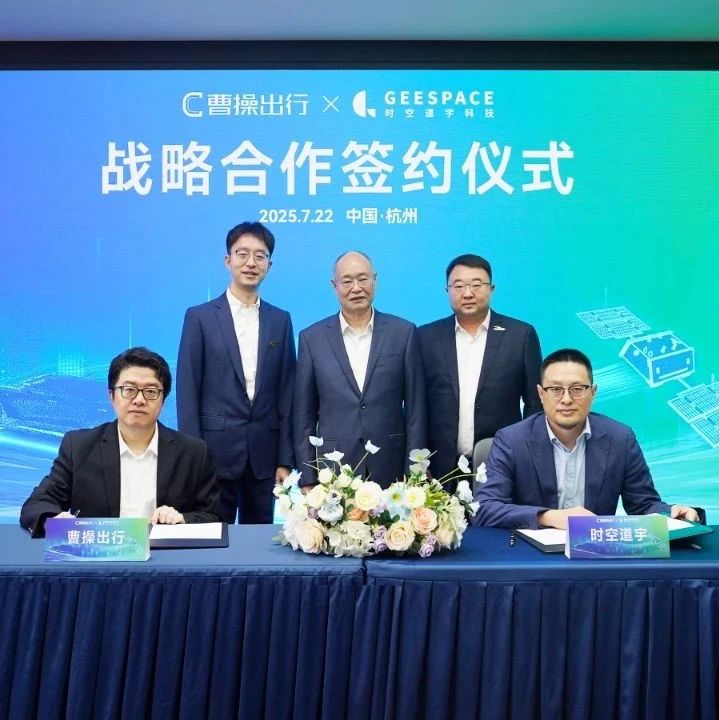
Core Viewpoint - The strategic partnership between Cao Cao Mobility and the aerospace company Time Space Dao Yu aims to enhance autonomous driving safety standards by integrating satellite communication and high-precision positioning technology into their Robotaxi operations [1][3][7] Group 1: Strategic Partnership - Cao Cao Mobility announced a strategic collaboration with Time Space Dao Yu to utilize their existing 30 satellites for improving autonomous driving safety [1][3] - This partnership positions Cao Cao Mobility as the first global platform to fully integrate low-orbit satellite communication and centimeter-level high-precision positioning technology in Robotaxi operations [3][4] Group 2: Safety and Technology Integration - The integration of satellite communication ensures real-time data transmission and emergency reporting, maintaining reliable connections between vehicles and control centers [4][5] - Cao Cao Mobility's autonomous driving platform will achieve centimeter-level positioning accuracy, even in complex urban environments, enhancing operational safety [5][6] Group 3: Market Response and Future Plans - Following the announcement, Cao Cao Mobility's stock price increased by 4.56%, indicating market confidence in its Robotaxi business potential [3] - The company plans to launch a custom L4-level Robotaxi model by the end of 2026, designed for long-term operation with lower total cost of ownership (TCO) [7]


直连卫星!曹操出行放大招,Robotaxi将实现厘米级定位
证券时报· 2025-07-23 12:29
Core Viewpoint - The strategic partnership between Cao Cao Mobility and the aerospace company Time Space Dao Yu aims to enhance the safety standards of autonomous driving through satellite communication and high-precision positioning technology, marking a significant step towards the commercialization of Robotaxi services [1][3][10]. Group 1: Strategic Partnership and Technology Integration - Cao Cao Mobility announced a strategic cooperation with Time Space Dao Yu to utilize its existing 30 satellites for improving autonomous driving safety [1]. - The collaboration will explore the integration of global satellite communication and high-precision positioning technology for managing and operating autonomous vehicle fleets [3]. - This initiative positions Cao Cao Mobility as the first global platform to fully integrate low-orbit satellite communication and centimeter-level high-precision positioning technology in Robotaxi operations [3][10]. Group 2: Safety and Operational Enhancements - The partnership aims to ensure that vehicles are "always online and never disconnected," enhancing real-time data transmission and emergency reporting capabilities [6]. - Vehicles will achieve centimeter-level positioning accuracy, even in complex urban environments, ensuring reliable operation under adverse weather conditions [7]. - Cao Cao Mobility's existing ride-hailing services have demonstrated a significantly lower accident rate compared to industry averages, indicating a strong focus on safety [5]. Group 3: Future Developments and Market Position - The company plans to launch a custom L4-level Robotaxi model by the end of 2026, designed specifically for autonomous driving with lower total cost of ownership [10]. - Cao Cao Mobility's integration with Geely Group's resources positions it as a key player in the future of shared mobility, with a comprehensive ecosystem that includes vehicle manufacturing, autonomous driving technology, and operational platforms [9][10]. - Following the announcement of the partnership, Cao Cao Mobility's stock price increased by 4.56%, reflecting market confidence in its Robotaxi business potential [3].
广州的士司机最新收入公布,出租汽车市场供给趋于饱和
Nan Fang Du Shi Bao· 2025-07-23 11:27
Core Insights - The report from Guangzhou's Transportation Bureau indicates a decline in the number of traditional taxis and drivers, while the number of ride-hailing vehicles and drivers continues to increase [1][2] Group 1: Traditional Taxi Industry - As of June 2025, Guangzhou has 14,252 traditional taxis and 27,841 active drivers, a decrease of 1,655 vehicles compared to December 2024 [2] - The number of traditional taxis and drivers has decreased by over 30% and 15% respectively compared to the same period three years ago [2] - The average daily revenue per traditional taxi is approximately 607.40 yuan, which is a decrease of 23.24 yuan compared to the second half of 2024 [3] Group 2: Ride-Hailing Industry - By June 2025, there are 120 licensed ride-hailing companies in Guangzhou, with 209,607 ride-hailing transport permits issued, an increase of 10,957 since December 2024 [2] - The number of ride-hailing driver permits issued reached 343,091, an increase of 19,515 since December 2024 [2] - The average daily order volume for ride-hailing vehicles is approximately 13.23 orders [3] Group 3: Regulatory and Market Conditions - In the first half of 2025, Guangzhou's transportation enforcement authorities handled 639 illegal operation cases and 2,284 operational violation cases related to traditional taxis [4] - The market for traditional taxis is approaching saturation, leading to increased operational pressure [5]
滴滴暑期打车活动上线
Mei Ri Shang Bao· 2025-07-23 10:49
Core Insights - The summer travel season has seen a significant increase in demand for cross-border travel, prompting Didi Chuxing to launch a promotional campaign offering discounts on rides from July 1 to July 31 [1][2] Group 1: Promotional Activities - Didi Chuxing is offering a summer discount of 30% on rides, with users able to access exclusive ride vouchers through the Didi app or mini-program [1] - The promotional package includes two 30% off vouchers (up to 20 yuan each) and one 20% off voucher (up to 10 yuan) for overseas rides [1] - Specific discounts vary by destination, such as special ride vouchers for users traveling to South Korea, Japan, and Hong Kong, with varying maximum discounts [1] Group 2: User Experience and Features - Since the launch of Didi's overseas service, it has provided convenient and affordable travel options during major holidays, allowing users to switch to overseas cities without needing additional apps [2] - The app supports Chinese and English input for locations, offers Chinese customer service, and allows payment through Alipay and WeChat, enhancing the user experience for international travelers [2] - Popular travel destinations during the summer include Tokyo, Seoul, and Singapore, with users primarily coming from first and second-tier cities in China [2]

广州出租汽车市场供给趋于饱和
news flash· 2025-07-23 07:19
Core Insights - The Guangzhou taxi market is approaching saturation, with a decline in the number of traditional taxi vehicles, drivers, and average daily revenue per vehicle [1] Group 1: Market Trends - The number of traditional taxi vehicles and drivers in Guangzhou is decreasing, with average daily revenue per vehicle at approximately 607.40 yuan [1] - In contrast, the number of ride-hailing vehicles and drivers is increasing, with 343,091 ride-hailing driver certificates issued by the end of June, an increase of 19,515 since December 2024 [1]
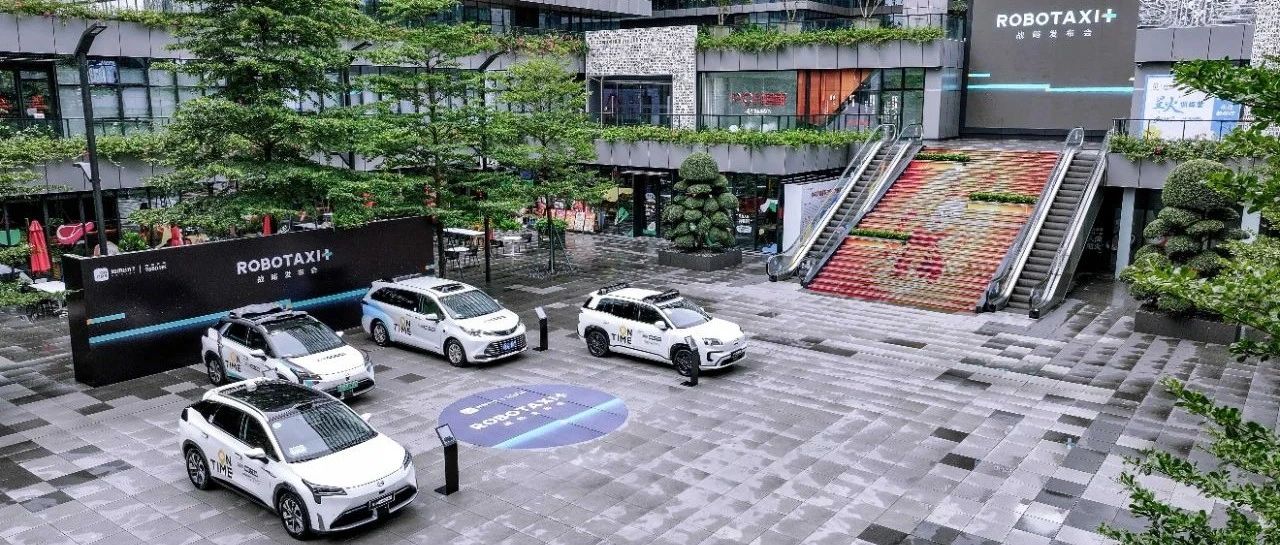
如祺出行发布“Robotaxi+”战略:要做「中国版Uber」,加速Robotaxi大规模商业化落地
IPO早知道· 2025-07-23 04:44
Core Viewpoint - The article discusses the launch of "Robotaxi+" strategy by Ruqi Mobility, aiming to accelerate the large-scale commercialization of Robotaxi services through collaboration with various stakeholders in the industry [2][4]. Group 1: Robotaxi Development Strategy - Ruqi Mobility's approach to Robotaxi development is similar to that of global ride-hailing company Uber, focusing on expanding partnerships and operational capabilities to enhance service delivery [2]. - The CEO of Ruqi Mobility emphasized that the industry is now in a phase where the ability to achieve large-scale commercial deployment will determine the viability of players in the Robotaxi sector [4]. - The "Robotaxi+" strategy aims to upgrade the existing open Robotaxi operational technology platform to provide comprehensive solutions for all participants in the Robotaxi commercialization process [5]. Group 2: Expansion Plans - Ruqi Mobility has introduced two major expansion plans, "Spark Plan" and "Galaxy Plan," to enhance the scale of Robotaxi fleets and operational infrastructure [7]. - The "Spark Plan" focuses on expanding the operational range and fleet size of Robotaxi services, with a goal to cover 100 core cities and build a fleet of over 10,000 vehicles in the next five years [7]. - The "Galaxy Plan" involves a 1 billion investment over the next five years to establish a three-tier maintenance network for Robotaxi services across 100 core cities, supporting the operation of 100,000 vehicles annually [8]. Group 3: Partnerships and Collaborations - Ruqi Mobility has signed cooperation agreements with several strategic partners, including GAC Commerce and GAC Energy, to deepen collaboration in building Robotaxi fleets and operational networks [9]. - The company aims to leverage its operational data and asset management experience to provide comprehensive operational solutions to ecosystem partners [7][10]. Group 4: Market Position and Performance - Since its inception in 2019, Ruqi Mobility has positioned itself as a leader in the mixed operation of human-driven and Robotaxi services, becoming the first platform to commercialize such a model [10]. - As of June 2025, Ruqi Mobility's Robotaxi fleet has exceeded 300 vehicles, covering multiple regions and achieving significant operational milestones, including over 4,000 service stations and 4 million kilometers of safe operation [10]. - The demand for Robotaxi services has surged, with order volumes in regions like Nansha, Guangzhou, increasing by over 480% in the first half of 2025 [10].
非权威信源被引用 “北京燃油车彻底禁入网约平台”消息不实
Zhong Guo Jing Ji Wang· 2025-07-23 04:31
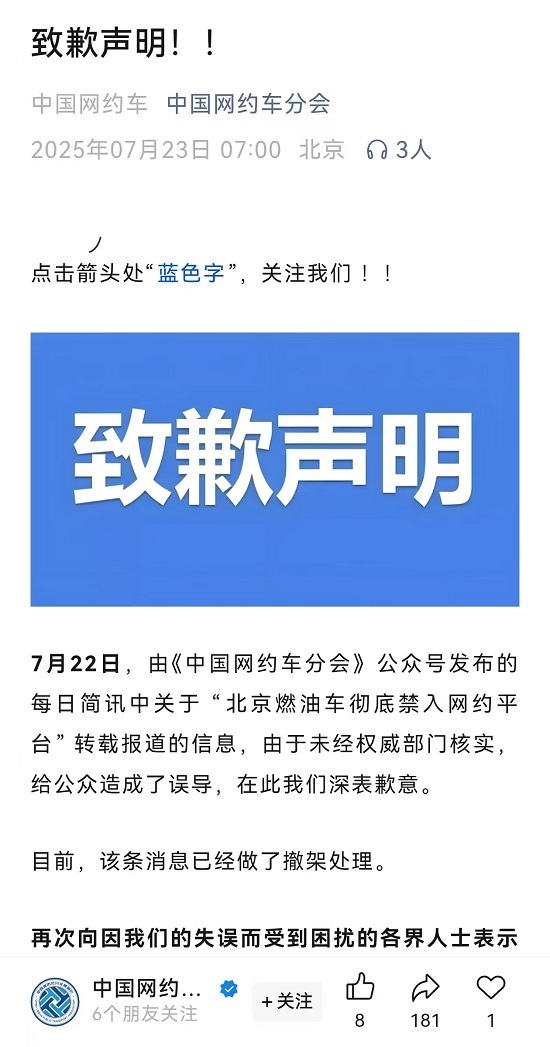
Core Viewpoint - The China Urban Public Transport Association's ride-hailing branch issued an apology for misleading information regarding a complete ban on fuel vehicles in Beijing's ride-hailing platforms, which was published without proper verification [1][5][10]. Group 1: Incident Overview - On July 22, the "China Ride-Hailing Branch" published a daily brief stating that as of July 20, fuel vehicles were completely banned from ride-hailing platforms in Beijing [6][10]. - The brief included subjective statements such as "killing all fuel vehicles" and "plummeting prices of ride-hailing vehicles in the second-hand market," which were widely circulated by major media outlets [10]. Group 2: Official Response - The Beijing Transportation Committee confirmed that they had not received any notification regarding the ban on fuel vehicles [11]. - The Beijing Transportation APP customer service stated that vehicles must meet specific criteria, including being registered in the city and complying with the latest emission standards, to operate as ride-hailing vehicles [11]. Group 3: Industry Context - The spread of unverified information has reignited discussions about the challenges faced by fuel vehicles, with the penetration rate of new energy vehicles exceeding 44% as of mid-year [13]. - Despite the rise of new energy vehicles, fuel vehicles remain a significant source of revenue for major automotive companies and contribute to various industry taxes [13].
异动盘点0723|曹操出行盘中创新高;稳定币概念继续活跃;蔚来再涨超8%;meme股科尔百货暴涨
贝塔投资智库· 2025-07-23 04:15
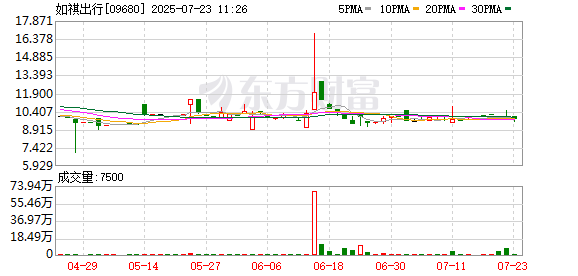
Group 1: Hong Kong Stock Market Movements - Jin Jing New Energy (01783) rose over 4.5% as the Hang Seng Index company is set to release its mid-year review results on August 22, with changes effective from September 8 [1] - Paper stocks in Hong Kong continued to rise, with Nine Dragons Paper (02689.HK) increasing over 7%, recording five consecutive gains, while Lee & Man Paper (02314.HK) rose about 5% [1] - Airline stocks saw significant gains, with China National Aviation (0753.HK) up over 7%, driven by the Civil Aviation Administration's emphasis on enhancing the industry’s competitive landscape [1] - Renrui Talent (06919) surged over 19% after announcing a positive earnings forecast, expecting revenue of approximately RMB 2.49 billion to 2.69 billion for the year ending June 30, 2025, representing a year-on-year growth of 21.1% to 30.8% [1] Group 2: Other Notable Stock Movements - China Antibody-B (03681) increased over 8% after entering into subscription agreements for the issuance of 182 million new shares at a subscription price of HKD 2.03 per share [2] - Fufeng Group (00546) rose over 4% with an expected net profit of RMB 1.74 billion for the first half of the year, a 67% increase year-on-year, attributed to higher sales and lower raw material costs [2] - Cao Cao Travel (02643) gained over 4%, reaching a new high following a strategic partnership with a leading commercial aerospace company [2] - NIO-SW (09866) rose over 8%, with a cumulative increase of over 40% in the month [2] Group 3: US Stock Market Highlights - Kohl's (KSS.US) saw a dramatic increase of nearly 90%, becoming a popular "meme stock" among retail investors, closing at $14.34, up 37.62% [3] - Daqo New Energy (DQ.US) closed at $24.60, with a rise of 16.75%, as silicon material prices have been on the rise, with an increase of 25-35% recently [3] - General Motors (GM.US) stock fell by 8.12% to $48.89, with the CFO indicating potential tariff impacts of up to $5 billion this year [3] - The Nasdaq Golden Dragon China Index rose 1.35%, with notable gains in Chinese concept stocks, including PONY.US up 8.62% and NIO.US up 10.84% [3] Group 4: Additional Stock Movements - Faraday Future (FFAI.US) surged over 43% after receiving a non-binding order for 1,000 vehicles valued at up to $100 million [4] - Most new energy vehicle stocks rose, with Lucid Group (LCID.US) closing at $3.13, an increase of about 11% [4] - Circle (CRCL.US) fell by 8.23% after a downgrade from "neutral" to "sell" by Compass Point Research [4] - Replimune (REPL.US) dropped 77% after the FDA rejected its application for a combination therapy for advanced melanoma, citing insufficient evidence [4]



如祺出行启动“Robotaxi+”战略,5年覆盖100城
Guang Zhou Ri Bao· 2025-07-23 03:25
Group 1 - The core strategy of the company is the launch of the "Robotaxi+" initiative, aiming to expand Robotaxi operations to 100 core cities and build a fleet of over 10,000 vehicles within five years [2][5] - The "Robotaxi+" platform will provide comprehensive solutions for the commercial operation of Robotaxis, including asset operation and maintenance plans, while ensuring data transparency and efficient regulation [3][4] - The company is committed to becoming a leader in the large-scale commercialization of Robotaxis, with a focus on operational capabilities and strategic partnerships with leading autonomous driving technology firms [4][7] Group 2 - The "Starfire Plan" aims to expand the operational range and fleet size of Robotaxis, leveraging existing operational experience in the Greater Bay Area to replicate standardized operational models across 100 cities [5][6] - The "Star River Plan" involves a 1 billion yuan investment to establish a three-tier maintenance network in 100 cities, supporting the operation of 100,000 Robotaxis annually [6] - As of mid-2025, the company operates over 300 Robotaxis, with significant growth in order volume, particularly in Guangzhou Nansha, where orders increased by over 480% year-on-year [8]
官方回应北京燃油车禁入网约车|新鲜早科技
2 1 Shi Ji Jing Ji Bao Dao· 2025-07-23 02:29
Group 1: Industry Developments - Beijing has announced a complete ban on fuel vehicles from ride-hailing platforms, but the Chinese Urban Public Transport Association has since deleted the announcement and issued an apology due to verification issues [2] - OpenAI has partnered with Oracle to develop an additional 4.5 GW capacity for the "Stargate" data center in the U.S., bringing the total capacity to over 5 GW [5] - The "Civil Aviation Official Direct Sales Platform" has been launched by the Hanglv Zongheng App, allowing users to compare and purchase tickets from multiple airlines without agent fees [6] Group 2: Company Initiatives - Meituan has launched the "Ten Thousand Brands" plan to support 10,000 well-known restaurant brands with traffic support and brand assistance, aiming for over 1 million merchants by July 2025 [7] - Tencent Cloud has initiated the internal testing of CodeBuddy IDE, an AI-integrated development platform that allows users to program using natural language [8] - xLight, a U.S. semiconductor startup, has completed a $40 million Series B funding round to further develop extreme ultraviolet (EUV) free electron lasers [13] Group 3: Technological Innovations - India's first domestically produced semiconductor chip is set to be announced by the end of 2025, with six semiconductor factories under construction [10] - Samsung is focusing on improving the yield of its 2nm GAA process technology, delaying the production of its 1.4nm process to 2029 [11] - iFlytek has released the X5, the world's first local large model smart office device, featuring offline AI capabilities and a lightweight design [16]
