光模块

Search documents
海外大厂百亿美元算力合作,光模块需求上修!云计算ETF汇添富(159273)探底回升!机构:政策引领,重点布局算力与存储赛道
Sou Hu Cai Jing· 2025-10-29 03:28
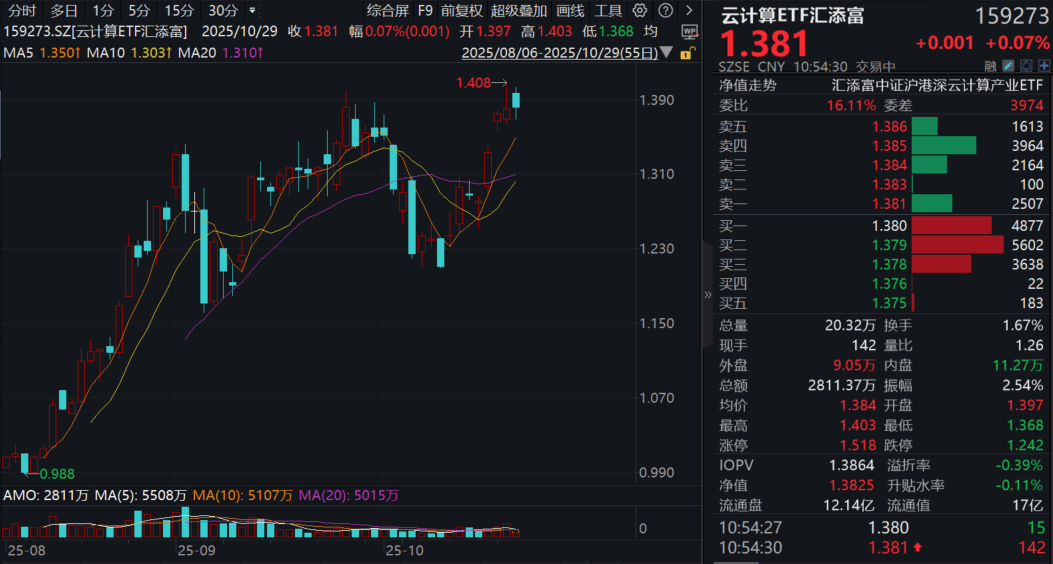
Group 1 - The cloud computing ETF Huatai (159273) showed a rebound after a volatile trading session, with a trading volume exceeding 30 million yuan, and its latest scale reached nearly 1.7 billion yuan, leading its peers [1] - As of October 28, the ETF's net value was 1.3825, with a slight increase of 0.07% on October 29, and the trading data indicated a total volume of 203,200 shares with a turnover rate of 1.67% [1] - Major component stocks of the ETF, such as Inspur Information and Kingdee International, experienced gains, with Inspur Information rising over 2% [1][2] Group 2 - Anthropic confirmed a partnership with Google Cloud worth several billion dollars, involving the provision of up to 1 million TPU AI chips and 1GW of power capacity, marking Anthropic's largest TPU procurement agreement to date [3] - The global AI computing power arms race is intensifying, with companies like OpenAI also forming significant partnerships with Nvidia and AMD for large-scale computing systems [3] - The demand for AI tokens has surged, leading to optimistic market expectations for AI computing investments and commercialization prospects [3][4] Group 3 - The demand for optical modules is projected to increase significantly, with estimates for 2025-2027 showing a demand of 50 million, 75 million, and 100 million units respectively [4] - Recent adjustments in procurement plans for 1.6T optical modules have raised the total industry demand from 10 million to 20 million units, driven by the rapid growth in bandwidth requirements for AI training and inference networks [5] - The semiconductor industry in China is focusing on self-sufficiency, with a strong push for domestic equipment and materials to meet the increasing demand for AI computing power [6]

公募三季报揭秘,AI概念股成新宠
Huan Qiu Wang· 2025-10-29 03:15
Core Insights - The latest public fund holdings reveal a significant shift, with Ningde Times reclaiming the top position and AI-related stocks becoming the focus of increased investments in Q3 2025 [1][3] Group 1: Fund Holdings Changes - The top ten holdings of public funds now include Ningde Times, Tencent Holdings, New East Wisdom, Zhongji Xuchuang, Luxshare Precision, Industrial Fulian, Zijin Mining, and Kweichow Moutai, with notable entries being Zhongji Xuchuang and Industrial Fulian, while Midea Group and Xiaomi Group-W exited the list [1] - Ningde Times leads with a holding market value of 75.881 billion yuan, surpassing Tencent Holdings at 69.938 billion yuan [1] Group 2: AI Sector Focus - The public funds have shown a clear preference for the AI sector, with the top four increased holdings closely related to AI hardware: Zhongji Xuchuang, New East Wisdom, Industrial Fulian, and Alibaba-W, with increases of 40.174 billion yuan, 36.930 billion yuan, over 30 billion yuan, and over 20 billion yuan respectively [3] - Stocks like Cambrian, Luxshare Precision, and SMIC also received significant increases, each exceeding 12 billion yuan [3] Group 3: Market Performance and Fund Manager Sentiment - The stock price increases for Zhongji Xuchuang, New East Wisdom, and Industrial Fulian exceeded 170%, 180%, and 210% respectively, marking them as leading performers [3] - Fund managers express a mix of optimism and caution regarding the AI sector, with a focus on the strong domestic demand for computing power and the gradual resolution of supply chain bottlenecks [3][4] - Concerns about long-term AI market conditions and the need for cautious investment in technology stocks are highlighted, emphasizing the importance of maintaining a balance between optimism and caution [4]



成长风格持续回暖,创业板50ETF大成(159298)红盘涨超2%,跟踪指数优势凸显:多元赛道+高弹性+契合“十五五”政策
Xin Lang Cai Jing· 2025-10-29 03:06
Core Viewpoint - The article highlights the strong performance of the Chuangye Board 50 ETF (159298), which has seen significant gains and inflows, driven by its alignment with emerging industries and government policies [1][3][4]. Group 1: Performance Metrics - As of October 29, 2025, the Chuangye Board 50 ETF (159298) experienced an intraday increase of over 2%, currently up 1.68%, marking a potential five-day winning streak [1]. - The ETF has accumulated a weekly increase of 5.61%, ranking first among comparable funds [1]. - The latest scale of the ETF reached 471 million yuan, with a total of 417 million shares, both hitting record highs since inception [1]. - In terms of capital inflow, the ETF has seen continuous net inflows over the past three days, with a peak single-day net inflow of 156 million yuan, totaling 372 million yuan [1]. Group 2: Index Characteristics - The Chuangye Board 50 Index focuses on core areas of new productivity, covering diverse high-growth sectors such as renewable energy, semiconductors, biomedicine, and AI, with the top three industries accounting for over 68% of the index [1]. - The index exhibits significant high beta characteristics, having increased over 60% since the beginning of 2025, outperforming mainstream indices like the CSI 300 [2]. - The index's recent performance includes a weekly increase of over 10%, showcasing its elasticity under a growth-oriented market [2]. Group 3: Policy Alignment - The index aligns closely with the "15th Five-Year Plan," emphasizing technological self-reliance and the cultivation of emerging industries, with over 80% of its weight in sectors like AI, high-end manufacturing, and green energy [3]. - The recent policy guidance encourages the development of strategic emerging industries, including new energy, new materials, and aerospace, which are expected to benefit from the index's focus [3]. - The plan outlines the exploration of diverse technological routes and market regulations to foster new economic growth points, including quantum technology and hydrogen energy [3]. Group 4: Market Outlook - According to China International Capital Corporation, the market may see a shift in style favoring large-cap growth stocks in the medium term (3-6 months) [4]. - The current macroeconomic environment supports emerging growth sectors, with ongoing economic recovery and a focus on innovation and mergers [4]. - The proportion of institutional investors in large-cap emerging growth companies is expected to increase, indicating a balanced impact on market segments [4].

刚刚,公募基金十大重仓股出炉!
天天基金网· 2025-10-29 01:13
Core Viewpoint - The public fund industry has shown a significant shift in its investment strategy, with a notable increase in holdings of technology stocks, particularly those related to artificial intelligence (AI) and semiconductor sectors, while reducing exposure to traditional consumer and banking stocks [3][8][12]. Group 1: Public Fund Holdings - As of the end of Q3 2025, the top ten holdings of public funds include Ningde Times, Tencent Holdings, and new entrants like Zhongji Xuchuang and Industrial Fulian, while companies like Midea Group and Xiaomi Group have exited the top ten [3][5]. - Ningde Times has regained its position as the largest holding, with a market value of 75.881 billion yuan, while Tencent Holdings is now the second largest at 69.938 billion yuan [5]. - The public funds have significantly increased their holdings in Zhongji Xuchuang and New Yisheng, with increases of 40.174 billion yuan and 36.930 billion yuan respectively [6][8]. Group 2: Performance of Technology Stocks - The technology sector has outperformed in Q3, with Zhongji Xuchuang's stock price increasing over 170%, New Yisheng over 180%, and Industrial Fulian over 210% [8]. - Several funds with high returns in the first three quarters have heavily invested in these technology stocks, indicating a strong belief in their growth potential [8]. Group 3: Reduction in Traditional Holdings - Public funds have significantly reduced their positions in traditional blue-chip stocks, with Xiaomi Group being the most reduced stock at 10.834 billion yuan, followed by Midea Group and others [9]. - Notably, Pop Mart, which saw increased holdings in Q2, was also heavily reduced in Q3, indicating a shift in investor sentiment [9]. Group 4: Market Outlook and Investment Strategy - Fund managers express a cautious optimism regarding the technology sector, particularly in AI, while also highlighting the importance of maintaining a balanced portfolio that includes undervalued consumer stocks [11][12]. - The demand for domestic computing power and the gradual resolution of supply chain bottlenecks are expected to drive growth in the AI sector, with a focus on hardware innovations [12][13].




知名科技基金经理最新操作!
券商中国· 2025-10-28 23:33
Core Viewpoint - The article discusses the significant performance of overseas computing power sectors, represented by optical modules and PCBs, which have provided substantial returns for heavily invested funds, but have also led to increased divergence after substantial price increases [1] Summary by Sections Fund Performance - On October 28, the third-quarter report of well-known fund manager Jin Zicai from Caitong Fund was released, showing that the net value growth rate of the Caitong Growth Preferred A class share reached 90.4% in Q3, outperforming the benchmark by over 80 percentage points [2][3] Portfolio Adjustments - Jin Zicai made significant adjustments to his holdings, drastically reducing positions in leading optical module companies like NewEase and Tianfu Communication, while increasing investments in core PCB industry players such as Shenzhen South Circuit, Shengyi Technology, and Huitian Technology [2][3] - After the adjustments, the top five holdings of the fund included Industrial Fulian, Shenzhen South Circuit, Shengyi Technology, Huitian Technology, and Zhongji Xuchuang [3] Market Insights - Jin Zicai noted that the market's understanding of the optical communication sector has improved, leading to a reduction in the fund's holdings in this area. He believes that the PCB industry may experience unexpected price increases due to structural supply-demand imbalances by 2026 [3] - Despite reducing exposure to optical modules, Jin Zicai continues to heavily overweight the overseas computing power sector, indicating that the growth certainty of overseas AI has increased, and demand for computing power is expected to grow rapidly in 2026 and 2027 [4][5] Investment Strategy - The fund's management scale increased from 4.618 billion to 6.525 billion yuan, with a focus on maintaining research and tracking of other sectors, aiming for proactive and replicable investments in high-quality companies aligned with industry trends [5]
基金经理"同题异做"科技赛道AI算力投资图谱现分歧
Zheng Quan Shi Bao· 2025-10-28 23:15
Core Insights - The AI computing sector has seen significant returns for heavily invested funds this year, leading to a divergence in investment strategies among fund managers [1][2] - Notable fund managers are adjusting their portfolios within the AI computing chain, with some reducing holdings in high-performing optical modules while increasing positions in PCB and AI application sectors [2][3] Fund Manager Adjustments - Fund managers like Jin Zicai from Caitong Fund have significantly increased their holdings in PCB-related companies such as Shenzhen South Circuit and Shengyi Technology, while reducing positions in leading optical module firms like NewEase and Zhongji Xuchuang [2][4] - The China Europe Digital Economy Fund, managed by Feng Ludan, has made more substantial adjustments, reducing exposure to optical modules and PCB while increasing investments in AI application stocks like Alibaba and Tencent [3][4] Long-term Outlook on AI Infrastructure - Despite the adjustments, there remains a consensus among fund managers regarding the long-term potential of AI infrastructure, with expectations of increased demand for computing power in the coming years [4][5] - Jin Zicai emphasized that the growth certainty of overseas AI has improved, predicting faster growth in computing demand for 2026 and 2027 [4] Investment Risks and Valuation Concerns - While acknowledging the long-term value of the AI computing sector, fund managers have also highlighted the risks associated with high valuations following significant price increases [7] - Concerns have been raised about the sustainability of past performance as the AI sector's overall valuation is no longer at a low level, with some stocks reflecting overly optimistic growth expectations [7]



知名基金经理调仓动向曝光 下一个“风口”在哪里?
2 1 Shi Ji Jing Ji Bao Dao· 2025-10-28 23:12
Core Insights - The article highlights the significant adjustments made by various fund managers in their portfolios during the third quarter, particularly focusing on sectors like PCB and AI computing [1][2][3]. Group 1: Fund Manager Adjustments - Notable fund managers such as Fu Pengbo and Xie Zhiyu increased their stakes in PCB leader Dongshan Precision, while Mo Haibo reduced his holdings in optical modules and shifted focus to the robotics industry [1][2]. - The top ten shareholders of Dongshan Precision now include prominent fund managers, indicating a strong interest in this stock [2]. - The "champion fund" Yongying Technology Smart Selection has seen a year-to-date return exceeding 200%, with significant increases in holdings of key stocks in the PCB and optical module sectors [3][6]. Group 2: Sector Focus and Performance - The article emphasizes the growing preference for AI computing and related sectors among fund managers, with Yongying Technology Smart Selection heavily investing in this area since the second quarter [3][4]. - Mo Haibo's fund continues to favor AI and coal sectors, highlighting the potential for substantial growth in domestic computing capabilities [9]. - The performance of funds focused on AI computing has attracted considerable net subscription funds, reflecting investor confidence in this sector [9][10]. Group 3: Market Outlook - Fund managers express confidence in the A-share market, citing favorable domestic fiscal and monetary policies, which may lead to increased asset allocation towards equities [8]. - The article notes that despite external uncertainties, the market may continue to trend upwards, supported by a release of trading sentiment and pressure in certain sectors [8]. - The long-term growth potential of the cloud computing industry is acknowledged, with caution advised against assuming past performance will predict future results [10].

宁德时代重回头号重仓股宝座 公募三季度“独宠”科技主线
Zhong Guo Zheng Quan Bao· 2025-10-28 21:14
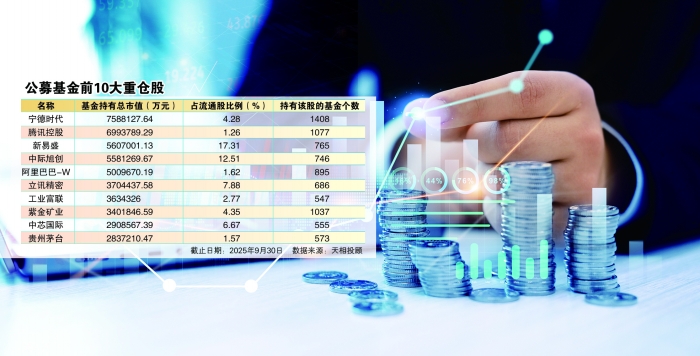
10月28日,公募基金2025年三季报披露完毕。公募基金最新前十大重仓股出炉,分别是宁德时代、腾讯 控股、新易盛、中际旭创、阿里巴巴-W、立讯精密、工业富联、紫金矿业、中芯国际、贵州茅台。 与2025年二季度末相比,中际旭创、工业富联新进成为公募基金前十大重仓股,美的集团、小米集团- W则退出前十大重仓股行列。 宁德时代成为第一大重仓股 从减持的情况来看,今年三季度,公募基金减持市值最多的是小米集团-W,减持108.34亿元;公募基 金减持美的集团、招商银行、顺丰控股的市值均超过70亿元。美团-W、格力电器、长江电力、比亚迪 等个股也被公募基金减持较多。 公募"擒牛"有方 三季度,科技板块表现突出,公募基金三季度增持的方向也聚焦这一领域,增持的前十大个股中,大多 是科技股,尤其是光模块等与人工智能(AI)相关的细分领域。 中际旭创三季度股价涨幅超170%,新易盛三季度股价涨幅超180%,工业富联三季度股价涨幅超210%, 这三家公司是三季度公募基金增持市值最多的三只个股。另外,寒武纪、立讯精密、中芯国际、沪电股 份等主营业务与AI相关的公司也位列公募基金三季度增持市值前十的个股榜单中。其中,中际旭创、 新易盛 ...
宁德时代重回头号重仓股宝座公募三季度“独宠”科技主线
Zhong Guo Zheng Quan Bao· 2025-10-28 21:10
Core Insights - The latest public fund report for Q3 2025 reveals significant changes in the top ten holdings, with Ningde Times regaining the top position, followed by Tencent Holdings and several technology stocks [1][2] Fund Holdings - Ningde Times is the largest holding with a market value of 75.881 billion yuan, while Tencent Holdings is the second largest at 69.938 billion yuan [2] - New entrants to the top ten holdings include Zhongji Xuchuang and Industrial Fulian, while Midea Group and Xiaomi Group-W have exited [1][2] Investment Trends - The most increased holdings in Q3 were Zhongji Xuchuang and New Yisheng, with increases of 40.174 billion yuan and 36.930 billion yuan respectively [3] - Other notable increases include Industrial Fulian (over 30 billion yuan) and Alibaba-W, Ningde Times (over 20 billion yuan) [3] - The technology sector, particularly AI-related stocks, has been a focal point for public fund investments [3][4] Stock Performance - Zhongji Xuchuang, New Yisheng, and Industrial Fulian saw stock price increases of over 170%, 180%, and 210% respectively in Q3 [4] - Funds with high returns in the first three quarters have heavily invested in these technology stocks, with Yongying Technology Smart Selection A being the top performer [4] Market Sentiment - Public funds have significantly reduced their holdings in several blue-chip stocks, with Xiaomi Group-W being the most reduced at 10.834 billion yuan [5] - Other notable reductions include Midea Group, China Merchants Bank, and SF Express, each exceeding 7 billion yuan [5] Manager Insights - Fund managers express a cautious yet optimistic view on technology stocks, particularly in AI, highlighting the potential for growth in domestic demand and supply chain improvements [6][7] - The overall market is perceived as healthy, with opportunities in undervalued stocks and those with strong balance sheets [6][7] - The focus remains on AI hardware innovations and semiconductor advancements as key investment opportunities [7][8]
持仓 宁德时代重返头号重仓股“宝座” AI标的晋升公募持仓“新贵”
Shang Hai Zheng Quan Bao· 2025-10-28 20:06
Core Insights - The A-share market experienced a strong rebound in Q3, with major indices showing significant gains, indicating a recovery in market confidence and accelerated capital inflow [1][2][3] Fund Holdings Overview - As of the end of Q3, the top ten holdings of public funds include Ningde Times, Tencent Holdings, NewEase, and Zhongji Xuchuang, with Ningde Times reclaiming the top position [2][5] - The average equity positions of stock and mixed funds increased to 90.14% and 82.15%, respectively, compared to the previous quarter [3][4] Sector Performance - The top 50 holdings of public funds are primarily concentrated in the information technology, consumer goods and services, and pharmaceutical sectors, with 19 stocks in the information technology sector [5][6] - AI-related stocks have emerged as new favorites among public funds, with NewEase and Zhongji Xuchuang making significant gains [5][7] Fund Manager Insights - Fund managers expressed optimism about the A-share market, citing supportive policy environments and potential earnings improvements across various sectors [4][9] - There is a notable focus on the AI sector, with several funds maintaining high allocations to AI-related stocks and increasing positions in lithium battery and non-ferrous metals sectors [7][8] Future Outlook - Fund managers are generally optimistic about the growth potential in the technology sector, particularly in AI, energy storage, and new energy vehicles, viewing the current market as a pivotal point for the next industrial revolution [9]