
种植业

Search documents
吉林省秋收进入收尾阶段 确保应收尽收
Xin Hua She· 2025-10-31 07:24
Core Insights - The article highlights the successful progress of autumn harvest production in Jilin Province, with efforts ensuring that all crops are harvested efficiently [1][2] Group 1: Harvest Progress - As of October 30, a total of 89.2764 million acres of grain crops have been harvested, accounting for 95.72% of the total area, which is 4.2% faster than last year [2] - The late onset of the first frost this year has positively impacted the weight of grain crops and their maturity [2] Group 2: Agricultural Performance - This year is noted as one of the best for Jilin Province in terms of crop growth, with the least disaster impact, optimal crop conditions, and the highest grain yield recorded [2] - All metrics, including planting area, yield per unit, and total production, are showing an upward trend [2] Group 3: Future Agricultural Practices - The agricultural department is focused on ensuring complete harvest and is promoting practices such as straw returning and conservation tillage to protect black soil, laying a solid foundation for next year's agricultural production [2]
辽宁彰武:“麦豆两茬”一年两种 春季锁风沙 秋季土生金
Zhong Guo Xin Wen Wang· 2025-10-31 05:40
Core Viewpoint - The "wheat and bean double cropping" rotation model implemented in Zhangwu County, Liaoning Province, has revitalized previously desertified farmland, enabling farmers to achieve two harvests a year and increasing their income [1] Group 1: Agricultural Innovation - The "wheat and bean double cropping" rotation model was explored starting in 2023, transforming sandy farmland that was often subject to wind erosion [1] - This agricultural practice has led to significant improvements in land productivity, allowing for a more sustainable farming approach [1] Group 2: Economic Impact - The new farming model directly contributes to increased income for local farmers, enhancing their economic stability [1] - The initiative reflects a broader trend of agricultural innovation aimed at combating land degradation and improving food security [1]
八一总场公司积极推进西培天角潭黄皮种植项目
Hai Nan Ri Bao· 2025-10-31 02:03
Core Viewpoint - The company is actively promoting the Xipei Tianjiaotan Huangpi planting project, focusing on standardized planting, large-scale operations, and brand development to create a distinctive agricultural demonstration project that supports rural revitalization [1] Summary by Relevant Sections Project Overview - The Xipei Tianjiaotan Huangpi planting project is located in Dacheng Town, Danzhou City, covering a total area of approximately 792.6 acres with a total investment of 28.11 million yuan [1] - The construction includes land leveling, irrigation systems, power supply, road construction, and supporting infrastructure, as well as seedling procurement, planting, and management [1] Strategic Goals - The project aims to leverage Danzhou City's unique resources to expand tropical characteristic high-efficiency agriculture, aligning with Hainan Agricultural Reclamation's "one field, one product" initiative [1] - The company intends to establish the project as a model for standardized planting, large-scale operations, and brand development, contributing to the development of the local immigrant industry and enhancing livelihoods [1]
这个“重中之重”,如何抓紧抓实(乡村观察)
Ren Min Ri Bao· 2025-10-30 22:37
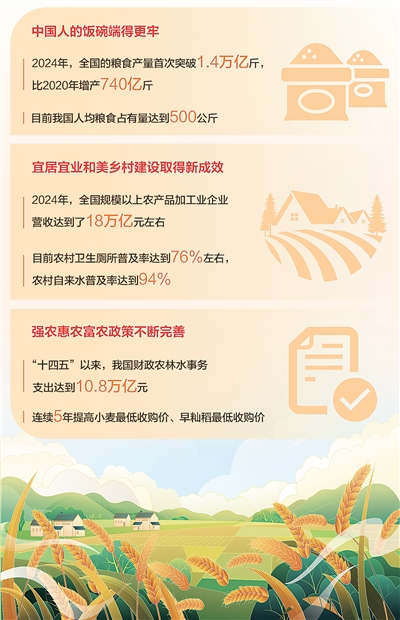
Core Viewpoint - The modernization of agriculture and rural areas is essential for China's overall modernization, as emphasized by the 20th Central Committee and the 15th Five-Year Plan proposal, which prioritizes addressing "three rural issues" and promoting urban-rural integration [1][3]. Group 1: Agricultural Production - The proposal aims to enhance agricultural comprehensive production capacity and quality, with a target of exceeding 1.4 trillion jin in national grain production by 2024 [1][3]. - The strategy includes implementing "storing grain in the ground and technology," advancing high-standard farmland construction, and improving agricultural machinery levels to ensure food security [3][4]. - The focus is on balancing production capacity, ecological sustainability, and income growth, ensuring that agricultural production meets both quantity and quality standards [5][6]. Group 2: Rural Development - The initiative promotes the construction of livable and workable rural areas, emphasizing the importance of improving living conditions and public services in rural communities [6][7]. - The "ten million project" experience is being utilized to enhance rural environments, leading to increased farmer satisfaction and community development [7][8]. - Collaborative development mechanisms among neighboring villages are encouraged to address resource limitations and promote integrated rural revitalization [7][8]. Group 3: Farmer Income - Policies aimed at increasing farmer income include direct financial support, such as subsidies for agricultural machinery and crop planting, which have significantly reduced costs for farmers [9][10]. - The stable prices for summer wheat and autumn rice, approximately 1.2 yuan and 1.3 yuan per jin respectively, are contributing to farmers' income stability [9][10]. - The government is enhancing the effectiveness of agricultural support policies, ensuring that financial aid reaches farmers directly and efficiently [10][11].

鸡蛋11月报-20251030
Yin He Qi Huo· 2025-10-30 15:38
1. Report Industry Investment Rating No relevant content provided. 2. Core Viewpoints of the Report - The current supply of eggs is under pressure, and November is a relatively off - season in the second half of the year. Considering the current spot price has fallen to a historical low, the short - term egg price is likely to remain at the current level. If the active culling of laying hens continues, the future supply pressure may ease, and the price may strengthen. - In the futures market, the near - term contracts are expected to continue to be weak without significant improvement, while the pre - Spring Festival contracts of the far - term may rebound if the culling of hens remains high [5][39][40]. 3. Summary by Relevant Catalogs 3.1 First Part: Preface Summary 3.1.1 Market Review - In October, the spot price of eggs was weak. The average price in the main producing areas dropped to around 2.7 yuan/jin, and then rebounded slightly after restocking. In the main selling areas, it dropped to around 2.97 yuan/jin and then rebounded to around 3.09 yuan/jin. - In November, the egg futures contracts were also weak. The supply of laying hens in production remained high, and the demand was average after the double festivals, resulting in weak egg prices. The November contract dropped to around 2748 at the lowest [4]. 3.1.2 Market Outlook - The supply side is still under pressure, and November is a relatively off - season. Given the current low spot price, the short - term egg price is likely to stay at the current level. If the active culling of laying hens continues, the supply pressure may ease, and the price may strengthen. - In the futures market, the near - term contracts are expected to be weak, while the far - term pre - Spring Festival contracts may rebound if the culling of hens remains high [5]. 3.1.3 Strategy Recommendation - For single - side trading, considering the weak oscillation of near - term contracts, shorting on rallies can be considered. - For arbitrage and options, it is recommended to wait and see [6]. 3.2 Second Part: Fundamental Situation 3.2.1 Market Review - In October, the spot price of eggs rebounded. The average price in the main producing areas reached around 2.91 yuan/jin and showed signs of stabilization, while in the main selling areas, it reached around 3.14 yuan/jin and then stabilized. - The October egg futures contracts were strong. Although the peak demand season was average, the significant increase in the spot price led to a rise in the futures price. However, due to the high inventory of laying hens in production, the increase in the futures price was limited [10]. 3.2.2 Fundamental Situation - **Supply Side** - In September, the national inventory of laying hens in production was 1.368 billion, an increase of 30 million from the previous month and a 6% year - on - year increase, higher than expected. Without considering delayed or concentrated culling, the estimated inventory of laying hens in production from October 2025 to January 2026 is approximately 1.36 billion, 1.36 billion, 1.356 billion, and 1.347 billion respectively. - In October, the proportion of large - sized eggs was 39.33% (low - middle level in the same period over the years), medium - sized eggs was 44.1% (medium level), and small - sized eggs was 16.57% (high - middle level). - The egg - laying rate in October changed little, remaining at a low level in the same period over the years, currently about 91.78%. It is expected to gradually increase as the weather gets colder. - In September, the monthly output of laying hen chicks in sample enterprises (accounting for about 50% of the national total) was 39.2 million, a 1.5% month - on - month and 14% year - on - year decrease. The current weekly market price of laying hen chicks in the Chinese market is 2.73 yuan per chick, a decrease of 0.16 yuan per chick from the previous month. - Due to the weak egg price and average peak - season demand, the culling enthusiasm increased, and the culling volume rose. From October 24th, the weekly culling volume of laying hens in the main producing areas was 20.02 million, a 1.4% decrease from the previous week. The average culling age of culled hens in that week was 499 days, the same as the previous week [11][12][14]. - **Demand Side** - In October, the demand was average, and the seasonal peak was weaker than in previous years. Although the recent demand has rebounded, it is still at a low - middle level in the same period over the years. As of October 25th, the weekly egg sales volume in the national representative selling areas was 7498 tons, a 1.6% increase from the previous week. - From January to September 2025, the total retail sales of social consumer goods were 36.5877 trillion yuan, a 4.5% year - on - year increase. In September, the absolute value of catering revenue was 450.9 billion yuan, a 0.9% year - on - year increase [21]. - **Inventory** - As of October 17th, the average weekly inventory in the production link was 1.04 days, a decrease of 0.01 days from the previous week, and the average weekly inventory in the circulation link was 1.1 days, the same as the previous week [21]. - **Cost and Breeding Profit** - The current feed cost has changed little and is expected to remain stable in the short term. In October, the corn price was 2242 yuan/ton, and the soybean meal price dropped to 2984 yuan/ton. The current comprehensive feed cost is about 2464 yuan/ton, corresponding to a feed cost of about 2.71 yuan/jin for one jin of eggs. - As of October 23rd, the average weekly profit per jin of eggs was - 0.22 yuan/jin, a decrease of 0.09 yuan/jin from the previous week. On October 24th, the expected profit of laying hen breeding was - 0.51 yuan per hen, a decrease of 2.79 yuan/jin from the previous week [28]. - **Substitutes** - The vegetable price index continued to rise. On October 26th, the total vegetable price index in Shouguang was 108.23. Although the vegetable price has increased significantly recently, it is at a relatively medium level in the same period over the years. - The pork price fluctuated this month with little overall change. As of October 26th, the national average wholesale price of pork was about 15.17 yuan/kg. The low vegetable price has a weak substitution demand for eggs, and the current low - level fluctuating pork price has a relatively limited substitution demand for eggs [34]. 3.3 Third Part: Future Outlook and Strategy Recommendation - The supply side is expected to be under pressure in November as the inventory of laying hens in production remains high. The demand in November is in the off - season, and the market performance is average. Considering the current low spot price, the short - term egg price is likely to remain at the current level. - Due to the previous low egg price and market losses, the culling enthusiasm of laying hens has increased. If the active culling continues, the future supply pressure may ease, and the price may strengthen. - In the futures market, the near - term contracts are expected to be weak without significant improvement, while the pre - Spring Festival contracts of the far - term may rebound if the culling of hens remains high [39][40].
秋粮收获接近尾声 各地抢抓时机保丰收
Yang Shi Wang· 2025-10-30 12:13
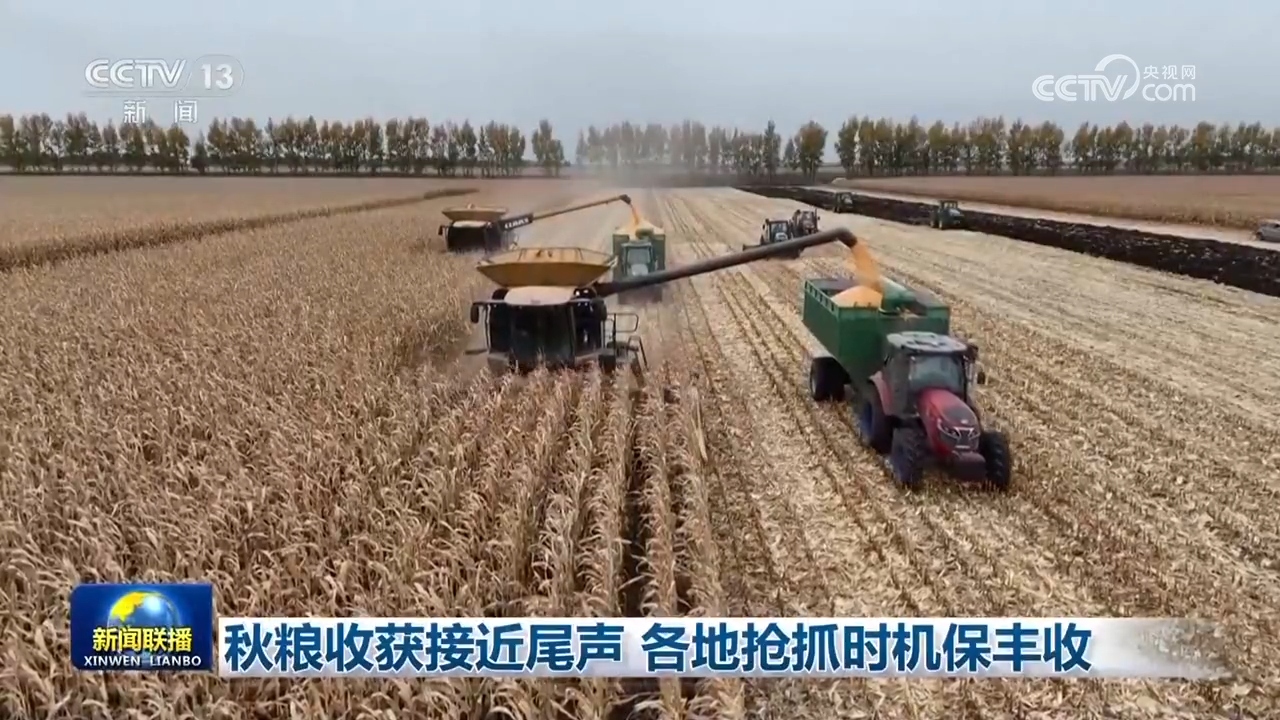
Group 1 - The national autumn grain harvest has surpassed 85%, with various regions actively ensuring a successful harvest [1] - In Northeast China, the harvest is nearing completion, with Heilongjiang province having harvested over 230 million acres, and major crops like rice and soybeans nearly finished [3] - Inner Mongolia has exceeded 100 million acres in autumn grain harvest, with over 80% of corn harvested [3] Group 2 - In the Huanghuaihai region, Shandong province has completed over 93% of its autumn grain harvest, with effective soil improvement measures leading to increased corn yields [5] - Jiangsu province has harvested over 24 million acres of autumn grain, utilizing machinery for efficient collection and transportation [5] Group 3 - In Southern China, rice harvesting is accelerating, with Sichuan province having surpassed 90% completion, and innovative farming practices leading to increased efficiency and yield [7] - Jiangxi province has over 60% of its late rice harvested, with a focus on high-quality, high-yield rice varieties and full mechanization [7]
种植业板块10月30日跌0.49%,雪榕生物领跌,主力资金净流出1.26亿元
Zheng Xing Xing Ye Ri Bao· 2025-10-30 08:28
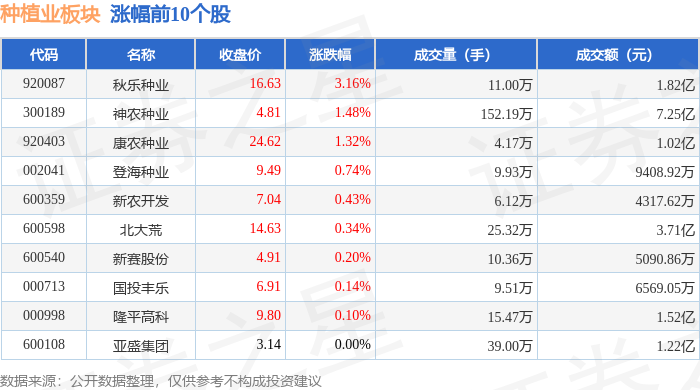
证券之星消息,10月30日种植业板块较上一交易日下跌0.49%,雪榕生物领跌。当日上证指数报收于 3986.9,下跌0.73%。深证成指报收于13532.13,下跌1.16%。种植业板块个股涨跌见下表: | 代码 | 名称 | 主力净流入(元) | 主力净占比 游资净流入 (元) | | 游资净占比 散户净流入(元) | | 散户净占比 | | --- | --- | --- | --- | --- | --- | --- | --- | | 600598 | 北大荒 | 1036.32万 | 2.79% | -543.96万 | -1.47% | -492.36万 | -1.33% | | 002215 | 诺普信 | 815.60万 | 4.55% | -785.88万 | -4.38% | -29.73万 | -0.17% | | 000713 国投丰乐 | | 439.70万 | 6.69% | -190.33万 | -2.90% | -249.37万 | -3.80% | | 002041 | 三世规规 | 405.95万 | 4.31% | -24.60万 | -0.26% | -381.35万 ...

从金融到产业 如何有效管理 农业风险?
Jin Rong Shi Bao· 2025-10-30 00:32
Core Insights - The recent prolonged rainy weather in regions such as Shandong, Henan, Hebei, Shanxi, and Shaanxi has significantly impacted corn production, leading to concerns about reduced yield and quality due to delayed harvesting and inadequate drying conditions [1][2] - The lack of drying facilities in these areas has exacerbated the situation, as the local agricultural practices favor selling fresh corn rather than dried corn, which is less suitable for storage [2] - Financial and industry responses have been swift, with measures in place to support affected agricultural entities, including targeted assistance and pre-compensation mechanisms to mitigate losses and facilitate quick replanting [2][3] Agricultural Infrastructure and Risk Management - The need for improved agricultural infrastructure is highlighted, as many regions face challenges such as inadequate drainage systems and aging facilities, which hinder effective crop management and increase vulnerability to adverse weather [2][3] - Long-term strategies for enhancing agricultural risk management are essential, focusing on infrastructure improvements and resource allocation to better prepare for unexpected events [3][4] Financial Tools for Risk Mitigation - The increasing scale and intensity of agricultural production necessitate the adoption of financial instruments like insurance and futures to manage risks associated with abnormal weather patterns [4] - Current challenges in agricultural insurance include a lack of precision and insufficient coverage, indicating a need for financial institutions and local governments to enhance service quality and adapt to the specific needs of the agricultural sector [4]
中国人民大学教授陈敏鹏:农业适应气候变化亟待系统性规划
Zhong Guo Huan Jing Bao· 2025-10-29 13:28
Core Viewpoint - The article discusses the impact of extreme weather events and climate change on agriculture in China, emphasizing the need for proactive measures to enhance climate resilience in farming practices and infrastructure [3][4][5]. Group 1: Impact of Extreme Weather on Agriculture - Extreme weather events, such as droughts and floods, have significantly affected agricultural production, particularly in central China during the summer of 2025 [3]. - Traditional farming practices are becoming less effective due to the increasing frequency and intensity of extreme weather, necessitating a shift towards systematic adaptation strategies [4][5]. Group 2: Vulnerability of Different Farming Entities - Smallholder farmers, relying on traditional knowledge, are more vulnerable to climate risks compared to larger agricultural enterprises that have better access to resources and information [4]. - Larger agricultural companies can enhance their risk management capabilities through asset allocation and strategic planning [4]. Group 3: Recommendations for Farmers - Farmers should improve their understanding of climate change and its risks to take adaptive actions effectively [6]. - Access to precise information and guidance on climate adaptation strategies is crucial for farmers, with a focus on transforming weather alerts into actionable guidelines [6]. Group 4: Infrastructure and Emergency Systems - There is a pressing need to develop agricultural emergency response systems, but adaptation should be integrated into all levels of decision-making and planning [7]. - The Chinese government has initiated a national strategy for climate change adaptation, guiding provinces to develop localized action plans [7]. Group 5: Building Climate-Resilient Agriculture - Key areas for developing climate-resilient agriculture include strategic planning, infrastructure upgrades, and promoting adaptive technologies [8][9]. - Establishing a low-carbon agricultural standard system is essential for achieving China's dual carbon goals, alongside encouraging consumer choices that favor low-carbon products [10].

特写:芝山村“蝶变”
Xin Hua Wang· 2025-10-29 13:04
Core Insights - The transformation of Zhishan Village into a "zero-carbon" agricultural model showcases innovative practices in sustainable farming and environmental restoration [1][2]. Group 1: Agricultural Practices - The implementation of "carbon-based organic fertilizer" has significantly improved soil quality, leading to an expected rice yield of 600 kg per mu, an increase of approximately 100 kg compared to the previous year [1]. - The village's pig farm, housing 50,000 pigs, contributes to the production of this organic fertilizer, effectively addressing waste management and enhancing soil fertility [1]. Group 2: Environmental Initiatives - Zhishan Village has installed photovoltaic panels on 123 households, generating a total capacity of 1,997 kW and approximately 10,000 kWh of electricity daily, contributing to reduced carbon emissions [2]. - The village has undergone significant environmental improvements, transitioning from a polluted area with mining activities to a green, low-carbon community [2]. Group 3: Economic Impact - The sale price of Zhishan's selenium-rich rice has doubled to 8 yuan per pound, with strong demand evidenced by numerous pre-orders for the new harvest [1]. - The village's collective operating income is projected to exceed 3.4 million yuan in 2024, with an average income of nearly 40,000 yuan per resident, establishing it as a model for rural development [2].