
智能手机

Search documents
因为一个骚操作,印度的反诈APP被全民抵制了
3 6 Ke· 2025-12-12 01:41
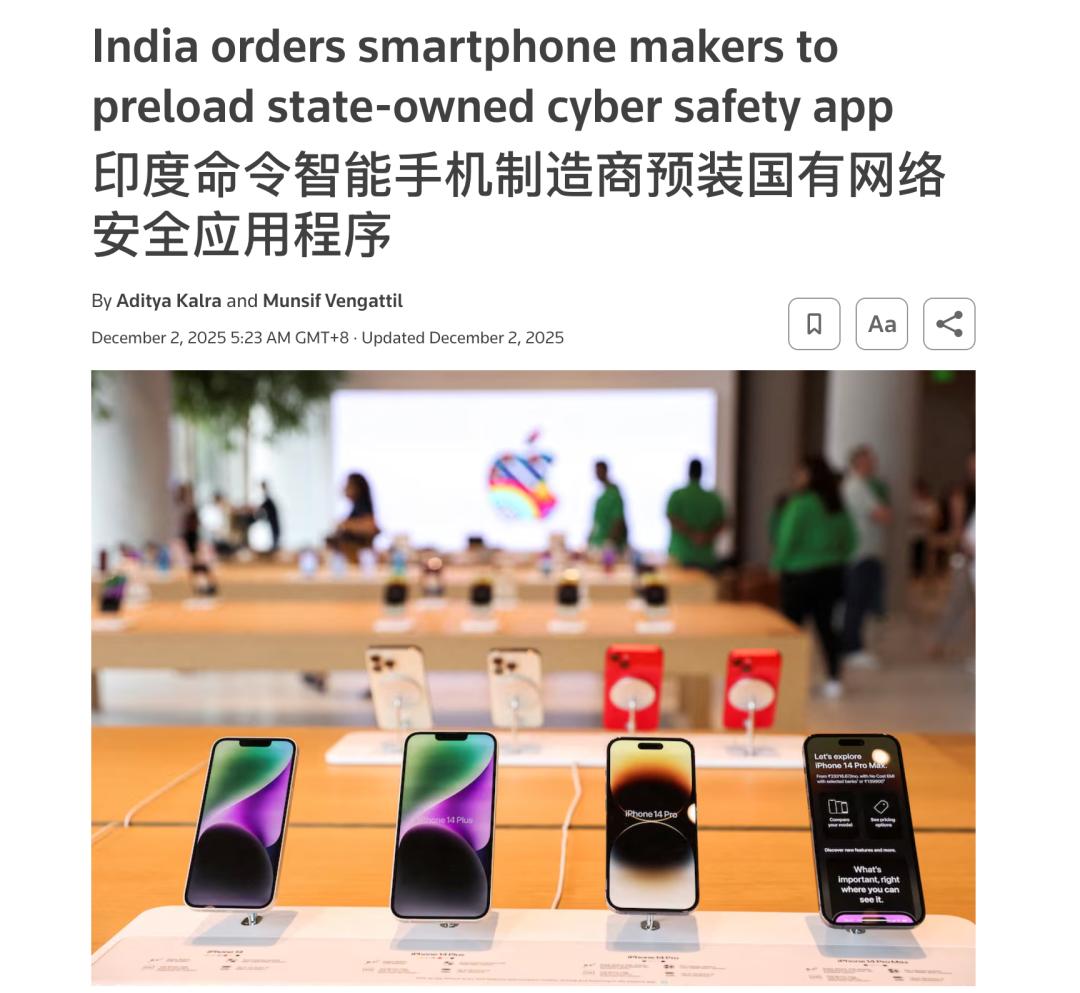
Core Viewpoint - The Indian government has mandated that all mobile manufacturers, including Apple and Samsung, must pre-install a network security application called "Sanchar Saathi" within 90 days, which cannot be disabled or uninstalled by users [1][4]. Group 1: Application Overview - "Sanchar Saathi" was initially launched as a web feature by the Indian Ministry of Telecommunications in 2023 to help users report scam calls, locate lost or stolen phones, verify phone authenticity, and check the number of SIM cards registered under their name [4][12]. - The application leverages the Central Equipment Identity Register (CEIR) to lock devices, which is a government database that records all device IMEI numbers, allowing for effective tracking and management of mobile devices [12][16]. Group 2: Public Reaction - The public response has been divided, with supporters arguing that if personal data can be shared with foreign software companies, it should also be shared with the government for security purposes [6]. - Some users have reported positive experiences, such as recovering stolen or lost phones through the application, which has garnered support from those affected by rising phone theft and telecom fraud in India [19][21]. Group 3: Opposition Concerns - Opponents of the mandate focus on issues of "compulsion" and "privacy," arguing that the government should not force users to install the application, citing potential violations of privacy rights [9][22]. - The Indian Ministry of Telecommunications faced backlash for not publicly disclosing the decision to mandate the application, leading to concerns about surveillance and privacy among the public [25][26]. Group 4: Technical and Privacy Issues - Critics, including software advocacy groups, have pointed out that the application requests excessive permissions that are not necessary for its core functions, raising concerns about privacy and security vulnerabilities [30][34]. - The application has been criticized for being poorly designed and for overstepping in terms of permission allocation, which could potentially increase the risk of security breaches [34][38]. Group 5: Industry Response - Major tech companies, including Apple and Google, have expressed opposition to the mandate, as it sets a precedent for pre-installing third-party applications, which could lead to similar demands in other markets [38].

港股股票回购一览:57只个股获公司回购
Mei Ri Jing Ji Xin Wen· 2025-12-12 01:13
Group 1 - On December 11, a total of 57 Hong Kong stocks conducted share buybacks, with 11 stocks having buyback amounts exceeding 10 million HKD [1] - Tencent Holdings, Xiaomi Group-W, and China COSCO Shipping Holdings had the largest buyback amounts, with Tencent repurchasing 636 million HKD, Xiaomi 97.2035 million HKD, and COSCO 41.3004 million HKD [1] - Year-to-date, 257 Hong Kong stocks have conducted buybacks, with 68 stocks having cumulative buyback amounts exceeding 100 million HKD [1] Group 2 - The largest cumulative buyback amounts year-to-date were by Tencent Holdings at 72.408 billion HKD, HSBC Holdings at 30.257 billion HKD, and AIA Group at 17.693 billion HKD [1]




市值突破4000亿!摩尔线程5天股价狂飙723%;Meta蒸馏优化阿里千问训练其最新AI模型;喜茶一年关店超650家丨邦早报
创业邦· 2025-12-12 00:12
Group 1 - The article discusses the recent announcement by artist Fan Zeng, who declared a complete severance of ties with his daughter and stepson while entrusting all personal and business affairs to his wife, Xu Meng. This decision is linked to the establishment of a new company, "Shiyi Fan Zeng (Beijing) Cultural and Art Co., Ltd." [1] - The new company is expected to handle all commercial operations related to Fan Zeng's art, indicating a significant shift in his business strategy and personal relationships [1]. Group 2 - The stock of Moer Thread, known as the "first domestic GPU stock," surged by 723% within five trading days after its debut on the STAR Market, reaching a market capitalization of 442.3 billion yuan [2][3]. - As of December 11, the stock price hit a high of 941.08 yuan, with a single-day increase of 28.04%, indicating strong market interest and a potential redefinition of valuation logic in the tech sector [2][3]. Group 3 - Meta is reportedly using Alibaba's Qwen model for distillation optimization in training its new AI model, "Avocado," which is expected to be released in spring 2026 [4]. - The article highlights the recognition of AI pioneers, including Elon Musk and others, as TIME magazine's "Person of the Year," emphasizing the significant impact of AI on various sectors [4]. Group 4 - Bilibili (B Station) has denied rumors regarding a mandatory membership requirement for all video content starting March 1, 2026, and stated that legal action will be taken against those spreading false information [6]. - The company aims to maintain a sustainable community ecosystem and ensure quality content creation [6]. Group 5 - Heytea has closed over 650 stores in a year, with a significant reduction in total store count from 4,610 to 3,930, reflecting a 15.41% year-on-year decline [8][9]. - The company previously announced a halt on franchise applications to avoid price wars and focus on user experience and brand integrity [9]. Group 6 - OPPO is restructuring its AI department, merging several projects into a new initiative called "Super Xiaobu," aimed at enhancing its AI capabilities [8]. - The company is focusing on integrating its AI technologies to improve product offerings and user experience [8]. Group 7 - Disney has agreed to invest $1 billion in OpenAI and has authorized the use of its iconic characters for AI-generated short videos, marking a significant partnership in the AI content creation space [11]. - This agreement allows OpenAI to leverage Disney's extensive character library while excluding the use of actor likenesses or voices [11]. Group 8 - The AI drug development platform "AI Kongming" has been launched to address global health challenges, aiming to enhance the efficiency and success rate of drug development processes [19]. - This platform is the first of its kind in China, focusing on diseases like malaria and tuberculosis [19]. Group 9 - China's automotive industry has seen production and sales exceed 31 million units in the first 11 months of the year, with a notable increase in new energy vehicle production and exports [20]. - The data indicates a strong growth trajectory in the automotive sector, with a year-on-year increase of over 10% in both production and sales [20].

集邦解析 明年第1季存储器显著涨价效应 智能机、NB 销量恐下修
Jing Ji Ri Bao· 2025-12-11 23:29
Core Insights - TrendForce forecasts a significant increase in memory prices by Q1 2026, leading to cost challenges for global end products, which will force smartphone and laptop industries to raise product prices and lower specifications, resulting in a downward revision of sales outlook [1] - The impact of memory on the bill of materials (BOM) for consumer electronics like smartphones and PCs is rapidly expanding, with Apple's iPhone series also expected to see a notable increase in BOM cost share, prompting a reassessment of new device pricing [1] - The rise in memory prices will lead laptop brands to adjust their product mix, procurement strategies, and regional sales layouts, particularly affecting high-end lightweight laptops that cannot easily change specifications due to design constraints [1] - The consumer laptop market, while sensitive to changes in specifications and pricing, currently benefits from existing inventory of finished products and low-cost memory, allowing for short-term price stability, but a price adjustment period is anticipated in the PC market by Q2 2026 [1] Industry Adjustments - "Specification reduction" or "postponing upgrades" has become a necessary strategy for smartphone and laptop brands to balance costs [2]
小米造车后的下一个梦想,雷军已经选好了?
Sou Hu Cai Jing· 2025-12-11 23:16
Core Viewpoint - Xiaomi is strategically moving into the humanoid robotics sector, with plans to dominate this market within the next five years, as indicated by CEO Lei Jun's recent statements [2][19]. Group 1: Xiaomi's Robotics Strategy - Lei Jun has signaled a strong intent to integrate humanoid robots into Xiaomi's future, emphasizing that the home will be the ultimate battleground for these technologies [2]. - The recruitment of Lu Zeyu, a former key member of Tesla's Optimus team, highlights Xiaomi's serious commitment to robotics, with Lu now leading the development of Xiaomi's robotic dexterity technology [6][22]. - Xiaomi has already invested approximately 15 billion RMB in the robotics sector, targeting a comprehensive ecosystem that includes hardware, software, and applications [22]. Group 2: Historical Context and Market Position - Lei Jun has a track record of identifying and capitalizing on market trends, having successfully navigated multiple technological waves since 1999, which has significantly increased his wealth [2][8]. - Xiaomi's previous ventures into e-commerce and smartphones have established a strong foundation, allowing the company to leverage its experience in entering new markets like robotics [11][12]. - The robotics industry is experiencing rapid growth, with over 200 companies emerging and significant funding exceeding 20 billion RMB in the past year, indicating a robust market opportunity for Xiaomi [19]. Group 3: Competitive Landscape - Xiaomi's entry into the robotics market is timely, as it aims to compete with established players like Tesla and Boston Dynamics, while also leveraging its cost-effective strategies [19][20]. - The company has already launched products like the robotic dog "Iron Egg" and humanoid robot "Iron Big," which have garnered positive market responses, reinforcing Xiaomi's confidence in this sector [19][22]. - As the robotics field evolves, Xiaomi is integrating its robotics efforts with its automotive division, aiming for synergy in AI capabilities and talent [20][22].

Mate80发布后,华为连续两周重夺中国手机市场第一
Xin Hua Cai Jing· 2025-12-11 13:51
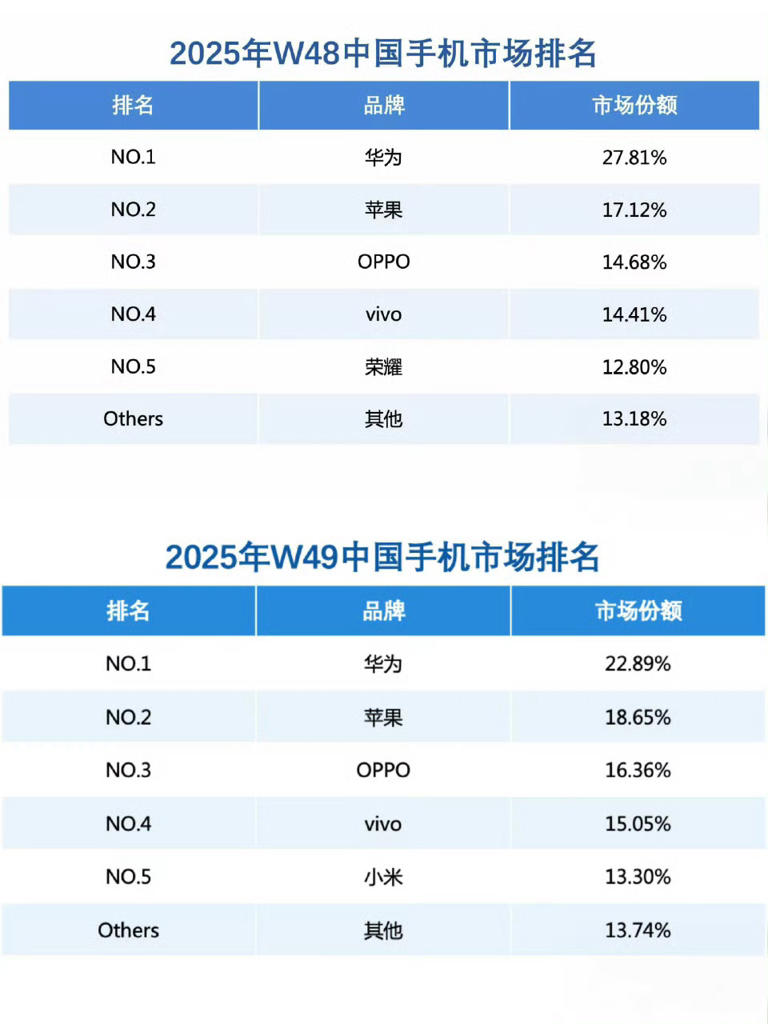
Core Insights - Huawei has regained the top position in the domestic smartphone market, surpassing Apple for two consecutive weeks since the launch of the Mate80 series [1][6]. Market Share Summary - In week 48, Huawei achieved a market share of 27.81%, significantly ahead of Apple's 17.12%. OPPO, vivo, and Honor ranked third to fifth with shares of 14.68%, 14.41%, and 12.80% respectively [3]. - In week 49 (December 1-7), Huawei maintained its lead with a market share of 22.89%, while Apple followed with 18.65%. OPPO and vivo ranked third and fourth with shares of 16.36% and 15.05%, and Xiaomi was fifth with 13.30% [5]. Pricing Strategy - Despite a global increase in storage prices, Huawei has reduced the pricing of its new models compared to the previous generation. This is attributed to improved yield rates of self-developed chips and the maturation of the Harmony OS [5].

小米MIX Fold 3评测:折叠屏影像,也开始卷起来了?
Xin Lang Cai Jing· 2025-12-11 13:06
Group 1 - The core theme of the article revolves around Xiaomi's ambition to penetrate the high-end smartphone market, particularly through the launch of the MIX Fold 3 [1] - The MIX Fold 3, priced starting at 8999 yuan, represents one of Xiaomi's most premium products, showcasing advancements in design and camera technology [2] - The new model emphasizes a Leica-style imaging system and aims to enhance user experience through improved handling, design, and large screen optimization [2] Group 2 - The article highlights the importance of the MIX Fold 3 in solidifying Xiaomi's position in the high-end market segment [2]
豆包和智谱,二线手机厂商的救命稻草
Tai Mei Ti A P P· 2025-12-11 12:35
Core Insights - Elon Musk predicts that traditional smartphones and standalone apps will disappear within the next 5 to 6 years, evolving into "AI reasoning edge nodes" that rely on cloud and local AI for complex tasks [2] - The launch of the "Doubao AI phone" in collaboration with ZTE has sparked significant market interest, with initial sales of 30,000 units selling out quickly and prices on secondary markets reaching as high as 36,000 yuan [2][3] Group 1: AI Phone Market Dynamics - The concept of AI phones has transitioned from a novelty to a practical tool capable of cross-app operations and comprehensive price comparisons, significantly increasing market appeal [3] - The introduction of the Doubao AI phone has led to a surge in AI phone-related stocks, indicating a strong investor interest in this emerging market [4] - The new generation of AI phones integrates "edge AI models" directly into devices, allowing for independent processing of complex tasks without needing constant internet connectivity [7] Group 2: Technological Advancements - The Doubao AI phone utilizes a system-level integration of its AI model, enabling it to perform automated operations across applications, such as price comparisons and order placements, with minimal user input [7][8] - The AutoGLM model from Zhiyu provides robust capabilities for understanding and executing complex tasks across over 50 popular Chinese applications, enhancing user experience through voice commands [8] Group 3: Market Challenges and Responses - Despite initial excitement, the Doubao AI phone faced restrictions from multiple platforms within three days of launch, prompting the company to adjust features to comply with security regulations [9] - Industry experts acknowledge the impressive capabilities of the Doubao AI phone but highlight the inherent data security risks associated with its ability to control system functions [10] Group 4: Competitive Landscape - The competition between Doubao and Zhiyu reflects two distinct strategies: Doubao focuses on deep integration of its AI into existing devices, while Zhiyu promotes an open-source approach to foster a collaborative ecosystem among manufacturers [11][15] - The AI phone market is projected to see significant growth, with an estimated 147 million units expected to ship in China by 2026, representing a 31.6% year-on-year increase [17] Group 5: Future Considerations - The emergence of AI agents capable of managing multiple applications could disrupt traditional app ecosystems, potentially diminishing the role of major internet companies as gatekeepers of user engagement [18][19] - Establishing a compliance framework for AI operations on mobile devices will be crucial to differentiate between legitimate assistance and potential misuse, highlighting the need for a balanced approach to user experience, business interests, and security [20]
集邦咨询:预计2026年第一季度存储器涨势持续强劲,智能手机、笔电品牌启动价格上修与规格降级
Zheng Quan Shi Bao Wang· 2025-12-11 11:32
Core Insights - The latest survey by TrendForce indicates that significant price increases for memory chips are expected in Q1 2026, leading to cost challenges for global end products [1] - As a result, smartphone and laptop industries are likely to raise product prices and lower specifications, with sales outlooks being further downgraded [1] - Resource advantages are expected to concentrate among a few leading brands [1]
小米预装加密钱包合作引市场关注
Xin Lang Cai Jing· 2025-12-11 11:17
Core Insights - SEI blockchain development team Sei Labs has announced a partnership with Xiaomi to pre-install the SEI crypto wallet application on new Xiaomi smartphones, targeting markets outside of mainland China and the United States, including Europe, Latin America, Southeast Asia, and Africa [1][2] Group 1: Market Position and Sales - Xiaomi holds over 36% market share in the Greek smartphone market and over 24% in India [2] - The company is projected to sell over 168 million devices in 2024, capturing 13% of the global market share [2] Group 2: Wallet Features and Services - The pre-installed wallet will allow user registration via Google or Xiaomi account credentials [2] - The collaboration aims to support decentralized applications, peer-to-peer transfers, and consumer-level commercial transactions [2] Group 3: Future Plans and Investments - SEI and Xiaomi plan to enable USDC and other stablecoin transactions on the SEI network, with stablecoin payment services expected to launch in Hong Kong and the EU by Q2 2026 [2] - SEI has committed $5 million to initiate the "Global Mobile Innovation Program," which will provide funding support for developers and startups creating blockchain applications for consumer devices [2] - The partnership is anticipated to bring tens of millions of new users to the SEI platform annually, focusing on expanding wallet services in emerging markets [2]