
银行

Search documents
黄金动荡!多家银行出手,积存金或将“限购”
券商中国· 2026-03-14 08:41
Core Viewpoint - Recent fluctuations in gold prices have led to increased investment risks, prompting several banks to adjust their gold accumulation trading rules to manage these risks effectively [1][2]. Group 1: Bank Responses to Gold Price Volatility - China Construction Bank has implemented dynamic trading limits on its gold accumulation products to enhance risk control, with delivery times for physical gold orders extended to 10-15 working days starting March 3, 2026 [2]. - Industrial and Commercial Bank of China was the first to announce limits on gold accumulation purchases, effective February 7, 2026, during non-trading days, with various limit types being dynamically set [3]. - Zhejiang Commercial Bank may temporarily suspend its wealth gold accumulation business in response to significant market fluctuations or liquidity issues [3]. Group 2: Dynamic Limitations and Investor Behavior - The dynamic limit system allows banks to set daily total limits based on international market risks, preventing excessive buying once the limit is reached, while selling transactions remain unaffected [3][4]. - This approach aims to reduce speculative trading behaviors and protect banks from operational risks during extreme market conditions [4][5]. - Analysts suggest that these measures will guide investors towards more rational asset allocation, favoring long-term holders over short-term traders [5][6]. Group 3: Future Implications and Recommendations - As international gold prices continue to fluctuate, it is anticipated that more banks will adopt similar limit management measures for gold accumulation products [6]. - Experts recommend that banks enhance investor education and risk assessment processes to ensure appropriate product offerings align with investor risk profiles [7].





A股市场运行周报第83期:地缘继续扰动市场,保持定力、优化结构-20260314
ZHESHANG SECURITIES· 2026-03-14 07:19
Core Insights - The report indicates that the geopolitical situation in the Middle East has reached a dramatic turning point, with oil prices fluctuating at high levels, leading to continued volatility in global financial markets. It is anticipated that the current geopolitical conflict has peaked, but disturbances are not entirely over. The report suggests that A and H shares may experience range-bound fluctuations and narrow oscillations in the near future, with a positive outlook for a "systematic slow bull" market in the longer term [1][3][47]. Market Overview - The major indices have shown mixed performance, with the Shanghai Composite Index and the Shanghai 50 Index declining by 0.70% and 1.20% respectively, while the CSI 300 Index saw a slight increase of 0.19% due to support from new energy and optical module leaders. Growth indices such as the CSI 500 and CSI 1000 experienced declines of 1.44% and 0.42% respectively, while the ChiNext Index rose by 2.51% supported by heavyweight stocks [9][44]. - The energy sector has shown resilience, with the report highlighting that the "new and old energy" sectors performed well, with electricity equipment rising by 4.55%, coal increasing by 5.03%, and public utilities up by 3.07%. Conversely, sectors like military, non-ferrous metals, media, and machinery saw declines due to ongoing geopolitical tensions [12][46]. Investment Strategy - The report recommends maintaining strategic discipline in timing investments, avoiding excessive pessimism or blind optimism until the market stabilizes. It emphasizes optimizing industry structure to achieve a balanced offensive and defensive strategy. The "new and old energy" combination is suggested as a key focus, with new energy (electricity) and old energy (power) serving as the offensive spearhead. Additionally, it is advised to hold relatively low-positioned securities and to enhance defensive positions by adding agriculture and transportation sectors to mitigate risks [1][48][47]. - The report also points out that certain state-owned enterprises with low positions and dividend attributes could act as stabilizers during escalated geopolitical conflicts, while stocks related to infrastructure, oil transportation, shipping, and ports may directly benefit from the situation [1][48].
中国建设银行吉林省2026年度春季校园招聘启动
Xin Lang Cai Jing· 2026-03-14 06:00
Group 1 - The core message of the announcement is the recruitment of 194 positions for the China Construction Bank Jilin Branch for the 2026 Spring Campus Recruitment, aiming to support the bank's strategic development and business operations [1][2]. Group 2 - The recruitment is targeted at graduates from domestic and overseas institutions, requiring a bachelor's degree or higher, with graduation dates between January 2025 and July 2026 [2]. - Specific language proficiency requirements are set for applicants in certain regions, including passing scores in various English proficiency tests [2]. Group 3 - The positions available include Management Trainees, Technology Specialists, and roles in Comprehensive Marketing, with specific qualifications and training paths outlined for each [3][4]. - A special recruitment channel is available for university student village officials and "Three Supports and One Assistance" personnel, with additional eligibility criteria [4][5]. Group 4 - The recruitment process includes multiple stages: application, initial selection, written examination, interview, physical examination, and final hiring [8][10]. - The written examination will take place in 44 cities across China, covering both comprehensive and information technology subjects [10][11]. Group 5 - Applicants can register through the official website or via the mobile recruitment platform, with a deadline for applications set for March 31, 2026 [6][7][9]. - The bank reserves the right to adjust or terminate recruitment for specific positions based on demand and application conditions [15].
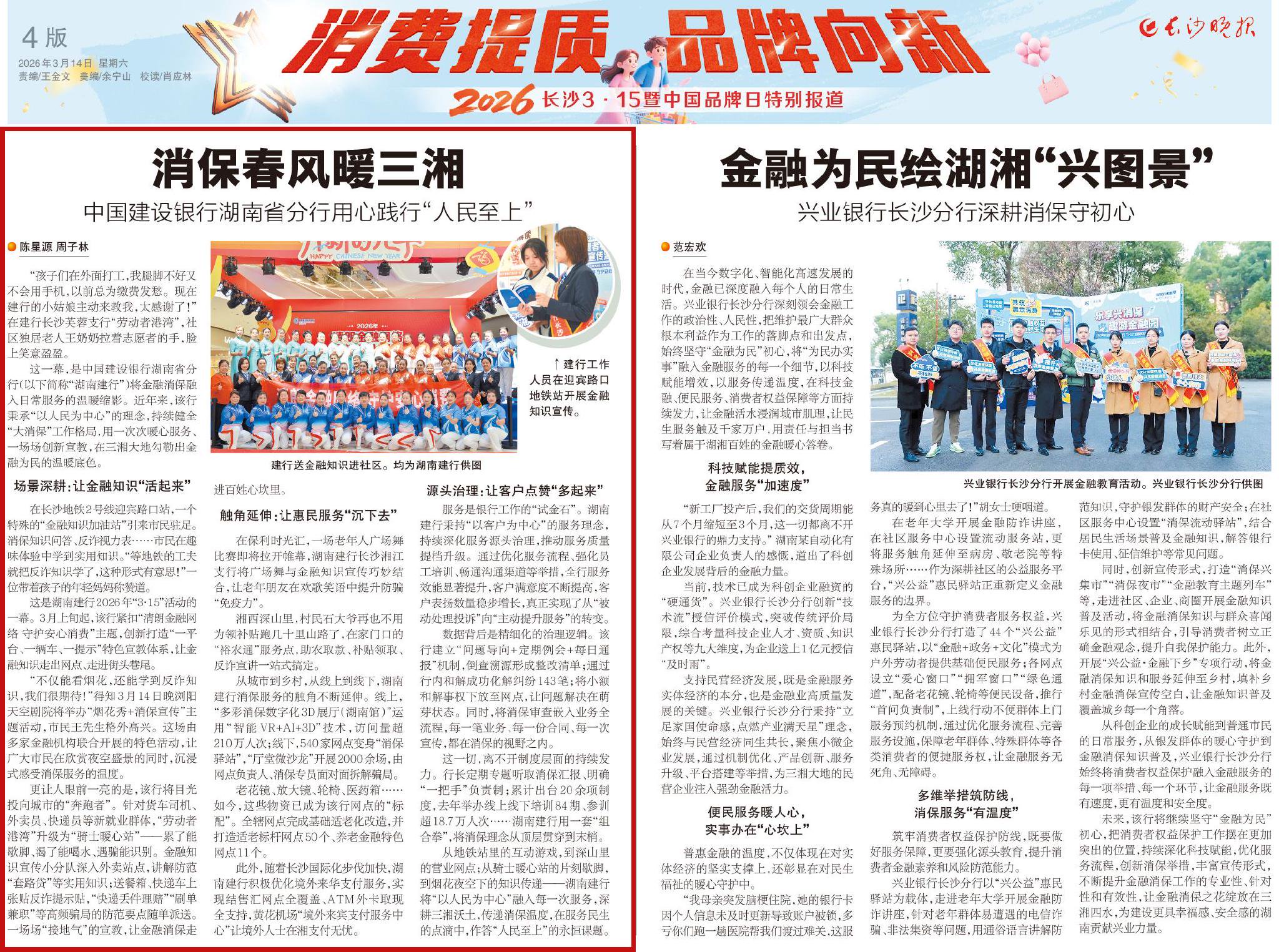
消保春风暖三湘 中国建设银行湖南省分行用心践行“人民至上”
Chang Sha Wan Bao· 2026-03-14 01:45
Core Viewpoint - China Construction Bank Hunan Branch (referred to as "Hunan CCB") integrates financial consumer protection into daily services, emphasizing a people-centered approach and enhancing community engagement through innovative outreach and education initiatives [2][11]. Group 1: Financial Knowledge Promotion - Hunan CCB has launched a unique "financial knowledge gas station" at the Changsha Metro, where citizens can learn practical financial knowledge through interactive experiences [3][13]. - The bank has created a distinctive educational system themed "Clear Financial Network, Safeguard Peaceful Consumption," which includes various outreach activities such as a "fireworks show + consumer protection promotion" event [3][13]. - The bank targets new employment groups like truck drivers and delivery workers by upgrading its "Laborer Port" to "Knight Warm Station," providing rest areas and educational resources on fraud prevention [4][14]. Group 2: Community Engagement and Accessibility - Hunan CCB combines community events, such as a senior citizens' square dance competition, with financial knowledge dissemination to enhance fraud prevention awareness among the elderly [7][15]. - The bank has established "Yunong Tong" service points in rural areas, allowing villagers to access financial services and fraud education without traveling long distances [7][16]. - The bank's online initiatives, including a digital 3D exhibition, have attracted over 2.1 million visits, while 540 branches have transformed into consumer protection stations, hosting over 2,000 educational events [7][16]. Group 3: Service Quality Improvement - Hunan CCB focuses on enhancing service quality through a customer-centric approach, leading to increased customer satisfaction and a rise in positive feedback [8][17]. - The bank has implemented a problem-oriented mechanism to address service issues, successfully resolving 143 disputes through internal mediation [8][17]. - Continuous training and the establishment of over 20 new policies have been pivotal in embedding consumer protection principles throughout the bank's operations [8][17].
企业融资需求改善——2026年2月金融数据点评【华福宏观·陈兴团队】
陈兴宏观研究· 2026-03-14 01:14
Group 1 - The core viewpoint of the article highlights that corporate medium and long-term loans are the main contributors to credit growth, with a seasonal decline in loan issuance in February but a narrowing of the year-on-year decrease, primarily driven by the corporate sector [2][4][7] - In February, the social financing scale increased by 2.38 trillion yuan, with a year-on-year increase of 146.1 billion yuan, supported mainly by RMB loans and undiscounted acceptances [4][8] - The government bond net financing reached 1.4 trillion yuan in February, but showed a year-on-year decrease of 290.3 billion yuan, indicating a shift from growth to decline in direct financing [4][8] Group 2 - The M2 growth rate remained stable at 9% in February, supported by a significant net financing from government bonds and a strong RMB, which contributed to domestic liquidity [3][8] - The increase in corporate loans was substantial, with corporate medium and long-term loans rising by 890 billion yuan, reflecting a year-on-year increase of 350 billion yuan [7][8] - The M1 growth rate rebounded to 5.9%, indicating improved liquidity conditions, while the difference between M2 and M1 growth rates narrowed to 3.1% [3][8]

中小银行再掀降息潮,苹果标准佣金率下调 | 财经日日评
吴晓波频道· 2026-03-14 00:29
Group 1: Banking Sector - A new wave of interest rate cuts has been initiated by small and medium-sized banks in China, with adjustments typically ranging from 5 to 30 basis points, and some banks reducing five-year fixed deposit rates by up to 30 basis points [2] - The phenomenon of "inverted" deposit rates has emerged, where shorter-term rates exceed longer-term rates, indicating a shift in deposit strategies among banks [2] - The overall trend in the banking sector is towards lower interest rates, with the People's Bank of China likely to continue its "moderately loose monetary policy" and further reductions in the Loan Prime Rate (LPR) expected [2][3] Group 2: Real Estate Market - The real estate market in Guangzhou and Shenzhen is showing signs of recovery, with significant increases in new housing projects and a surge in second-hand housing transactions in Shenzhen [4] - Unlike previous market trends, this year's recovery is characterized by structural improvements, particularly in core urban areas where property prices are stabilizing [4][5] - The real estate market is becoming increasingly segmented, with varying conditions across different cities and regions, particularly as urbanization progresses [5] Group 3: Technology Sector - Apple has announced a reduction in its standard commission rate for the App Store in mainland China from 30% to 25%, with further reductions for small businesses and subscription renewals [6] - This move is part of a broader trend where major tech companies like Google are also lowering fees, reflecting increased competition and regulatory pressures [6][7] - The shift in commission structures is seen as a response to the evolving landscape of app distribution and the potential impact of AI on traditional business models [7] Group 4: AI and Semiconductor Industry - Cambricon Technologies reported a revenue increase of 453.21% year-on-year, reaching 6.497 billion yuan, marking its first profitable year since its IPO [11] - Despite significant revenue growth, the company faces challenges with inventory levels rising sharply, indicating potential risks related to market competition and product differentiation [12] - The demand for AI computing power is expected to grow significantly, but competition from other domestic chip manufacturers may pose challenges for Cambricon's market position [12] Group 5: Global Economic Trends - The yield on 30-year U.S. Treasury bonds has risen to nearly 4.9%, reflecting a broader trend of increasing bond yields globally due to geopolitical tensions and rising government spending [13][14] - The ongoing conflicts and economic uncertainties are leading to higher risk premiums demanded by bondholders, contributing to the upward pressure on global bond yields [14] - The market is adjusting to the implications of these geopolitical events, with potential impacts on inflation and government fiscal policies [13][14]



中国农业银行股份有限公司关于150亿美元中期票据发行计划于香港联合交易所有限公司上市的公告
Xin Lang Cai Jing· 2026-03-13 19:34
Core Viewpoint - China Agricultural Bank has announced a plan to issue a total of 15 billion USD in medium-term notes, which will be listed on the Hong Kong Stock Exchange [1] Group 1: Issuance Details - The bank has applied for the listing of its 15 billion USD medium-term note issuance plan on the Hong Kong Stock Exchange [1] - The issuance plan allows the bank to issue notes to professional investors starting from March 13, 2026, for a period of twelve months [1] - The listing of the issuance plan is expected to take effect on March 16, 2026 [1] Group 2: Legal Assurance - The board of directors of China Agricultural Bank guarantees that the announcement does not contain any false records, misleading statements, or major omissions, and they assume legal responsibility for the authenticity, accuracy, and completeness of the content [1]

金融工程日报:沪指震荡走低,锂电池概念领涨、风电股反复活跃-20260313
Guoxin Securities· 2026-03-13 15:35
- The report does not contain any quantitative models or factors for analysis[1][2][3]
【债券日报】:转债市场月度跟踪20260313-20260313
Huachuang Securities· 2026-03-13 14:51
1. Report Industry Investment Rating No information about the industry investment rating is provided in the report. 2. Core Viewpoints - The convertible bond market continued to be weak today, with valuations compressing on a month - on - month basis. The trading sentiment in the convertible bond market heated up, but the overall market showed a downward trend [1]. - The central price of convertible bonds decreased, and the proportion of high - price bonds declined. The valuation of convertible bonds compressed, with different types of convertible bonds showing different trends in price and premium rate [2]. - Most of the underlying stock industry indices declined, and the convertible bond market also had more declining industries. Different industries had different performance in terms of closing price, conversion premium rate, conversion value, and pure bond premium rate [3]. 3. Summary by Relevant Catalogs Market Main Index Performance - The CSI Convertible Bond Index decreased by 1.04% month - on - month, the Shanghai Composite Index decreased by 0.82%, the Shenzhen Component Index decreased by 0.65%, the ChiNext Index decreased by 0.22%, the SSE 50 Index decreased by 0.50%, and the CSI 1000 Index decreased by 1.46%. The large - cap growth style was relatively dominant, with large - cap growth decreasing by 0.06%, large - cap value decreasing by 0.16%, mid - cap growth decreasing by 1.06%, mid - cap value decreasing by 1.28%, small - cap growth decreasing by 0.87%, and small - cap value decreasing by 0.66% [1][7]. Market Fund Performance - The trading volume of the convertible bond market was 71.943 billion yuan, a month - on - month increase of 14.73%. The total trading volume of the Wind All - A Index was 2.417276 trillion yuan, a month - on - month decrease of 1.76%. The net outflow of the main funds in the Shanghai and Shenzhen stock markets was 4.0095 billion yuan, and the yield of the 10 - year Treasury bond increased by 0.91bp to 1.81% [1]. Convertible Bond Price and Valuation - The weighted average closing price of convertible bonds was 139.51 yuan, a month - on - month decrease of 0.88%. Among them, the closing price of equity - biased convertible bonds was 199.31 yuan, a month - on - month increase of 2.06%; the closing price of debt - biased convertible bonds was 121.96 yuan, a month - on - month decrease of 0.35%; the closing price of balanced convertible bonds was 132.14 yuan, a month - on - month decrease of 0.81%. The proportion of high - price bonds above 130 yuan was 73.41%, a month - on - month decrease of 2.22pct. The price median was 137.91 yuan, a month - on - month decrease of 0.93% [2]. - The fitted conversion premium rate of 100 - yuan par value was 37.90%, a month - on - month decrease of 1.58pct; the overall weighted par value was 106.98 yuan, a month - on - month decrease of 0.51%. The premium rate of equity - biased convertible bonds was 14.43%, a month - on - month increase of 1.01pct; the premium rate of debt - biased convertible bonds was 89.32%, a month - on - month increase of 1.39pct; the premium rate of balanced convertible bonds was 25.22%, a month - on - month decrease of 0.97pct [2]. Industry Performance - In the A - share market, the top three industries with the largest declines were non - ferrous metals (-2.70%), computer (-2.70%), and national defense and military industry (-2.69%); the top three industries with the largest increases were food and beverage (+0.87%), building decoration (+0.60%), and banking (+0.38%). In the convertible bond market, 26 industries declined, with the top three industries with the largest declines being communication (-7.15%), national defense and military industry (-3.67%), and machinery and equipment (-2.75%); only two industries rose against the trend, namely petroleum and petrochemicals (+0.73%) and banking (+0.21%) [3]. - In terms of closing price, the large - cycle decreased by 0.84%, manufacturing decreased by 2.08%, technology decreased by 3.37%, large - consumption decreased by 1.00%, and large - finance decreased by 0.16%. In terms of conversion premium rate, the large - cycle decreased by 0.45pct, manufacturing decreased by 0.85pct, technology increased by 0.27pct, large - consumption decreased by 1.5pct, and large - finance decreased by 0.26pct. In terms of conversion value, the large - cycle decreased by 0.27%, manufacturing decreased by 1.22%, technology decreased by 3.40%, large - consumption decreased by 0.67%, and large - finance decreased by 0.12%. In terms of pure bond premium rate, the large - cycle decreased by 1.3pct, manufacturing decreased by 3.4pct, technology decreased by 5.4pct, large - consumption decreased by 1.3pct, and large - finance decreased by 0.2pct [3][4]. Industry Rotation - Food and beverage, building decoration, and banking led the rise. The daily increase rates of food and beverage, building decoration, and banking in the underlying stocks were 0.87%, 0.60%, and 0.38% respectively; the daily increase rates in the convertible bond market were - 0.30%, - 1.09%, and 0.21% respectively [53].
中国工商银行庄浪支行深化科技金融服务 赋能地方科创企业发展
Sou Hu Cai Jing· 2026-03-13 14:23
Core Viewpoint - The Industrial and Commercial Bank of China (ICBC) Zhuanglang Branch is actively supporting the national strategy for technological innovation by enhancing financial services for the real economy, particularly through its "Tech Innovation e-Loan 2.0" product aimed at small and micro technology enterprises [1][2]. Group 1: Financial Support Initiatives - ICBC Zhuanglang Branch has issued a special financing of 3 million yuan to a local ethnic technology enterprise, alleviating its cash flow pressure [1]. - Since the beginning of the year, the branch has provided a total of 11.5 million yuan through the "Tech Innovation e-Loan" product to support multiple technology-oriented small and micro enterprises [1]. Group 2: Product Features and Benefits - The "Tech Innovation e-Loan" is designed specifically for small and medium-sized technology enterprises, offering credit financing without collateral, addressing common financing challenges such as asset-light and lack of guarantees [1][2]. - The product integrates multi-dimensional core enterprise information to create a scientific credit assessment model, ensuring effective financial support for quality technology enterprises [1]. Group 3: Collaboration and Service Enhancement - The branch has formed a professional service team to strengthen collaboration with local government departments and to understand the operational status and financing difficulties of target enterprises [2]. - By customizing financial service solutions that integrate financing and settlement, the branch aims to resolve urgent operational needs for technology enterprises [2]. Group 4: Future Directions - ICBC Zhuanglang Branch plans to continue enhancing its financial services for the real economy, aligning with national technological innovation efforts, and optimizing the experience of products like "Tech Innovation e-Loan" [2]. - The branch aims to provide high-quality financial support to empower the development of technology enterprises and contribute to the transformation and upgrading of the local economy [2].