
资产管理

Search documents
美国债务危机引爆加密货币钱包格局,最新XBIT Wallet或成关键“变量”
Sou Hu Cai Jing· 2025-12-08 05:57
Core Insights - BlackRock's 2026 Financial Outlook report predicts that the total U.S. debt will exceed $38 trillion by 2026, diminishing the hedging properties of traditional tools like long-term government bonds [1] - Institutional investors are increasingly adopting cryptocurrencies like Bitcoin as alternative assets, with analysts forecasting Bitcoin prices to surpass $200,000 [1] - Tokenized assets and stablecoins are highlighted as key pillars of the digital financial ecosystem, while the AI industry's demand for electricity is transforming Bitcoin miners into AI infrastructure providers [1] Group 1: XBIT Wallet Features - XBIT Wallet is a decentralized web3 wallet that utilizes a revolutionary security architecture to redefine digital asset management standards [1] - Over 120 institutional investors are currently using XBIT Wallet for crypto asset allocation, which employs a decentralized structure for true asset ownership [3] - The wallet's security design includes a dual-mode architecture of hot and cold wallets, ensuring both transaction efficiency and the elimination of single-point failure risks [3] Group 2: Security and Backup Mechanisms - XBIT Wallet incorporates quantum-resistant encryption algorithms to safeguard assets against future quantum computing threats [3] - Users can back up their mnemonic phrases using physical solutions like steel etching and titanium alloy plates, ensuring cross-generational asset inheritance [3] - The wallet's unique "time lock" feature allows users to set delayed confirmations for large transactions, enhancing asset disposal decision-making through multi-signature technology [6] Group 3: Market Integration and Efficiency - XBIT Wallet supports on-chain interactions with mainstream stablecoins and is developing cross-chain interoperability modules [5] - The wallet's built-in stablecoin aggregator enables one-click exchanges between assets like USDT, USDC, and DAI, potentially saving up to 30% in transaction costs compared to traditional centralized exchanges [5] - The integration of a power market module allows users to lease excess computing power to AI companies, creating a dual-driven model of "mining + computing power" [6] Group 4: User Experience and Risk Management - XBIT Wallet features a modular design that allows users to customize their trading panels according to their needs [8] - The "security sandbox" function isolates suspicious transactions and employs machine learning algorithms for real-time risk analysis [8] - As the U.S. debt crisis escalates, cryptocurrencies are transitioning from fringe assets to core institutional allocations, with XBIT Wallet serving as a critical infrastructure in the web3 economy [8]

洪灏:2026年美股将会先涨后跌 美联储即将重启扩表推高风险资产
Sou Hu Cai Jing· 2025-12-07 15:26
Core Viewpoint - The U.S. stock market is expected to rise initially and then decline, driven by the current liquidity cycle not being over [1] Group 1: Federal Reserve Actions - The upcoming year will see a change in the Federal Reserve chair, which is contributing to a tight short-term funding market in the U.S. [1] - Short-term interest rates are currently higher than the Federal Reserve's benchmark rate, indicating a need for the Fed to lower interest rates next week [1] - The Federal Reserve has abandoned its plan to reduce its balance sheet, which is currently around $6 trillion, due to issues in the repurchase market [1] Group 2: Market Implications - The potential for the Federal Reserve to expand its balance sheet again could lead to new heights, resulting in an increase in risk asset prices [1] - The current market conditions suggest that shorting risk assets may not be a favorable strategy, as there is a belief that risk assets will rise before eventually falling [1]
莲华资产洪灏:2026年美股将会先涨后跌,美联储即将重启扩表推高风险资产
Xin Lang Cai Jing· 2025-12-07 14:17
Core Viewpoint - The U.S. stock market is expected to rise initially and then decline, primarily due to the ongoing liquidity cycle [1][4]. Group 1: U.S. Economic Conditions - The U.S. dollar is expected to weaken significantly as a necessary measure to attract capital back to the U.S. and invest in American manufacturing, given the high labor and operational costs [3][6]. - The upcoming change in the Federal Reserve chairmanship next year is anticipated to impact monetary policy, with current short-term funding markets being very tight, leading to short-term interest rates exceeding the Fed's benchmark rate [3][6]. - The Federal Reserve is likely to lower interest rates soon, as it has no other viable options, and this decision is seen as inevitable [3][6]. Group 2: Federal Reserve's Monetary Policy - The Federal Reserve has abandoned its plan to reduce its balance sheet, which currently stands at approximately $6 trillion, due to issues arising in the repurchase market [3][6]. - A new round of balance sheet expansion by the Federal Reserve is expected, potentially reaching new heights, which will likely result in an increase in risk asset prices [3][6]. - The current market conditions suggest that shorting risk assets may not be cost-effective, as there is a belief that risk assets will experience both upward and downward movements [3][6].

一周重磅日程:全球屏息!年末最关键一周来了
华尔街见闻· 2025-12-07 12:44
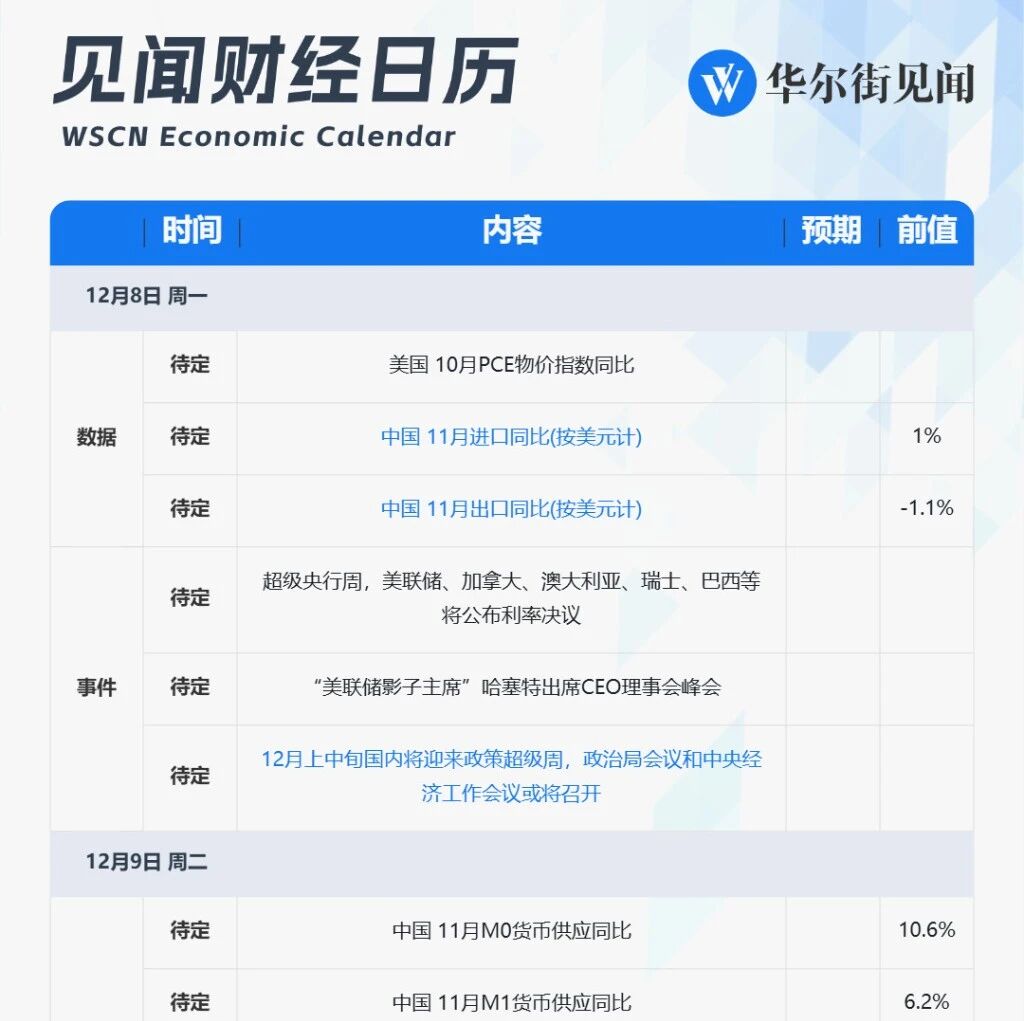
Core Viewpoint - The article highlights significant upcoming economic events and data releases, particularly focusing on the Federal Reserve's interest rate decision and the implications for global markets [6][9]. Economic Data and Events - On December 8, China will release November import and export data, with expectations of a 1% increase in imports and a 1.1% decrease in exports [3]. - The Federal Reserve is expected to announce a 25 basis point rate cut during its meeting on December 11, following recent trends in consumer spending and inflation [7][8]. - Key economic indicators such as China's CPI and PPI will be released on December 10, with CPI expected to rise to 1% from 0.2% [10][12]. Central Bank Meetings - The week of December 8-14 is termed a "super central bank week," with multiple central banks, including the Federal Reserve, Canada, Australia, and Switzerland, set to announce their monetary policy decisions [14][15]. - The Federal Reserve's decision will be closely monitored for its impact on global risk assets and future monetary policy directions [9]. Corporate Earnings Reports - Major companies like Oracle and Broadcom are scheduled to release their quarterly earnings, which are critical for assessing the AI infrastructure investment landscape [25][26]. - Broadcom is expected to report strong growth driven by demand for AI chips, while Oracle's performance will be scrutinized for its cloud infrastructure growth and capital expenditure management [25][26]. Upcoming Events - Microsoft CEO Satya Nadella will visit India from December 10 to 12, engaging with government officials and participating in AI-related discussions [17]. - OpenAI plans to release GPT-5.2 earlier than expected to compete with rivals, indicating a competitive landscape in AI development [16].
世界黄金协会中国区CEO:黄金投资永远不嫌晚
21世纪经济报道· 2025-12-07 01:25
Core Viewpoint - The World Gold Council advocates the "Gold+" asset allocation concept to help investors overcome challenges in gold investment, promoting gold as a long-term strategic asset to enhance risk resilience and optimize overall returns [1][3][5]. Group 1: Challenges Faced by Investors - Investors face three main difficulties in gold investment: understanding, entry, and holding [3][4]. - "Understanding difficulty" arises from the complex factors influencing gold prices, leading many to treat gold as a speculative tool rather than a strategic asset [4][5]. - "Entry difficulty" is characterized by hesitation over whether the current price is too high, causing investors to miss opportunities [4][5]. - "Holding difficulty" refers to the challenge of maintaining long-term positions in gold, with many selling during price fluctuations instead of holding for potential long-term gains [4][5]. Group 2: Long-term Value of Gold - Over the past 50 years, gold has provided an average annual return of approximately 10%, with a cumulative increase of nearly 60% since early 2025 [5]. - The "Gold+" concept encourages a shift from short-term speculation to long-term allocation, establishing gold as a strategic core asset [5][6]. Group 3: Recommended Allocation Strategies - The World Gold Council suggests two main strategies for gold allocation: indirect allocation through institutional investors and direct allocation by individuals [5][6]. - For individual investors, it is recommended to allocate 5% to 15% of household assets to gold, depending on personal risk tolerance [6][10]. - Institutional investors, such as public FOFs, actively incorporate gold into their long-term investment strategies, emphasizing discipline and strategic positioning [10][11]. Group 4: Successful International Examples - The Texas Teacher Retirement Fund exemplifies a conservative approach to gold allocation as part of a long-term investment strategy [7]. - Bridgewater Associates, led by Ray Dalio, views gold as a safeguard against credit risk, advocating for its inclusion in strategic asset allocation rather than tactical price betting [8]. Group 5: Domestic Market Trends - Public FOFs, particularly those targeting retirement, are actively incorporating gold into their investment strategies due to regulatory frameworks and product characteristics that favor long-term, disciplined investment [10][11]. - The discipline in managing gold allocations distinguishes institutional investors from individual investors, who may be more prone to short-term trading [13]. Group 6: Practical Investment Guidance - Investors should avoid speculative mindsets and consider gold as a long-term investment, with a recommended allocation not exceeding 20% of total assets [14][15]. - A gradual approach to investing in gold, such as starting with 2% to 3% of flexible funds and increasing to 5%, is advised to mitigate risks associated with market timing [14][15]. - Regularly reviewing gold investments and taking profits without fully liquidating positions can help maintain a balanced approach [15][16]. Group 7: Future Development of "Gold+" Products - The World Gold Council plans to promote the "Gold+" concept through industry meetings and public outreach, emphasizing gold's role as a strategic asset in long-term wealth preservation [16][17].

继续加码AI基建!软银洽谈私有化DigitalBridge (DBRG.US),小摩估值上看35美元/股
智通财经网· 2025-12-06 03:32
Group 1 - SoftBank is in negotiations to acquire DigitalBridge and take it private, aiming to capitalize on the surge in demand for AI-driven digital infrastructure [1] - DigitalBridge's stock has dropped 13% year-to-date but surged nearly 45% in a single day, closing at $14.12, giving it a market capitalization of $2.58 billion [1] - DigitalBridge manages approximately $108 billion in assets, with a portfolio that includes various digital infrastructure operators [1] Group 2 - The potential acquisition price for DigitalBridge is estimated to be between $25 and $35 per share, with analysts suggesting a conservative estimate of $25 and a potential upside to $30-$35 [2] - Analysts from Morgan Stanley predict an attractive exit price of $28 per share based on 2026 forecasts, with higher valuations for 2027 potentially reaching $30-$35 [2] - Raymond James analysts believe acquiring DigitalBridge is a wise move for a large alternative asset management company, provided the sale price is reasonable and favorable terms are offered [2] Group 3 - SoftBank previously engaged in a significant acquisition in 2017, purchasing Fortress Investment Group for over $3 billion [2] - The "Interstellar Gateway" project, announced in January, aims to build data centers in the U.S. with a budget of $500 billion, although progress has been slower than planned due to various disagreements [3] - SoftBank has announced plans to build five power plants in Texas, New Mexico, and Ohio, with a total capacity of 7 gigawatts, necessitating a reallocation of funds [3]


明年投资要降低预期!景林高云程最新交流回答12个高关注问题
聪明投资者· 2025-12-06 02:07
4、中国最强AI模型和公有云业务。在AI时代,想用AI,大部分企业必须用公有云; "像 2025年这样比较容易赚钱的年份不会太多,所以明年我觉得要降低预期。" "我的大概率判断是,中国会保持非常宽松的货币环境和流动性水平,这让股票市场中的优质公司的估值是比较稳定的。" "在做投资时,要把核心要素的权重放的足够大,就是买对好公司。剩下的都是次要条件、次要因素,权重很低。" "(产业板块的机会)未来半年到一年,在新能源(尤其是储能)和人工智能的应用(不管是软件还是与硬件结合)可能会出现一些机会。" 景林 资产管理合伙人、总经理高云程 ,近日在客户交流中回答了12个关注度很高的问题。 今年初高云程提出"MCGF"的投资线索,即"Make China Greater Future"。在半年度致持有人信中,他具象了这些线索的聚焦领域,主要包括: 1、大众娱乐社交平台,正在朝AIagent快速迭代; 2、无论谁设计最先进的芯片,都需要请他来做,具备强定价权; 3、在美元长期趋势出现动摇的情况下,拥有稀缺金铜资源的企业; 5、运动,户外生活方式的品牌矩阵经营集团。公司的供应链和品牌运营能力在持续提升,肉眼可见的和对手拉开了 ...
员工被举报接受高档宴请、KTV有偿陪侍,每次花费10万元不等,官方通报:立案调查,3人已停职
Mei Ri Jing Ji Xin Wen· 2025-12-06 01:30
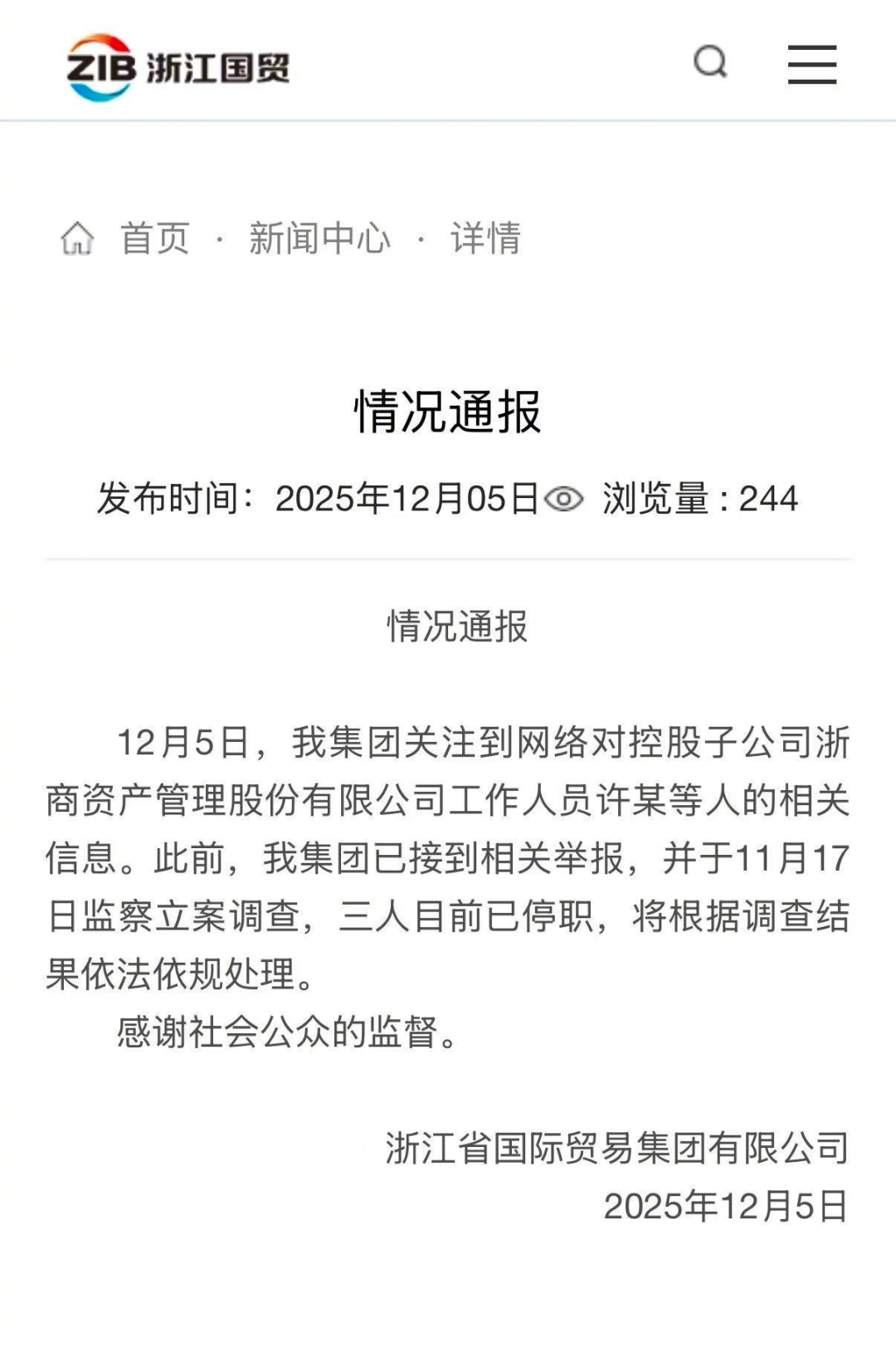
Core Viewpoint - Zhejiang International Trade Group Co., Ltd. has initiated an investigation into allegations of misconduct involving employees of its subsidiary, Zhejiang Merchants Asset Management Co., Ltd. [1][5] Group 1: Allegations and Investigation - Allegations surfaced on social media regarding misconduct by several management personnel at Zhejiang Merchants Asset, including accepting lavish banquets and paid companionship at KTV [5] - The group has confirmed that three employees, including Xu, have been suspended pending the outcome of the investigation, which was initiated after receiving reports on November 17 [1][5] - The reported misconduct includes extravagant hospitality expenses, with claims of over 500,000 yuan spent on receptions, including high-end liquor and entertainment [5] Group 2: Company Background - Zhejiang International Trade Group is a large state-owned enterprise established in 2008, with over 300 subsidiaries and more than 27,000 employees, ranking among China's top 500 enterprises [6] - The financial services segment of the group holds 12 financial and quasi-financial business licenses, with a focus on asset management and bad debt recovery, having acquired over 686.9 billion yuan in bad debt principal by the end of 2024 [6] - Zhejiang Merchants Asset, established in 2013, is a key player in the financial services sector, specializing in the acquisition and disposal of non-performing assets, investment banking services, and fund management [8]
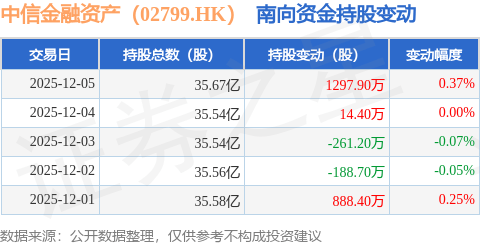
中信金融资产(02799.HK):12月5日南向资金增持1297.9万股
Sou Hu Cai Jing· 2025-12-05 19:27
Core Viewpoint - Southbound funds have increased their holdings in CITIC Financial Assets (02799.HK) by 12.979 million shares on December 5, 2025, indicating a growing interest from investors in the company [1]. Group 1: Shareholding Changes - In the last five trading days, southbound funds have increased their holdings for three days, with a total net increase of 17.508 million shares [1]. - Over the past 20 trading days, there have been ten days of net increases, totaling 43.564 million shares [1]. - As of now, southbound funds hold 3.567 billion shares of CITIC Financial Assets, accounting for 10.07% of the company's total issued ordinary shares [1]. Group 2: Company Overview - CITIC Financial Assets Management Co., Ltd. (formerly known as China Huarong Asset Management Co., Ltd.) primarily engages in asset management [2]. - The company operates through three main divisions: - The Non-performing Asset Management Division focuses on managing non-performing debt assets, debt-to-equity swap assets, and related investment opportunities [2]. - The Financial Services Division mainly provides financial leasing services [2]. - The Asset Management and Investment Division is involved in private equity fund operations, financial investments, international business, and other activities [2].
高管被举报接受高档宴请、KTV有偿陪侍,国企通报:已停职
Guan Cha Zhe Wang· 2025-12-05 13:50
近日,有网友举报称,浙商资产管理有限公司(以下简称"浙商资产")几名管理层人员存在接受高档宴 请、KTV有偿陪侍等行为。 12月5日,,浙商资产控股母公司浙江省国际贸易集团有限公司在官方网站发布情况通报,全文如下: 据新黄河此前报道,近日,有网友在社交平台发帖爆料称,浙商资产管理有限公司几名管理层人员存在 接受高档宴请、KTV有偿陪侍等行为,要求纪委介入调查。 爆料人赵先生表示,2023年公司为了拓展业务,向浙商资产申请6亿元左右用于收购河北信达资产包的 配资业务,前后一共6次接待了浙商资产许某等人的考察队伍,每次都要求安排住五星豪华套房、接受 高档宴请等,前后花费共计50多万元。其间,许某还多次暗示索要该项目的巨额好处费,在被拒绝后拖 着不办,最终导致该项目流产。 目前,他已经将情况反映给浙商资产控股公司浙江省国际贸易集团有限公司纪委,国贸纪委工作人员表 示,许某等人已经承认自己存在违规吃喝等问题,至于是否存在为自己谋取私利、审批业务是否有暗箱 操作等问题还需要进一步调查。 公开资料显示,浙江省浙商资产管理股份有限公司成立于2013年,位于杭州市上城区,为全国首批5 家、浙江省第一家具备批量转让金融不良资产 ...