健康等

Search documents
如何让服务消费“花得起、买得到、放心买”?
2 1 Shi Ji Jing Ji Bao Dao· 2026-02-04 02:19
Core Viewpoint - Service consumption is becoming a structural variable driving economic growth in China, with a shift from material to service-oriented consumption as residents' income rises and GDP per capita exceeds $13,000 [1][2] Group 1: Reasons for Service Consumption as a Key Driver - The combination of resident demand upgrade, economic structure transformation, and continuous policy support has established service consumption as a new driving force for high-quality economic development [2][3] - The aging population and the growing number of young children create a strong demand for services such as elderly care and childcare, with the domestic service industry expected to employ over 30 million people by 2024 [2] - The "scene economy" in sectors like tourism and health is driving consumption, with projected leisure tourism revenue of 450 billion yuan during the 2025-2026 winter season [2] Group 2: Economic Structure Transformation - The service sector has become the largest industry in China's economy, with the unique non-standard nature of services influencing consumer behavior and market dynamics [3] - Establishing a reliable service standard and credit system is crucial for enhancing consumer trust and expanding service consumption [3] Group 3: Policy Support and Institutional Framework - A comprehensive policy framework has been developed to support service consumption, transitioning from merely stimulating demand to fostering supply-demand collaboration [3][6] - The government is focusing on improving market access in sectors like healthcare and education while enhancing consumer infrastructure, with a 95.9% year-on-year increase in sales of tax refund goods expected by 2025 [3] Group 4: Practical Pathways for Modernizing Service Supply - Addressing structural mismatches in supply and demand, improving service quality, and enhancing consumer confidence are essential for the growth of service consumption [4][5] - Emphasizing technological innovation and digital transformation can help standardize services and reduce transaction costs, making services more accessible and reliable [4][5] Group 5: Focus on Basic Needs and Social Welfare - The aging population is shifting service consumption from optional to essential, increasing demand for healthcare and home care services [7] - Strengthening social security systems and expanding coverage can stabilize residents' income expectations and enhance consumer confidence [7] Group 6: Future Outlook - Service consumption is positioned as a key driver for China's economic transformation, with significant growth potential and a favorable policy environment [8] - The success of service consumption will depend on building a modern supply system that ensures quality, trust, and accessibility, ultimately benefiting the entire population [8]
如何让服务消费“花得起、买得到、放心买”?丨孙立坚专栏
Xin Lang Cai Jing· 2026-02-03 22:56
Core Viewpoint - Service consumption is becoming a structural variable in China's economic growth, driven by the transformation of consumer demand from material to service-oriented, with a projected increase in per capita service consumption expenditure to 46.1% by 2025 [2] Group 1: Reasons for Service Consumption as a Key Driver - The combination of resident demand upgrades, economic structure transformation, and continuous policy support creates a robust foundation for service consumption [3] - The aging population and the growing number of young children in China are driving demand for essential services like elderly care and childcare, with the domestic housekeeping industry expected to create over 30 million jobs by 2024 [3] - Experience-based consumption in sectors like tourism and health is expected to generate significant economic activity, with leisure tourism revenue projected to reach 450 billion yuan during the 2025-2026 winter season [3] Group 2: Economic Structure and Trust - The service sector has become the largest industry in China's economy, with its unique non-standard nature influencing consumer behavior and market dynamics [4] - Establishing a unified service standard and a reliable credit system is essential for enhancing service quality and consumer trust, which are critical for unlocking potential demand [4] Group 3: Policy Support and Institutional Framework - The policy framework has shifted from merely stimulating demand to a dual focus on supply and demand collaboration, with significant improvements in areas like medical and educational market access [4] - By 2025, the sales of tax refund goods for outbound travelers are expected to increase by 95.9%, indicating a growing emphasis on enhancing consumer infrastructure [4] Group 4: Challenges and Opportunities - Despite rapid growth in service consumption, issues such as structural mismatches in supply and demand, quality concerns, and consumer confidence need to be addressed [5] - The integration of AI and big data in service consumption can help overcome challenges related to non-standard services, enhancing precision and efficiency in service delivery [5] Group 5: Modernization of Supply System - The modernization of the service supply system is crucial, focusing on making services affordable, accessible, and trustworthy [6] - Emphasizing the development of a professional workforce in essential service areas like elderly care and childcare is vital for meeting growing demand [6] Group 6: Institutional Improvement and Market Integration - The establishment of a unified national market can reduce transaction costs and facilitate the replication of quality services across regions [7] - Continuous efforts to optimize the business environment for private enterprises and enhance service standards are necessary for fostering a safe and fair consumption environment [7] Group 7: Open Cooperation and Trade Upgrading - Promoting high standards in service trade and enhancing cross-border payment systems can lower costs and improve efficiency in service consumption [8] - The focus on integrating regional economies and enhancing service resource collaboration can lead to improved supply efficiency and quality [8] Group 8: Focus on Livelihood and Essential Services - The aging population is shifting service consumption from optional to essential, creating stable demand for healthcare and related services [9] - Strengthening social security systems and expanding coverage can enhance consumer confidence and support service consumption growth [9] Group 9: Long-term Economic Growth - Service consumption is positioned as a new engine for economic growth, with significant potential for expansion and development [10] - The successful transformation of service consumption into a long-term economic driver depends on building a modern supply system that ensures quality, trust, and accessibility [10]


国资委:明年要加强上市公司质量和市值管理
Sou Hu Cai Jing· 2025-12-24 02:06
Group 1 - The core viewpoint emphasizes the need for state-owned enterprises to focus on stabilizing operations and improving quality and efficiency in 2026 [1] Group 2 - Companies should seize market opportunities by closely monitoring macroeconomic conditions and enhancing structural and trend analysis within industries [1] - There is a call for the use of big data and industry models to accurately capture potential market demand and innovate in product and service quality [1] - The aim is to cultivate new consumption scenarios in sectors such as culture, tourism, digital, and health to create new growth points [1] Group 3 - Companies are encouraged to strengthen management practices to improve development quality, including comprehensive budget management and cost control across all aspects [1] - There is a focus on managing receivables, contract assets, inventory, and payables more effectively [1] - Emphasis is placed on enhancing the quality and market value of listed companies [1] Group 4 - Effective investment is highlighted as a means to accumulate development potential, particularly in key areas such as industrial chain strengthening, infrastructure construction, and energy resource security [1] - Companies are urged to utilize various support policies to plan and implement significant projects and landmark initiatives [1] - The goal is to lay a solid foundation for sustainable development [1]
落实党的二十届四中全会部署 以服务业数智化促服务消费扩容升级
Jin Rong Shi Bao· 2025-12-01 03:31
Core Viewpoint - The 20th Central Committee of the Communist Party of China emphasizes the importance of "digital intelligence" and "consumption" in the 14th Five-Year Plan, aiming to drive high-quality development in service consumption through the digitalization of the service industry [1][2]. Group 1: Strategic Significance of Service Industry Digitalization - Service industry digitalization is a crucial approach to align with technological revolution trends and cultivate new productive forces, with a focus on integrating AI, big data, and cloud computing [2]. - It meets the growing demand for high-quality, personalized services as consumer preferences shift towards more diverse and enjoyable experiences [3]. - Digitalization supports the construction of a new development pattern and enhances the reliability of domestic circulation, which is vital for China's modernization [4]. Group 2: Challenges and Solutions in Service Consumption - The service industry faces a "low-level equilibrium trap," where there is a mismatch between high demand and insufficient quality supply, particularly in sectors like elderly care and childcare [5]. - Digitalization can optimize service supply and expand coverage, breaking the deadlock between supply and demand [5]. Group 3: Achievements in the 14th Five-Year Plan - Significant advancements in digital infrastructure have been made, with over 459.8 thousand 5G base stations established, enhancing network quality and user experience [6][7]. - The platform economy has thrived, with online retail in service consumption projected to reach approximately 2.44 trillion yuan in 2024, accounting for 15.7% of total online retail [8]. - New consumption scenarios have emerged, integrating online and offline experiences, and enhancing consumer engagement through immersive technologies [9]. Group 4: Directions and Paths for the 15th Five-Year Plan - The focus will be on deepening the integration of technology and service consumption, emphasizing the need for personalized and immersive service experiences [14][16]. - Key measures include breaking institutional barriers to stimulate service supply and fostering a regulatory framework that adapts to new business models [15]. - The plan aims to enhance the quality of service consumption by promoting the integration of modern services with advanced manufacturing and agriculture [16]. Group 5: Policy Environment and Safety Measures - The government aims to optimize fiscal and financial policies to support public services and enhance consumer confidence [17]. - Data security and privacy protection will be prioritized to ensure the safe operation of digitalized services [17]. - There will be an emphasis on improving digital literacy and talent cultivation to support the growth of new service consumption models [17].
打造消费“新三样”!名单公示,50城拟入选
券商中国· 2025-11-20 14:18
Core Viewpoint - The article discusses the significant progress in the pilot program for new consumption formats, models, and scenarios initiated by the Ministry of Finance and the Ministry of Commerce to stimulate domestic demand and unleash consumer potential [1][2]. Summary by Sections Pilot Program Overview - The pilot program has officially announced a list of 50 cities, including all four direct-controlled municipalities and five cities with independent planning, covering major provinces across the country [2]. - The program will last for two years, with the central government providing up to 400 million yuan per city based on city size to enhance the consumption market [4]. Funding and Support Structure - Funding will be tiered based on city size: super-large cities will receive a total of 400 million yuan, large cities 300 million yuan, and other cities 200 million yuan, with funds distributed in two batches [5]. - The policy focuses on supply-side innovation, supporting the establishment of first-store economies, diverse service consumption scenarios, and collaborations with well-known IPs [5][6]. Key Support Areas - The program aims to create first-store centers and economic clusters, supporting the opening of flagship and concept stores for leading domestic and international brands [6]. - It encourages the development of diverse service consumption scenarios, enhancing cultural, health, and entertainment functions in shopping areas, and promoting night economy initiatives [6]. - The initiative also supports collaborations between local cultural resources and popular IPs to create innovative consumption experiences [6]. Economic and Employment Impact - The pilot program is expected to stimulate both consumption and employment, fostering high-quality, innovative supply to meet diverse consumer demands [7][8]. - It aims to create numerous job opportunities across various service sectors, including retail, dining, and tourism, thereby enhancing the employment absorption capacity of the service industry [7][8].

四川出台促进服务消费“十九条” 让百姓的日子更“活色生香”
Si Chuan Ri Bao· 2025-11-19 02:01
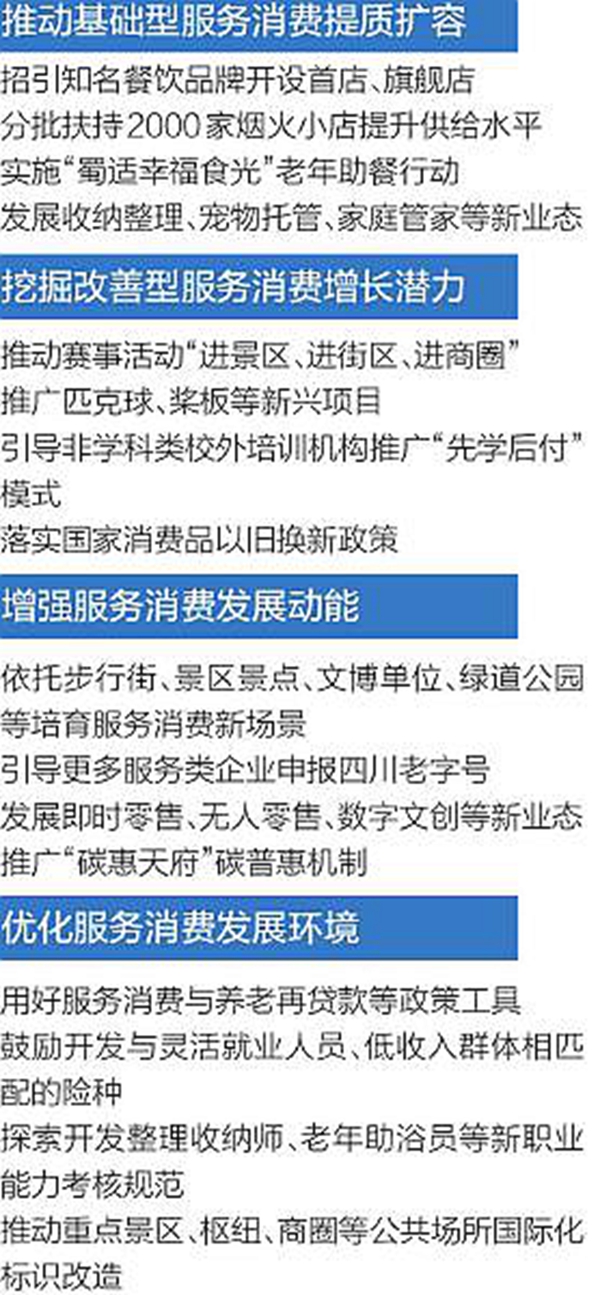
Group 1 - The core viewpoint of the news is the implementation of a comprehensive plan to enhance service consumption quality and expand its capacity in Sichuan Province, focusing on various sectors including dining, elderly care, and cultural tourism [2][3][4] - The plan includes nurturing 2,000 distinctive local shops to improve urban liveliness and convenience, alongside initiatives to enhance community elderly care services and develop new home service industries [4][5] - The strategy aims to tap into the growth potential of improved service consumption by promoting sports events and outdoor activities, as well as enhancing non-academic training services [4][6] Group 2 - The plan outlines 19 measures across four main areas: improving basic service consumption, exploring growth potential in improved service consumption, enhancing development momentum for service consumption, and optimizing the consumption environment [3][4] - New service consumption scenarios and business models will be developed, leveraging commercial complexes, pedestrian streets, and cultural sites to create unique and international service experiences [5][6] - Financial support will be strengthened for key service consumption sectors and the elderly care industry through various policy tools, aiming to meet diverse consumer needs and stimulate economic growth [6]
服务消费迎政策助力,多措并举扩大内需!市场午后“变脸”,消费ETF(159928)回调1.61%弱势三连阴,近2天疯狂吸金近8亿元!
Xin Lang Cai Jing· 2025-09-18 10:16
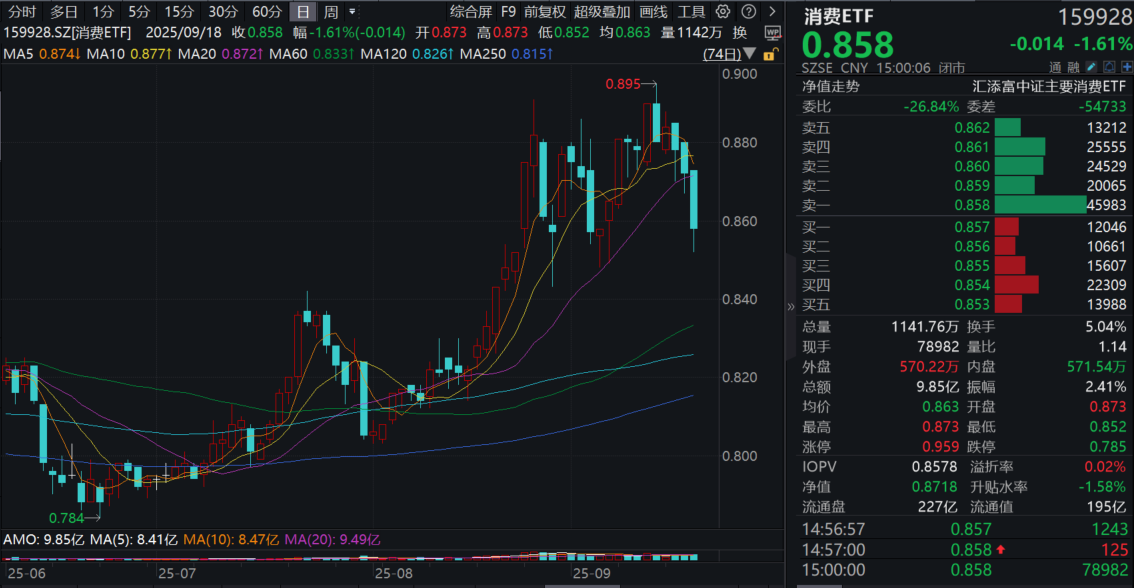
Market Overview - The market experienced a high of 3899 points before a decline, with all three major indices dropping over 1% [1] - The Consumption ETF (159928) fell by 1.61%, marking a three-day downward trend, with a total trading volume of 1 billion yuan, slightly higher than the previous day [1] - The Consumption ETF (159928) attracted nearly 800 million yuan in two days, with a total size exceeding 19.7 billion yuan, leading its peers [1] Hong Kong Market - The Hong Kong Consumption 50 ETF (159268) also saw a decline of 1.43%, with a trading volume exceeding 33 million yuan [3] - Over the past five days, there were net inflows on four days, accumulating over 32 million yuan [3] - Notable stocks included Pop Mart rising over 4% and China Duty Free increasing over 2%, while stocks like Anta Sports and Midea Group fell over 2% [3] Policy Measures - The State Council introduced policies to expand service consumption, selecting around 50 pilot cities for new consumption models [5] - A series of policy documents will be released to promote high-quality development in the accommodation industry and integrate railways with tourism [5] - The government plans to conduct over 25,000 cultural and tourism consumption activities during the consumption month, distributing over 330 million yuan in consumption subsidies [5] Service Consumption Policies - The recent policies are seen as a refinement of the 2024 guidelines for promoting high-quality service consumption, emphasizing cross-department collaboration [6][7] - The measures cover 19 specific actions across key service sectors, including culture, tourism, sports, education, and health, aiming to enhance service consumption from multiple dimensions [7] - The policies focus on practical execution and operational feasibility, introducing innovative and implementable measures [7] Key Highlights of the Measures - The policies include initiatives for service consumption seasons, targeting areas with high demand potential [8] - Supply-side measures aim to expand openness and reduce restrictions in various sectors, enhancing service product offerings [8] - Demand-side strategies focus on attracting inbound consumption and exploring new consumption forms through AI and digital services [8] - Financial support will be provided through various tools to inject liquidity into the service consumption market [8] Industry Insights - The policies are expected to boost sectors like IP economy, maternal and infant care, and AI-driven consumption [9][10] - The IP economy is encouraged to innovate and create new consumption scenarios, with strong growth in domestic IP industries [9] - Maternal and infant care will benefit from supportive policies, reducing costs and stimulating demand in related industries [9] - AI technology is anticipated to enhance consumer experiences and create new products and scenarios in the market [10] Consumption ETF Insights - The Consumption ETF (159928) is characterized by its resilience across economic cycles, with top ten holdings accounting for over 68% of its weight [11] - Key holdings include leading liquor brands and major players in the agricultural sector, indicating a strong focus on essential consumer goods [11] - The Hong Kong Consumption 50 ETF (159268) is positioned as an efficient choice for investing in the Hong Kong consumption sector, supporting T+0 trading and not occupying QDII quotas [12]