
半导体材料设备

Search documents
超500亿元,“跑了”
Zhong Guo Ji Jin Bao· 2026-01-21 06:10
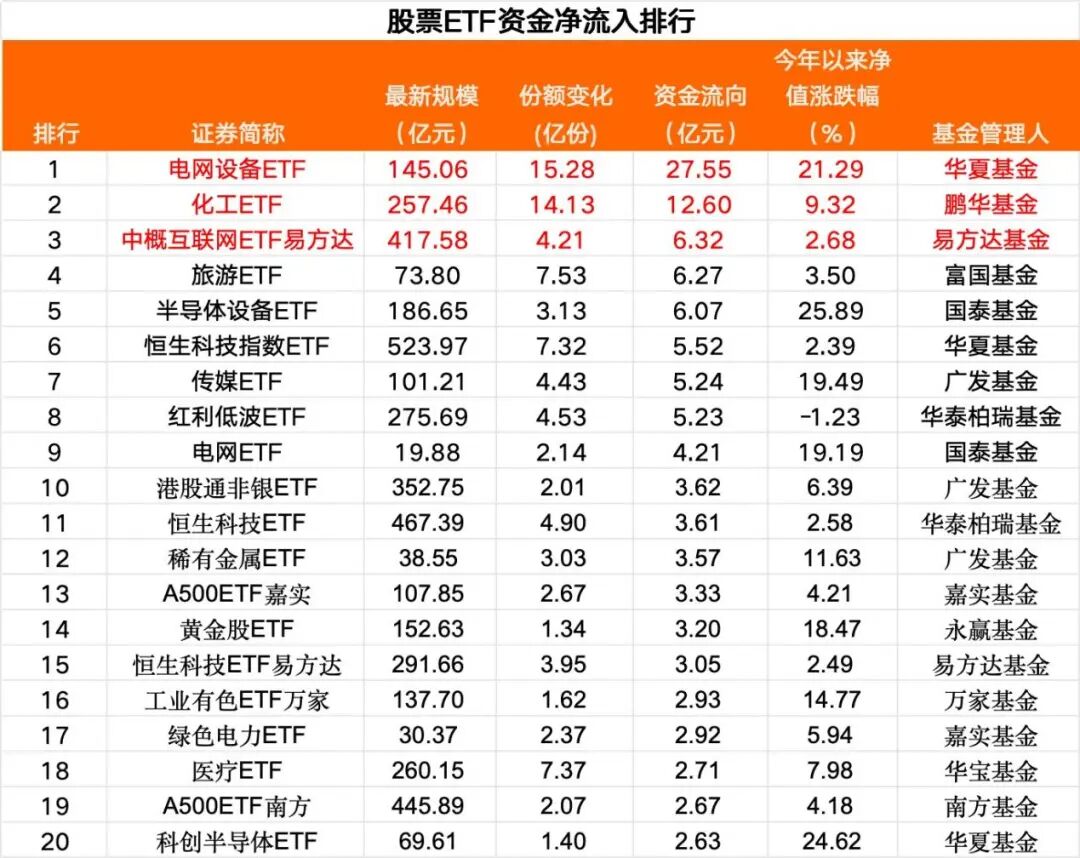
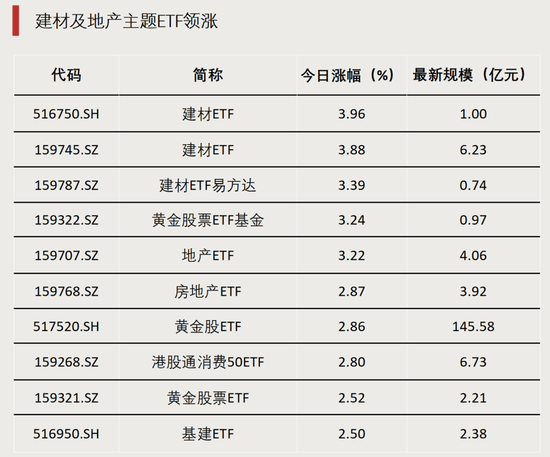
Group 1 - On January 20, the A-share market experienced a decline, with all three major indices falling, and over 500 billion yuan in net outflows from stock ETFs [1][2] - In the past four trading days, the total net outflow from stock ETFs exceeded 240 billion yuan, with over 920 billion yuan in net outflows in the first two days of the week [2] - The total scale of stock ETFs in the market reached 4.75 trillion yuan as of January 20, 2026, with a trading volume of 3.13 trillion yuan on that day [3] Group 2 - The building materials and real estate sectors led the gains among stock ETFs, with the top three performing ETFs all from the building materials sector, each rising over 3.3% [4] - The worst-performing ETFs included those related to satellites, aviation, and communication equipment, with many experiencing declines exceeding 3% [4] - On January 20, the net outflow from stock ETFs was approximately 505 billion yuan, with 51 ETFs seeing inflows of over 100 million yuan [5] Group 3 - The top five inflow sectors included new energy (net inflow of 2.91 billion yuan), gold (2.75 billion yuan), and petrochemical (1.87 billion yuan) [5] - The leading ETFs by net inflow included the Electric Grid Equipment ETF with a net inflow of 2.755 billion yuan, followed by the KI ETF and the China Concept Internet ETF [6] - The top outflow ETFs included the CSI 300 ETF from Huatai-PineBridge, which saw a net outflow of 10.984 billion yuan, and the CSI 500 ETF with a net outflow of 9.143 billion yuan [7] Group 4 - Major public fund companies continue to see inflows into their ETFs, with E Fund's China Concept Internet ETF attracting 640 million yuan and the Gold ETF attracting 360 million yuan on January 20 [8] - The market is expected to remain stable due to supportive monetary policy and positive macroeconomic data, with a potential spring rally anticipated [8] - Short-term market fluctuations may occur due to regulatory measures aimed at preventing excessive volatility, but a spring rally is expected to resume around the Chinese New Year [9]

资金涌入,行业主题ETF
Xin Lang Cai Jing· 2026-01-20 13:39
Group 1 - The real estate and building materials sectors showed strength on January 20, with multiple related ETFs rising over 3% [1][4][15] - The precious metals sector, represented by gold stocks, also gained momentum in the afternoon, with several gold-themed ETFs increasing by over 2% [1][4][15] - The commercial aerospace sector has recently entered a high volatility range, with several satellite-themed ETFs dropping over 4% [2][16] Group 2 - There has been a noticeable trend of capital flowing out of broad-based ETFs and into industry-specific ETFs, with significant net inflows into semiconductor materials and non-ferrous metals ETFs exceeding 10 billion yuan [3][17] - On January 19, the electric grid-themed ETF saw a net inflow of over 2.5 billion yuan, while gold ETFs and semiconductor materials equipment also attracted over 1 billion yuan each [10][24] - The broad-based ETFs continued to experience net outflows, with the CSI 300 ETF seeing a net outflow of over 30 billion yuan on January 19, although this was a decrease from over 58 billion yuan on January 16 [10][24] Group 3 - The leading broad-based ETFs remain highly active in trading, with several ETFs achieving transaction volumes exceeding 10 billion yuan [8][22] - The A500 ETF, which is the first to "go abroad" under the mutual market access mechanism, was listed on the Singapore Exchange on January 20, marking a significant milestone for cross-border ETF investment [13][27] - Analysts suggest that the domestic equity market remains active, with a focus on sectors supported by performance, as the market prepares for upcoming earnings reports [12][26]
申万金工ETF组合202512
Shenwan Hongyuan Securities· 2025-12-16 03:30
Report's Investment Rating for the Industry The provided content does not mention the industry investment rating. Core Views of the Report - The report constructs multiple ETF portfolios, including macro industry, macro + momentum industry, core - satellite, and trinity style rotation portfolios, to capture investment opportunities and manage risks in the ETF market [1][5]. - It combines macro - based and momentum - based methods to form complementary strategies, aiming to improve the performance of the portfolios [12]. - The trinity style rotation model uses macro liquidity as the core to build a long - term style rotation model and selects ETFs based on the model's results [6]. Summary by Relevant Catalog 1. ETF Portfolio Construction Methods 1.1 Based on Macro Method - Calculate the macro - sensitivity scores of economic, liquidity, and credit for industry - themed ETFs, and adjust the scores according to the latest indicators. Select the top 6 industry - themed indices and corresponding largest - scale ETFs for equal - weight allocation [1][7]. - Traditional cyclical industries are sensitive to the economy, TMT is sensitive to liquidity, and consumption is sensitive to credit. State - owned enterprises and ESG - related themes have low sensitivity to liquidity and credit [5]. 1.2 Trinity Style Rotation - Build a long - term style rotation model centered on macro liquidity, including growth/value, market capitalization, and quality models. Combine the results of the three models to get the final style preference [6]. - Screen ETFs with high exposure to the target style, control industry exposure, and set allocation limits to obtain the ETF allocation model [6]. 2. Macro Industry Portfolio - Select industry - themed ETFs that have been established for over 1 year and have a current scale of over 200 million. Calculate and adjust sensitivity scores, and remove liquidity scores if there is a significant divergence between liquidity and credit. Then select the top 6 industry - themed indices and corresponding largest - scale ETFs for equal - weight allocation [7][8]. - Currently, with economic forward - looking indicators rising and liquidity and credit indicators tightening, the portfolio is value - oriented with high proportions of banks and cyclical sectors. The December 2025 holdings include Huabao CSI Bank ETF, Cathay CSI Coal ETF, etc. [9]. - The portfolio has large fluctuations and outperformed the benchmark significantly in November 2025 [11]. 3. Macro + Momentum Industry Portfolio - Combine macro - based and momentum - based methods. Use clustering to group industry - themed indices and select the product with the highest 6 - month return from each group for equal - weight allocation [12]. - The December 2025 holdings include Huabao CSI Bank ETF, Cathay CSI Coal ETF, and others. The battery and metal industries selected by momentum have increased [15]. - The portfolio has performed well this year and outperformed the CSI 300 significantly in November 2025 [16]. 4. Core - Satellite Portfolio - Design a "core - satellite" portfolio with the CSI 300 as the core to address the high volatility and rapid industry rotation of industry - themed ETFs [18]. - Calculate macro - sensitivity scores for domestic broad - based, industry - themed, and Smart Beta ETFs, construct three stock portfolios, and weight them at 50%, 30%, and 20% respectively [18]. - The December 2025 holdings include Huatai - Peregrine CSI 300 ETF, Huaxia SSE 50 ETF, etc. The portfolio has been stable this year and outperformed the index almost every month, including in November 2025 [21][23]. 5. Trinity Style Rotation ETF Portfolio - The model currently favors small - cap growth + high - quality segments. The factor exposures and historical performance are presented in the report [24]. - The December 2025 holdings include Southern CSI 500ETF, Southern CSI 1000ETF, etc. [30].
本期震荡偏积极:定量视角下的收官之战
Guotou Securities· 2025-11-30 06:05
- The report discusses a **cycle analysis model**, which observes the market's monthly upward trend since early 2024, despite recent adjustments and a temporary break below the rising channel. This model suggests that the overall risk remains controllable, even if there is a future pullback, as the high-frequency temperature gauge of major broad-based indices remains below 20, indicating a relatively low level [1][9] - The **industry divergence indicator** is highlighted, showing that the divergence among primary industries has dropped to a historically low level. Historically, this indicator tends to rise again when the market restarts, potentially signaling the emergence of a sustainable market theme. The report notes that the TMT sector, which previously adjusted, is showing signs of renewed capital attention [2][9] - The **Four-Drive Model** provides insights into specific sectors. It identifies potential rebounds in the small-cap growth sector, coal sector, semiconductor materials and equipment sector, and sci-tech materials sector. These sectors are noted for signals such as low-cycle absorption, volume contraction during adjustments, and signs of stabilization or rebound after significant corrections [3][6][11]
机构风向标 | 耐科装备(688419)2025年三季度已披露持仓机构仅7家
Xin Lang Cai Jing· 2025-10-28 02:32
Core Insights - Neike Equipment (688419.SH) reported its Q3 2025 results, revealing that as of October 27, 2025, seven institutional investors held a total of 29.953 million shares, representing 26.15% of the company's total equity [1] Institutional Holdings - The total institutional holding percentage decreased by 0.19 percentage points compared to the previous quarter [1] - Notable institutional investors include Tongling Songbao Intelligent Equipment Co., Ltd., Anhui Tuo Ling Investment Co., Ltd., J.P. Morgan Securities PLC, Barclays Bank PLC, and others [1] Public Fund Activity - One public fund, the Huaxia Shanghai Stock Exchange Sci-Tech Innovation Board Semiconductor Materials Equipment Theme ETF, increased its holdings by 0.20% compared to the last period [1] - One new public fund disclosed its holdings this period, namely the Yimin Dividend Growth Mixed Fund [1] - A total of 67 public funds did not disclose their holdings this quarter, including notable funds such as Guotou Ruijin Shanghai Stock Exchange Sci-Tech Innovation Board Comprehensive Price Index Enhanced A and others [1]

科创板“1+6”改革落地有多重意义
Zheng Quan Ri Bao Zhi Sheng· 2025-10-27 17:08
Core Viewpoint - The successful listing of three companies on the Sci-Tech Innovation Board marks the substantial implementation of the "1+6" reform, aimed at supporting unprofitable but technologically advanced enterprises [1][2]. Group 1: Reform Significance - The establishment of the Sci-Tech Growth Layer demonstrates the inclusiveness of the system and its alignment with the development of "hard tech" enterprises, providing institutional support for unprofitable companies with significant technological breakthroughs [2][3]. - The reform facilitates financing channels for "hard tech" companies, accelerating the gathering of new enterprises in the Sci-Tech Growth Layer, with 26 new companies accepted post-reform, including 8 unprofitable ones [3][4]. Group 2: Valuation Logic and Market Dynamics - The reform reshapes the valuation logic for "hard tech" companies, encouraging the market to focus on long-term value and technological barriers rather than short-term profits, which fosters a patient capital environment [4][5]. - The introduction of 21 new Sci-Tech Board ETFs since the reform, with a total scale of 300 billion yuan, directs funds towards key development areas in new productivity [4]. Group 3: Company Performance Post-Listing - Companies must maintain a focus on technological breakthroughs and commercialization after going public, as demonstrated by successful cases like ChipLink and Suzhou Zejing Biopharmaceutical, which have achieved significant market penetration and product approvals [5][6].
【广发金工】AI识图关注新能源
广发金融工程研究· 2025-10-19 13:24
Market Performance - The Sci-Tech 50 Index decreased by 6.46% over the last five trading days, while the ChiNext Index fell by 5.71%. In contrast, the large-cap value stocks rose by 2.08%, and large-cap growth stocks declined by 3.90%. The Shanghai Stock Exchange 50 Index dropped by 0.24%, and the small-cap stocks represented by the CSI 2000 fell by 4.69%. The banking and coal sectors performed well, while electronics and media lagged behind [1]. Risk Premium and Valuation Levels - As of October 17, 2025, the static PE of the CSI All Share Index indicates a risk premium of 2.97%, calculated as the inverse of the PE minus the yield of ten-year government bonds. The two standard deviation boundary is set at 4.75%. The valuation levels show that the CSI All Share Index's PETTM is at the 77th percentile, with the Shanghai 50 and CSI 300 at 73% and 70%, respectively. The ChiNext Index is close to the 47th percentile, while the CSI 500 and CSI 1000 are at 60% and 54% [1]. Fund Flows and Trading Activity - In the last five trading days, ETF inflows amounted to 68.6 billion yuan, and the margin trading balance increased by approximately 70.5 billion yuan. The average daily trading volume across both markets was 2.1746 trillion yuan [2]. Thematic Indexes - The latest thematic allocations focus on low-carbon economy, new energy, and semiconductor materials. Specific indices include the CSI Mainland Low-Carbon Economy Theme Index, ChiNext New Energy Index, and the Shanghai Stock Exchange Sci-Tech Board Semiconductor Materials Equipment Theme Index [2][3]. Long-Term Market Sentiment - The report includes observations on the proportion of stocks above the 200-day moving average, indicating long-term market sentiment trends [13]. Financing Balance - The report tracks the financing balance, which reflects the overall leverage and risk appetite in the market [16].

恒生电子: 北京竞天公诚(杭州)律师事务所关于恒生电子股份有限公司2025年员工持股计划之法律意见书
Zheng Quan Zhi Xing· 2025-08-22 14:18
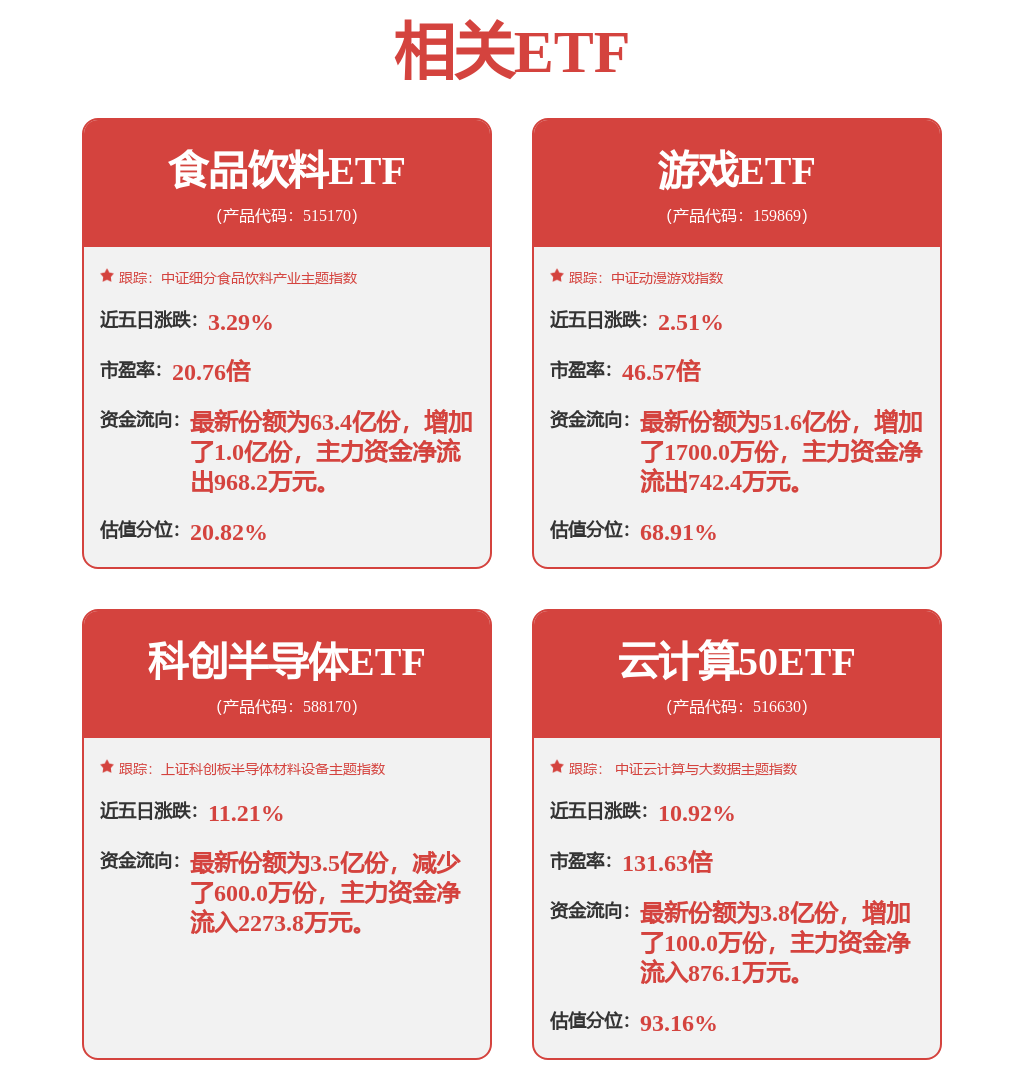
Group 1 - The Food and Beverage ETF (code: 515170) tracks the China Securities Food and Beverage Industry Theme Index, with a recent five-day change of 3.29% and a price-to-earnings ratio of 20.76 times. The latest share count is 6.34 billion, an increase of 100 million shares, with a net outflow of 9.682 million yuan in principal funds [2] - The Gaming ETF (code: 159869) follows the China Securities Animation and Gaming Index, showing a five-day change of 2.51% and a price-to-earnings ratio of 46.57 times. The latest share count is 5.16 billion, an increase of 17 million shares, with a net outflow of 742.4 thousand yuan in principal funds [2] - The Sci-Tech Semiconductor ETF (code: 588170) tracks the Shanghai Stock Exchange Sci-Tech Innovation Board Semiconductor Materials and Equipment Theme Index, with a five-day change of 11.21%. The latest share count is 350 million, a decrease of 6 million shares, with a net inflow of 22.738 million yuan in principal funds [2] Group 2 - The Cloud Computing 50 ETF (code: 516630) tracks the China Securities Cloud Computing and Big Data Theme Index, with a five-day change of 10.92% and a price-to-earnings ratio of 131.63 times. The latest share count is 3.8 billion, an increase of 1 million shares, with a net inflow of 8.761 million yuan in principal funds [3]

ETF英雄汇(2025年5月28日):通信ETF(515880.SH)领涨、标普消费ETF(159529.SZ)溢价明显
Xin Lang Cai Jing· 2025-05-28 09:34
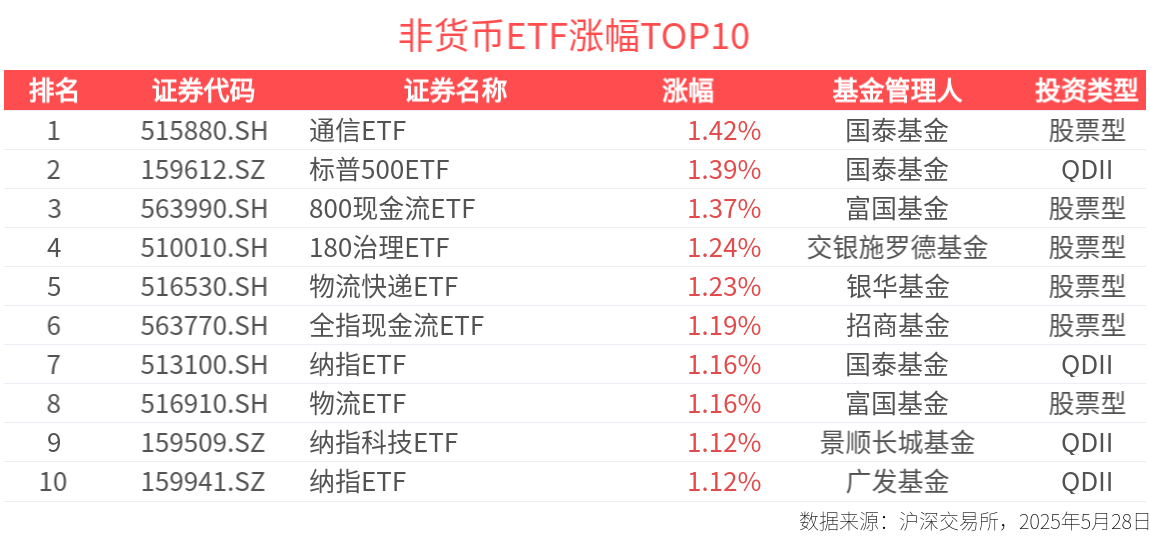
Market Overview - As of May 28, 2025, the Shanghai Composite Index closed down 0.02% at 3339.93 points, the Shenzhen Component Index down 0.26% at 10003.27 points, and the ChiNext Index down 0.31% at 1985.38 points, indicating a broad market decline [1] - The total trading volume of both markets reached 1.01 trillion yuan [1] Sector Performance - The top three sectors by increase were jewelry, non-white liquor, and beverage dairy, with respective gains of 5.09%, 2.43%, and 2.23% [1] - The sectors with the largest declines were professional chains, passenger vehicles, and internet e-commerce, with respective losses of 2.00%, 1.98%, and 1.74% [1] ETF Performance - A total of 293 non-currency ETFs rose, representing an increase rate of 26% [1] - The China Securities Index Communication Equipment Index rose by 1.28%, while the Communication ETF increased by 1.42% [1] - The China Securities Modern Logistics Index rose by 1.01%, with the Logistics Express ETF and Logistics ETF increasing by 1.23% and 1.16%, respectively [1] - The China Securities 800 Free Cash Flow Index rose by 1.00%, with the 800 Cash Flow ETF increasing by 1.37% [1] Notable ETFs - The Communication ETF (515880.SH) has a latest share size of 2.055 billion shares and closely tracks the China Securities Index Communication Equipment Index, which includes major companies like ZTE Corporation and Huazhong University of Science and Technology [3] - The S&P 500 ETF (159612.SZ) has a latest share size of 347 million shares and tracks the S&P 500 Index, which includes 500 leading companies representing about 80% of the available market capitalization [4] - The 800 Cash Flow ETF (563990.SH) has a latest share size of 124 million shares and tracks the China Securities 800 Free Cash Flow Index, which selects 50 companies with high free cash flow rates [4] Valuation Metrics - The current P/E ratio (TTM) for the China Securities Index Communication Equipment Index is 28.26, which is below 68.77% of the time over the past three years [4] - The S&P 500 Index has a current P/E ratio (TTM) of 26.50, below 76.20% of the time over the past three years [4] - The P/E ratio (TTM) for the China Securities 800 Free Cash Flow Index is 10.95, below 57.02% of the time over the past three years [5] Declining ETFs - A total of 760 non-currency ETFs declined, representing a decrease rate of 67% [5] - The top declining sectors included the China Securities Semiconductor Materials and Equipment Index and the China Securities All-Index Automotive Index, with respective declines of 1.57% and 1.46% [5] Premium Rates - The S&P 500 Consumer Select Index had a premium rate of 26.13%, while the S&P 500 ETF had a premium rate of 20.06% [8][10]
宁夏完善政策厚植民营经济发展沃土
Jing Ji Ri Bao· 2025-05-04 22:06
Core Viewpoint - The private economy plays a crucial role in driving development in Ningxia, contributing nearly 50% of the regional GDP, over 50% of tax revenue, more than 60% of R&D investment, nearly 70% of social employment, and over 90% of business entities [1] Group 1: Economic Contribution - The private economy contributes nearly 50% of Ningxia's regional GDP and over 50% of its tax revenue [1] - Private enterprises account for more than 60% of R&D investment and nearly 70% of social employment in the region [1] - Ningxia's private sector has invested over 50 billion yuan in various projects, generating over 40 billion yuan in revenue and contributing over 3 billion yuan in taxes [2] Group 2: Policy Support and Development - Ningxia has been continuously improving its policy framework and development environment to support the private economy [1][3] - A recent training program was held to enhance the capabilities of officials in implementing policies that support private enterprises [1] - The region has established a "policy library" with 13 categories and 3,455 policy documents aimed at benefiting enterprises [7] Group 3: Business Environment - The business environment in Ningxia is characterized by significant reductions in administrative burdens, including a decrease in required documentation and processing times [3][8] - The city of Yinchuan has implemented measures to streamline processes, reducing the time for project approvals from 234 days to 57 days [8] - The region has seen a 9.6% year-on-year increase in industrial added value, with private enterprises growing by 15% [8] Group 4: Financial Support - Over the past three years, Ningxia has implemented tax reductions and refunds exceeding 52 billion yuan, benefiting 45.8 million private enterprises [9] - The government has introduced financial measures to alleviate the financing difficulties faced by private enterprises, including a 60 billion yuan investment from government funds [9] - In 2024, Ningxia plans to allocate 8.7 billion yuan for interest subsidies and guarantees, aiming to mobilize 784 billion yuan in credit funds [9]