
集成电路装备

Search documents
厅局长访谈丨胡异冲:加快构建具有辽宁特色的“2211”产业体系
Xin Lang Cai Jing· 2026-01-27 16:55
Core Viewpoint - The article emphasizes the importance of deepening "baseline management" and enhancing industrial operation scheduling and analysis to stabilize key sectors such as transportation, oil, and steel in Liaoning Province as it embarks on its "14th Five-Year Plan" [1] Group 1: Industrial Strategy - The provincial industrial and information technology system will focus on strengthening the foundation, building platforms, aggregating resources, and enhancing services to implement "foundation service" initiatives [1] - There will be a push for the transformation and upgrading of traditional industries, alongside the cultivation and expansion of strategic emerging industries, aiming to establish a distinctive "2211" industrial system in Liaoning [1] Group 2: Technological Innovation - The government plans to promote the intelligent transformation and digital transition of traditional industries, while also reinforcing the integration of technological and industrial innovation [1] - There is a focus on nurturing new industries such as integrated circuit equipment and aerospace, as well as forward-looking sectors like advanced energy storage and atomic-level manufacturing [1] Group 3: Enterprise Development - The strategy includes fostering high-quality enterprises and creating a batch of specialized, innovative "little giants," manufacturing champions, and high-tech enterprises [1] - The government aims to enhance the matching of production, demand, finance, and innovation through quality services and a favorable industrial ecosystem to create a first-class business environment [1]

三省“双城德比”透视区域经济新格局
Xin Lang Cai Jing· 2026-01-20 22:59
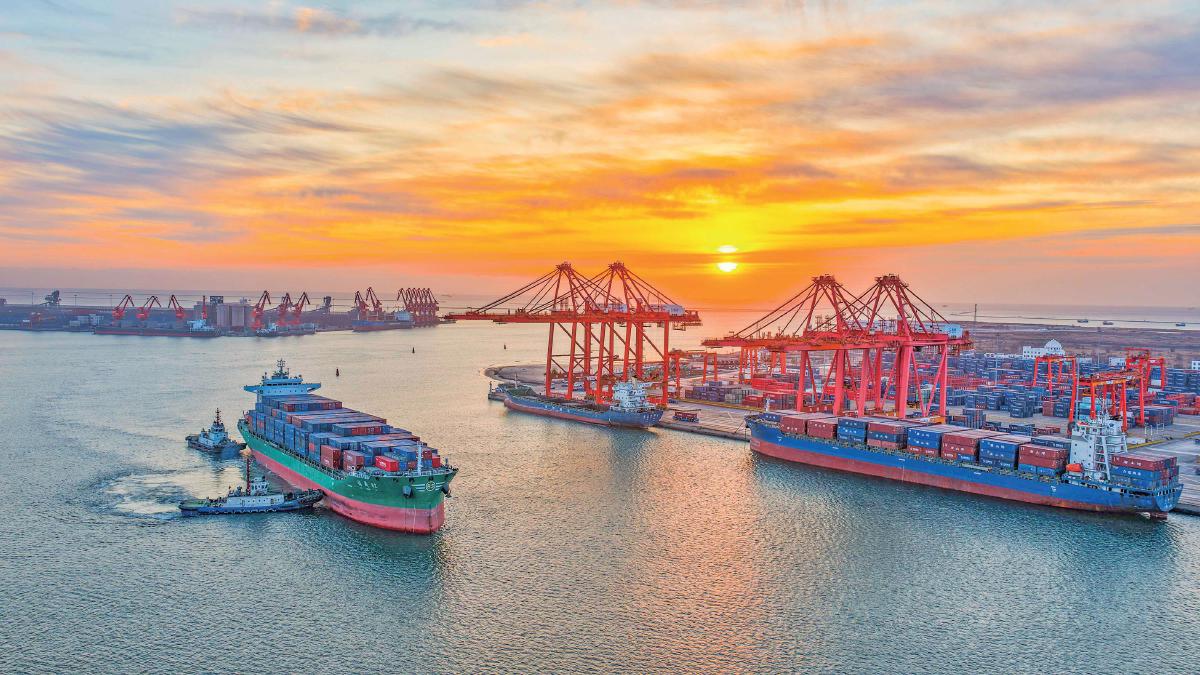
Group 1: Economic Competition Overview - The competition among cities in China is intensifying, with notable "provincial derbies" emerging in various regions, reflecting strategic adjustments and economic dynamics [2] - In Northeast China, the competition between Shenyang and Dalian is highlighted, with Shenyang narrowing the GDP gap to less than 500 billion yuan in 2024 [3][4] - In Southeast China, Fuzhou and Quanzhou have been engaged in a long-standing economic rivalry, with Fuzhou reclaiming its position as the leading city after 22 years [6][7] Group 2: Shenyang vs. Dalian - In 2024, Dalian's GDP reached 9516.9 billion yuan, while Shenyang's GDP was 9027.1 billion yuan, marking a significant competition in the Northeast region [3] - Shenyang's economic growth rate of 6.1% in 2023 allowed it to slightly surpass Dalian's 6.0% growth, reducing the GDP gap by 245 billion yuan over two years [3][4] - Dalian's strengths lie in its industrial base and port advantages, while Shenyang focuses on transforming its economy through innovation and high-end manufacturing [4][5] Group 3: Fuzhou vs. Quanzhou - Fuzhou's economic resurgence is attributed to its strategic initiatives, including the development of digital economy, which reached over 450 billion yuan by 2020 [6][7] - The GDP gap between Fuzhou and Quanzhou has shifted from 600 billion yuan in 2018 to a lead of 1142 billion yuan for Fuzhou by 2024 [7] - Quanzhou is undergoing industrial upgrades to maintain its competitiveness, focusing on high-end manufacturing and emerging industries [7][8] Group 4: Tangshan vs. Shijiazhuang - Tangshan became the first city in Hebei to surpass the trillion yuan GDP mark in 2024, while Shijiazhuang's GDP reached 8203.4 billion yuan, indicating a narrowing gap [8][9] - The economic strategies of both cities emphasize integration with the Beijing-Tianjin-Hebei region and the development of their respective urban areas [9][10] - Both cities are focusing on leveraging digital economy and emerging industries to enhance their economic prospects in the coming years [10]
三省“双子星”抢龙头,透视区域经济新格局
Xin Jing Bao· 2026-01-20 11:44
Group 1: Economic Competition Overview - The competition between cities like Shenyang and Dalian is intensifying, with Shenyang narrowing the GDP gap to less than 500 billion yuan in 2024, marking a significant phase in the "Northeast first city" contest [1][2] - In Southeast China, Fuzhou and Quanzhou have been in a prolonged economic rivalry for over 20 years, with Fuzhou reclaiming its leading position in recent years after being surpassed by Quanzhou in 1999 [1][6][7] Group 2: Shenyang vs. Dalian - In 2024, Dalian's GDP reached 9516.9 billion yuan, while Shenyang's was 9027.1 billion yuan, with Dalian becoming the first city in Northeast China to join the "trillion yuan club" [2] - Shenyang's economic growth rate of 6.1% in 2023 allowed it to slightly surpass Dalian's 6.0%, reducing the economic gap by 245 billion yuan over two years [2][3] - Dalian's economic strength is rooted in its industrial base and port advantages, while Shenyang is leveraging its transportation hub status and policy support to transition towards high-end manufacturing [3][4] Group 3: Fuzhou vs. Quanzhou - Fuzhou's economic growth has been bolstered by its provincial capital status and the development of digital economy initiatives, with its digital economy surpassing 450 billion yuan by 2020 [6][7] - The GDP gap between Fuzhou and Quanzhou narrowed from over 600 billion yuan in 2018 to approximately 130 billion yuan by 2020, with Fuzhou regaining its position as the leading city in 2021 [7] - Quanzhou is focusing on upgrading its traditional manufacturing sectors while also developing emerging industries such as artificial intelligence and new materials [7][8] Group 4: Tangshan vs. Shijiazhuang - Tangshan surpassed Shijiazhuang in GDP for the first time in 2005, and by 2021, the gap had widened to 1740 billion yuan, but Shijiazhuang has since begun to close this gap [8][10] - In 2024, Tangshan's GDP crossed the trillion yuan mark, while Shijiazhuang reached 8203.4 billion yuan, indicating a potential shift towards a "dual trillion city" economy in Hebei [8][10] - Both cities are focusing on integrating with the Beijing-Tianjin-Hebei region and developing new industries, with Shijiazhuang emphasizing artificial intelligence and future industries [10][11]
三省“双子星”抢龙头,透视区域经济新格局|城市论
Sou Hu Cai Jing· 2026-01-20 10:23
Group 1: Economic Competition in Northeast China - In 2024, the GDP of Dalian and Shenyang surpassed 900 billion yuan, with Dalian reaching 951.69 billion yuan and Shenyang at 902.71 billion yuan, marking a significant competition for the title of "Northeast Champion" [3] - The gap between Shenyang and Dalian has narrowed to 489.8 billion yuan, with Shenyang showing a growth rate of 6.1% compared to Dalian's 6.0%, indicating a strong catching-up momentum [3][6] - Dalian's economic strength is rooted in its industrial base and port advantages, while Shenyang is leveraging its transportation hub status and rich educational resources to transition towards high-end manufacturing [5][6] Group 2: Economic Dynamics in Southeast China - The competition between Fuzhou and Quanzhou has been ongoing for over 20 years, with Fuzhou recently reclaiming its position as the leading city in Fujian province [7][8] - Fuzhou's economic growth has been bolstered by its digital economy, which exceeded 450 billion yuan, accounting for over 45% of its GDP by 2020 [7][8] - Quanzhou, while facing challenges in traditional manufacturing, is focusing on upgrading its industries and developing strategic emerging sectors such as artificial intelligence and new materials [8] Group 3: Economic Developments in Hebei Province - The competition between Shijiazhuang and Tangshan has lasted for 20 years, with Tangshan initially surpassing Shijiazhuang in GDP due to its strong industrial base [12][13] - In 2024, Tangshan's GDP reached over 1 trillion yuan, while Shijiazhuang's GDP was 820.34 billion yuan, indicating a shift towards a "dual trillion city" dynamic in Hebei [13][15] - Both cities are focusing on integrating with the Beijing-Tianjin-Hebei region and developing new industries, with a shared goal of enhancing their economic growth potential [15][16]

从高速增长到高质量发展 北京亦庄绘就活力奔涌发展画卷
Xin Lang Cai Jing· 2026-01-11 20:19
Core Insights - Beijing Economic-Technological Development Area (also known as "Beijing Yizhuang") is projected to achieve an average annual GDP growth rate of 10% during the 14th Five-Year Plan period, ranking first among national economic development zones [1] - The area is expected to contribute significantly to Beijing's industrial growth, with an anticipated GDP growth of 9% and industrial output growth of 11% by 2025, accounting for over 50% of the capital's industrial growth [1] Group 1 - The four leading industries in Beijing Yizhuang, including new-generation information technology, high-end automobiles, biotechnology, and intelligent manufacturing, are thriving, resulting in the formation of six industrial clusters each worth over 100 billion [1] - The integrated circuit equipment industry is leading nationally, with the entire industry chain's output value expected to exceed 100 billion by 2025, marking a historical high [1] - The artificial intelligence sector has over 600 companies, with an industry scale surpassing 80 billion, while the biopharmaceutical field leads the city in the number of clinical approval applications for new drugs [1] Group 2 - As a primary platform for Beijing's international science and technology innovation center, Yizhuang is becoming a fertile ground for the transformation of scientific achievements, with over 2,300 national high-tech enterprises and 190 national specialized and innovative "little giant" enterprises [2] - The region has a research and development investment intensity exceeding 7%, and it ranks first among national economic development zones in terms of PCT international patent applications [2] - The business environment is continuously improving, with reforms such as "efficient handling of matters" and "integrated comprehensive supervision" fostering a supportive ecosystem for over 23,000 enterprises [2]
竞逐新赛道,都有啥新招?
Xin Lang Cai Jing· 2026-01-04 22:08
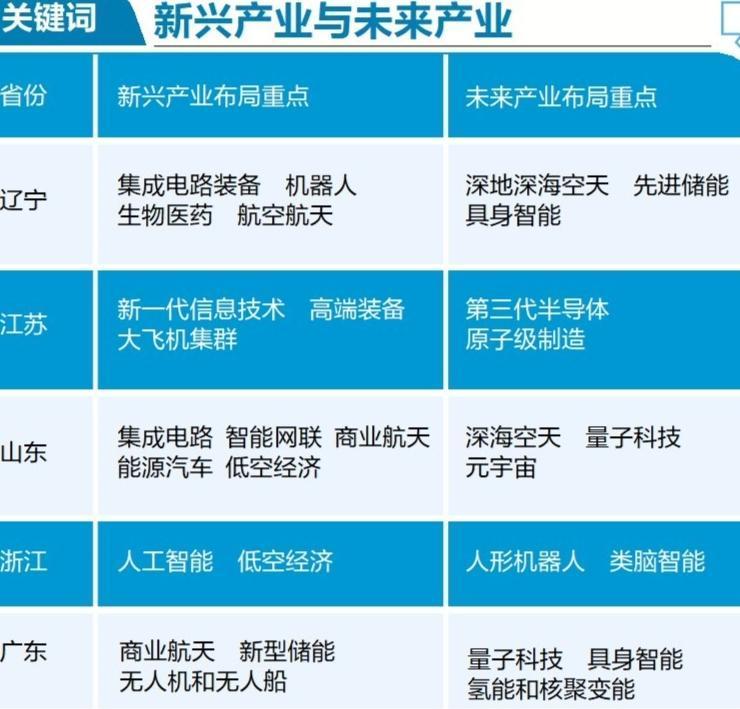
Group 1: Emerging and Future Industries - Various provinces are focusing on emerging and future industries, with specific emphasis on sectors like integrated circuits, robotics, and advanced energy storage [1][6] - Jiangsu aims to deepen integration into the Yangtze River Delta's aircraft manufacturing cluster and emphasizes atomic-level manufacturing [6] - Provinces like Shandong and Guangdong are prioritizing sectors such as quantum technology and hydrogen energy, indicating a trend towards high-tech and sustainable industries [1][7] Group 2: Digital Development - Provinces are actively developing digital infrastructure, with Liaoning focusing on data annotation industries and integrating AI into traditional industries [2][9] - Beijing aims to become a global benchmark city for digital economy, emphasizing core technologies like high-end chips and software [2][9] - Guangdong is enhancing its data trading platforms to foster industrial clusters, showcasing a strong market-driven approach [2][9] Group 3: Marine Economy - Coastal provinces are shifting their focus to marine economies, with Guangdong and Shandong aiming to create comprehensive marine industry ecosystems [8][19] - Liaoning and Jiangsu are leveraging their industrial bases to upgrade traditional marine industries towards high-end and green solutions [8][19] - The emphasis on marine economic development reflects a strategic pivot towards utilizing ocean resources for economic growth [8][19] Group 4: Consumption and Economic Growth - Guangdong is promoting the establishment of international consumption centers, aiming to enhance service industry standards and consumer environments [10][11] - Provinces like Beijing and Jiangsu are emphasizing high-energy consumption innovations, focusing on cultural and tourism integration to stimulate local economies [11][15] - The strategies aim to release local market potential and enhance consumer confidence through improved infrastructure and services [11][15] Group 5: Strategic Technology and Talent Development - Provinces are prioritizing the establishment of national laboratories and major scientific facilities to strengthen strategic technological capabilities [12][14] - There is a focus on integrating education, technology, and talent development to foster innovation and address regional needs [13][14] - Collaborative efforts across provinces aim to enhance the overall effectiveness and resilience of the national innovation system [12][14]
锚定目标任务 狠抓工作落实
Liao Ning Ri Bao· 2025-12-24 01:25
Economic Development Initiatives - The provincial economic work conference emphasized the need for high-quality completion of eight key tasks to ensure a good start for the "14th Five-Year Plan" [1] - The provincial development and reform commission plans to implement policies that promote high-quality economic development, focusing on effective investment and project planning [1] - The industrial system aims to establish a "2211" industrial structure, integrating traditional industry upgrades with the growth of strategic emerging industries [2] Financial Management and Support - The provincial finance department is committed to enhancing fiscal capacity through improved revenue organization and resource allocation [3] - A focus on optimizing expenditure structures and integrating special funds is planned to support major strategic tasks and basic livelihood needs [3] - The implementation of a long-term risk prevention mechanism is prioritized to ensure stable grassroots financial operations [3] Transportation Infrastructure - The transportation department aims to accelerate the construction of a modern comprehensive transportation system, enhancing infrastructure and digital transformation [4] - Efforts will be made to improve port management and logistics efficiency while promoting green transformation in the transportation sector [4] State-Owned Enterprises and Economic Growth - The conference highlighted the importance of state-owned enterprise reform to enhance operational efficiency and management levels [5] - The focus will be on optimizing the business environment and reducing logistics costs to support economic revitalization [5] Agricultural Development - The agricultural sector is tasked with advancing high-standard farmland construction and implementing black soil protection projects to improve grain yield and quality [8] - Specific initiatives include organic fertilizer application and protective tillage to enhance soil health and agricultural productivity [8]
使命在肩行不辍 攻坚克难再扬帆
Liao Ning Ri Bao· 2025-12-23 01:19
Group 1 - The annual provincial economic work conference in Liaoning aims to set goals and tasks for the upcoming year, emphasizing high-quality development as a priority [1] - Liaoning's grain production reached a historical high of 51.56 billion jin, and significant achievements were noted in various sectors, including the approval of a national China-Europe freight train assembly center in Shenyang [1] - The provincial statistics bureau reported a 1.1% year-on-year increase in industrial output value for the first 11 months of the year, with high-tech manufacturing growing by 3.3% and mining increasing by 6.8% [2] Group 2 - The provincial government plans to implement a "2211" industrial system, focusing on both traditional industry upgrades and the cultivation of strategic emerging industries [3] - Key initiatives include updating outdated chemical facilities, promoting the transition of fishing vessels from wood to steel, and enhancing the quality of the mining industry [3] - The emergency management department will focus on risk prevention, development promotion, and improving emergency management capabilities at the grassroots level [4] Group 3 - The provincial human resources department aims to stabilize employment, enhance social security, and improve public employment services while supporting entrepreneurship [5] - The city of Liaoyang plans to activate private investment and improve the business environment to enhance market consumption [6] - Universities in Liaoning are encouraged to strengthen collaboration with industries to foster innovation and facilitate the transformation of scientific research into practical applications [7]
研报掘金丨华安证券:维持北方华创“买入”评级,高研发与强激励共筑护城河
Ge Long Hui A P P· 2025-12-02 06:18
Core Viewpoint - The report from Huazhong Securities indicates that Northern Huachuang's net profit attributable to shareholders for Q3 2025 reached 1.9 billion yuan, reflecting a year-on-year increase of 15% and a quarter-on-quarter increase of 18% [1] Group 1: Financial Performance - The rapid growth in Q3 performance is attributed to the increasing demand in the domestic integrated circuit equipment market and a steady rise in market share driven by efficient R&D [1] - The company's R&D expenses for the first three quarters amounted to approximately 3.3 billion yuan, representing a year-on-year increase of 48% [1] Group 2: Strategic Initiatives - Continuous investment in technology has effectively enhanced the process coverage, laying a solid foundation for the company's long-term high-quality development [1] - The company has announced a new round of equity incentives with positive assessment conditions, which is beneficial for fully stimulating the core team's enthusiasm and aligning employee interests with the company's long-term development [1] Group 3: Investment Rating - The company maintains a "Buy" rating [1]


毕马威发布长三角高端装备新质领袖榜单
Zheng Quan Ri Bao Wang· 2025-11-21 14:17
Core Insights - The Yangtze River Delta region is recognized as a core cluster for high-end equipment manufacturing in China, benefiting from strategic initiatives like the G60 Science and Technology Innovation Corridor [1] - The release of the "Yangtze River Delta High-end Equipment New Quality Leaderboard" highlights the region's growth potential, supported by continuous policy incentives from "Made in China 2025" to the "14th Five-Year Plan" [1] Industry Overview - The leaderboard focuses on five key sectors: robotics, energy equipment, low-altitude economy, intelligent transportation equipment, and other emerging industrial technologies [1] - Evaluation criteria for participating companies include core team strength, technological and product leadership, market and business layout, financial health, market influence, and future planning [1] Company Highlights - A total of 38 companies were recognized for their outstanding innovation capabilities and development potential [1] - Emerging industrial technology equipment sector leads with a representation of 34.2% among the evaluated companies, while integrated circuit equipment companies account for 10.5% of the total [1] - The robotics sector follows closely with a 31.6% share, indicating strong growth momentum [1]