
东方爽茶

Search documents
看穿商标和营销的“文字游戏”丨2025消费问题高发区⑦
Xin Jing Bao· 2025-12-30 11:41
Core Viewpoint - The article highlights the misleading marketing practices in the food industry, where products are often misrepresented through names, concepts, and branding, leading to consumer confusion and potential health risks [1][2][4]. Misleading Product Names - Many food products are marketed under names that do not accurately reflect their content or quality, such as "edible raw eggs" which may not be safe for consumption as claimed [2][3]. - The term "cordyceps egg" is often misleading, as it refers to feed containing insects and grass rather than the well-known medicinal cordyceps [4]. Misleading Marketing Concepts - Products labeled with "new concepts" often do not deliver on their health claims, with many nutritional benefits being overstated or based on minimal ingredient presence [11][12]. - For example, some fish sausages marketed for their DHA content may actually contain little to no real fish, misleading consumers about their nutritional value [11][12]. Brand Confusion and Trademark Issues - Companies are using "near-brand" trademarks to confuse consumers, such as "Oriental Refreshing Tea" mimicking the branding of "Oriental Leaf," leading to potential legal disputes [14][15]. - The practice of "riding on the coattails" of established brands through similar names or packaging is prevalent, with companies facing legal challenges for trademark infringement [15][16]. Regulatory and Consumer Rights - Consumers have the right to know the true characteristics of the products they purchase, and misleading packaging can violate consumer protection laws [10]. - New regulations are being introduced to prevent misleading claims such as "zero additives," which have been misused in marketing [10]. Recommendations for Consumers - Consumers are advised to scrutinize ingredient lists and nutritional information rather than relying solely on product names and marketing claims [5]. - There is a call for the establishment of clearer national standards to regulate misleading marketing practices in the food industry [5].
碰瓷东方树叶东方爽茶被下架东方爽茶仿冒东方树叶属典型混淆行为
Xin Lang Cai Jing· 2025-12-19 14:23
Core Viewpoint - The article discusses the legal implications of the counterfeit product "Dongfang Shuangcha," which closely resembles the well-known brand "Dongfang Shuye," leading to consumer confusion and subsequent legal actions against the infringing company [1] Group 1: Legal Implications - The product "Dongfang Shuangcha" is considered a typical case of "confusion behavior," as its name and packaging are highly similar to "Dongfang Shuye," which is a registered trademark [1] - The involved company has been fined 180,000 yuan for unfair competition, indicating the seriousness of trademark infringement and the legal consequences that can arise from such actions [1] - Market supervision authorities have the power to confiscate illegal gains, infringing products, impose fines, and even revoke business licenses in cases of trademark infringement [1] Group 2: Consumer Rights - Consumers who purchase counterfeit products have the right to seek compensation and protect their rights, especially when misled by similar branding [1] - If sellers can prove they were unaware of the infringement and that the products were legally obtained, they may avoid administrative penalties but must cease sales of the infringing items [1]
马斯克称盖茨做空特斯拉损失或超100亿美元|首席资讯日报
首席商业评论· 2025-12-19 03:44
Group 1 - Elon Musk claims that Bill Gates' short position on Tesla may have resulted in losses exceeding $10 billion, as Gates shorted 1% of Tesla's shares, impacting investor confidence during a critical period for the company [2] Group 2 - CICC forecasts that the financial statements of the liquor industry will show improvement by 2026, with a clearer upward turning point as demand-side policy impacts diminish and consumption scenarios gradually recover [3] - The report anticipates that the industry will begin to see a sequential recovery starting in the first half of the year, driven by deepening consumption policies and innovation in supply to address inventory issues [3] Group 3 - The National Bureau of Statistics reported that the unemployment rate for urban youth aged 16-24 reached 16.9% in November, while the rate for those aged 25-29 was 7.2%, and for ages 30-59, it was 3.8% [4] Group 4 - The "Oriental Refresh Tea" and related products have been completely removed from shelves following consumer complaints about misleading branding, resulting in a fine of 180,000 yuan for the involved company [5] Group 5 - Douyin has upgraded its batch infringement reporting tool, allowing users to submit up to 2,000 reports at once, enhancing the efficiency of reporting potential infringements across various content types [6] Group 6 - The film "Zootopia 2" has surpassed 3.613 billion yuan in cumulative box office revenue, ranking among the top two films of 2025 [7] Group 7 - The Ministry of Industry and Information Technology plans to strengthen capacity regulation in the photovoltaic industry by 2026, focusing on managing manufacturing projects and promoting the orderly exit of outdated capacity [7] Group 8 - Hong Kong anticipates an increase in visitors during the New Year holiday, with the government preparing to enhance reception services and manage tourist flows effectively [8] Group 9 - Shenzhen reported a significant increase in tax refunds for outbound tourists, with 56,000 refunds processed in the first 11 months of the year, marking a 13-fold increase year-on-year [9] Group 10 - SWIFT reported that the renminbi ranked as the sixth most active global payment currency in November, accounting for 2.94% of the total, with a 2.20% share in international payments outside the eurozone [10] Group 11 - Three companies, including Guangdong Longxing Tianxia Technology Co., Ltd., have initiated IPO counseling as disclosed by the China Securities Regulatory Commission [11] Group 12 - Morgan Stanley has raised its target price for TSMC from 1,688 to 1,888 New Taiwan dollars, citing growth potential in revenue and profit margins driven by rising wafer prices and strong demand for AI semiconductors [12]



东方爽茶,全部下架!
新华网财经· 2025-12-16 14:08
Core Viewpoint - The article discusses the issue of counterfeit products resembling the well-known brand "Oriental Leaf," highlighting consumer confusion and regulatory actions taken against the infringing products [2][5][6]. Group 1: Consumer Confusion - Multiple consumers reported purchasing products like "Oriental Refreshing Tea" and "Oriental Yuan Zhen," mistakenly believing they were buying "Oriental Leaf," leading to complaints about misleading branding [2][5]. - A specific case involved a consumer who bought "Oriental Refreshing Tea" for 17.9 yuan, while the official "Oriental Leaf" product was priced at 63 yuan for a larger pack, indicating a significant price difference [5]. Group 2: Regulatory Actions - In July 2024, the company behind "Oriental Leaf" reported the counterfeit products to local market supervision authorities, leading to administrative penalties against the manufacturers for unfair competition [6]. - The involved manufacturer, Heze Youjia Food Factory, has a history of legal issues related to trademark infringement, with a total of 750,000 yuan in claims against it [6]. Group 3: Product Composition and Quality - The counterfeit "Oriental Refreshing Tea" contains eight additives and does not use tea extraction methods, raising concerns about product quality compared to the original brand [5].


以为买到便宜“东方树叶”,结果却是“东方爽茶”,最新消息:已全部下架!
Mei Ri Jing Ji Xin Wen· 2025-12-16 09:39
Core Viewpoint - The article highlights the issue of counterfeit products, specifically "东方爽茶" and "东方元甄," which mislead consumers into believing they are purchasing the legitimate "东方树叶" brand from Nongfu Spring. The counterfeit products have been removed from the market, and the involved company has been fined 180,000 yuan for unfair competition [1][2][11]. Group 1: Consumer Experience - Multiple consumers reported being deceived by purchasing "东方爽茶," mistaking it for "东方树叶" due to their similar appearance and lower price [1][2]. - A consumer shared their experience on social media, expressing disappointment after realizing that "东方爽茶" was not the expected product [2][10]. Group 2: Product Comparison - "东方树叶" is marketed as a high-quality tea beverage with no sugar, fat, calories, artificial flavors, or preservatives, while "东方爽茶" uses tea powder and contains eight additives, indicating a significant difference in quality [5][10]. - The price of "东方爽茶" was reported at 17.9 yuan for a box of nine 500ml bottles, while "东方树叶" was priced at 63 yuan for a box of fifteen 500ml bottles, highlighting the price disparity that may attract consumers to the counterfeit [5][11]. Group 3: Regulatory Actions - The involved company, 菏泽市优佳食品厂, was fined for producing counterfeit products and has a history of similar legal issues, indicating a pattern of unfair competition [11][12]. - Nongfu Spring has taken legal action against the counterfeit products and reported them to market supervision authorities, demonstrating proactive measures to protect its brand [11][12]. Group 4: Industry Implications - The rise of counterfeit products in the sugar-free tea market poses a challenge for established brands like Nongfu Spring, Coca-Cola, and others, as these knock-offs often lure consumers with lower prices [12]. - The article emphasizes the importance of consumer vigilance when purchasing food products to avoid confusion with counterfeit items [2][12].
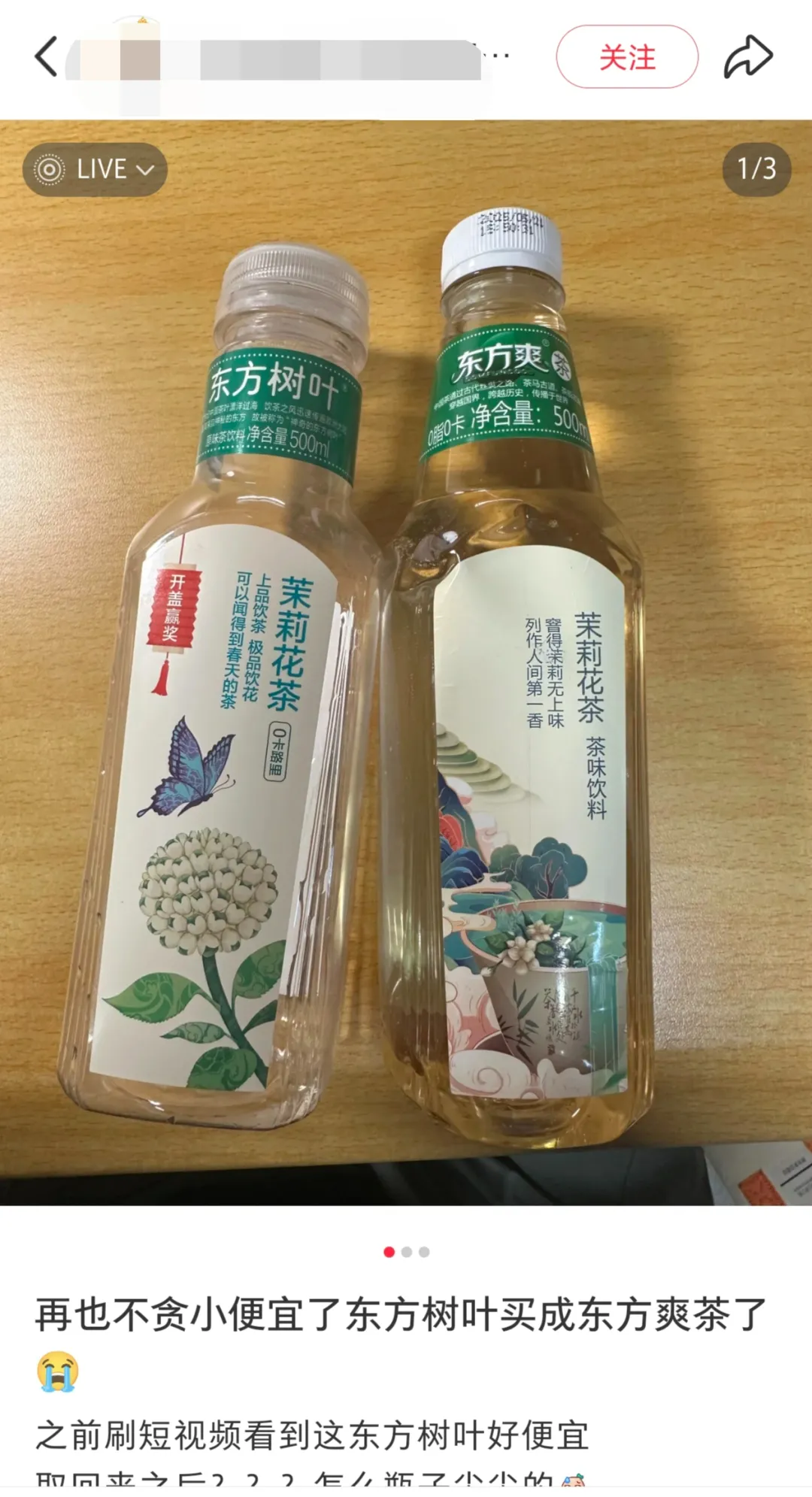
无糖茶山寨品已下架,涉事企业被罚18万元丨消费质量年终回访⑦
Bei Ke Cai Jing· 2025-12-15 04:13
Core Insights - The ready-to-drink tea market is experiencing significant growth, attracting various brands while also facing challenges from counterfeit products [1][3] - Regulatory actions have been taken against counterfeit brands, with penalties imposed on companies producing misleading products [4][5] Group 1: Market Dynamics - The ready-to-drink tea category is divided into sugar-containing and sugar-free segments, with products containing sugar substitutes classified as sugar-free [2] - Counterfeit products have emerged as a major issue in the beverage industry, targeting popular brands like Oriental Leaf and others [3] Group 2: Regulatory Actions - The counterfeit product "Oriental Refreshing Tea" has been removed from the market, and the involved company was fined 180,000 RMB for trademark infringement [4][5] - The local market regulatory authority confirmed that the counterfeit products caused consumer confusion and constituted unfair competition [4][5] Group 3: Product Quality Concerns - Counterfeit beverages often compromise quality, with "Oriental Refreshing Tea" containing various additives that differ significantly from legitimate products [6][8] - The use of food additives in counterfeit products raises safety concerns, as they may not adhere to quality standards [9][10] Group 4: Consumer Awareness - Consumers are advised to purchase food products from reputable stores and to verify product labels and packaging to avoid counterfeit goods [11] - The importance of recognizing brand names and packaging details is emphasized to prevent confusion with counterfeit products [11]
无糖茶山寨品已下架,涉事企业被罚18万元
Xin Jing Bao· 2025-12-15 04:12
Core Insights - The ready-to-drink tea market is experiencing significant growth, attracting various brands while also facing challenges from counterfeit products [1][2] - Regulatory actions have been taken against counterfeit brands, with penalties imposed on companies producing misleading products [3][4] Group 1: Market Dynamics - The ready-to-drink tea category is divided into sugar-containing and sugar-free segments, with sugar-free products increasingly popular among consumers [2] - Counterfeit products have emerged as a significant issue in the beverage industry, targeting popular brands like Oriental Leaf and others [2][7] Group 2: Regulatory Actions - The company behind the counterfeit product "Oriental Refreshing Tea" was fined 180,000 RMB for infringing on the packaging rights of the legitimate brand Oriental Leaf [3] - Regulatory bodies have emphasized the importance of consumer vigilance when purchasing food products, advising checks on product names, trademarks, and packaging details [1][8] Group 3: Product Quality Concerns - Counterfeit beverages often compromise on quality, with ingredients that may not meet safety standards, raising concerns about consumer health [4][6] - The ingredient list of "Oriental Refreshing Tea" includes various additives, contrasting sharply with the simpler formulations of legitimate brands [5][6] Group 4: Consumer Awareness - Consumers are advised to purchase food products from reputable stores and to be cautious of products lacking proper labeling or from unverified sources [8] - The market has seen a rise in legal actions from legitimate brands against counterfeiters, highlighting the ongoing battle for brand protection and consumer safety [7]