
云盘

Search documents
中国移动(600941):算力+智能网络先行
Guolian Minsheng Securities· 2026-03-30 01:13
Investment Rating - The report maintains a "Recommended" rating for China Mobile (600941.SH) with a current price of 93.42 CNY [2] Core Insights - China Mobile achieved a revenue of 1,050.187 billion CNY in 2025, reflecting a year-on-year growth of 0.9%, while the net profit attributable to shareholders was 137.095 billion CNY, down 0.9% year-on-year [8] - The company is focusing on enhancing its differentiated competitive advantage through increased investment in intelligent computing and network services, with significant growth in its cloud services and data center revenues [8] - The mobile customer base reached 1.01 billion, with 5G network users at 642 million, marking a penetration rate of 63.9% [8] - The report forecasts net profits for 2026, 2027, and 2028 to be 136.3 billion CNY, 144.6 billion CNY, and 147.3 billion CNY respectively, with corresponding PE ratios of 15, 14, and 14 [8] Financial Projections - Revenue projections for 2026, 2027, and 2028 are estimated at 1,063.939 billion CNY, 1,084.505 billion CNY, and 1,106.718 billion CNY respectively, with growth rates of 1.3%, 1.9%, and 2.0% [9] - The net profit attributable to shareholders is expected to show slight declines in 2026 and 2027, followed by a modest increase in 2028 [9] - The company plans capital expenditures of approximately 1,509 billion CNY in 2025 and 1,366 billion CNY in 2026, primarily to enhance communication networks and accelerate intelligent computing capabilities [8]

中国下载网事:那些年,我们在深夜等一个“叮”
3 6 Ke· 2026-02-09 01:40
Core Insights - The article reflects on the evolution of Xunlei (Thunder) as it celebrates its 23rd anniversary, highlighting its journey from a download tool to a broader service provider in the digital content landscape [1][2][28] Group 1: Historical Context - Xunlei was launched in 2003, addressing the significant pain point of slow download speeds in an era when internet usage was primarily about downloading files to local storage [3][4][5] - The introduction of P2SP technology allowed Xunlei to enhance download speeds by utilizing both server and peer-to-peer resources, revolutionizing the downloading experience for users [8][9] - By 2006, Xunlei had surpassed 100 million users, becoming the most popular download software in China, alongside other applications like QQ and Baofeng Video [9] Group 2: Market Dynamics - The period from 2005 to 2007 marked Xunlei's golden age, as the rapid expansion of broadband users transformed download tools into essential infrastructure for home computers [10][11] - Xunlei became a major content distribution channel during a time when copyright regulations were still developing, allowing for widespread sharing of digital content [11][12] - The introduction of premium services in 2009, such as membership-based high-speed downloads, provided Xunlei with a stable revenue stream and redefined user engagement [12][13] Group 3: Industry Challenges - The rise of 4G technology and streaming services around 2014 significantly altered user behavior, leading to a decline in the necessity for traditional downloading tools [16][17][18] - Many once-popular download tools, including Xunlei's competitors, began to fade from the market as users shifted towards streaming and cloud services [19][20] - Regulatory actions aimed at copyright protection further diminished the viability of traditional downloading methods, marking the end of an era for free content sharing [20] Group 4: Transformation and Future Outlook - In response to industry changes, Xunlei began diversifying its offerings in 2015, venturing into cloud computing and CDN services, thus transitioning from a download tool to a comprehensive service provider [22][23] - The company has expanded its product matrix to include cloud storage, media players, and game accelerators, maintaining a user base of over 7 million members [24] - Despite the shift in content consumption methods, the concept of downloading has been redefined, becoming more integrated into cloud services, reflecting a broader change in user expectations and behaviors [24][25]



游戏及互联网行业税率探讨运营商税率变化视角
2026-02-04 02:27
Summary of Conference Call Industry and Company Involved - The discussion primarily revolves around the telecommunications industry, specifically focusing on the impact of changes in value-added tax (VAT) rates for telecom operators and its implications for the internet and gaming sectors. Core Points and Arguments 1. **VAT Rate Increase**: The VAT rate for telecom operators has been raised from 6% to 9%, effective January 1, 2026. This change raises concerns about potential ripple effects on other industries, particularly the internet and gaming sectors [1][2][3]. 2. **Historical Context**: The expert explains that the tax rate for telecom services has varied historically, with basic services taxed at higher rates (11%) and value-added services at lower rates (6%). This differentiation has been a long-standing practice [3][4]. 3. **Tax Audits and Revenue Recognition**: The expert discusses the complexities of tax audits related to revenue recognition from various services, emphasizing the importance of accurately defining the revenue split between voice, data, and other services for tax purposes [4][5][6]. 4. **Impact of Broadband Services**: The introduction and growth of broadband services have shifted the revenue structure, leading to a decrease in the taxable base for traditional voice services. This has prompted tax authorities to reassess how these services are taxed [7][8][9]. 5. **Future Tax Implications**: The expert indicates that the tax authority is likely to enforce a more stringent approach to how telecom operators report their revenues, particularly as broadband and data services become more prevalent [10][11]. 6. **Industry Classification**: The classification of internet and gaming industries as either traditional or emerging sectors will significantly influence their tax treatment. The expert suggests that the government may view these sectors as essential infrastructure, which could lead to different tax obligations [12][13][14]. 7. **Investment in Technology**: The discussion highlights the importance of ongoing investment in technology and innovation within the internet and gaming sectors. Companies that demonstrate significant R&D and technological advancement may be viewed more favorably in terms of tax classification [20][21][22]. 8. **Differences Between State-Owned and Private Enterprises**: The expert notes that state-owned telecom companies have different obligations and expectations compared to private internet companies, particularly regarding tax contributions and service provision [22][24][25]. Other Important but Possibly Overlooked Content 1. **Public Infrastructure Role**: The expert emphasizes that telecom operators play a crucial role in providing public infrastructure and services, which justifies their tax obligations and the government's regulatory approach [24][26]. 2. **Market Competition**: The expert warns that despite the dominance of certain internet companies, competition remains fierce, and the landscape is subject to rapid changes, which could affect future tax policies [25][26]. 3. **Future of Telecom Services**: The conversation touches on the evolution of telecom services, including the shift towards more advanced services like quantum communication and AI-driven applications, which may influence future tax considerations [17][18][19]. This summary encapsulates the key discussions and insights from the conference call, providing a comprehensive overview of the implications of VAT changes in the telecommunications sector and its potential impact on related industries.
联通万家情 数智惠民生—菏泽联通2025年交出亮眼答卷
Qi Lu Wan Bao· 2026-01-01 08:17
Core Insights - The article highlights the commitment of Heze Unicom to serve the community by enhancing communication services and infrastructure, focusing on high-quality network construction and digital innovation to meet the needs of the public [1] Group 1: Network Infrastructure Development - Heze Unicom has significantly invested in digital infrastructure, achieving comprehensive 5G network coverage across urban, county, town, and major administrative village areas, with residential communities equipped for 10 Gbps broadband access [3] - The company has optimized coverage in over 600 weak signal areas, including underground parking lots, ensuring a seamless network experience for users [3] Group 2: Smart Services for Public Welfare - The company has integrated technological innovation with public needs, creating a "5G + Pre-hospital Emergency Rescue Platform" that reduces average response times by over 30%, allowing emergency services to reach patients within 15 minutes [4] - The "5G + Remote Medical Vehicle" initiative has improved treatment success rates by 25% in rural areas by enabling local CT and ultrasound examinations and remote consultations with senior experts [4] - Heze Unicom promotes FTTR whole-home fiber networking services to meet the demand for high-speed connections across multiple devices in households [4] Group 3: Customer-Centric Initiatives - Heze Unicom has established a "customer-first" service mechanism, resolving ordinary complaints within 24 hours and conducting regular "Unicom Customer Day" events to provide tailored services for different demographics, including the elderly [5] - The company has served over 2,000 elderly users with services such as free phone screen protection, usage guidance, and anti-fraud education, while also offering student-specific services during the school season [5] Group 4: Corporate Social Responsibility - Heze Unicom has been recognized for six consecutive years as an "Advanced Unit Supporting Heze Development," investing 12 million yuan in infrastructure improvements and contributing to the creation of a civilized city [6] - The company has successfully provided communication support for major events and has launched over 3,000 information solutions across various sectors, demonstrating its commitment to digital and intelligent development in Heze [6] - Looking ahead to 2026, Heze Unicom plans to continue enhancing network construction, optimizing service systems, and innovating product offerings to benefit the community [6]

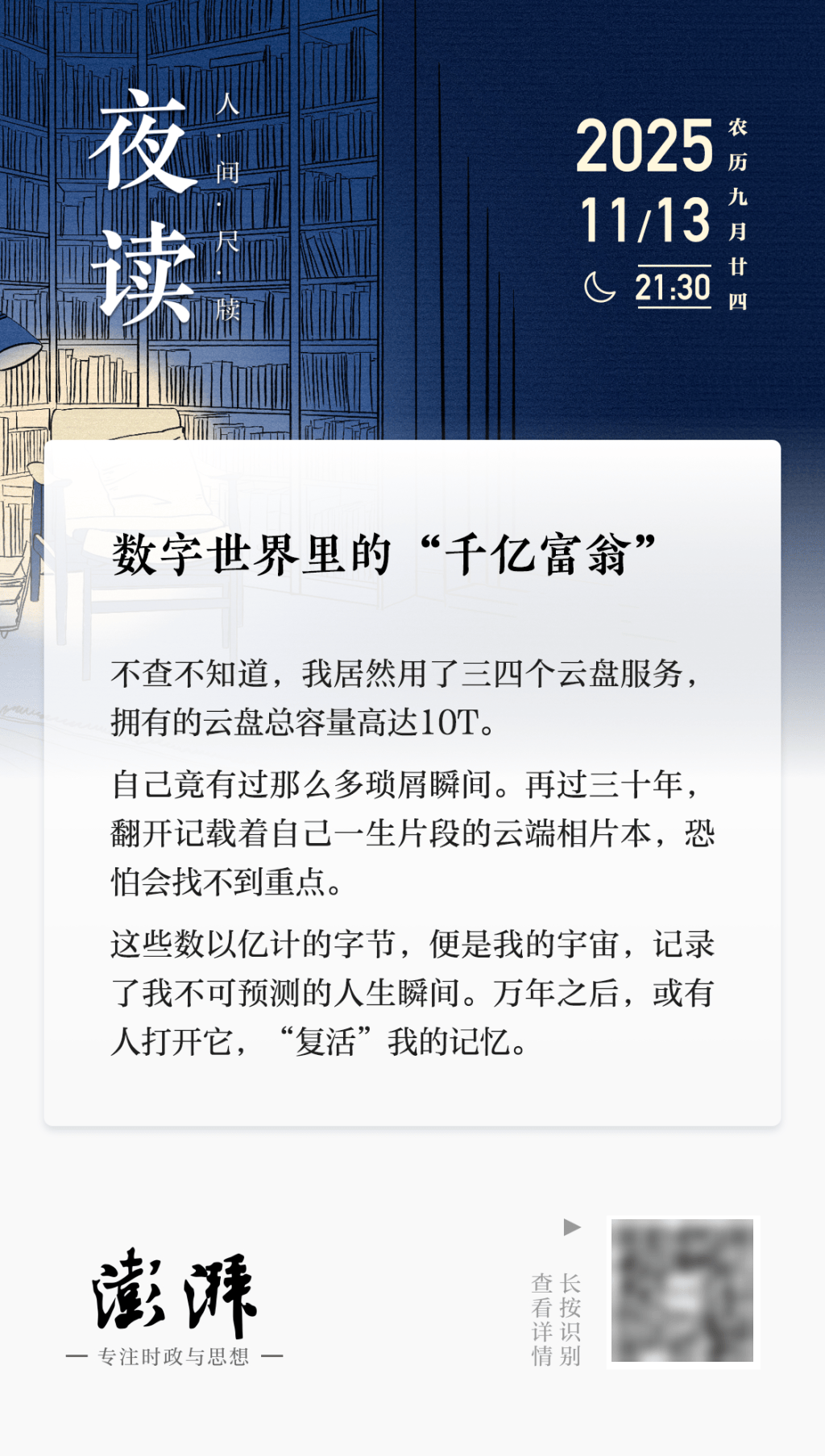
夜读|数字世界里的“千亿富翁”
Sou Hu Cai Jing· 2025-11-13 13:35
Core Points - The article discusses the evolution of photography and digital storage, highlighting the transition from physical photo albums to cloud storage and the implications of this shift on personal memories and experiences [1][3][4] Group 1: Digital Storage - The individual has utilized three to four cloud storage services, accumulating a total capacity of 10 terabytes (T) [1] - The total number of photos exceeds 30,000, and there are over a thousand videos, which collectively amount to billions of bytes [1][6] Group 2: Nostalgia and Memory - The article reflects on the past when photography was a rare and significant event, contrasting it with the current ease of taking hundreds of photos in a day [2][3] - There is a sense of nostalgia for the past when photos were treated with more care and significance, as opposed to the overwhelming volume of digital images today [3][4] Group 3: Future Implications - The vast amount of digital memories may lead to a chaotic recollection of life experiences in the future, raising concerns about the ability to find meaningful moments among countless images [3][6] - The notion that these digital bytes represent a personal universe, capturing unpredictable life moments, is emphasized, suggesting a potential for future retrieval of memories [3][6]
省科技馆“科学之夜”精彩纷呈 山东联通云智产品引爆AI新体验
Qi Lu Wan Bao· 2025-09-19 08:32
Core Viewpoint - The "Science Night" event held in Jinan from September 12 to 14 showcased various technological innovations and aimed to enhance public engagement with science and technology through interactive experiences and educational activities [1][17]. Group 1: Event Overview - The "Science Night" event attracted over 5,000 attendees each night, featuring diverse activities such as experimental theater, science stage plays, and exhibitions on the Yellow River and ocean [1]. - Shandong Unicom participated by showcasing cloud-based products like cloud phones, cloud computers, and AI imaging studios, allowing citizens to experience unique AI technology [1]. Group 2: Interactive Activities - The AI fitness dance imitation show was particularly popular among children and even attracted participation from older adults, highlighting the event's appeal across age groups [4]. - The AI video ringtone DIY activity allowed participants to create personalized videos using digital human technology, which was met with enthusiasm and excitement [6]. - The AI imaging studio became a favorite spot for families, providing interactive experiences with changing backgrounds that created memorable moments [8]. Group 3: Product Demonstrations - Various cloud products, including cloud phones, cloud computers, and smart devices, were demonstrated on-site, with staff providing one-on-one explanations and hands-on experiences [10]. - Attendees expressed appreciation for the convenience of cloud technology after trying out the cloud computer, indicating a growing recognition of its practical applications in daily life [10]. Group 4: Senior Engagement - A special "Silver Age Assistance Classroom" was established to cater to the needs of elderly participants, focusing on smartphone applications and fraud prevention education [14]. - Participants in the senior classroom expressed their satisfaction with the knowledge gained, particularly in using technology to protect their finances [12][14]. Group 5: Incentives for Participation - To further encourage public participation, Shandong Unicom prepared various prizes, including cloud storage and AI video ringtones, as rewards for engaging in the science quiz during the event [16].

165.81亿元!这一央企巨头拟大手笔分红
Zheng Quan Ri Bao Zhi Sheng· 2025-08-14 13:19
Group 1 - The core viewpoint of the news is that China Telecom reported a revenue increase of 1.3% year-on-year for the first half of 2025, reaching 269.42 billion yuan, and a net profit increase of 5.5%, amounting to 23.017 billion yuan [1] - The company plans to distribute a cash dividend of 0.1812 yuan per share, totaling 16.581 billion yuan, which represents 72% of the net profit attributable to shareholders during the reporting period [1] - Mobile communication service revenue was 106.6 billion yuan, showing a year-on-year growth of 1.3%, while broadband and smart home service revenue reached 64.1 billion yuan, growing by 0.2% [1] Group 2 - The number of mobile users reached 433 million, and broadband users totaled 199 million, with an ARPU of 46.0 yuan for mobile users and 48.3 yuan for broadband [1] - The company achieved industrial digitalization revenue of 74.9 billion yuan, with AIDC revenue growing by 7.4% [1] - Key product revenues showed significant growth, with Tianyi Cloud revenue at 57.3 billion yuan, smart revenue at 6.3 billion yuan (up 89.4%), security revenue at 9.1 billion yuan (up 18.2%), and satellite revenue increasing by 20.5% [1] Group 3 - China Telecom is focusing on the implementation of a cloud transformation strategy, enhancing innovation-driven development, and promoting the integration of basic and digital business [3] - The company is advancing its "AI+" initiative, which includes the development of over 160 AI applications across various sectors to improve efficiency and reduce costs [2] - Capital expenditures for the first half of the year totaled 34.2 billion yuan, with investments in mobile networks and industrial digitalization at 12.1 billion yuan and 11.6 billion yuan, respectively [2]

为什么GDP增速5.3%,通信运营商却陷入滞涨?
Hu Xiu· 2025-07-21 01:09
Core Viewpoint - The Chinese economy shows resilience with a GDP growth of 5.3% in the first half of 2025, but the telecom industry faces stagnation, with telecom revenue growth at only 1.4%, significantly lagging behind GDP growth [1][2]. Group 1: Industry Challenges - The telecom industry's growth has been hindered by the saturation of traditional business models, with mobile phone users exceeding 1.8 billion and fixed broadband users nearing 600 million, leading to a decline in revenue from mobile data services [2][3]. - Intense price competition among telecom operators has resulted in a race to the bottom, where marketing costs remain high while average revenue per user (ARPU) has stagnated or declined [3][4]. - The shift towards digital transformation has not yielded expected results, with growth in digital revenue slowing significantly, indicating that operators are struggling to adapt to new market demands [5][6]. Group 2: Structural Issues - The telecom sector's lagging growth compared to GDP is attributed to a structural imbalance, where the rapid expansion of the digital economy outpaces traditional telecom services [8][9]. - The contribution of telecom revenue to GDP growth has diminished, with the multiplier effect dropping from 1.7% to 0.8% by 2025, reflecting a reduced impact on the broader economy [9]. Group 3: Strategic Recommendations - To overcome stagnation, the telecom industry must transition from a volume-driven model to a value-driven approach, focusing on service differentiation and industry-specific solutions [10][11]. - Strengthening technological capabilities in emerging fields such as 6G and quantum communication is essential for maintaining competitive advantage [11]. - Building collaborative ecosystems with internet companies and manufacturers can enhance operational efficiency and drive innovation, as demonstrated by successful joint projects [11][12].