
人工智能终端产品

Search documents
坚持创新驱动 突出应用导向 推动人工智能更好赋能高质量发展
Xin Lang Cai Jing· 2026-01-04 20:03
Core Insights - The article emphasizes the importance of innovation-driven and application-oriented approaches to enhance the development of the artificial intelligence (AI) industry in Chengdu, aligning with national strategies and policies [1][3] Group 1: AI Industry Development - The Chengdu government is focusing on building a national AI innovation application pilot zone to better empower high-quality development through AI [1] - The National Supercomputing Center in Chengdu is highlighted as a key infrastructure supporting AI innovation, with a focus on enhancing computing power, algorithms, and data resources [1] - The AI industry is seen as a significant driver of technological revolution and industrial transformation, with the government aiming to integrate AI technology into traditional industries and emerging sectors [3] Group 2: Research and Application - The West China Medical Robot Research Institute is encouraged to enhance the intelligence level of robots and expand their application scenarios to meet growing health service demands [2] - The National Ultra High Definition Innovation Center is tasked with deepening technology transfer and market application in the ultra HD industry, promoting innovation and integration across the industry chain [2] - Chengdu Reading and Writing Technology Co., Ltd. is urged to develop more popular AI products that cater to market needs, enhancing the application of AI in daily work and life [2] Group 3: Policy and Ecosystem - The article stresses the need for a collaborative innovation system involving enterprises, academia, and research institutions to support AI technology development and application [3] - There is a call for strengthening policy coordination and support for AI research, industry transformation, and application promotion [3] - The government aims to cultivate a high-quality talent pool in AI to drive the industry's growth and innovation [3]
政策问答·回应关切丨如何增强消费品供需适配性
Ren Min Ri Bao· 2025-11-30 04:06
Core Viewpoint - The implementation plan aims to enhance the adaptability of supply and demand in the consumer goods market, addressing the mismatch between what consumers want to buy and what is available for sale [1][2]. Group 1: Supply and Demand Adaptability - The plan emphasizes the need for consumer goods production to actively adapt to changing consumption trends, ensuring dynamic and precise matching of diverse consumer demands in terms of quality, structure, and utility [1]. - The initiative is expected to maximize consumption potential and promote smooth economic circulation by aligning what consumers desire with what companies produce [1]. Group 2: Consumer Goods Market Overview - China currently has a total of 230 million types of consumer goods, with over 100 categories, including home appliances, furniture, and clothing, leading the world in production [2]. - The strong manufacturing capability allows consumer goods companies to quickly respond to technological upgrades and subtle changes in consumer preferences, facilitating continuous product iteration and innovation [2]. Group 3: Specific Measures in the Implementation Plan - On the supply side, the plan includes accelerating the application of new technologies, expanding the supply of unique and new products, and focusing on sectors like smart connected vehicles and smart home devices [2]. - On the demand side, the plan aims to activate domestic demand by creating a favorable development environment, addressing differentiated needs across age groups, and enhancing consumer financial products and services [2]. Group 4: Future Market Potential - The implementation plan focuses on supply-side structural reforms, aiming to stimulate the multiplier effect and structural dividends of China's vast domestic market, with the potential to create trillions of yuan in new consumer markets by 2027 [3].
如何增强消费品供需适配性(政策问答·回应关切)
Ren Min Ri Bao· 2025-11-29 22:18
Core Viewpoint - The implementation plan aims to enhance the adaptability of supply and demand in consumer goods, addressing the mismatch between what consumers want to buy and what is available in the market [1][2]. Group 1: Supply and Demand Adaptability - The plan emphasizes the need for consumer goods production to actively adapt to changing consumer trends, ensuring dynamic and precise matching of diverse consumer demands in terms of quality, structure, and utility [1]. - The initiative is expected to maximize consumption potential and promote smooth economic circulation by aligning what consumers desire with what companies produce [1]. Group 2: Current Market Landscape - China currently has a total of 230 million types of consumer goods, with over 100 categories such as home appliances, furniture, and clothing leading global production [2]. - The strong manufacturing capability allows consumer goods companies to quickly respond to technological upgrades and subtle changes in consumer preferences, facilitating continuous product iteration and innovation [2]. Group 3: Specific Measures in the Implementation Plan - On the supply side, the plan includes accelerating the application of new technologies, expanding the supply of unique and new products, and focusing on emerging fields like smart connected vehicles and smart home devices [2]. - On the demand side, the plan aims to activate domestic demand potential by creating a favorable development environment, addressing differentiated needs across age groups, and implementing safety measures for children's products [2]. - The plan also includes policies for large-scale equipment updates and trade-in programs for consumer goods, as well as enhancing consumer finance products and services [2]. Group 4: Future Market Potential - The implementation plan focuses on supply-side structural reforms, aiming to stimulate the multiplier effect and structural dividends of China's vast domestic market, with the potential to create trillions of yuan in new consumer markets by 2027 [3].
时报观察丨供需双侧协同升级 激活万亿消费新动能
Zheng Quan Shi Bao· 2025-11-28 02:39
Group 1 - The core viewpoint emphasizes the importance of enhancing the adaptability of supply and demand in consumer goods to stimulate consumption and expand domestic demand as a key economic strategy [1][2] - Recent policies include a total of 300 billion yuan in subsidies for replacing old consumer goods, which have already driven sales exceeding 2.4 trillion yuan in the first ten months of this year [1] - Long-term solutions for boosting consumption require strengthening social security systems and improving income distribution reforms to enhance consumer purchasing power and marginal propensity to consume [1] Group 2 - The implementation plan highlights the need to accelerate the development of artificial intelligence terminal products, transforming technological innovations into convenient consumer applications [2] - Achieving high-level dynamic adaptation of supply and demand should primarily rely on companies' insights into market needs and adjustments in their operational behaviors to strengthen competitiveness [2] - Government roles should focus on institutional innovation to release reform dividends, enforce standards for product safety and environmental upgrades, and foster a conducive environment for technological innovation, rather than directly regulating production [2]
时报观察丨供需双侧协同升级 激活万亿消费新动能
证券时报· 2025-11-28 00:20
Core Insights - The article emphasizes the importance of enhancing the adaptability of supply and demand in consumer goods to stimulate consumption and expand domestic demand as a key economic strategy [1][2] - It highlights that boosting consumption is a systemic project requiring not only financial incentives but also structural reforms in social security and income distribution to enhance consumer purchasing power [1] - The need for high-quality goods and services is stressed, particularly in the context of evolving consumer preferences, necessitating upgrades in supply-side capabilities [1][2] Summary by Sections Policy Initiatives - Recent measures by six government departments aim to enhance the adaptability of consumer goods supply and demand, continuing the focus on expanding domestic demand [1] - A total of 300 billion yuan in subsidies for replacing old consumer goods has generated over 2.4 trillion yuan in sales in the first ten months of the year [1] Structural Reforms - Long-term consumption enhancement requires building a robust social security system and reforming income distribution to improve consumer capacity and marginal propensity to consume [1] - The article stresses the importance of investing in human capital to achieve these goals [1] Supply-Side Upgrades - The need for producers to respond quickly to market demands and provide better-suited products is highlighted, addressing mismatches in supply and demand [1] - The article calls for a shift from merely increasing production to producing more adaptable and higher-quality goods [1] Technological Innovation - The implementation plan emphasizes accelerating the development of artificial intelligence terminal products, transforming technological innovations into consumer conveniences [2] - Sustainable development in technology and industry upgrades is linked to enhanced consumer demand [2] Role of Enterprises - The article asserts that achieving high-level dynamic adaptation of supply and demand should primarily rely on enterprises understanding market needs and adjusting their operations [2] - Government's role is to create a conducive environment for enterprises through institutional innovation and setting standards for safety and environmental considerations [2]


宏观专题分析报告:2026年财政政策展望:投资于人
SINOLINK SECURITIES· 2025-11-23 08:50
Economic Growth and Policy Focus - The economic growth target for 2026 is set around 5%, emphasizing the shift towards domestic demand, particularly in the areas of livelihood and consumption[2][9]. - The "14th Five-Year Plan" aims for a per capita GDP growth rate of approximately 4.4% annually, with a potential GDP growth rate of around 5% during this period[8]. Fiscal Policy and Budget - The general public budget deficit rate for 2026 is projected to be 4.2%, with a deficit scale of 6.18 trillion yuan, an increase of 520 billion yuan from 2025[3][15]. - In a more optimistic scenario, the deficit rate could rise to 4.5%, with a total deficit of 6.62 trillion yuan, reflecting an increase of 960 billion yuan[16]. Social Welfare and Consumer Support - Fiscal spending on child-rearing subsidies is expected to be between 100 billion to 120 billion yuan in 2026, alongside an expansion of free preschool education costing over 50 billion yuan[3][10]. - The increase in urban and rural residents' basic pensions is anticipated to exceed 1,000 billion yuan, with a minimum increase of 50 yuan per person[11]. Investment and Infrastructure - Effective investment will be expanded, focusing on urban renewal and basic public service construction, with an estimated 200 billion yuan allocated for urban renewal projects[4][28]. - The issuance of special bonds for equipment upgrades is expected to remain at 200 billion yuan, supporting the modernization of key industries[5][34]. Debt Management and Corporate Support - The issuance of special refinancing bonds is projected to reach 2 trillion yuan in 2026, aimed at alleviating debt pressure on local governments[35]. - The new local government special bond limit is expected to reach 5 trillion yuan, with 1.6 trillion yuan allocated for debt repayment and 2.9 trillion yuan for project construction, marking an increase of 1 trillion yuan from 2025[36].
全国卫星导航定位基准站将被纳入统一监管;道指、纳指收跌逾1%丨盘前情报
2 1 Shi Ji Jing Ji Bao Dao· 2025-11-19 00:36
Market Overview - On November 18, the A-share market experienced fluctuations, with the Shanghai Composite Index and Shenzhen Component Index both dropping over 1% during the day. The Shanghai Composite Index closed down 0.81% at 3939.81 points, while the Shenzhen Component Index fell 0.92% to 13080.49 points, and the ChiNext Index decreased by 1.16% to 3069.22 points [2][3] - The total trading volume in the Shanghai and Shenzhen markets reached 1.93 trillion yuan, an increase of 15.3 billion yuan compared to the previous trading day [2] Sector Performance - The market showed mixed performance across sectors, with over 4100 stocks declining. Notably, AI application concepts rose against the trend, while semiconductor and robotics sectors showed active performance. Conversely, popular themes recently faced corrections, with the Fujian sector experiencing significant declines and the lithium battery sector showing weakness [2] - Sectors with notable gains included AI applications and software development, while battery, coal, and steel sectors faced the largest declines [2] International Market - On the same day, U.S. stock indices collectively fell, with the Dow Jones down 1.07%, the S&P 500 down 0.83%, and the Nasdaq down 1.21%. Major tech stocks like Amazon and AMD dropped over 4%, while Microsoft and Nvidia fell more than 2% [4][5] - European markets also saw declines, with the FTSE 100 down 1.27%, the CAC 40 down 1.86%, and the DAX down 1.74% [4][5] - International oil prices increased, with WTI crude oil rising by 1.39% to $60.74 per barrel [4][5] Policy and Development Initiatives - The Ministry of Industry and Information Technology aims to establish around 200 high-standard digital parks by 2027, focusing on digital transformation and management improvements for industrial enterprises [7] - The National Development and Reform Commission approved five inter-regional power mutual assistance projects, with a total investment of 24.4 billion yuan, enhancing cross-regional power supply capabilities [9][10] - Beijing plans to incubate 3,000 technology-based enterprises and 600 specialized and innovative enterprises by 2027, aiming to form a robust technology transfer system [11] Company Announcements - Several companies reported significant developments, including: - Furi Shares' third-largest shareholder transferring 6.36% of shares [15] - Xianhui Technology receiving contracts worth approximately 796 million yuan from CATL [15] - Jiemai Technology signing a cooperation agreement with CATL for lithium battery composite materials [15] - Hongbo Shares won an arbitration case, receiving over 243 million yuan in compensation [16] Fund Flow Analysis - The internet services sector saw a net inflow of 4.186 billion yuan, while the battery sector experienced a significant net outflow of 10.625 billion yuan [17] - Notable stocks with net inflows included Liou Shares and N Hengkun, while Sunshine Power and CATL faced substantial net outflows [17]


重庆:制定人工智能终端创新产品目录和爆款产品清单 培育推广一批贯标“热销产品”
Zheng Quan Shi Bao Wang· 2025-11-18 10:34
Core Viewpoint - The Chongqing Municipal Economic and Information Commission has issued an action plan to accelerate the innovation transformation of the artificial intelligence terminal industry from 2026 to 2030, focusing on product development and market expansion [1] Group 1: Action Plan Details - The plan includes the establishment of a directory for innovative AI terminal products and a list of popular products to promote and cultivate a range of standardized "hot-selling products" [1] - Support will be provided for the establishment of exhibition and experience centers to showcase AI terminal products through multiple channels, enhancing consumer awareness of these products [1] Group 2: Market Expansion Initiatives - The plan encourages outstanding products to enter overseas markets, supporting companies in developing AI terminal products tailored to specific international market demands [1] - AI terminal enterprises will be supported in participating in high-end exhibitions abroad to further promote their products [1]
创业板 新高!
Shang Hai Zheng Quan Bao· 2025-09-25 05:07
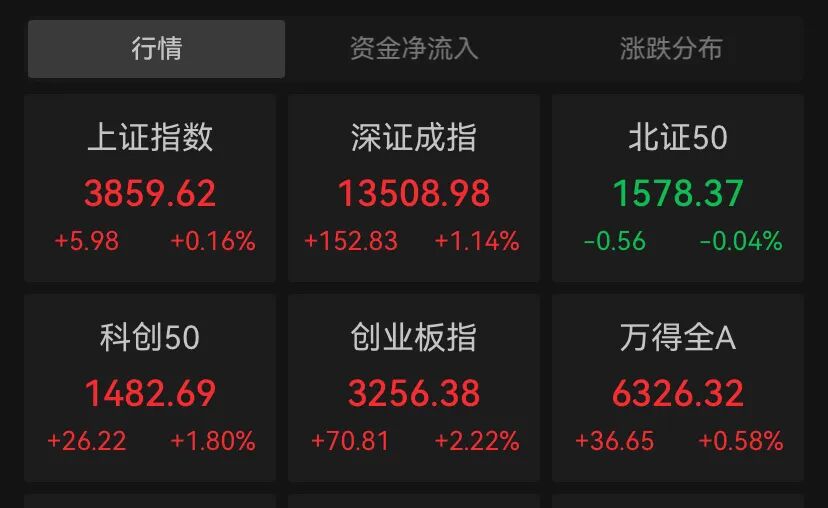
Market Performance - The A-share major indices strengthened, with the ChiNext Index leading the gains, breaking through 3200 points and reaching a three-year high, with an approximate cumulative increase of 80% since the low on April 8 [1][2] - As of the midday close, the ChiNext Index rose by 2.22% to 3256.38 points, the Shanghai Composite Index increased by 0.16% to 3859.62 points, and the Shenzhen Component Index climbed by 1.14% to 13508.98 points [1][2] Sector Highlights - Technology growth sectors such as solid-state batteries, AI applications, AI computing hardware, and consumer electronics saw collective surges, with leading stock CATL reaching a historical high and surpassing Kweichow Moutai in market capitalization [2][4] - Solid-state battery concept stocks strengthened, with EVE Energy surging over 9% at one point and closing up 7.81%, while CATL's A-shares rose nearly 5%, reaching a total market capitalization of 1.83 trillion yuan [4][6] - The AI application and AI computing hardware sectors also rebounded, with Inspur Information hitting the daily limit and reaching a historical high, pushing its market capitalization above 110 billion yuan [7][9] Industry Developments - The 7th High Energy Density Solid-State Battery Key Materials Technology Conference was held in Suzhou, focusing on solid-state electrolytes, electrode materials, and industrialization progress, providing a platform for collaboration among enterprises and research institutions [6] - According to Guotai Junan Securities, the industrialization of solid-state batteries is expected to accelerate, with a potential milestone year in 2027 for full solid-state battery production [6] - The Ministry of Commerce and other departments recently issued guidelines to promote digital consumption, encouraging innovation in AI terminal products and accelerating the development of smart appliances and connected vehicles [12]

A股盘前播报 | 中概股深夜逆势大涨 八部门发文推动数字消费
智通财经网· 2025-09-25 00:40
Group 1: Industry Developments - Xi Jinping announced a new round of national contributions, aiming for a 7%-10% reduction in greenhouse gas emissions by 2035, with non-fossil energy consumption exceeding 30% of total energy consumption [1] - The U.S. and EU reached a trade agreement to lower tariffs on EU imported cars to 15%, effective retroactively from August 1 [3] - The Chinese Ministry of Commerce emphasized the importance of protecting the rights of Chinese enterprises in the U.S. and stabilizing Sino-U.S. economic cooperation [4] Group 2: Market Performance - U.S. stock indices fell, but Chinese concept stocks surged, with the Nasdaq Golden Dragon China Index rising by 2.83% and Alibaba increasing by over 8% due to its commitment to invest more in AI infrastructure [2] - Copper prices jumped by 2% following production halts at the Grasberg mine, with expectations of strong prices due to supply disruptions and increased demand from home appliance subsidies and power grid investments [9] - Following Goldman Sachs, UBS also raised Tesla's third-quarter delivery expectations, indicating a potential acceleration in new model launches and advancements in robotics and electric vehicles [10] Group 3: Policy Focus - Eight departments issued a document to promote digital consumption, highlighting the need for increased supply of AI terminal products, which presents opportunities for hardware manufacturers [8] Group 4: Company Announcements - Upbeat announcements included a planned acquisition of 37% of shares by Zhiyuan Robot's associated company [11] - Negative announcements included a reduction in shareholding by major shareholders in several companies, indicating potential market volatility [13]