
储水式电热水器

Search documents
速查!这些电热水器抽查不合格!
Xin Lang Cai Jing· 2026-02-28 00:41
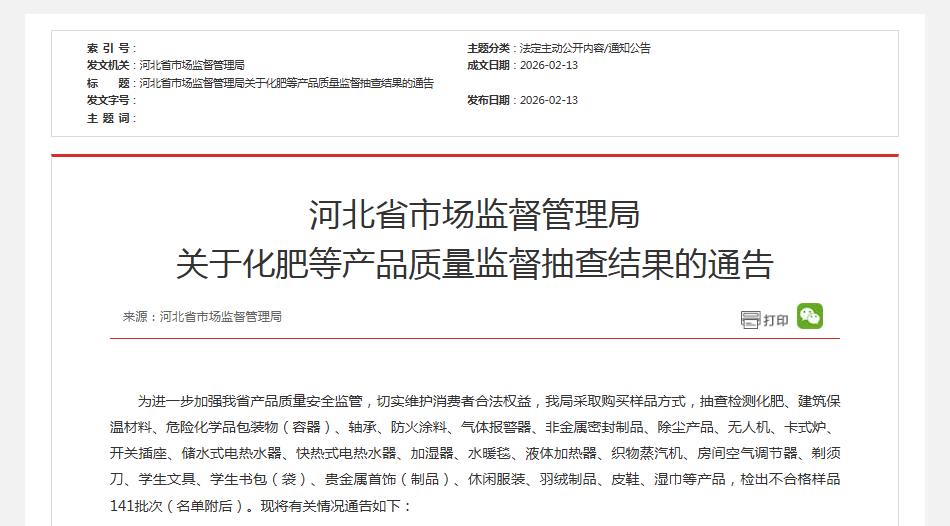
Group 1 - The Hebei Provincial Market Supervision Administration has released the results of quality supervision and random inspection of products, including fertilizers, liquid heaters, precious metal jewelry, leisure clothing, down products, leather shoes, and wet wipes [2] - The inspection revealed two batches of non-compliant samples for water storage and fast heating electric water heaters, prompting local market supervision departments to take legal action [2] - Consumers are encouraged to report any product quality violations by calling the "12315" hotline [2] Group 2 - Specific non-compliance details include a water storage electric water heater from Shijiazhuang with energy efficiency issues and a fast heating electric water heater from Cangzhou failing to meet grounding measures [3][3]

2025年儿童及婴幼儿服装等41种产品质量国家监督抽查情况通报
Xin Lang Cai Jing· 2026-02-13 13:12
Summary of Key Points Core Viewpoint The recent national quality supervision sampling of children's and infant clothing, among 41 product categories, revealed a significant number of non-compliant products, highlighting ongoing quality control issues in the market. Group 1: Sampling Overview - A total of 41 product categories were sampled, with 4,972 batches tested, primarily focusing on low-priced products [3] - The sampling involved 2,585 sales units across 25 platforms, with 2,844 batches from online sales and 1,405 batches from physical sales in 28 provinces [3] - 660 batches were found to be non-compliant, including 52 batches of illegal products related to children's clothing [3] Group 2: Specific Product Findings - **Children's and Infant Clothing**: 359 batches tested, with 42 batches non-compliant, including issues with labeling and safety standards [4] - **Children's Toys**: 519 batches tested, with 60 batches non-compliant, including products lacking necessary certifications and safety performance issues [4] - **Student Backpacks**: 104 batches tested, with 18 batches non-compliant, including safety issues related to plastic components [4] - **School Uniforms**: 65 batches tested, with 4 batches non-compliant, primarily related to fiber content [5] - **Children's Strollers**: 182 batches tested, with 8 batches non-compliant, including labeling and safety performance issues [5] Group 3: Compliance and Enforcement Actions - Non-compliant products are subject to removal from the market, with local regulatory bodies taking action against manufacturers [22] - Continuous non-compliance leads to stricter penalties, including legal actions against violators [22] - The regulatory authority will enhance monitoring of compliance and follow-up on corrective actions taken by manufacturers [22]
家电低价内卷时代面临终结,新国标家电「计划报废」是安全警示,还是刺激消费?
3 6 Ke· 2026-01-13 04:48
Core Viewpoint - The new national standard for household appliances mandates the labeling of "safe usage years," emphasizing the importance of timely replacement to mitigate safety risks associated with aging appliances [2][3][7]. Group 1: New Regulations - Starting January 2026, the revised national standard requires household appliances to indicate their "safe usage years" and warn users about the risks of continued use beyond this period [2]. - Manufacturers must clearly label the safe usage period on products, including a warning about the risks of exceeding this timeframe [3][7]. - The safe usage period will generally start from the date of purchase, or from the installation date for appliances requiring professional installation [5][7]. Group 2: Safety Concerns - Many households overlook the safety risks associated with aging appliances, often waiting for visible issues before considering replacement [1][8]. - Recent incidents, such as fires caused by aging electrical components, highlight the dangers of using appliances beyond their safe usage years [8][9]. - The new standard aims to provide consumers with a clear guideline for when to replace appliances, reducing reliance on subjective judgment [13][15]. Group 3: Industry Implications - The introduction of the safe usage year standard may shift competition in the appliance industry from price and features to safety and reliability [16][17]. - Established brands with robust testing and quality assurance processes may benefit from the new regulations, as they can confidently communicate the safety of their products [16][17]. - Conversely, manufacturers that focus on cost-cutting may face increased pressure to meet the new standards, potentially impacting their market position [17].
安徽省市场监管局发布2025年衬衫等51种产品质量省级监督抽查结果
Zhong Guo Zhi Liang Xin Wen Wang· 2025-12-22 08:31
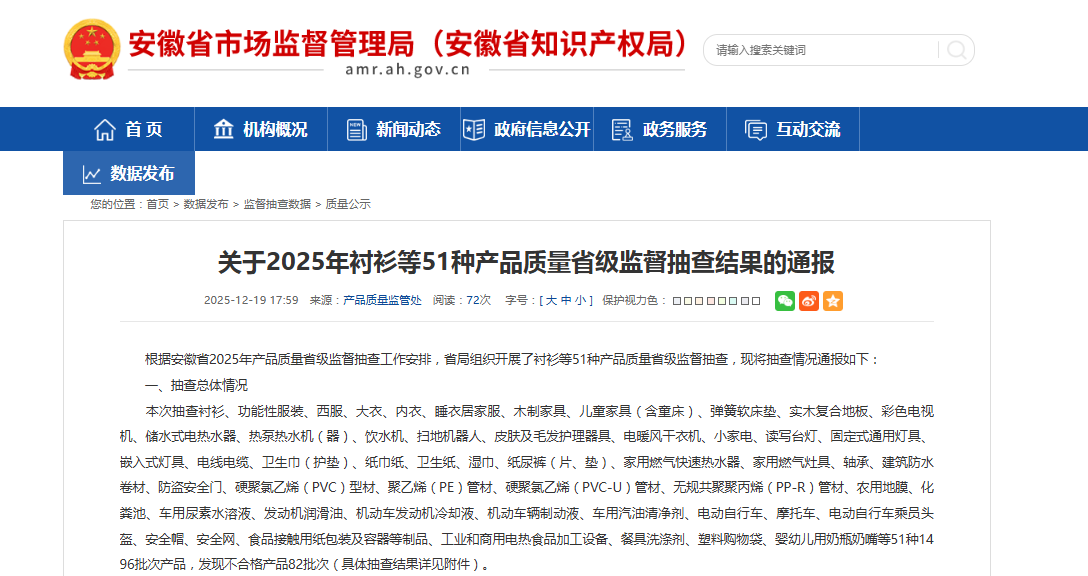
Overall Summary - The Anhui Provincial Market Supervision Administration released the results of the provincial quality supervision sampling inspection for 51 products, including shirts, functional clothing, and various household items, revealing that 82 out of 1496 batches were found to be non-compliant [3][4]. Group 1: Product Categories with Non-compliance - Shirts: Out of 50 batches inspected, 3 batches were non-compliant due to fiber content [4]. - Functional Clothing: Among 112 batches, 3 batches failed due to fiber content and hydrostatic pressure after washing [4]. - Underwear: 1 out of 62 batches was non-compliant due to fiber content [5]. - Wooden Furniture: 2 out of 12 batches were non-compliant due to woodworking requirements [6]. - Spring Mattresses: 3 out of 12 batches failed due to appearance performance (zipper) [6]. - Electrical Appliances: Various categories such as skin and hair care devices, small appliances, and lighting fixtures showed multiple non-compliance issues related to safety and performance standards [13][14][21]. Group 2: Specific Non-compliance Issues - Skin and Hair Care Devices: 3 batches failed due to protection against live parts, input power and current, and radiation interference [13]. - Small Appliances: 1 batch was non-compliant due to stability and mechanical hazards, and power connection issues [13]. - Lighting Fixtures: 10 out of 27 batches of fixed general lighting and 8 out of 27 batches of embedded lighting were found non-compliant due to various electrical interference and efficiency standards [14][15]. - Electrical Cables: 1 out of 112 batches failed due to insulation thickness issues [21]. Group 3: Additional Product Categories - Children’s Furniture: No non-compliance was found in 12 batches inspected [6]. - Household Gas Appliances: No non-compliance was reported in 12 batches of gas water heaters and stoves [19][20]. - Disposable Hygiene Products: Categories such as sanitary napkins, tissues, and diapers showed no non-compliance in their respective batches [15][16][17][18].
2024—2025年度中国家用电器行业品牌评价结果发布
Xin Lang Cai Jing· 2025-09-16 23:51
Group 1 - The 2024-2025 China Home Appliance Industry Brand Evaluation event was held at the IFA in Berlin, covering 11 categories of home appliances with a total of 55 brands selected [1] - The brand evaluation project, initiated in 2010, is guided by the Ministry of Industry and Information Technology and aims to support the development of domestic home appliance brands through a scientific and objective evaluation system [1] - The project has positively contributed to the high-quality development of the industry by enhancing brand value and cultivating industry benchmarks [1] Group 2 - The home appliance industry in China is experiencing significant growth opportunities due to the old-for-new policy, with a recovery trend observed over the past year [2] - Traditional categories are benefiting from policy incentives, while emerging categories are expanding and reshaping competitive structures, driven by large-scale equipment updates and consumer replacement actions [2] - Companies are focusing on technological innovation to strengthen brand foundations, increasing R&D investments in AI, smart sensing, and energy-saving technologies to enhance user experience and product reliability [2] Group 3 - Brand building is a comprehensive reflection of national competitiveness and is crucial for establishing a new development pattern in the home appliance industry [3] - The industry is committed to increasing product variety, improving quality, and creating strong brands to better align supply with market demand [3] - Chinese home appliance brands are gaining global influence through diversified strategies and technological innovation, positioning themselves as key representatives of Chinese manufacturing and creativity [3]
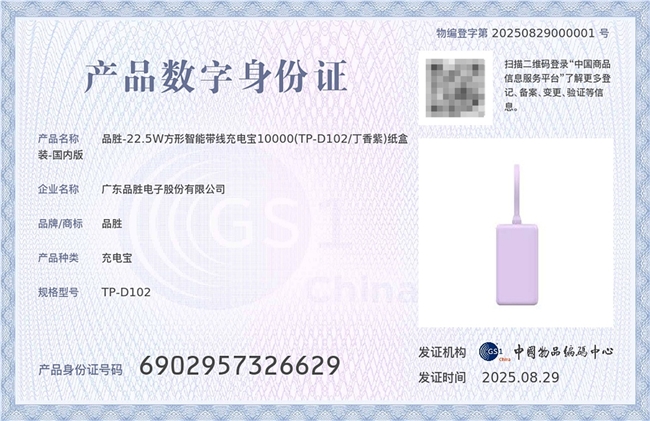
全国首张充电宝“产品数字身份证”落地深圳
Jin Tou Wang· 2025-09-08 01:42
Core Viewpoint - The National Market Supervision Administration of China has initiated a pilot program for quality safety verification of key online products to combat counterfeit goods and protect consumer rights [1] Group 1: Pilot Program Details - The pilot program includes 10 key products: safety helmets, electric bicycles, gas stoves, induction cookers, storage-type electric water heaters, extension cords, mobile power supplies, children's shoes, fire extinguishers, and household combustible gas detectors [1] - Major e-commerce platforms involved in the pilot include Taobao, Kuaishou, Pinduoduo, Douyin, JD.com, Suning, Xiaohongshu, Dewu, Vipshop, and Tencent [1] - Nearly 2,000 online product companies in Shenzhen have been included in the pilot, covering over 100,000 products [1] Group 2: Digital Product Identity - The first global digital product identity will be officially launched in Shenzhen on August 29, 2025, following verification by the Shenzhen branch of the China Goods Coding Center [1] - The core value of the "digital product identity" lies in establishing a full-chain mechanism of "source coding, platform verification, and consumer identification" [1] - This initiative aims to enhance product quality and create a safer, more regulated online shopping environment [1]
广东召开网售重点产品质量安全赋码核验试点工作培训会
Nan Fang Ri Bao Wang Luo Ban· 2025-09-05 08:01
Group 1 - The Guangdong Provincial Market Supervision Administration has initiated a pilot program for product quality safety coding, focusing on 10 key product categories including power banks, helmets, and gas stoves [1][2] - Over 2,000 manufacturing enterprises participated in the training meeting to implement product coding measures and collaborate with e-commerce platforms for quality verification [1][2] - The training emphasized the importance of a full-chain regulatory mechanism that includes source coding, platform verification, and consumer identification to combat counterfeit products and enhance consumer safety [2] Group 2 - Experts from the China Commodity Coding Center provided detailed guidance on data registration and coding operations for the 10 key products, with a focus on power banks [2] - E-commerce platform representatives outlined specific standards for product verification and coding, ensuring traceability of products [2] - The training session combined online and offline participation, engaging nearly 2,500 individuals from various regulatory bodies, industry associations, and manufacturing enterprises [2]
广东指导充电宝等十类网售产品落实赋码追溯要求
Zhong Guo Xin Wen Wang· 2025-09-04 09:11
Core Viewpoint - Guangdong Province is leading a nationwide initiative to implement product coding and traceability requirements for ten categories of online sold products, including power banks, to enhance product quality and consumer safety [1][2] Group 1: Regulatory Actions - The Guangdong Provincial Market Supervision Administration held a training session for over 2,000 manufacturers of ten key products to guide them in implementing product coding measures [1] - The initiative is part of a broader effort to address the high rate of substandard products in online sales compared to offline sales, which negatively impacts consumer experience and safety [1] Group 2: Product Categories and Focus - The ten categories of products targeted include safety helmets, electric bicycles, gas stoves, induction cookers, storage-type electric water heaters, extension cords, power banks, children's shoes, fire extinguishers, and household combustible gas detectors [1][2] - Experts provided detailed guidance on the data registration management process and specific coding operations for these products, with a particular emphasis on power banks [2] Group 3: Quality Assurance Mechanism - The initiative aims to establish a comprehensive regulatory mechanism that includes source coding, platform verification, and consumer identification to ensure product authenticity and traceability [2] - This mechanism is expected to effectively curb the prevalence of counterfeit and substandard products, thereby enhancing consumer confidence [2]