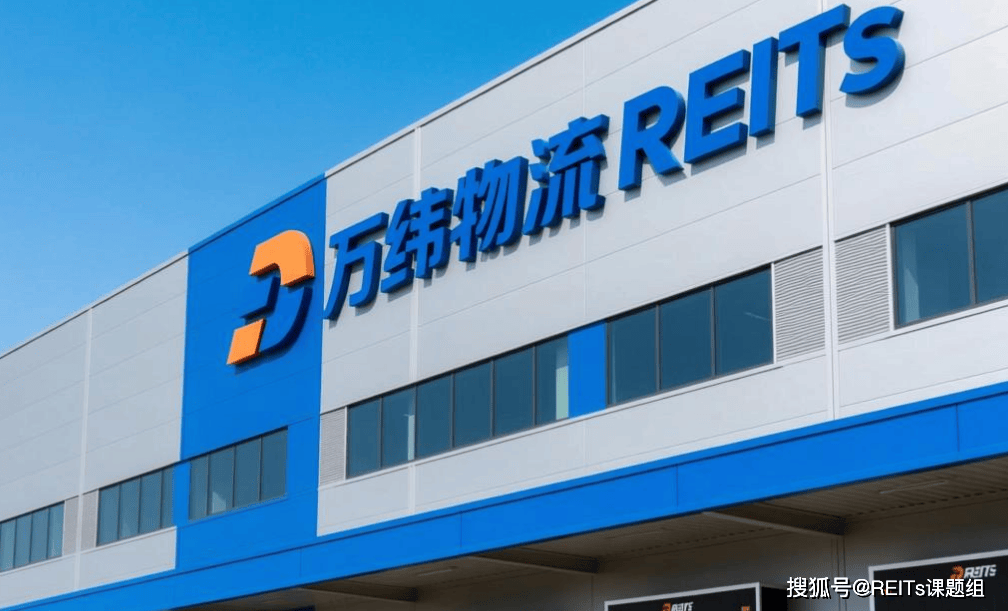
华夏万纬仓储物流REIT

Search documents
首批商业不动产REITs拟募资超314亿,资金锁定优质资产
2 1 Shi Ji Jing Ji Bao Dao· 2026-02-03 13:01
Group 1 - The core viewpoint is that the public REITs market in mainland China is undergoing a consolidation phase, with both new applications and withdrawals reflecting market dynamics [1][2] - The first batch of eight commercial real estate REITs has been submitted for approval, aiming to raise a total of 31.475 billion yuan, with the largest single offering targeting 7.47 billion yuan [1][4] - The underlying assets of these REITs include shopping centers, office buildings, and hotels, with expected distribution rates above 4.5% by 2026, reaching as high as 5.5% [1][4] Group 2 - The withdrawal of some previously submitted REITs, such as the Electronic City Industrial Park REIT and Vanke's logistics REIT, indicates a market correction and aligns with investor expectations [1][6][7] - The market is shifting towards a preference for long-cycle quality assets, which will influence both asset holders and fund managers, creating a positive feedback loop [2][5] - The recent policy support for commercial real estate REITs is seen as a long-awaited opportunity for the real estate sector, allowing dormant assets to be revitalized [3][4] Group 3 - The underlying assets of the newly submitted commercial real estate REITs are diverse, including outlets and hotels, which can help companies optimize their capital structure [4][5] - Investors are adopting a cautious approach, focusing on high-quality assets located in first- and second-tier cities to gain trust from fund managers [5][6] - The overall available distribution amount for public REITs has decreased by 16% quarter-on-quarter but increased by 3% year-on-year, indicating a need for careful asset selection [8] Group 4 - The market's reaction to the submissions and withdrawals of public REITs has been relatively calm, suggesting a mature acceptance of the evolving landscape [9] - The success of public REITs will depend on the effective selection of assets characterized by long leases, high occupancy rates, and professional management [9]
从“申报热”到“赎回潮” 5单公募REITs叫停
2 1 Shi Ji Jing Ji Bao Dao· 2026-01-29 23:36
Core Viewpoint - The domestic public REITs market in China has experienced a significant turning point, with several leading companies voluntarily withdrawing their public REITs issuance or expansion applications after years of preparation, raising concerns about the market's future prospects [1][15]. Group 1: Market Overview - Public REITs, or Real Estate Investment Trusts, are financial instruments that raise funds through issuing shares to invest in income-generating real estate, distributing most of the profits to investors [1][15]. - The REITs market was once a hot financing innovation in China's infrastructure sector, rapidly growing to a market size exceeding 100 billion, and was characterized by high demand and oversubscription [2][15]. - The recent wave of withdrawals from the REITs market has shifted the perception from a "hot" investment to a more rational correction phase, indicating a potential end to the market's previous high point [1][15]. Group 2: Withdrawn Projects - The withdrawn projects include: - Jianxin Jianrong Home Rental Housing REIT - Chuangjin Hexin Electronic City Industrial Park REIT - Huaxia Wanwei Warehousing Logistics REIT - Jianxin Jinfeng New Energy REIT - Fuguo Shouchuang Water REIT's expansion application [1][2][16]. - These projects were submitted between September 2022 and May 2025, covering various asset types such as affordable rental housing, industrial parks, warehousing logistics, new energy wind power, and water treatment [2][16]. Group 3: Reasons for Withdrawals - The withdrawals are attributed to two significant changes in the market environment: - The overall cooling of the REITs secondary market, leading to decreased investor willingness to subscribe to new products due to pricing pressures and potential risks of breaking below par [8][21]. - Challenges in the operational quality of underlying assets, such as declining rental income and rising vacancy rates in logistics real estate, which necessitate downward adjustments in cash flow forecasts [8][21]. - Specific concerns raised during the review process included compliance issues, rental stability, and the impact of policy changes on cash flows [6][20]. Group 4: Regulatory Environment - Recent policy signals have emerged to promote the standardized development of the REITs market, including a notice from the National Development and Reform Commission in September 2025 to encourage regular applications [9][23]. - The China Securities Regulatory Commission's "Document No. 63" issued in December 2025 sets a new tone for "high-quality development," marking a significant step towards the market's expansion and regulatory compliance [10][23]. Group 5: Future Outlook - Despite the short-term adjustments, favorable long-term factors for market development remain, with the potential for REITs to play an irreplaceable role in the macroeconomy [11][24]. - The market is expected to continue experiencing a "market dividend period," with ongoing demand for "fixed income plus" assets, particularly in early 2026 [12][25]. - Investors are advised to focus on the fundamental performance of projects, asset scarcity, and dividend yield while enhancing their understanding of REITs products [12][25].
从“申报热”到“赎回潮”,5单公募REITs叫停
2 1 Shi Ji Jing Ji Bao Dao· 2026-01-29 10:45
Core Viewpoint - The public REITs market in China is experiencing a significant downturn, marked by a wave of project withdrawals from major companies, raising questions about the future of the market and potential investment opportunities [1][2]. Group 1: Market Dynamics - The public REITs market, once a hot financing innovation in China's infrastructure sector, has seen its market size rapidly exceed 100 billion, driven by strong policy support and investor demand [2]. - Recent withdrawals of REIT applications, including projects from major financial institutions and listed companies, indicate a shift from a previously bullish market to a more cautious environment [2][5]. - The terminated projects cover various asset types, including affordable rental housing, industrial parks, logistics, renewable energy, and water treatment, reflecting a broad impact across sectors [3][5]. Group 2: Reasons for Withdrawals - The withdrawals are attributed to two main factors: a cooling secondary market leading to decreased investor appetite and challenges in the operational quality of underlying assets [6][7]. - Specific concerns raised by regulatory bodies include rental stability, cash flow predictions, and compliance issues, which have led to prolonged periods of silence from project sponsors before the eventual withdrawal [5][6]. - The market environment has created significant pricing pressure on new issuances, with risks of underpricing and substantial asset impairment for original rights holders [6][7]. Group 3: Future Outlook - Despite the current challenges, there are favorable long-term factors for the REITs market, including regulatory support aimed at high-quality development and the potential for market expansion [8][9]. - The recent policy signals indicate a move towards normalizing REIT applications, suggesting that the market may eventually stabilize and grow, albeit with a more rigorous quality assessment process [7][8]. - The REITs market is projected to remain a significant player in China's macroeconomic landscape, with ongoing demand for stable income-generating assets, particularly from 'fixed income plus' funds [9].


建行、万科等巨头撤回公募REITs申报
Zhong Guo Zheng Quan Bao· 2026-01-29 08:28
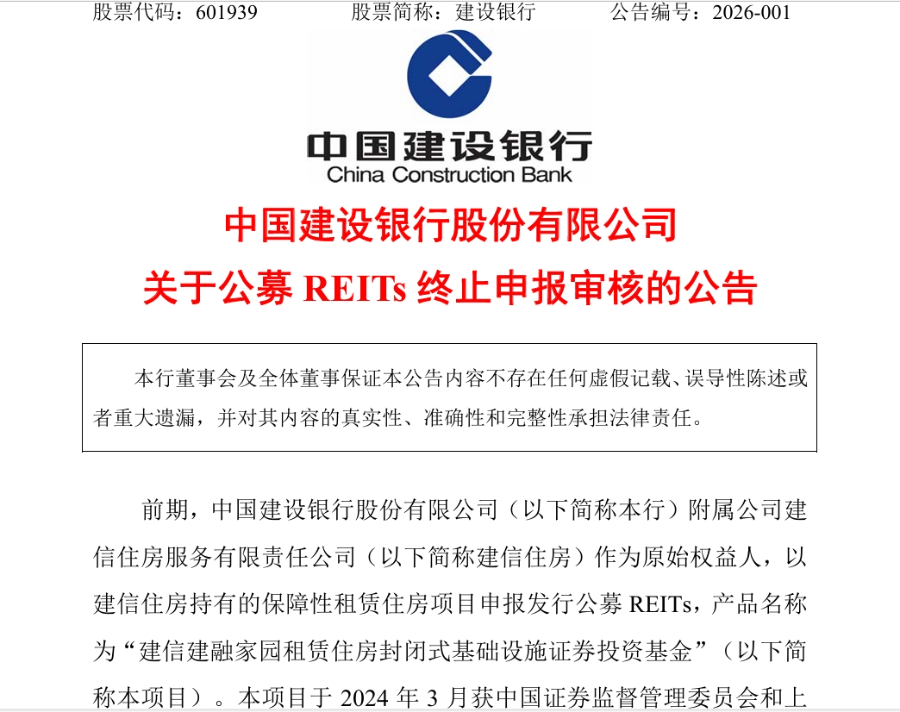
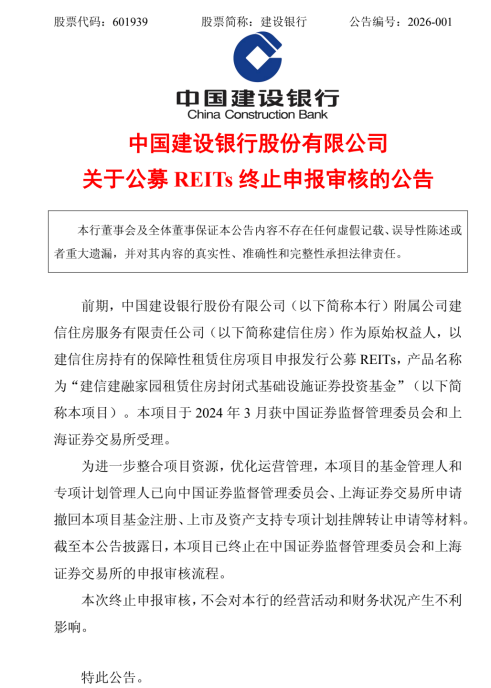
Core Viewpoint - Several leading companies, including China Construction Bank, Vanke A, Goldwind Technology, and Electronic City, have recently announced the voluntary withdrawal or termination of their public REITs issuance applications, indicating a shift in the public REITs market towards a focus on asset quality and a restructuring of valuation logic [1][6]. Group 1: Company Actions - China Construction Bank announced the withdrawal of its public REITs application for a housing project, which was accepted by the regulatory authorities in March 2024, to further integrate project resources and optimize operational management [2][4]. - Vanke A also withdrew its application for the Huaxia Wanwei logistics REIT, which aimed to raise approximately 1.16 billion yuan, citing various external and market factors [5]. - Goldwind Technology and Electronic City have also announced the termination of their respective REIT applications, with plans to revisit the issuance at a later date [5]. Group 2: Regulatory and Market Environment - The recent withdrawals are attributed to the implementation of new regulatory guidelines and changes in market conditions, signaling a transition from rapid expansion to a focus on quality and efficiency in the public REITs market [6][7]. - The new guidelines from the Shanghai and Shenzhen Stock Exchanges clarify the circumstances under which public REITs applications may be suspended or terminated, enhancing the regulatory framework for the approval process [6]. - The China Securities Regulatory Commission has emphasized the need for high-quality development in the REITs market, reinforcing the scrutiny of asset ownership, compliance, and sustainable profitability [6]. Group 3: Future Market Trends - Investors are expected to demand higher quality and stability in the underlying assets and cash flows of REITs, leading to a potential shift in valuation logic from asset appreciation to cash flow discounting [7]. - The banking sector is exploring opportunities in the housing rental market, although current participation in public REITs remains limited, indicating potential for future growth under favorable policy conditions [8].



5单REITs为何集体叫停
经济观察报· 2026-01-28 10:01
Core Viewpoint - The recent collective termination of public REITs applications is significantly influenced by the decline in underlying asset valuations, marking a critical shift in the regulatory landscape and market dynamics [1][10][12]. Group 1: Termination of REITs Applications - On January 23, 2026, both the Shanghai and Shenzhen Stock Exchanges announced the termination or withdrawal of five public infrastructure REITs applications, marking the first instance of such a collective termination since the pilot program began [2]. - The terminated projects include various types of underlying assets such as rental housing, industrial parks, logistics, new energy, and water treatment, all structured as "public funds + infrastructure asset-backed securities" [5][6]. - The termination is attributed to the new regulatory guidelines effective December 31, 2025, which stipulate that applications not responding to feedback within a specified timeframe will be automatically terminated [10]. Group 2: Underlying Asset Challenges - The underlying assets of the terminated REITs face structural challenges that hinder compliance with regulatory requirements, such as the need for stable cash flows and operational stability [11][12]. - For instance, the rental housing REIT faced issues related to compliance verification and operational stability, leading to a lack of response to inquiries for over a year [5][11]. - The logistics REIT encountered declining rental prices and high tenant concentration, complicating its ability to demonstrate operational stability [12]. Group 3: Market Dynamics and Regulatory Changes - The public REITs market has grown significantly, with over 78 products launched and a cumulative financing scale exceeding 210 billion yuan, positioning it as the largest in Asia and the second largest globally [15]. - However, the market is now transitioning from a focus on quantity of issuance to an emphasis on the quality of underlying assets and the stability of cash flows [3][15]. - The decline in asset valuations, particularly in the real estate sector, has led to increased reluctance among original equity holders to proceed with applications, as they may not find the valuations acceptable [13][16]. Group 4: Future Outlook - The termination of these applications is viewed as a necessary phase for the high-quality development of public REITs, with expectations that the market will optimize and enhance resilience amid ongoing challenges [17]. - The introduction of commercial real estate REITs, which do not require approval from the National Development and Reform Commission, is anticipated to accelerate the approval process and improve market conditions [16][17].
5单REITs为何集体叫停
Jing Ji Guan Cha Wang· 2026-01-28 09:29
Core Viewpoint - The Shanghai and Shenzhen Stock Exchanges announced the termination or withdrawal of five public infrastructure REITs applications, marking the first occurrence of such terminations since the pilot program began in 2021 [1][2]. Group 1: Termination of REITs Applications - Five REITs projects have been terminated, including those focused on rental housing, industrial parks, logistics, and renewable energy, with the aim of achieving stable cash flow for dividends [1][3]. - The terminated projects include: - Jianxin Jianrong Rental Housing REIT - Chuangjin Hexin Electronic City Industrial Park REIT - Huaxia Wanwei Logistics REIT - Jianxin Jinfeng Renewable Energy REIT - Fuguo Shouchuang Water REIT [1][5]. - The termination is attributed to the projects not responding to regulatory feedback within the required timeframe, as per the new guidelines effective from December 31, 2025 [6][11]. Group 2: Market Context and Regulatory Changes - The public REITs market has surpassed 200 billion yuan in scale, transitioning to a phase of normalized development, with a shift in regulatory focus from quantity to the quality of underlying assets and cash flow stability [2][10]. - The new regulatory guidelines introduced a "termination" mechanism for applications that do not meet response deadlines, aiming to enhance market efficiency and quality [6][11]. Group 3: Challenges Faced by Terminated Projects - The terminated projects faced various structural challenges, such as compliance issues, rental stability, and cash flow predictability, which hindered their ability to meet regulatory requirements [7][8]. - Specific issues included: - Jianxin Jianrong Rental Housing REIT struggled with compliance for non-residential housing conversions and high short-term rental ratios [7]. - Chuangjin Hexin Electronic City Industrial Park REIT had concerns regarding tenant stability and lease renewal risks [7]. - Huaxia Wanwei Logistics REIT faced declining rental prices and high tenant concentration [7]. - Jianxin Jinfeng Renewable Energy REIT was impacted by subsidy reductions affecting cash flow [7][8]. Group 4: Future Outlook for REITs Market - The termination of these projects is seen as a necessary phase for the high-quality development of public REITs, with expectations for structural optimization and resilience in the market as commercial real estate REITs trials deepen [12]. - However, the market still faces challenges related to the stability of underlying assets and macroeconomic cycles [12].
两只公募REITs终止发行,新规后首现“清退”效应
Di Yi Cai Jing· 2026-01-20 12:00
Core Viewpoint - The recent regulatory changes have led to the first case of a public REIT failing to issue after entering the exchange review stage, highlighting the impact of new guidelines aimed at preventing projects from remaining unresolved for extended periods [1][2]. Group 1: Regulatory Changes - The new guidelines from the Shanghai and Shenzhen Stock Exchanges, effective by the end of 2025, explicitly define circumstances under which public REIT applications can be terminated, aiming to enhance transparency and efficiency in the review process [2][3]. - The guidelines list seven specific scenarios for application termination, including failure to respond to exchange feedback within the stipulated timeframe [2]. Group 2: Company-Specific Cases - Jin Feng Technology announced the termination of its public REIT application, which began in September 2021 and had not progressed due to a lack of response to feedback from the exchange [1]. - Similarly, Electronic City plans to withdraw its infrastructure public REIT project application, which was submitted in May 2025, due to a lack of progress following initial feedback [2]. Group 3: Market Implications - The implementation of the new regulations is expected to shift the focus of public REITs from merely issuing to emphasizing operational compliance and management capabilities, favoring projects with stable cash flows [3]. - As of the end of 2025, there are 79 public REITs listed in the market, with a total issuance scale exceeding 210 billion yuan, indicating a growing market despite recent challenges [3].
万科债务危机演绎下万纬物流REITs申报困境与危局
Sou Hu Cai Jing· 2025-12-10 08:44
Core Viewpoint - The financial difficulties faced by Wanwei Logistics and its impact on the issuance of REITs highlight significant uncertainties in its operations and sustainability [2][12]. Group 1: Financial Condition - Wanwei Logistics has experienced high debt levels, with debt-to-asset ratios of 99.77%, 93.21%, 87.73%, and 87.54% at the end of 2020, 2021, 2022, and September 2023 respectively [2][9]. - The total liabilities of Wanwei Logistics were reported as 30.33 billion, 30.43 billion, 28.43 billion, and 28.51 billion at the end of 2020, 2021, 2022, and September 2023 respectively [9]. - Cash flow from investment activities has been negative, with net cash flows of 1.67 billion, -3.43 billion, -5.56 billion, and -2.35 billion for the same periods [9]. Group 2: REITs Issuance Requirements - The issuance of REITs requires that the financial condition of the initiators and management institutions be sound, with no significant legal violations or safety incidents in the past three years [4][5]. - The "Huaxia Wanwei Warehousing Logistics REIT" has been submitted for approval but has not made any recent public progress as of December 2025 [3]. Group 3: Asset Information - The assets included in the "Huaxia Wanwei Warehousing Logistics REIT" are located in Huzhou, Foshan, and Shaoxing, with varying occupancy rates [6]. - The occupancy rates for the Huzhou project were 98.27%, 99.42%, 61.28%, and 86.66% at the end of 2020, 2021, 2022, and September 2023, with a current rate of 98.35% [6]. - The Foshan and Shaoxing projects have occupancy rates of 95.62%, 98.82%, 99.89% and 98.79%, 97.45%, 77.24% respectively, with the latest rates being 99.89% and 97.45% [6]. Group 4: Debt Analysis - Wanwei Logistics has significant liabilities, with related party loans amounting to 22.82 billion, 21.79 billion, 19.78 billion, and 18.65 billion over the same periods [9]. - The company’s cash reserves were reported as 12.67 million, 169.89 million, 1.81 billion, and 535.69 million at the end of 2020, 2021, 2022, and September 2023 respectively [9]. Group 5: Corporate Actions - Vanke has been in discussions to sell its controlling stake in Wanwei Logistics and has pledged approximately 27 billion in equity to secure a 20 billion syndicated loan [10]. - Vanke's ongoing debt crisis has led to asset disposals as a means to manage its financial obligations, raising concerns about the sustainability of the REITs platform [12]. Group 6: Future Considerations - The current debt crisis significantly undermines the potential for future REITs issuance, as it disrupts the clarity of asset ownership and cash flow stability [12]. - The ability of Vanke to fulfill its commitments regarding the repurchase of fund shares is questionable given its financial pressures and upcoming debt maturities [12].