
即时零售业务

Search documents
招商证券:当前位置恒生科技有极大配置价值 建议逢低买入、持股过节
Zhi Tong Cai Jing· 2026-02-11 23:13
Core Viewpoint - The recent significant decline in the Hong Kong technology sector, represented by the Hang Seng Tech Index, has created a strong investment opportunity due to extreme pessimism in the market narrative [1] Economic Fundamentals - Economic data indicates a slowdown in both PMI production and demand, while prices continue to strengthen; structural issues related to insufficient domestic demand persist, making the expansion of domestic demand a key policy focus [2] - PPI is expected to recover further, indicating potential positive shifts in the economic landscape [2] Liquidity and Funding - The Federal Reserve did not lower interest rates in January, with the nomination of a new chair, which may influence market dynamics; both domestic and Hong Kong capital have been increasing their holdings in the Hong Kong stock market [2] Valuation - The relative valuation of the Hong Kong technology sector has reached historical lows, with the Hang Seng Tech Index/A-share dual innovation index premium nearing historical minimum levels; the current regulatory environment for internet companies is significantly better than in 2022 and 2023, suggesting that the Hong Kong tech sector is undervalued [2] - The odds and win rates for investing in Hong Kong technology appear favorable moving forward [2] Policy Environment - Strict control over IPO quality is expected to improve market sentiment, as the previous oversupply of IPOs has been a common narrative explaining the weak performance of Hong Kong stocks [2] Investment Strategy - Focus on sectors such as technology (AI and internet, high-end manufacturing), non-bank financials (insurance), and high-dividend stocks [3] - The investment paradigm is shifting from "arms race" to "profit verification," leading to value discovery for Hong Kong internet companies; the AI ecosystem in Hong Kong is becoming increasingly comprehensive, covering hardware, foundational models, and vertical applications [3] - Instant retail business losses are narrowing and are gradually being priced in by the market; the technology sector's discount is approaching historical extremes, providing a clear "high cut low" configuration advantage [3] Non-Bank Financials - The asset side is characterized by a "bull market in stocks and bear market in bonds," with a strong beta in the operating side and a favorable opening for liabilities [4] High-Dividend Strategy - The Hang Seng High Dividend Yield Index has a dividend yield of approximately 6%, indicating stable dividend capacity; there is an increasing allocation of insurance and "fixed income+" funds from southbound capital towards high-dividend assets [4]

即时零售业务爆发,把握顺丰同城投资机会
GOLDEN SUN SECURITIES· 2026-01-25 10:57
Investment Rating - The report recommends a "Buy" rating for key companies such as SF Holding, Jitu Express, and Caocao Travel [8]. Core Insights - The report highlights the explosive growth of instant retail driven by major companies increasing their investments, particularly Alibaba's commitment to enhancing its Taobao flash purchase services to achieve market leadership. It suggests capitalizing on investment opportunities in SF Express's urban delivery segment [1]. - The logistics sector is expected to benefit from two main investment themes: international expansion due to the rapid growth of overseas e-commerce and a focus on improving operational efficiency amid competitive pressures [3][18]. - The aviation sector is projected to see a significant recovery in passenger volumes, with the Civil Aviation Administration of China forecasting a record high of 95 million passengers during the 2026 Spring Festival, reflecting a year-on-year growth of approximately 5.3% [11][12]. Summary by Sections Transportation Sector Overview - The transportation sector index rose by 1.76% in the week of January 19-23, 2026, outperforming the Shanghai Composite Index by 0.93 percentage points [21]. - The top-performing sub-sectors included warehousing and logistics, road freight, and public transport, with increases of 6.05%, 5.91%, and 4.09% respectively [21]. Aviation - The report emphasizes the long-term positive outlook for the aviation sector, driven by low supply growth and recovering demand, which is expected to narrow the supply-demand gap. It also notes the potential for ticket prices to recover and airline profitability to improve [12][11]. - Key companies to watch include China Southern Airlines, China Eastern Airlines, and Spring Airlines [12]. Shipping and Ports - The VLCC market is experiencing high rates due to geopolitical risks, with the Middle East route rates reaching $107,937 per day as of January 23, 2026 [13]. - The dry bulk freight rates have rebounded, with the BDI index closing at 1,762 points on January 23, 2026 [14]. - The report suggests focusing on companies like China Merchants Energy and COSCO Shipping Energy for potential investment opportunities [15][16]. Logistics - The express delivery sector is seeing growth driven by international e-commerce, with Jitu Express recommended as a key player [18]. - The report notes that the express delivery industry handled 18.2 billion packages in December 2025, reflecting a year-on-year growth of 2.3% [19]. - Major players such as YTO Express and Shentong Express are highlighted for their market share gains, while SF Express is noted for its strategic business adjustments [20].

价值研究所|即时零售迎“奇点”,巨头激战正酣
Zhong Guo Ji Jin Bao· 2025-12-11 08:31
Core Insights - The instant retail market in China is projected to reach 971.4 billion yuan by 2025, with a year-on-year growth of 24.4%, nearing the trillion yuan mark [2][3] - Major e-commerce platforms are heavily investing in instant retail, with Alibaba, JD, and Meituan collectively spending nearly 60 billion yuan in the third quarter of this year [3] - The business model of instant retail, which focuses on rapid delivery from local warehouses, has evolved over the past decade and is now gaining traction among consumers, particularly the younger demographic [4][5] Market Expansion - The instant retail sector is expanding rapidly, with expectations to reach 2 trillion yuan by 2030, maintaining a compound annual growth rate of 25% [3] - Instant retail has transitioned from a focus on fresh produce to a broader range of products, including beauty and apparel, which are well-suited for quick delivery due to their high demand for timeliness [5][7] Consumer Behavior - The younger generation, particularly those born after 1995, prioritize delivery speed, with over 50% expecting same-day or even half-day delivery [3][4] - Instant retail aligns with the "immediate purchase and delivery" mindset of younger consumers, enhancing their shopping experience and brand loyalty [4] Channel Transformation - The shift towards instant retail is prompting a re-evaluation of market shares, with brands that embrace new channels likely to stand out [5] - Beauty products are among the fastest-growing categories in instant retail due to their high price points and urgent demand scenarios [5][7] Operational Innovations - Companies like Qingdao Beer have adapted their operations to leverage instant retail, achieving a nearly tenfold increase in gross merchandise volume (GMV) from 2 billion yuan to approximately 20 billion yuan over five years [8] - Instant retail is also enabling traditional retail businesses to transition from a "goods and venue" mindset to an "instant service" model, opening new growth avenues [8][10] Competitive Landscape - Despite the rapid growth, the instant retail sector is still in its early stages, with major players engaged in a subsidy war that raises questions about long-term profitability [10][11] - Retail brands face challenges from high platform fees and competition from e-commerce platforms that are also developing their own private label products, which can undermine traditional brands [11] Future Outlook - The future of retail is expected to be multi-faceted, with no single model completely replacing the others, as companies strive to find business models that fit the instant retail paradigm [11] - Companies that can enhance their supply chain responsiveness through digital transformation are likely to thrive in the instant retail era [11]


阿里最新业绩公布,三季度经营利润下滑85%
Di Yi Cai Jing· 2025-11-25 12:09
Core Insights - Alibaba's revenue for Q2 of fiscal year 2026 reached 247.8 billion RMB, a 5% year-on-year increase, surpassing market expectations of 245.2 billion RMB [1] - The company's operating profit significantly declined by 85% to 5.365 billion RMB, primarily due to heavy investments in instant retail, user experience upgrades, and advanced technology research [1][4] - Despite the profit decline, Alibaba Cloud's revenue grew by 34% to 39.824 billion RMB, marking a record high growth rate [2][4] Financial Performance - Alibaba's net cash flow from operating activities was 10.099 billion RMB, a 68% decrease compared to 31.438 billion RMB in the same period last year [2] - Free cash flow showed a net outflow of 21.840 billion RMB, contrasting with a net inflow of 13.735 billion RMB in the previous year, attributed to investments in instant retail and cloud infrastructure [2] - Capital expenditures for the quarter amounted to 31.5 billion RMB, with a total of approximately 120 billion RMB spent on AI and cloud infrastructure over the past four quarters [2] Business Segment Performance - Instant retail revenue surged by 60% to 22.906 billion RMB, while Alibaba's e-commerce customer management revenue increased by 10% [2][3] - The adjusted EBITA for the Chinese e-commerce group fell by 76% to 10.497 billion RMB, reflecting the impact of costs associated with instant retail and technology investments [3][4] - The adjusted EBITA for the cloud intelligence group grew by 35% to 3.604 billion RMB, indicating strong performance despite challenges in profitability [4] Strategic Outlook - The company is focusing on long-term investments in new business areas, which may lead to short-term fluctuations in profitability and free cash flow [4] - Alibaba's CFO indicated that the company is prioritizing future growth over immediate profit, suggesting a strategic shift towards sustaining long-term competitive advantages [4]

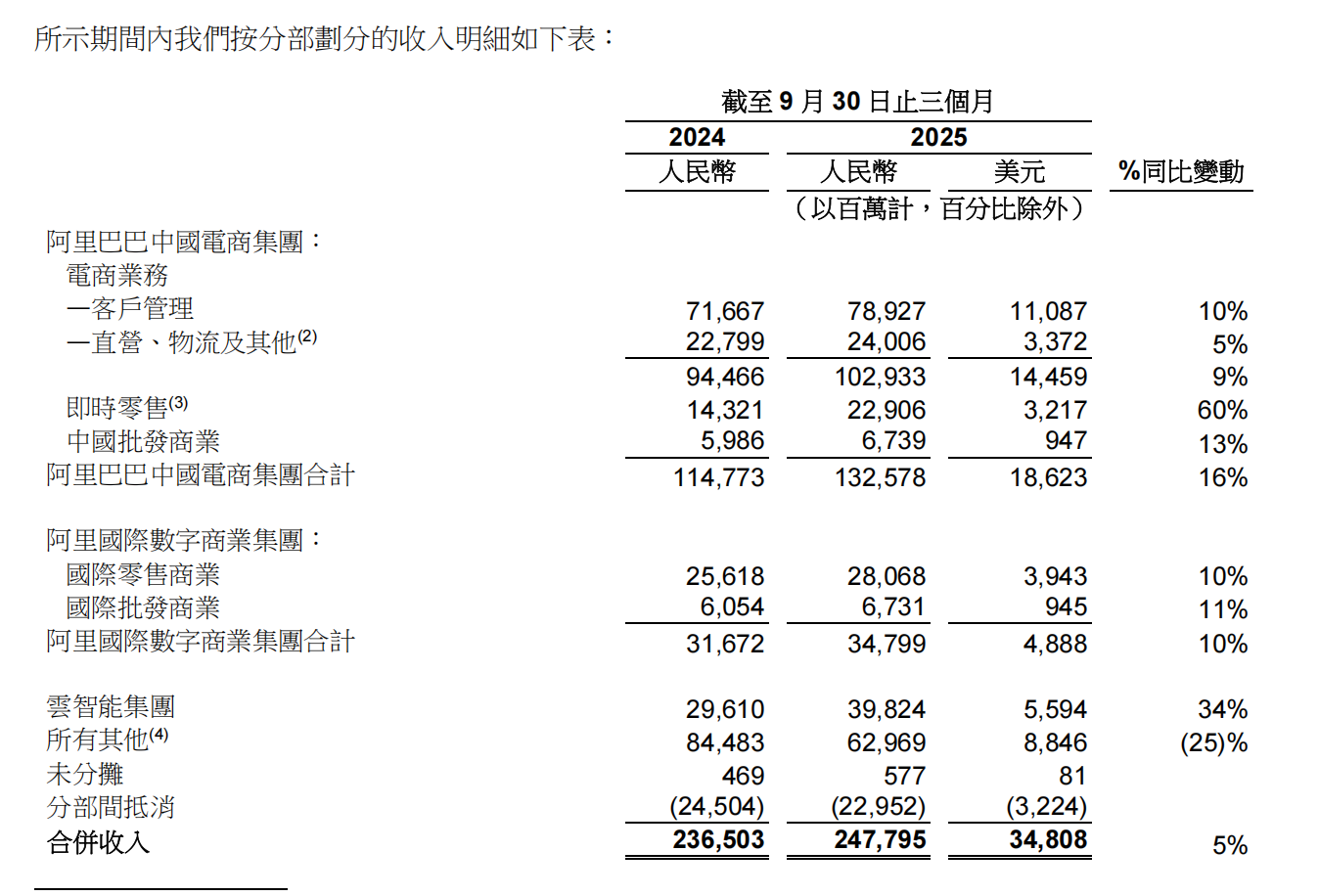
阿里季度即时零售收入为229亿元,战略投入致国内电商EBITA降76%
Xin Lang Cai Jing· 2025-11-25 11:37
Core Insights - Alibaba Group reported a significant increase in its instant retail business revenue, reaching 22.906 billion RMB, which represents a 60% growth compared to 14.321 billion RMB in the same period last year [1] - However, the adjusted EBITA for Alibaba's China e-commerce group fell sharply to 10.497 billion RMB, a 76% decline from 44.327 billion RMB year-over-year [1] Financial Performance - Instant retail business revenue: 22.906 billion RMB, up 60% from 14.321 billion RMB [1] - Adjusted EBITA: 10.497 billion RMB, down 76% from 44.327 billion RMB [1]
阿里即时零售业务收入单季同比增长60% AI收入连续9个季度三位数增长
Mei Ri Jing Ji Xin Wen· 2025-11-25 11:25
Core Insights - Alibaba Group reported Q2 FY2026 revenue of 247.795 billion yuan, with a year-on-year growth of 15% after excluding the impact of divested businesses [1] Revenue Breakdown - Cloud computing revenue accelerated growth at 34% year-on-year [1] - Revenue from AI-related products has achieved triple-digit growth for nine consecutive quarters [1] - E-commerce customer management revenue (CMR) increased by 10% year-on-year [1] - Instant retail business revenue surged by 60% year-on-year [1]
阿里巴巴季度经营现金流同比下降68%
Xin Lang Cai Jing· 2025-11-25 11:04
Core Insights - Alibaba Group reported a significant decline in net cash flow from operating activities for Q2 of fiscal year 2026, amounting to RMB 10.099 billion, a decrease of 68% compared to RMB 31.438 billion in the same period of 2024 [1] Financial Performance - The decline in free cash flow is primarily attributed to the company's ongoing investments in instant retail business and increased capital expenditures related to cloud infrastructure to support business development [1]
利群股份:公司时刻关注零售行业发展趋势,积极开展即时零售业务
Zheng Quan Ri Bao Wang· 2025-11-17 14:13
Group 1 - The company is closely monitoring trends in the retail industry and actively developing instant retail business [1] - The company is expanding cooperation with online platforms to increase product variety and the range of online discount coupons [1] - The company is continuously promoting its "Express Store" business, focusing on fresh produce to ensure delivery efficiency and enhance customer satisfaction [1]

港股迎来财报季,腾讯音乐绩后大跌超11%,聚焦阿里、腾讯等龙头股Q3业绩
Mei Ri Jing Ji Xin Wen· 2025-11-13 06:15
Core Viewpoint - The Hong Kong stock market indices are experiencing a decline, with the Hang Seng Technology Index dropping over 0.5%, and major ETFs following suit, particularly the Hang Seng Technology Index ETF [1] Group 1: Market Performance - The Hang Seng Technology Index ETF (513180) has seen a slight decline, with only a few holdings like BYD rising, while Tencent Music, Kingdee International, Sunny Optical Technology, Kuaishou, Lenovo Group, and Li Auto are leading the losses, with Tencent Music dropping over 11% [1] - High-profile companies such as Tencent and JD.com are set to release their Q3 earnings soon, with Alibaba, Meituan, and Pinduoduo following later in the month, indicating a mixed outlook for large-cap internet stocks [1] Group 2: Company Insights - Goldman Sachs projects that Tencent has the strongest profit outlook among large-cap internet stocks in China, with potential growth in gaming and advertising, and plans to expand into external AI cloud services [1] - Concerns exist among investors regarding Tencent's potential investments in AI and inference costs, which may suppress profit margin improvements, reminiscent of its previous short video investment cycle [1] - Alibaba's cloud business and capital expenditure outlook could be favorable, similar to the strong stock performance seen after earnings releases from Google and Amazon, while its customer management revenue shows steady growth [1] - However, Alibaba's instant retail business has significantly impacted group profits, with investments in this area expected to continue into the December quarter [1] Group 3: Valuation Perspective - Goldman Sachs believes that Tencent and Alibaba's valuations remain attractive compared to global peers, emphasizing Tencent as a key AI application stock and Alibaba's unique full-stack AI capabilities [2]

中国互联网巨头财报将至:AI、即时零售都在烧钱,三季度进入利润真空期?
Hua Er Jie Jian Wen· 2025-11-10 08:52
Core Insights - The upcoming Q3 earnings reports from major Chinese internet companies are expected to reveal a harsh reality, with aggressive investments in "instant retail" significantly eroding profits despite growth in AI and cloud businesses [1][2] - Goldman Sachs predicts a substantial year-on-year profit decline of 31% for the Chinese internet sector in Q3, worsening from a 9% decline in Q2 [1][2] - The focus for investors will shift from quarterly earnings to management guidance on investment intensity and paths to narrowing losses for Q4 and 2026 [1][2] Group 1: Profit Decline and Losses - Instant retail is projected to cause significant losses for Alibaba (RMB 36 billion), Meituan (RMB 20 billion), and JD.com (RMB 13 billion) in Q3 [4] - Despite expectations of a reduction in losses for Q4, achieving a 50% reduction in losses remains unlikely at this stage [4] Group 2: AI and Cloud Business - AI is a central theme in this quarter's earnings, with cloud revenue expected to accelerate due to strong AI demand, particularly for Alibaba and Tencent [3] - Alibaba's cloud revenue is forecasted to grow by 31% year-on-year in Q3, up from 26% in the previous quarter [3] Group 3: Capital Expenditure and Profit Erosion - Major investments in AI infrastructure are leading to increased capital expenditures, which are expected to dilute short-term profits [3] - Goldman Sachs anticipates Alibaba's capital expenditures to reach RMB 460 billion for the fiscal years 2026-2028, exceeding the company's previous target of RMB 380 billion [3]
